Who is the 'Only Alternative' to SpaceX, Valued at Trillions?

marsbitPubblicato 2026-05-08Pubblicato ultima volta 2026-05-08

Introduzione

Rocket Lab (RKLB), considered by many as the "only alternative" to SpaceX, reported strong Q1 2026 results with revenue of $200.3M, beating expectations. Its stock has surged 240% over the past year. The company is seen as replicating SpaceX's proven path. Its small-lift Electron rocket is the world's only frequently and reliably launched vehicle in its class and has demonstrated reusability through ocean recovery. The key to its future growth, however, is the upcoming medium-lift Neutron rocket, designed to compete directly with SpaceX's Falcon 9. Neutron features innovative designs like the fixed, reusable "HungryHippo" payload fairing, aiming for greater efficiency. Like SpaceX with Starlink, Rocket Lab operates a dual business model of "Launch + Space Systems," with satellite components already generating nearly 70% of its revenue. While SpaceX's valuation is estimated at $1.75-$2 trillion, Rocket Lab's market cap is around $45 billion. This gap represents both the reality of SpaceX's dominance and the significant upside potential investors see in Rocket Lab if Neutron succeeds. The major risk is that Neutron's first flight, currently scheduled for late 2026, could face delays or failures—a common challenge in aerospace. Its success is critical for validating Rocket Lab's ambition to become the world's second provider of reusable medium-lift launch capability.

Author|Azuma(@azuma_eth)
After the U.S. stock market closed on May 8th, commercial aerospace company Rocket Lab (RKLB) announced a much better-than-expected Q1 2026 earnings report.

The financial report data showed that Rocket Lab's Q1 revenue reached $200.3 million, a significant year-on-year increase of 63.5%, higher than the expected $189 million; the Q2 revenue guidance was raised to $225-240 million, far exceeding analysts' expectations of $205 million. Although the operating loss of $56 million shows the company is still in a "cash-burning" mode, the adjusted gross margin has climbed to 43% (only 33.4% in the same period last year), indicating that the company's unit economics are significantly improving while scaling up — in simple terms, it's "burning money" more efficiently.

Boosted by the positive earnings report, RKLB rose nearly 7% after hours, and has gained a whopping 240% over the past year.

As SpaceX's century-level IPO approaches, commercial aerospace has become another hot theme in the U.S. stock market, with capital beginning to assign internet-level valuation imagination to the business of "building rockets." In this frenzy, apart from SpaceX, whose valuation is pointing to $1.75-2 trillion with significant pre-market premium, Rocket Lab, positioned as "the pure commercial aerospace stock most similar to SpaceX," has also become an alternative option in the eyes of many investors.

The 'Only Alternative' to SpaceX?

The reason Rocket Lab is seen as the current "only alternative" to SpaceX is that it is perfectly replicating the successful path already proven by SpaceX — first achieving commercial closure and reusable technology with a small rocket, then using a larger rocket to optimize costs and capture the core market.

Electron: The Dominant Player in the Small Rocket Segment

In the business of building rockets, PPT presentations are everywhere, but companies that can reliably launch rockets are few and far between. Currently, Rocket Lab's "Electron" is the world's only small launch vehicle achieving frequent and reliable commercial operation, and it is also the second most frequently launched rocket in the U.S., second only to SpaceX's "Falcon 9."

The "maturity" of Electron is reflected not only in its dozens of launch records and extremely high success rate but also in the implementation of its recovery technology. Rocket Lab has successfully retrieved the first-stage booster from the ocean multiple times and has even reused engines in subsequent launches. This mastery of engineering "reusability" technology is precisely the trump card weapon that allowed SpaceX to dominate the commercial aerospace market.

Neutron: The Falcon 9 Chaser

If the small rocket is Rocket Lab's entry ticket, then the medium-to-large rocket "Neutron" currently under development is the main engine for its charge towards a hundred-billion-dollar market cap.

Neutron is not simply a scaled-up version of Electron; it was designed from the outset with a strong "target" — to chase Falcon 9. Falcon 9 is currently the only commercially reusable medium-to-large rocket on the market, and SpaceX holds an absolute monopoly in this field.
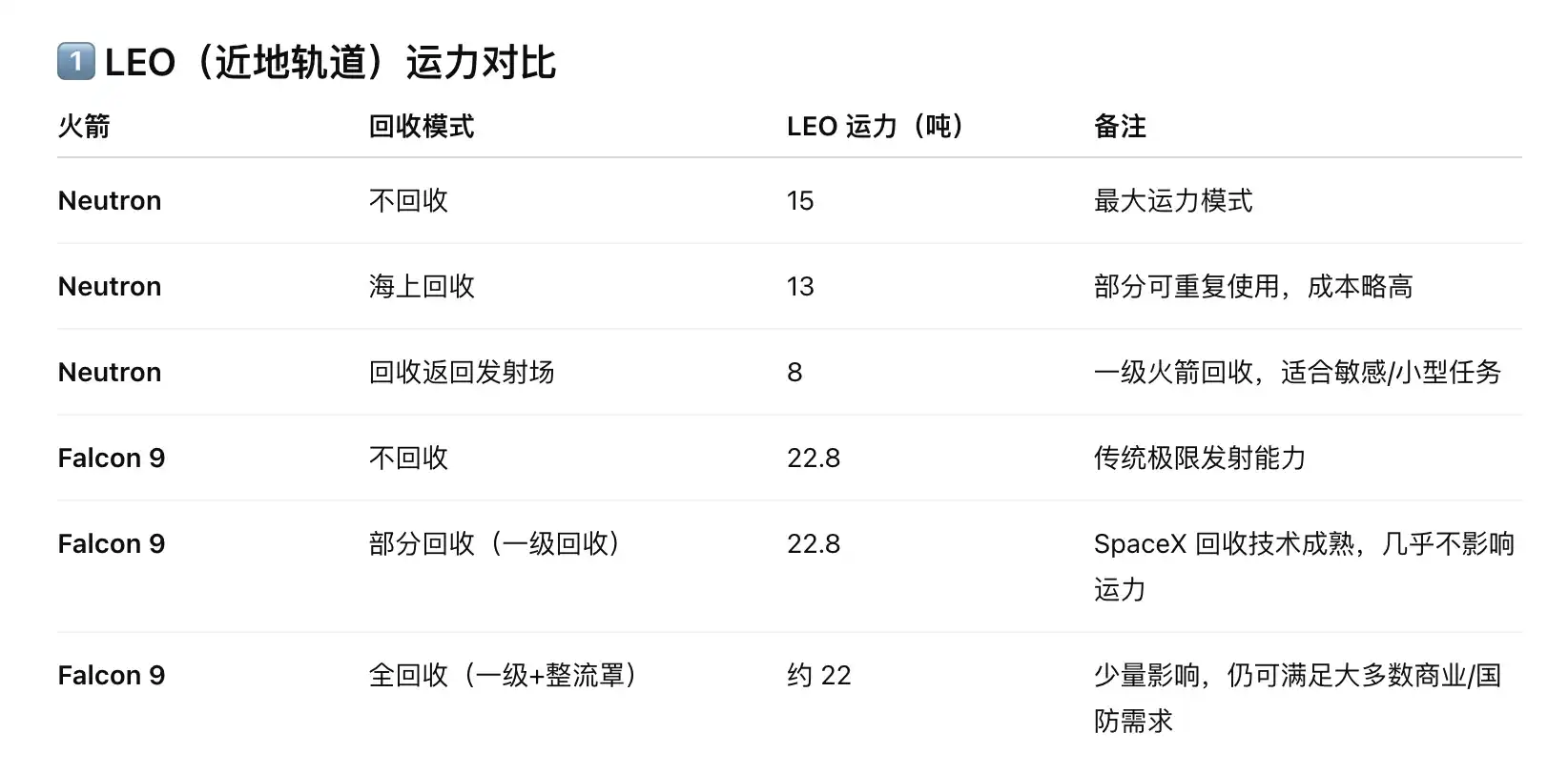
The biggest significance of Neutron's emergence is that it is expected to become the world's only second option that can compete with Falcon 9, although its designed payload capacity (approx. 8-15 tons) is still slightly inferior to Falcon 9. However, in engineering logic, it attempts to achieve a curved overtaking of its predecessor through "late-mover advantages" — with unique designs like the HungryHippo fairing and Archimedes engine, Neutron aims to surpass Falcon 9 in efficiency regarding fairing recovery and engine reusability.
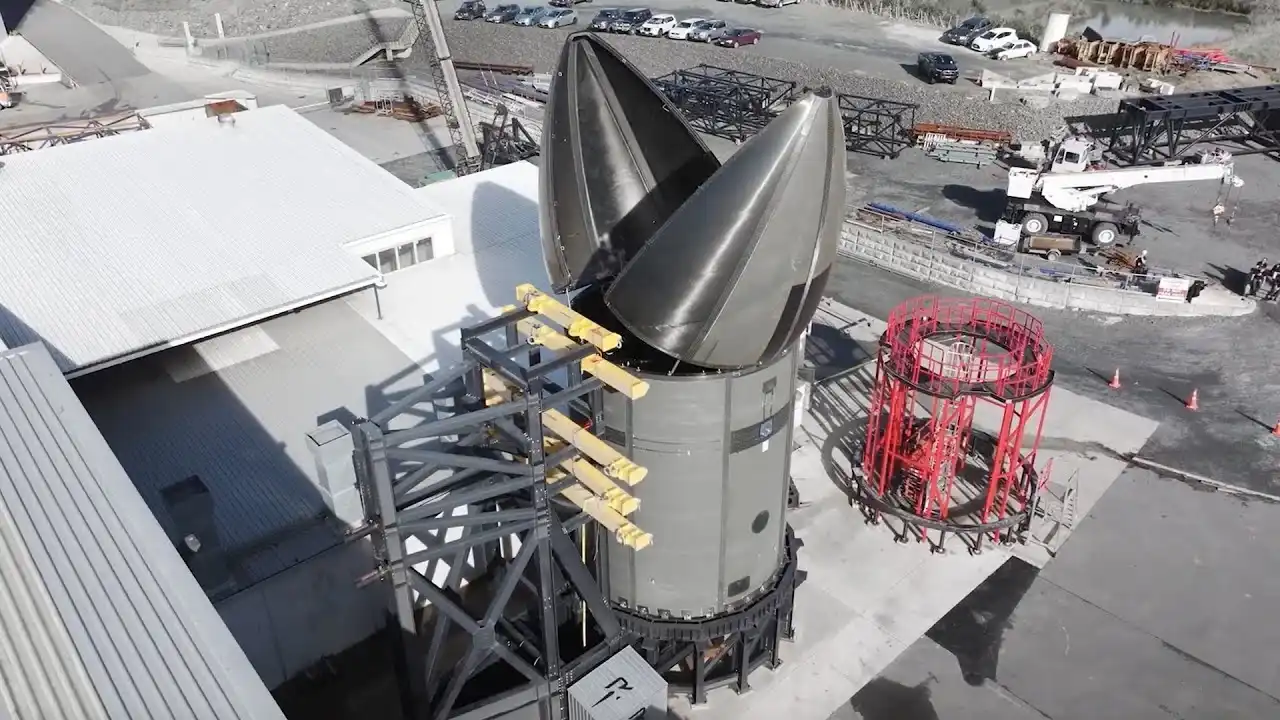
  • Odaily Note: HungryHippo is Neutron's most significant design highlight. Unlike SpaceX, which needs to retrieve millions of dollars worth of fairing debris from the sea after each launch, Neutron's fairing adopts a fixed, non-separating design connected to the first-stage booster. When releasing the second stage, it opens like a "hippopotamus mouth," closes after deployment, and lands with the first stage for recovery. This means the fairing avoids the complex process of at-sea recovery and post-landing reassembly; it's ready for refueling immediately after landing.

Judging from the disclosed testing progress, Rocket Lab is rapidly narrowing the generational gap with SpaceX in medium-to-large launch capabilities.

"Building Rockets" plus "Building Satellites": Replicating SpaceX's Ecological Loop

Just as SpaceX has Starlink, Rocket Lab is also building its own "launch + manufacturing" dual-drive ecosystem. Rocket Lab's "Space Systems" business (covering satellite platforms, laser communication, solar arrays, etc.) currently accounts for nearly 70% of its total revenue. This means that even during Neutron's R&D phase, Rocket Lab can still generate substantial revenue by selling satellite components.

This kind of "full industry chain" business model is almost unique to Rocket Lab in the public market, before SpaceX's own potential listing.

Huge Valuation Gap: A Reflection of Reality and an Investment Opportunity

Currently, SpaceX's private market valuation is as high as $1.75 to $2 trillion, while Rocket Lab's market cap has just surpassed $45 billion. The huge valuation gap objectively reflects the real-world status difference between the two companies, but this is precisely where investors see the most attractive "odds."

In the current global commercial aerospace field, the only company that can stably achieve frequent launches, reusability, high payload capacity, and low costs is SpaceX. Falcon 9's cost advantage has reached a level that makes most competitors despair, and this advantage is gradually forming a terrifying positive spiral — the cheaper, the more launches; the more launches, the more data; the more data, the faster the upgrades; the faster the upgrades, the cheaper it gets... This moat built by scale, data, and pace has left countless latecomers in awe.

But Rocket Lab's opportunity lies in the fact that, currently, Neutron appears to be the most promising reusable medium-to-large rocket to catch up with Falcon 9's pace. "The only choice after SpaceX" — this single label alone is compelling enough. Once Neutron successfully completes its maiden flight, Rocket Lab's valuation logic will completely shift from "a small rocket company" to "the world's second platform company with medium-to-large reusable rocket capability," poised to capture a large number of commercial contracts from SpaceX's hands. Therefore, the current market enthusiasm for Rocket Lab is largely a bet on the success probability of Neutron.

At this point in 2026, with SpaceX having broken through the trillion-dollar valuation ceiling, Rocket Lab, with a market cap of only about 2.5% of SpaceX's, clearly has more room for upside imagination.

Biggest Risk: "Neutron" Hasn't Flown Yet...

But there's still one big suspense — Can Neutron actually fly on schedule?

According to the latest disclosure, Neutron's maiden flight is scheduled for the end of 2026. However, looking back at history, no new rocket launch has ever proceeded without delays. The aerospace industry has a harsh reality — a PPT rocket ≠ a real rocket.

Historically, many rockets never flew; many rockets blew up on their first flight; and many rockets failed in their cost-control designs. Neutron has yet to make its first flight. If Neutron's R&D progress encounters setbacks or its maiden flight is delayed, the current market cap will face severe pressure tests, and even the best story will be hard to continue telling.


Domande pertinenti

QWhy is Rocket Lab considered the 'only alternative' to SpaceX in the commercial space sector?

ARocket Lab is seen as the primary alternative to SpaceX because it is replicating SpaceX's proven path to success. It established a viable commercial business with its small Electron rocket and reusability technology, and is now developing the Neutron medium-lift rocket to compete with SpaceX's Falcon 9. Additionally, Rocket Lab operates a dual business model of 'launch + manufacturing' similar to SpaceX's Starlink ecosystem.

QWhat was the market reaction to Rocket Lab's Q1 2026 earnings report?

AFollowing its Q1 2026 earnings report, Rocket Lab's stock (RKLB) rose nearly 7% in after-hours trading. The report showed revenue of $200.3 million, a 63.5% year-over-year increase, surpassing expectations of $189 million, and provided strong Q2 guidance.

QWhat is the key design feature of Rocket Lab's Neutron rocket that aims to surpass the Falcon 9's efficiency?

AA key efficiency feature of the Neutron rocket is its 'HungryHippo' fairing. Unlike SpaceX's fairings which separate and require sea recovery, Neutron's fairing is fixed and non-separating. It opens to release the second stage and then closes, allowing it to be recovered intact with the first stage, eliminating complex recovery and refurbishment processes.

QWhat is the primary risk currently facing Rocket Lab's growth story?

AThe primary risk for Rocket Lab is the development and first launch of its Neutron rocket. Scheduled for late 2026, any significant delays, technical failures, or cost overruns in Neutron's development could severely impact the company's valuation and growth narrative, as much of its future potential is tied to this vehicle.

QHow does Rocket Lab's current valuation compare to SpaceX's, and what opportunity does this present for investors?

ASpaceX's valuation is estimated at $1.75 to $2 trillion, while Rocket Lab's market capitalization is just over $45 billion. This massive gap reflects their current market positions but presents a significant opportunity for investors. If Rocket Lab's Neutron rocket succeeds, the company's valuation could be re-rated from a small-launch provider to the world's second platform with medium-lift reusable rocket capability, offering substantial upside potential.

Letture associate

Google TPU Shipments Revised Up by 50%

Recent industry research indicates a significant upward revision in the shipments of Google's TPU (Tensor Processing Unit) chips. Previous expectations for 2027 were set at around 10 million units, but new estimates now point to 15 million units, a 50% increase. This substantial boost directly translates to higher demand across the entire supporting supply chain. Google's TPU clusters utilize a standardized all-optical interconnect architecture. Consequently, key hardware components are deeply integrated and scaled in fixed ratios with the chips. The 15 million TPU target will drive corresponding demand increases for NPO optical engines (roughly a 1:1 match), 1.6T optical modules, OCS optical switches, high-end server power supplies, fiber optics & MPO connectors, and liquid cooling solutions. Among these, liquid cooling is highlighted as the sector experiencing the most significant transformation and offering the most stable potential for excess returns. As next-generation TPU chips reach power levels where traditional air cooling is insufficient, liquid cooling becomes essential. 2026 is forecasted as the first year of substantial adoption for Google's liquid cooling solutions. This shift, coupled with delivery and capacity bottlenecks faced by incumbent overseas manufacturers, is creating a prime window for domestic Chinese suppliers to enter and secure Google's core supply chain. The market size for Google-specific liquid cooling is projected to potentially triple from a baseline of hundreds of billions to around 300 billion units by 2028. The logic for the fiber optic sector is also being rewritten. Once considered a cyclical commodity tied to telecom operator procurement, fiber is now a strategic and scarce resource for AI Data Centers (AIDC). A severe supply-demand imbalance, driven by the long lead time for preform production (18-24 months) and surging demand from cloud giants, is supporting strong performance. Chinese fiber manufacturers are well-positioned to capture a significant share of global AIDC demand, with exports potentially reaching 200-300 million core kilometers in 2026. Overall, the investment focus within the AI computing industry is shifting from pure "chip performance speculation" towards the more certain incremental growth in computing infrastructure and its supporting ecosystem. The upward revision in Google TPU shipments, along with the potential for further doubling by 2028, is seen as solidifying performance visibility for the entire supporting supply chain over the next two years.

marsbit15 min fa

Google TPU Shipments Revised Up by 50%

marsbit15 min fa

What Wall Street Really Wants After the Crypto Story Recedes

The tide of speculative crypto narratives has receded, revealing Wall Street's true objective: building a controlled, yield-generating, and compliant financial pipeline on distributed ledgers. They are migrating core functions onto blockchains, not for decentralization, but for efficiency and new revenue streams. Key developments include BlackRock's BUIDL fund, a tokenized treasury fund acting as a foundational reserve asset, and the rise of Securitize, which is going public and partnering with the NYSE to build a 24/7 digital securities trading and settlement system. This signals a major shift of securities clearing to blockchain technology. To make volatile assets like Bitcoin palatable for institutional investors, firms like BlackRock and Goldman Sachs are creating "covered call" ETFs (e.g., BITA). These products systematically sell options on Bitcoin holdings, transforming price volatility into stable monthly income, effectively repackaging crypto as a yield-bearing asset. Stablecoins are being positioned not as speculative tools but as efficient payment rails. Companies like Stripe and Mastercard are integrating them for instant, low-cost merchant settlements and cross-border card payments, respectively. Critically, new legislation like the GENIUS Act shapes them as non-interest-bearing, heavily regulated extensions of the US dollar system. In summary, Wall Street is quietly constructing a parallel, blockchain-based financial infrastructure featuring tokenized traditional assets, structured crypto yields, and programmable dollar pipelines—all under its control and fully integrated with existing regulatory and credit frameworks.

marsbit32 min fa

What Wall Street Really Wants After the Crypto Story Recedes

marsbit32 min fa

Tying Itself to SpaceX: Cursor's $60 Billion Rise

This article recounts the rapid rise of AI-powered coding startup Cursor and its 25-year-old MIT graduate CEO, Michael Truell. Launched in 2023, Cursor achieved explosive growth, reaching over 10 billion USD in revenue by late 2025. However, its journey highlights a central dilemma for AI application companies: dependence on foundational model providers. Cursor initially relied heavily on Anthropic's models but faced an existential threat when Anthropic launched its own competing coding tool, Claude Code. In response, Cursor declared an internal emergency in early 2026 and accelerated development of its own model, Composer. To secure the immense computing power needed, Truell struck a pivotal deal with Elon Musk's SpaceX in April 2026. The collaboration grants Cursor access to SpaceX's supercomputing resources for Composer, while SpaceX's Grok model benefits from Cursor's programming data. The agreement includes a potential 600 billion USD acquisition of Cursor by SpaceX later in the year, though a substantial termination fee is in place if the deal falls through. The story explores Cursor's intense, sometimes controversial hiring practices involving lengthy unpaid "work trials," its complex partnership-turned-rivalry with Anthropic, and its high-stakes gamble to ensure independence through the SpaceX alliance. The core question remains: will Cursor evolve into a defining, independent "generational" software company, or become a key piece in a tech giant's AI arsenal?

marsbit37 min fa

Tying Itself to SpaceX: Cursor's $60 Billion Rise

marsbit37 min fa

Warsh's Debut: Will the FED Chair Who Knows Crypto Best Bring Surprises or Shocks to the Market?

Kevin Warsh, the new Federal Reserve Chairman, prepares for his inaugural press conference amidst a challenging macroeconomic landscape: resurgent inflation, a bond market sell-off, and political pressure from President Trump for rate cuts. Uniquely, Warsh holds indirect investments in over 20 crypto and Web3 entities (e.g., Solana, dYdX), making him the first Fed Chair with disclosed crypto exposure. His stance may combine a hawkish, inflation-focused monetary policy with a crypto-friendly regulatory philosophy that shifts from Powell’s “same risk, same rule” approach toward a framework acknowledging blockchain’s productivity value. Warsh’s leadership could impact crypto markets across three dimensions: a paradigm shift in regulation (potentially accelerating pro-innovation legislation and stable币 rules), a re-pricing of risk premiums based on clearer communication and his view of AI as a structural disinflationary force, and a long-term reallocation of global institutional capital driven by increased legitimacy. Two potential scenarios for the press conference are outlined. A “positive surprise” would involve a dovish-leaning tone on rates coupled with signals of regulatory openness, potentially boosting crypto asset valuations. Conversely, a “negative shock” would see a more hawkish-than-expected stance on inflation and rates, triggering a broad risk-asset selloff that crypto markets would not escape. While ethics rules required Warsh to divest his crypto holdings upon confirmation, his deep understanding of the technology may fundamentally lower policy uncertainty and build a more receptive long-term foundation for digital assets’ integration into the mainstream financial system.

marsbit11 h fa

Warsh's Debut: Will the FED Chair Who Knows Crypto Best Bring Surprises or Shocks to the Market?

marsbit11 h fa

Trading

Spot
Futures
活动图片