Who Defines the "Facts"? The Truth About Power and the Potential for Malpractice in Polymarket's Adjudication Mechanism

marsbitPubblicato 2026-01-08Pubblicato ultima volta 2026-01-08

Introduzione

Polymarket faces renewed criticism over fairness after intervening in a prediction market regarding a potential U.S. invasion of Venezuela. On January 4, Polymarket clarified that a U.S. operation to capture Venezuela’s president did not qualify as an “invasion,” causing YES shares (betting on invasion by January 31) to plummet and affecting user profits. This is not the first such incident. The platform relies on UMA’s oracle protocol for resolution. Each prediction market has predefined rules, but Polymarket may issue additional clarifications for unexpected events. Users can request clarifications via Discord. The resolution process requires a whitelisted address to propose an outcome with a security deposit (usually 750 USDC). If unchallenged within a window, it is accepted. If disputed, a debate and UMA token holder vote occur, with unbalanced incentives favoring challengers to ensure accuracy. However, ambiguities persist: rules may be incomplete or interpretable differently, platform neutrality is questionable (especially in geopolitics), and UMA’s governance—with only $100M FDV supporting Polymarket’s billions—is vulnerable to manipulation, as seen in past cases. Ultimately, users bet not on real-world outcomes, but on how rules are interpreted.

Original | Odaily Planet Daily (@OdailyChina)

Author | Azuma (@azuma_eth)

Polymarket has once again found itself embroiled in controversy over fairness.

The incident originated from the prediction market "Will the U.S. invade Venezuela by...?". On January 4th, Polymarket intervened to add a clarification stating that "the previous U.S. operation to capture Venezuelan President Maduro does not meet the definition of an invasion." This announcement caused a sharp drop in the price of YES shares (betting that the U.S. would invade Venezuela before January 31st) in this prediction pool, directly impacting the actual interests of many users.
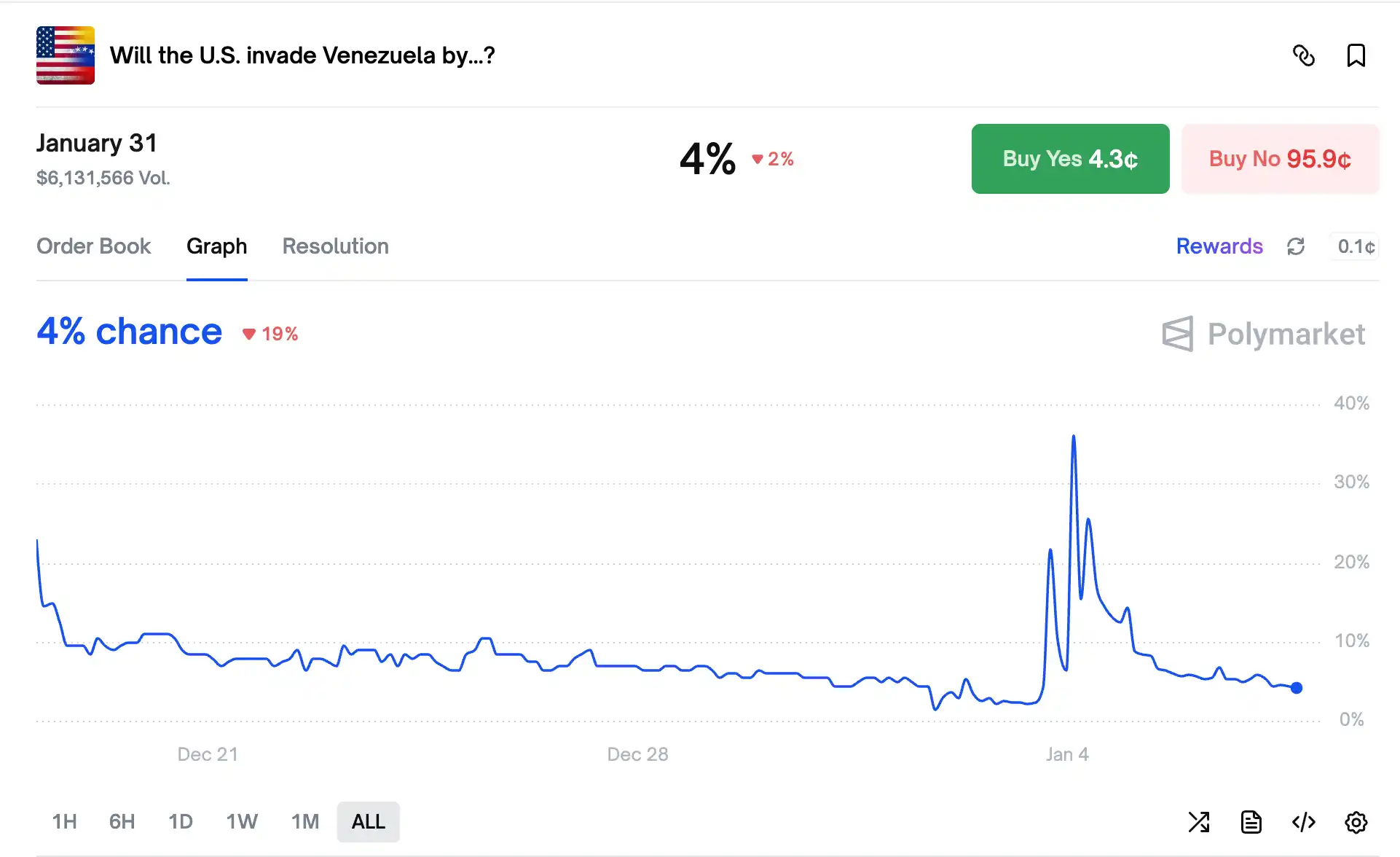
  • Odaily Note: The chart shows the price trend of YES shares betting on January 31st. The turning point is the moment when the official Polymarket account intervened to add the clarification.

This is not the first time Polymarket has faced similar controversy. Last year, in our articles "Polymarket Suffers Oracle Manipulation Attack, Can Whales Use Voting Power to 'Reverse Black and White'?" and "Polymarket Faces Another Truth Dispute: Zelenskyy's Outfit Will Determine the Fate of $140 Million," we discussed similar cases and briefly analyzed Polymarket's result adjudication logic.

During the discussion of this recent event, we noticed that although many readers are aware that Polymarket relies on the oracle protocol UMA for adjudication, they are not clear on how this process operates. Therefore, Odaily is publishing another article to parse its adjudication mechanism and attempt to explore the ambiguous areas that could potentially lead to disputed outcomes.

Predefined Rules and Supplementary Explanations

First, any prediction pool on Polymarket is created with a set of predefined rules. These rules clearly state the conditions for determining the outcome, the validity period, and anticipate in advance how to adjudicate under various unexpected circumstances.
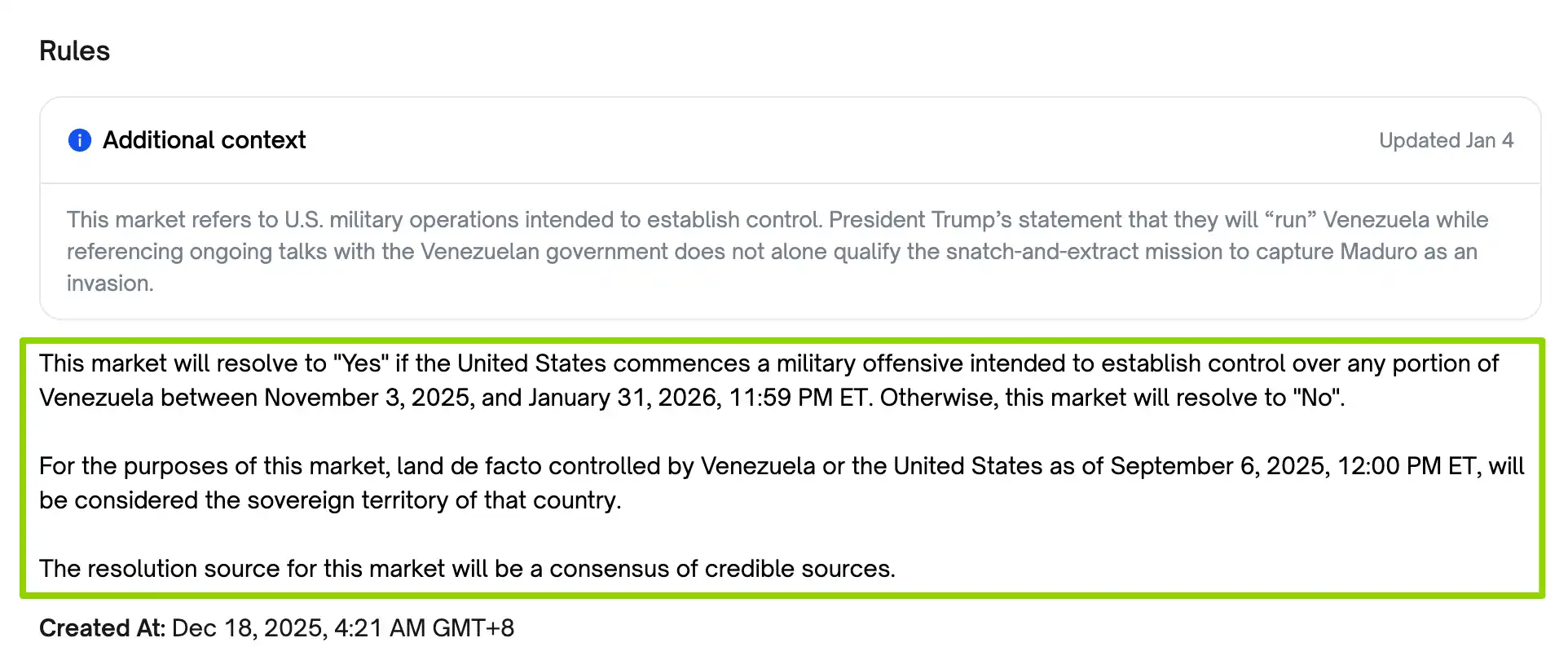
Take the prediction pool "Will the U.S. invade Venezuela by...?" as an example. As shown in the image above, the text under "Rules" is the predefined rule for this pool. The judgment condition and validity period are — if the United States launches a military offensive aimed at controlling any part of Venezuelan territory between November 3, 2025, and January 31, 2026 (11:59 PM EST), the outcome will be adjudicated as YES; otherwise, it will be NO.

However, even with various contingencies anticipated in advance, sometimes events unfold in unexpected ways. For instance, in this case, no one could have predicted that a country's president could be so suddenly captured by another force. Therefore, in very rare cases, Polymarket will personally intervene to provide supplementary explanations for unexpected situations not foreseen when the market was created, further clarifying the rules — the decision to clarify is not solely made unilaterally by Polymarket; users with doubts can actively request clarification in the #market-review channel of the Polymarket Discord.

Observant readers may have noticed that below the "Rules" in the image above, there is a fainter section labeled "Additional context," with a more recent update date (the predefined rule was posted on December 18th last year, while this content was added on January 4th). This is precisely the content Polymarket added as a supplementary explanation this time. The specific content is — "This market concerns US military action aimed at establishing control. President Trump, referring to ongoing negotiations with the Venezuelan government, stated he would 'manage' Venezuela, but this statement alone is not sufficient to characterize a 'capture and extraction' mission aimed at apprehending Maduro as an invasion."

Simply put, Polymarket does not believe the U.S. capture of Maduro should be defined as an invasion of Venezuela, and therefore does not support adjudicating the outcome as YES based on this event.

Let's set aside whether Polymarket's supplementary explanation is reasonable for now. What's more important to note here is that the validity period of this prediction pool (January 31st) has not yet ended, meaning it has not entered the final adjudication process. The reason for emphasizing this is twofold: first, to remind everyone that all current disputes essentially stem from rule ambiguities, unrelated to the adjudication环节 itself; second, to illustrate that this dispute is not yet settled, and users' current losses are actually paper losses—everything depends on the final adjudication outcome.

So how is the final adjudication process executed?

Adjudication Process: Outcomes Are Proposed by People

For any prediction pool on Polymarket, during the final adjudication process, someone must propose an outcome. Taking the previous prediction pool as an example, the window for proposing an outcome is right under "Rules" at "Propose resolution."

Of course, not everyone can casually propose an outcome胡乱. UMA and Polymarket have designed two main restrictions here: economic incentives and a whitelist requirement.

The economic incentive means that proposing an outcome requires submitting a amount of USDC as collateral (usually 750 USDC, higher for some pools). After submission, there is a challenge window (usually 2 hours). If no one challenges during this period, the outcome is deemed valid and will be used as the basis for the final adjudication of the prediction pool, with no further changes. The proposer then receives a certain bonus (usually 5 USDC). Conversely, if challenged, it enters a dispute phase, and the proposer risks losing their collateral (detailed below). Simply put, if someone proposes a random outcome just to cause trouble, the risk far outweighs the reward.
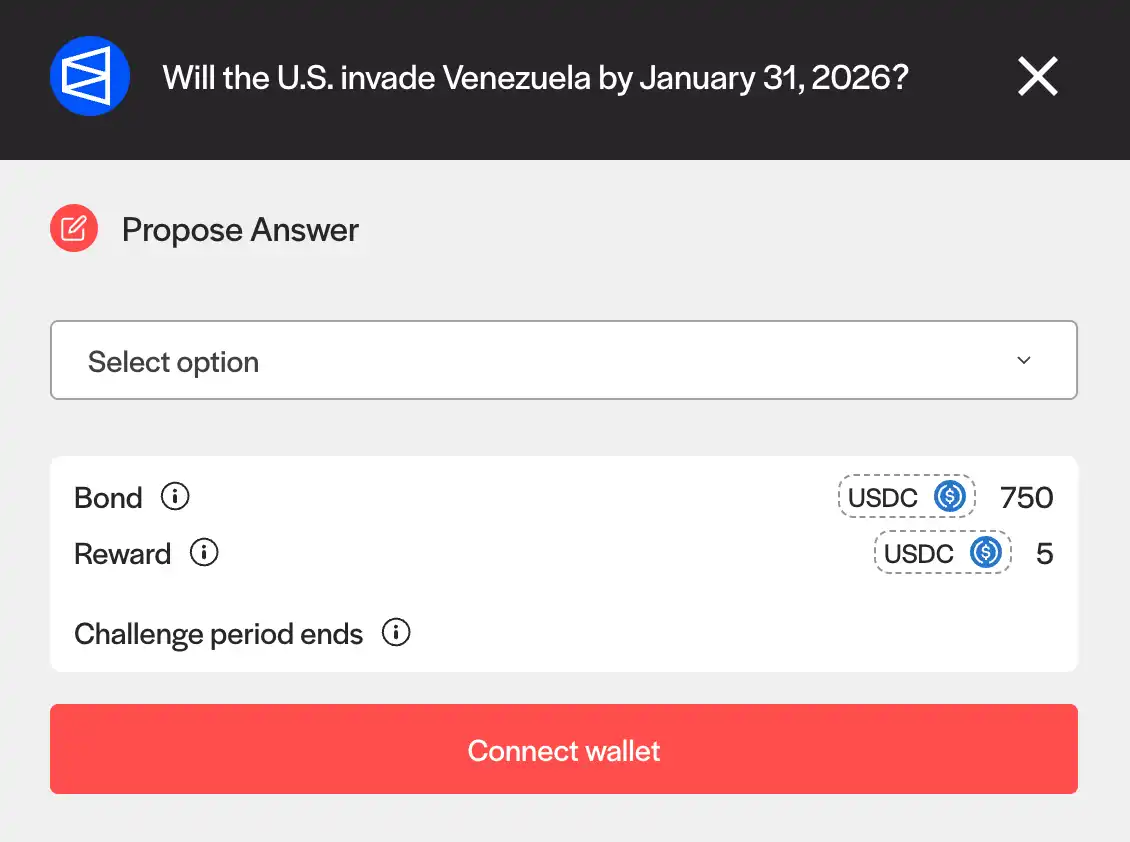
  • Odaily Note: Clicking on "Propose resolution" in the prediction pool shows the collateral requirement and bonus amount for proposing an outcome.

The whitelist restriction means that Polymarket initially allowed anyone to propose resolutions, but later, to improve adjudication efficiency, introduced a whitelist maintained jointly with Risk Labs in August last year. Subsequently, only whitelisted addresses are allowed to propose outcomes. There are three ways to get on the whitelist: first, join the Risk Labs team; second, join the Polymarket team; third, have submitted over 20 proposals with an accuracy rate exceeding 95% in the past three months — all addresses can be queried through this contract. Initially, there were only 40 addresses, but the number has now expanded significantly.

Dispute Phase: Economic Interest Game

As mentioned in the previous part, if a proposed outcome receives no异议 during the challenge window, it is deemed valid. This is the final outcome for the vast majority of prediction pools. However, in very rare cases, if an objection is raised, how is the adjudication made?

First, it must be said that, like proposing an outcome, objections cannot be raised frivolously — the objector must pay an equal amount of USDC as collateral (usually still 750 USDC) to confront the proposer, meaning both parties must put an equal stake on the table. However, unlike the proposer, the objector does not need to provide a complete alternative outcome; they only need to point out a specific error in the proposer's outcome.

Once an objection is confirmed, the UMA community will debate it. This phase typically lasts 24-48 hours (voting occurs the next day, allowing at least 24 hours for discussion each time). Anyone wishing to provide evidence for the discussion can do so in the #evidence-rationale and #voting-discussion channels of the UMA Discord server.

After the debate, UMA token holders will vote on the matter (this process takes approximately another 48 hours), and one of the following four outcomes may occur:

  • Proposer Wins: The proposer retrieves their collateral plus half of the objector's collateral as a bounty. The objector loses their collateral.
  • Objector Wins: The objector retrieves their collateral plus half of the proposer's collateral as a bounty. The proposer loses their collateral.
  • Too Early: This outcome applies to proposals where the relevant event has not yet concluded, such as an ongoing sports game result. The objector receives a refund plus half of the proposer's collateral as a bounty. The proposer loses their collateral.
  • Draw (50:50): The rarest scenario. In this case, the objector retrieves their collateral and receives half of the proposer's collateral as a bounty. The proposer loses their collateral.

Two points need attention in the above voting.

First, among the four potential outcomes, the objector profits in three scenarios, while the proposer profits in only one — this is intentional design by UMA, aiming to increase the accuracy of proposed outcomes through an imbalance of risk and reward between the parties. Since the objector only needs to point out one flaw to win, the proposer must provide a result that is as accurate and standard-compliant as possible.

The second point is that UMA's governance voting power holds absolute authority over the final outcome. In other words, the billion-dollar prediction market spectacle built by Polymarket is ultimately supported at its foundation by a protocol with a Fully Diluted Valuation (FDV) of only $100 million.

Exploring the Ambiguous Zones

Combining the above analysis of Polymarket's adjudication process with a review of historical real dispute cases, it is not difficult to find that there are certain ambiguous zones that can cause controversy, both during the rule-setting and supplementary explanation phase of the prediction pool's operation and in the final adjudication process.

First, in the rule-setting and supplementary explanation phase, the essence lies both in the fact that written rules sometimes cannot cover real-world variables, and in the fact that the same textual description can often be interpreted in different ways. For example, last year's "Did Zelenskyy wear a suit?" incident: firstly, the rules did not specify whether a "military-style suit counts as a suit"; although Polymarket explained in a supplementary clarification that "reliable reports have not confirmed whether Zelenskyy wore a suit," it did not define what constitutes a "reliable report." Ambiguities like these are destined to cause controversy.

If Polymarket itself, as a platform, could remain neutral, it might not anger the public every time, but the situation is hardly ideal. Polymarket's operating entity is based in the United States, which means the regulatory environment and political context it faces make it difficult to remain completely neutral on all issues involving geopolitics. For instance, in the current case of "Will the U.S. invade Venezuela?", when it comes to U.S. military and diplomatic actions themselves, rule interpretations tend to lean towards more conservative, "non-militarized" descriptions. This is not incomprehensible, but the ultimate losers are the users.

As for the adjudication process, the source of ambiguity points directly to the potential for fraud in UMA voting. Although UMA has designed a reward and punishment game mechanism to constrain proposal behavior and improve outcome accuracy, this game mechanism only constrains the internal economic interests within its system. When external profit opportunities exist, the potential for malicious activity theoretically remains. This is not baseless suspicion; in last year's "Ukrainian Rare Earth" incident, a UMA whale manipulated voting power to forcibly reverse the outcome, resulting in bets worth $7 million being adjudicated incorrectly.

The existence of these ambiguities is the root cause of frequent质疑 about Polymarket's fairness and is also a structural problem that prediction markets need to solve. In fact, any prediction market involving complex real-world events will inevitably face the following triple dilemma — First, real-world events themselves often cannot be clearly binarized; geopolitics, military actions, and diplomatic games are inherently full of gray areas. Second, rules must be expressed in language, but language naturally allows for interpretive space. Third, once human or governance participation is introduced into the adjudication mechanism, interest博弈 becomes inevitable.

From the user's perspective, perhaps you need to realize early on — in prediction markets, what you are betting on is not "what will happen in the world," but "how the rules will ultimately be interpreted."


Domande pertinenti

QWhat is the core controversy surrounding Polymarket's resolution mechanism as discussed in the article?

AThe core controversy is that Polymarket's resolution mechanism, which relies on the UMA oracle protocol and human governance, has significant ambiguities and potential for manipulation. This includes the platform's ability to issue supplementary clarifications that can drastically affect market prices and the possibility of UMA token holders voting to resolve markets in a way that benefits them, rather than reflecting objective truth.

QHow did Polymarket's supplementary clarification on January 4th impact the 'U.S. invasion of Venezuela' market?

APolymarket issued a clarification stating that the U.S. operation to capture Venezuelan President Maduro did not qualify as an 'invasion' under the market's rules. This caused the price of YES shares (betting an invasion would occur by January 31st) to plummet, directly impacting the financial interests of users who had placed those bets.

QWhat are the two main restrictions for proposing a resolution on a Polymarket prediction market?

AThe two main restrictions are: 1. An economic requirement to post a bond (usually 750 USDC) as collateral. 2. A whitelist restriction; only addresses on a whitelist maintained by Risk Labs and Polymarket are permitted to propose resolutions.

QWhat is the intended purpose of the asymmetric risk design in UMA's dispute process?

AThe asymmetric risk design, where the disputer can profit in three out of four possible outcomes while the proposer profits in only one, is intentionally structured to incentivize proposers to submit highly accurate and well-founded resolutions. It raises the cost and risk of submitting incorrect or frivolous proposals.

QAccording to the article, what is the fundamental thing users are actually betting on in a prediction market like Polymarket?

AUsers are not betting on 'what will happen in the world,' but rather on 'how the rules will ultimately be interpreted.' The outcome of a bet is determined by the human-governed resolution process and the specific definitions and clarifications provided by the platform, not solely by the real-world event itself.

Letture associate

Trading

Spot
Futures

Articoli Popolari

Cosa è $S$

Comprendere SPERO: Una Panoramica Completa Introduzione a SPERO Mentre il panorama dell'innovazione continua a evolversi, l'emergere delle tecnologie web3 e dei progetti di criptovaluta gioca un ruolo fondamentale nel plasmare il futuro digitale. Un progetto che ha attirato l'attenzione in questo campo dinamico è SPERO, denotato come SPERO,$$s$. Questo articolo mira a raccogliere e presentare informazioni dettagliate su SPERO, per aiutare gli appassionati e gli investitori a comprendere le sue basi, obiettivi e innovazioni nei domini web3 e crypto. Che cos'è SPERO,$$s$? SPERO,$$s$ è un progetto unico all'interno dello spazio crypto che cerca di sfruttare i principi della decentralizzazione e della tecnologia blockchain per creare un ecosistema che promuove l'impegno, l'utilità e l'inclusione finanziaria. Il progetto è progettato per facilitare interazioni peer-to-peer in modi nuovi, fornendo agli utenti soluzioni e servizi finanziari innovativi. Al suo interno, SPERO,$$s$ mira a responsabilizzare gli individui fornendo strumenti e piattaforme che migliorano l'esperienza dell'utente nello spazio delle criptovalute. Questo include la possibilità di metodi di transazione più flessibili, la promozione di iniziative guidate dalla comunità e la creazione di percorsi per opportunità finanziarie attraverso applicazioni decentralizzate (dApps). La visione sottostante di SPERO,$$s$ ruota attorno all'inclusività, cercando di colmare le lacune all'interno della finanza tradizionale mentre sfrutta i vantaggi della tecnologia blockchain. Chi è il Creatore di SPERO,$$s$? L'identità del creatore di SPERO,$$s$ rimane piuttosto oscura, poiché ci sono risorse pubblicamente disponibili limitate che forniscono informazioni dettagliate sul suo fondatore o fondatori. Questa mancanza di trasparenza può derivare dall'impegno del progetto per la decentralizzazione—un ethos che molti progetti web3 condividono, dando priorità ai contributi collettivi rispetto al riconoscimento individuale. Centrando le discussioni attorno alla comunità e ai suoi obiettivi collettivi, SPERO,$$s$ incarna l'essenza dell'empowerment senza mettere in evidenza individui specifici. Pertanto, comprendere l'etica e la missione di SPERO rimane più importante che identificare un creatore singolo. Chi sono gli Investitori di SPERO,$$s$? SPERO,$$s$ è supportato da una varietà di investitori che vanno dai capitalisti di rischio agli investitori angelici dedicati a promuovere l'innovazione nel settore crypto. Il focus di questi investitori generalmente si allinea con la missione di SPERO—dando priorità a progetti che promettono avanzamenti tecnologici sociali, inclusività finanziaria e governance decentralizzata. Queste fondazioni di investitori sono tipicamente interessate a progetti che non solo offrono prodotti innovativi, ma contribuiscono anche positivamente alla comunità blockchain e ai suoi ecosistemi. Il supporto di questi investitori rafforza SPERO,$$s$ come un concorrente degno di nota nel dominio in rapida evoluzione dei progetti crypto. Come Funziona SPERO,$$s$? SPERO,$$s$ impiega un framework multifunzionale che lo distingue dai progetti di criptovaluta convenzionali. Ecco alcune delle caratteristiche chiave che sottolineano la sua unicità e innovazione: Governance Decentralizzata: SPERO,$$s$ integra modelli di governance decentralizzati, responsabilizzando gli utenti a partecipare attivamente ai processi decisionali riguardanti il futuro del progetto. Questo approccio favorisce un senso di proprietà e responsabilità tra i membri della comunità. Utilità del Token: SPERO,$$s$ utilizza il proprio token di criptovaluta, progettato per servire varie funzioni all'interno dell'ecosistema. Questi token abilitano transazioni, premi e la facilitazione dei servizi offerti sulla piattaforma, migliorando l'impegno e l'utilità complessivi. Architettura Stratificata: L'architettura tecnica di SPERO,$$s$ supporta la modularità e la scalabilità, consentendo un'integrazione fluida di funzionalità e applicazioni aggiuntive man mano che il progetto evolve. Questa adattabilità è fondamentale per mantenere la rilevanza nel panorama crypto in continua evoluzione. Coinvolgimento della Comunità: Il progetto enfatizza iniziative guidate dalla comunità, impiegando meccanismi che incentivano la collaborazione e il feedback. Nutrendo una comunità forte, SPERO,$$s$ può affrontare meglio le esigenze degli utenti e adattarsi alle tendenze di mercato. Focus sull'Inclusione: Offrendo basse commissioni di transazione e interfacce user-friendly, SPERO,$$s$ mira ad attrarre una base utenti diversificata, inclusi individui che potrebbero non aver precedentemente interagito nello spazio crypto. Questo impegno per l'inclusione si allinea con la sua missione generale di empowerment attraverso l'accessibilità. Cronologia di SPERO,$$s$ Comprendere la storia di un progetto fornisce preziose intuizioni sulla sua traiettoria di sviluppo e sui traguardi. Di seguito è riportata una cronologia suggerita che mappa eventi significativi nell'evoluzione di SPERO,$$s$: Fase di Concettualizzazione e Ideazione: Le idee iniziali che formano la base di SPERO,$$s$ sono state concepite, allineandosi strettamente con i principi di decentralizzazione e focus sulla comunità all'interno dell'industria blockchain. Lancio del Whitepaper del Progetto: Dopo la fase concettuale, è stato rilasciato un whitepaper completo che dettaglia la visione, gli obiettivi e l'infrastruttura tecnologica di SPERO,$$s$ per suscitare interesse e feedback dalla comunità. Costruzione della Comunità e Prime Interazioni: Sono stati effettuati sforzi attivi di outreach per costruire una comunità di early adopters e potenziali investitori, facilitando discussioni attorno agli obiettivi del progetto e ottenendo supporto. Evento di Generazione del Token: SPERO,$$s$ ha condotto un evento di generazione del token (TGE) per distribuire i propri token nativi ai primi sostenitori e stabilire una liquidità iniziale all'interno dell'ecosistema. Lancio della Prima dApp: La prima applicazione decentralizzata (dApp) associata a SPERO,$$s$ è stata attivata, consentendo agli utenti di interagire con le funzionalità principali della piattaforma. Sviluppo Continuo e Partnership: Aggiornamenti e miglioramenti continui alle offerte del progetto, inclusi partnership strategiche con altri attori nello spazio blockchain, hanno plasmato SPERO,$$s$ in un concorrente competitivo e in evoluzione nel mercato crypto. Conclusione SPERO,$$s$ rappresenta una testimonianza del potenziale del web3 e delle criptovalute di rivoluzionare i sistemi finanziari e responsabilizzare gli individui. Con un impegno per la governance decentralizzata, il coinvolgimento della comunità e funzionalità progettate in modo innovativo, apre la strada verso un panorama finanziario più inclusivo. Come per qualsiasi investimento nello spazio crypto in rapida evoluzione, si incoraggiano potenziali investitori e utenti a ricercare approfonditamente e a impegnarsi in modo riflessivo con gli sviluppi in corso all'interno di SPERO,$$s$. Il progetto mostra lo spirito innovativo dell'industria crypto, invitando a ulteriori esplorazioni delle sue innumerevoli possibilità. Mentre il percorso di SPERO,$$s$ è ancora in fase di sviluppo, i suoi principi fondamentali potrebbero effettivamente influenzare il futuro di come interagiamo con la tecnologia, la finanza e tra di noi in ecosistemi digitali interconnessi.

75 Totale visualizzazioniPubblicato il 2024.12.17Aggiornato il 2024.12.17

Cosa è $S$

Cosa è AGENT S

Agent S: Il Futuro dell'Interazione Autonoma in Web3 Introduzione Nel panorama in continua evoluzione di Web3 e criptovalute, le innovazioni stanno costantemente ridefinendo il modo in cui gli individui interagiscono con le piattaforme digitali. Uno di questi progetti pionieristici, Agent S, promette di rivoluzionare l'interazione uomo-computer attraverso il suo framework agentico aperto. Aprendo la strada a interazioni autonome, Agent S mira a semplificare compiti complessi, offrendo applicazioni trasformative nell'intelligenza artificiale (AI). Questa esplorazione dettagliata approfondirà le complessità del progetto, le sue caratteristiche uniche e le implicazioni per il dominio delle criptovalute. Cos'è Agent S? Agent S si presenta come un innovativo framework agentico aperto, progettato specificamente per affrontare tre sfide fondamentali nell'automazione dei compiti informatici: Acquisizione di Conoscenze Specifiche del Dominio: Il framework apprende in modo intelligente da varie fonti di conoscenza esterne ed esperienze interne. Questo approccio duale gli consente di costruire un ricco repository di conoscenze specifiche del dominio, migliorando le sue prestazioni nell'esecuzione dei compiti. Pianificazione su Lungo Orizzonte di Compiti: Agent S impiega una pianificazione gerarchica potenziata dall'esperienza, un approccio strategico che facilita la suddivisione e l'esecuzione efficiente di compiti complessi. Questa caratteristica migliora significativamente la sua capacità di gestire più sottocompiti in modo efficiente ed efficace. Gestione di Interfacce Dinamiche e Non Uniformi: Il progetto introduce l'Interfaccia Agente-Computer (ACI), una soluzione innovativa che migliora l'interazione tra agenti e utenti. Utilizzando Modelli Linguistici Multimodali di Grandi Dimensioni (MLLM), Agent S può navigare e manipolare senza sforzo diverse interfacce grafiche utente. Attraverso queste caratteristiche pionieristiche, Agent S fornisce un framework robusto che affronta le complessità coinvolte nell'automazione dell'interazione umana con le macchine, preparando il terreno per innumerevoli applicazioni nell'AI e oltre. Chi è il Creatore di Agent S? Sebbene il concetto di Agent S sia fondamentalmente innovativo, informazioni specifiche sul suo creatore rimangono elusive. Il creatore è attualmente sconosciuto, il che evidenzia sia la fase embrionale del progetto sia la scelta strategica di mantenere i membri fondatori sotto anonimato. Indipendentemente dall'anonimato, l'attenzione rimane sulle capacità e sul potenziale del framework. Chi sono gli Investitori di Agent S? Poiché Agent S è relativamente nuovo nell'ecosistema crittografico, informazioni dettagliate riguardanti i suoi investitori e sostenitori finanziari non sono documentate esplicitamente. La mancanza di approfondimenti pubblicamente disponibili sulle fondazioni di investimento o sulle organizzazioni che supportano il progetto solleva interrogativi sulla sua struttura di finanziamento e sulla roadmap di sviluppo. Comprendere il supporto è cruciale per valutare la sostenibilità del progetto e il suo potenziale impatto sul mercato. Come Funziona Agent S? Al centro di Agent S si trova una tecnologia all'avanguardia che gli consente di funzionare efficacemente in contesti diversi. Il suo modello operativo è costruito attorno a diverse caratteristiche chiave: Interazione Uomo-Computer Simile a Quella Umana: Il framework offre una pianificazione AI avanzata, cercando di rendere le interazioni con i computer più intuitive. Mimando il comportamento umano nell'esecuzione dei compiti, promette di elevare le esperienze degli utenti. Memoria Narrativa: Utilizzata per sfruttare esperienze di alto livello, Agent S utilizza la memoria narrativa per tenere traccia delle storie dei compiti, migliorando così i suoi processi decisionali. Memoria Episodica: Questa caratteristica fornisce agli utenti una guida passo-passo, consentendo al framework di offrire supporto contestuale mentre i compiti si sviluppano. Supporto per OpenACI: Con la capacità di funzionare localmente, Agent S consente agli utenti di mantenere il controllo sulle proprie interazioni e flussi di lavoro, allineandosi con l'etica decentralizzata di Web3. Facile Integrazione con API Esterne: La sua versatilità e compatibilità con varie piattaforme AI garantiscono che Agent S possa adattarsi senza problemi agli ecosistemi tecnologici esistenti, rendendolo una scelta attraente per sviluppatori e organizzazioni. Queste funzionalità contribuiscono collettivamente alla posizione unica di Agent S all'interno dello spazio crittografico, poiché automatizza compiti complessi e multi-fase con un intervento umano minimo. Man mano che il progetto evolve, le sue potenziali applicazioni in Web3 potrebbero ridefinire il modo in cui si svolgono le interazioni digitali. Cronologia di Agent S Lo sviluppo e le tappe di Agent S possono essere riassunti in una cronologia che evidenzia i suoi eventi significativi: 27 Settembre 2024: Il concetto di Agent S è stato lanciato in un documento di ricerca completo intitolato “Un Framework Agentico Aperto che Usa i Computer Come un Umano”, mostrando le basi per il progetto. 10 Ottobre 2024: Il documento di ricerca è stato reso pubblicamente disponibile su arXiv, offrendo un'esplorazione approfondita del framework e della sua valutazione delle prestazioni basata sul benchmark OSWorld. 12 Ottobre 2024: È stata rilasciata una presentazione video, fornendo un'idea visiva delle capacità e delle caratteristiche di Agent S, coinvolgendo ulteriormente potenziali utenti e investitori. Questi indicatori nella cronologia non solo illustrano i progressi di Agent S, ma indicano anche il suo impegno per la trasparenza e il coinvolgimento della comunità. Punti Chiave su Agent S Man mano che il framework Agent S continua a evolversi, diversi attributi chiave si distinguono, sottolineando la sua natura innovativa e il potenziale: Framework Innovativo: Progettato per fornire un uso intuitivo dei computer simile all'interazione umana, Agent S porta un approccio nuovo all'automazione dei compiti. Interazione Autonoma: La capacità di interagire autonomamente con i computer attraverso GUI segna un passo avanti verso soluzioni informatiche più intelligenti ed efficienti. Automazione di Compiti Complessi: Con la sua metodologia robusta, può automatizzare compiti complessi e multi-fase, rendendo i processi più veloci e meno soggetti a errori. Miglioramento Continuo: I meccanismi di apprendimento consentono ad Agent S di migliorare dalle esperienze passate, migliorando continuamente le sue prestazioni e la sua efficacia. Versatilità: La sua adattabilità attraverso diversi ambienti operativi come OSWorld e WindowsAgentArena garantisce che possa servire un'ampia gamma di applicazioni. Man mano che Agent S si posiziona nel panorama di Web3 e delle criptovalute, il suo potenziale per migliorare le capacità di interazione e automatizzare i processi segna un significativo avanzamento nelle tecnologie AI. Attraverso il suo framework innovativo, Agent S esemplifica il futuro delle interazioni digitali, promettendo un'esperienza più fluida ed efficiente per gli utenti in vari settori. Conclusione Agent S rappresenta un audace passo avanti nell'unione tra AI e Web3, con la capacità di ridefinire il modo in cui interagiamo con la tecnologia. Sebbene sia ancora nelle sue fasi iniziali, le possibilità per la sua applicazione sono vaste e coinvolgenti. Attraverso il suo framework completo che affronta sfide critiche, Agent S mira a portare le interazioni autonome al centro dell'esperienza digitale. Man mano che ci addentriamo nei regni delle criptovalute e della decentralizzazione, progetti come Agent S giocheranno senza dubbio un ruolo cruciale nel plasmare il futuro della tecnologia e della collaborazione uomo-computer.

435 Totale visualizzazioniPubblicato il 2025.01.14Aggiornato il 2025.01.14

Cosa è AGENT S

Come comprare S

Benvenuto in HTX.com! Abbiamo reso l'acquisto di Sonic (S) semplice e conveniente. Segui la nostra guida passo passo per intraprendere il tuo viaggio nel mondo delle criptovalute.Step 1: Crea il tuo Account HTXUsa la tua email o numero di telefono per registrarti il tuo account gratuito su HTX. Vivi un'esperienza facile e sblocca tutte le funzionalità,Crea il mio accountStep 2: Vai in Acquista crypto e seleziona il tuo metodo di pagamentoCarta di credito/debito: utilizza la tua Visa o Mastercard per acquistare immediatamente SonicS.Bilancio: Usa i fondi dal bilancio del tuo account HTX per fare trading senza problemi.Terze parti: abbiamo aggiunto metodi di pagamento molto utilizzati come Google Pay e Apple Pay per maggiore comodità.P2P: Fai trading direttamente con altri utenti HTX.Over-the-Counter (OTC): Offriamo servizi su misura e tassi di cambio competitivi per i trader.Step 3: Conserva Sonic (S)Dopo aver acquistato Sonic (S), conserva nel tuo account HTX. In alternativa, puoi inviare tramite trasferimento blockchain o scambiare per altre criptovalute.Step 4: Scambia Sonic (S)Scambia facilmente Sonic (S) nel mercato spot di HTX. Accedi al tuo account, seleziona la tua coppia di trading, esegui le tue operazioni e monitora in tempo reale. Offriamo un'esperienza user-friendly sia per chi ha appena iniziato che per i trader più esperti.

849 Totale visualizzazioniPubblicato il 2025.01.15Aggiornato il 2025.03.21

Come comprare S

Discussioni

Benvenuto nella Community HTX. Qui puoi rimanere informato sugli ultimi sviluppi della piattaforma e accedere ad approfondimenti esperti sul mercato. Le opinioni degli utenti sul prezzo di S S sono presentate come di seguito.

活动图片