Who Cannot Be Distilled into a Skill?

marsbitPubblicato 2026-04-05Pubblicato ultima volta 2026-04-05

Introduzione

"This article explores the concerning trend of AI systems distilling human workers into replaceable 'skills,' using the viral 'Colleague.skill' phenomenon as a key example. It argues that the most diligent employees—those who meticulously document their work, write detailed analyses, and transparently share decision-making logic—are paradoxically the most vulnerable to being replaced. Their high-quality 'context' (communication records, documents, and decision trails) becomes the perfect fuel for AI agents, extracted from corporate platforms like Feishu and DingTalk. The piece warns of a deeper ethical crisis: the reduction of human relationships to functional APIs, as seen in derivatives like 'Ex.skill' or 'Boss.skill,' which reduce complex individuals to mere utilities. This reflects a shift from Martin Buber's 'I-Thou' relationship (seeing others as whole beings) to an 'I-It' dynamic (seeing them as tools). While AI can capture explicit knowledge (written documents, replies), it fails to capture tacit knowledge—the intuition, experience, and unspoken insights that define human expertise. However, a greater danger emerges when AI-generated content, based on distilled human data, is used to train future models, leading to 'model collapse' and homogenized, mediocre outputs—a process likened to 'electronic patina' degrading information over time. The article concludes by noting a small but symbolic resistance, such as the 'anti-distill' tool that generates meaningless text ...

Unfortunately, in this era, the more unreservedly and diligently you work, the more likely you are to accelerate your own distillation into a skill that can be replaced by AI.

Over the past couple of days,热搜榜 (hot search lists) and media channels have been flooded with news about "Colleague.skill." As this topic continues to ferment on major social platforms, public focus has, almost inevitably, been swept up by grand anxieties like "AI layoffs," "capital exploitation," and "the digital immortality of the working class."

These are indeed anxiety-inducing, but what makes me most anxious is a line of usage suggestion written in the project's README documentation:

"The quality of the raw material determines the quality of the skill: It is recommended to prioritize collecting long articles he proactively wrote > decision-making replies > daily messages."

The ones most easily and perfectly distilled by the system, pixel-perfectly replicated, are precisely those who work most conscientiously.

They are the ones who, after every project concludes, still bend over their desks to write retrospective documents; the ones who, when encountering disagreements, are willing to spend half an hour typing out long passages in a chat dialog, honestly剖析 (dissecting/analyzing) their decision-making logic; the ones who are extremely responsible that they meticulously entrust every work detail to the system.

Conscientiousness, once the most revered workplace virtue, has now become a catalyst accelerating the transformation of workers into AI fuel.

The Drained Worker

We need to re-understand a word: context.

In everyday language, context is the background of communication. But in the world of AI, especially those rapidly growing AI Agents, context is the fuel for the roaring engine, the lifeblood maintaining the pulse, the only anchor point allowing the model to make precise judgments amidst chaos.

An AI stripped of context, even with an astonishing number of parameters, is merely a search engine with amnesia. It cannot recognize who you are, cannot discern the undercurrents hidden beneath business logic, and has no way of knowing the prolonged tug-of-war and trade-offs you experienced on this network woven from resource constraints and interpersonal博弈 (game theory/strategizing) when making a decision.

The reason "Colleague.skill" has caused such a huge stir is precisely because it has, with extreme冷酷 (ruthlessness/coldness) and precision, targeted the mountain rich with vast amounts of high-quality context—modern enterprise collaboration software.

Over the past five years, the Chinese workplace has undergone a quiet yet筋剥骨 (sapping) digital transformation. Tools like Feishu, DingTalk, and Notion have become massive corporate knowledge bases.

Taking Feishu as an example, ByteDance has publicly stated that the number of documents generated internally daily is massive. These dense characters faithfully seal every brainstorming session, every heated meeting debate, and every strategic compromise gritted and swallowed by over a hundred thousand employees.

This digital penetration far exceeds any previous time. Once upon a time, knowledge was warm, residing in the minds of veteran employees, scattered in casual chats by the water cooler; now, all human intelligence and experience are forcibly dehydrated, mercilessly sedimented in the cold server matrices in the cloud.

In this system, if you don't write documents, your work cannot be seen, and new colleagues cannot collaborate with you. The efficient operation of modern enterprises is built on the cycle of every employee "offering" context to the system day after day.

Conscientious workers, harboring diligence and goodwill, unreservedly expose their thought processes on these cold platforms. They do this to make the team's gears mesh more smoothly, to strive to prove their value to the system, to desperately find their own place within this intricate (错综复杂的) commercial behemoth. They are not actively handing themselves over; they are just clumsily and diligently adapting to the survival rules of the modern workplace.

But it is precisely this context left for interpersonal collaboration that becomes the perfect fuel for AI.

Feishu's admin backend has a function that allows super administrators to批量导出 (batch export) members' documents and communication records. This means that the project retrospectives and decision logic you spent three years writing, burning countless late nights, can, with just one API interface, be easily packaged into a cold压缩包 (compressed file) in just a few minutes—slices of your life over these years.

When Humans Are Reduced to an API

With the explosion of "Colleague.skill," GitHub's Issues section and major social platforms began to see some extremely disturbing derivatives.

Someone made an "Ex.skill," trying to feed years of WeChat chat history to an AI, making it continue to argue or be affectionate in that familiar tone; someone made a "White Moonlight.skill" (unattainable crush/idealized love), reducing an untouchable flutter into a cold interpersonal sandbox, repeatedly rehearsing试探的话术 (probing rhetoric), step-by-step seeking the optimal solution for emotions;还有人做出了 "Dad-flavored Boss.skill" (paternalistic/condescending boss), preemptively咀嚼 (chewing over) those oppressive PUA words in the digital space, building a pathetic psychological defense for themselves.
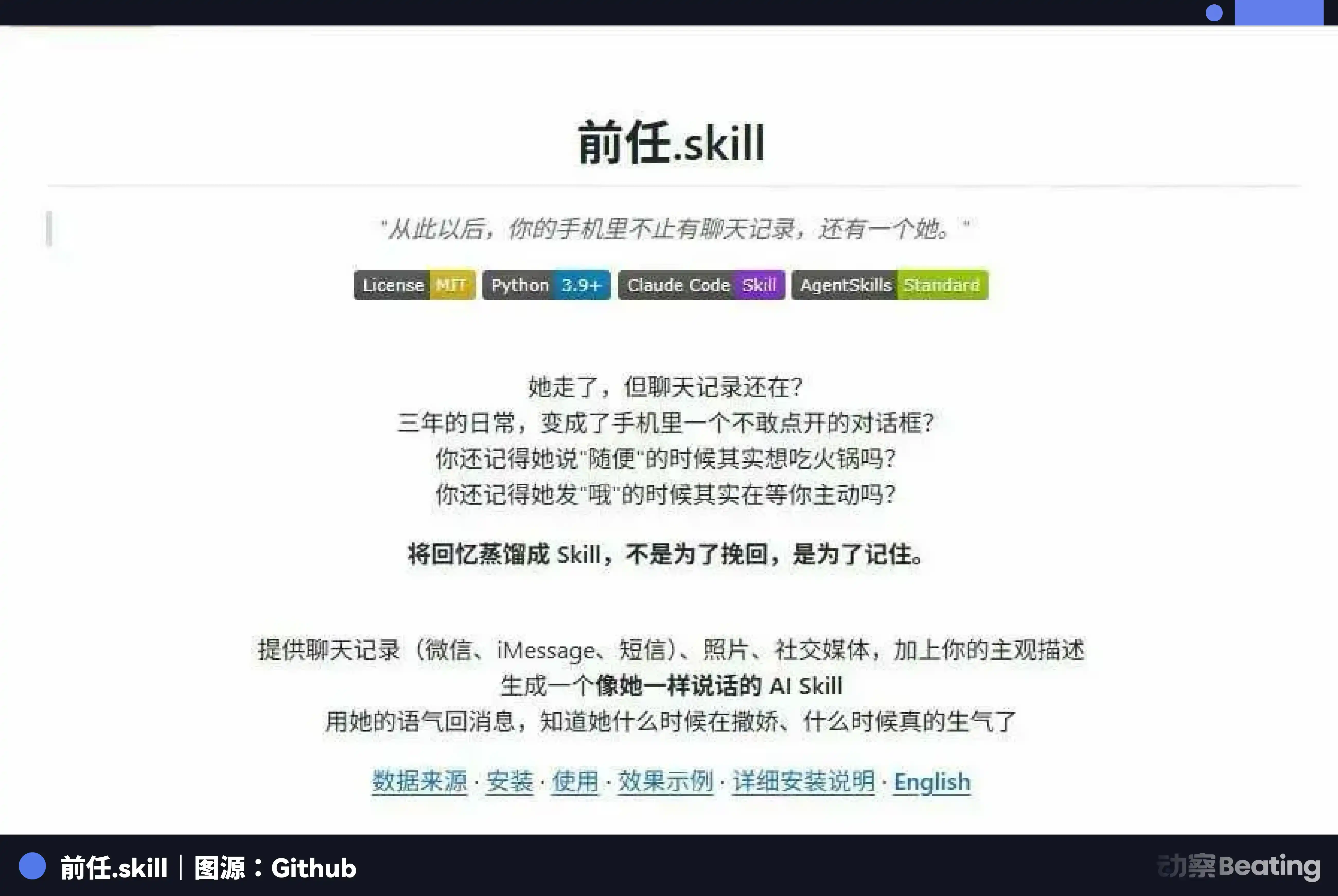
The usage scenarios of these skills have completely departed from the realm of work efficiency. It turns out,不知不觉间 (unconsciously), we have long become adept at wielding the cold logic used for tools to dismember and objectify living, breathing people of flesh and blood.

German philosopher Martin Buber once proposed that the underpinning of human relationships无非是 (is nothing more than) two distinct modes: "I-Thou" and "I-It."

In the "I-Thou" encounter, we transcend prejudice and regard the other as a complete and dignified being to behold. This bond is unreservedly open, full of vibrant unpredictability, and precisely because of its sincerity, it appears格外脆弱 (particularly fragile); however, once we fall into the shadow of "I-It," living people are reduced to an object that can be disassembled, analyzed, and categorized with labels. Under this utterly utilitarian gaze, the only thing we care about becomes, "What use is this thing to me?"

The emergence of products like "Ex.skill" marks the complete invasion of the instrumental rationality of "I-It" into the most private emotional realms.

In a real relationship, a person is three-dimensional, full of folds, flowing with contradictions and rough edges; their reactions change constantly based on specific situations and emotional interactions. Your ex's reaction to the same sentence might be completely different upon waking up in the morning versus after working late at night.

But when you distill a person into a skill, what you extract is merely the functional residue of that person that happened to be "useful" to you, able to "produce utility" for you within that specific bond. And that originally warm person, with their own joys and sorrows, is彻底抽干了灵魂 (completely drained of their soul) in this cruel purification process, alienated into a "functional interface" you can随意插拔 (arbitrarily plug and unplug) and call upon at will.

It must be admitted that AI did not凭空捏造 (fabricate out of thin air) this chilling冷酷 (coldness). Before AI appeared, we were already accustomed to labeling people, precisely weighing the "emotional value" and "network weight" of every relationship. For example, we量化 (quantify) people's conditions into spreadsheets in the dating market; we categorize colleagues into "those who can work" and "those who love to slack off" in the workplace. AI has merely made this implicit, functional extraction between people彻底显性化 (completely explicit).

People are flattened,只剩下 (leaving only) the facet that is "useful to me."

Electronic Patina (包浆 - Bao Jiang, referring to the worn, layered effect on frequently handled objects)

In 1958, Hungarian-British philosopher Michael Polanyi published "Personal Knowledge." In this book, he proposed a highly penetrating concept: Tacit Knowledge.

Polanyi famously stated, "We can know more than we can tell."

He used the example of learning to ride a bicycle. A skilled rider,驾驭御风而行 (riding the wind), can perfectly grasp balance with every tilt of gravity, but they cannot use dry physics formulas or pale vocabulary to accurately describe the subtle intuition of the body at that moment to a beginner. They know how to ride, but they cannot say it. This kind of knowledge that cannot be encoded, cannot be articulated, is tacit knowledge.

The workplace is full of this tacit knowledge. A senior engineer troubleshooting a system failure might glance at a log and locate the problem, but they would find it difficult to document this "intuition" built upon thousands of trials and errors; an excellent salesperson suddenly falling silent at the negotiation table, the timing and pressure of this silence, is something no sales manual can record; an experienced HR professional might, through a candidate avoiding eye contact for half a second during an interview, detect水分 (exaggeration/water) on the resume.

What "Colleague.skill" can extract is merely the explicit knowledge that has already been written down or spoken. It can capture your retrospective documents, but it cannot capture the纠结 (anguish/dilemma) you felt while writing them; it can replicate your decision-making replies, but it cannot replicate the intuition behind your decisions.

What the system distills is always just a shadow of a person.

If the story ended here, it would just be another case of technology clumsily imitating humanity.

But when a person is distilled into a skill, this skill does not remain static. It will be used to reply to emails, write new documents, make new decisions. That is to say, these AI-generated shadows begin to produce new context.

And this context generated by AI will, in turn, be sedimented in Feishu and DingTalk, becoming training material for the next round of distillation.

As early as 2023, research teams from Oxford and Cambridge universities jointly published a paper on "model collapse." The research showed that when AI models use data generated by other AIs for iterative training, the data distribution becomes increasingly narrow. Those rare,边缘的 (marginal), but极其真实的 (extremely real) human traits are quickly erased. After just a few generations of training on synthetic data, the model completely forgets those long-tail, complex real human data, instead outputting极其平庸和同质化的 (extremely mediocre and homogenized) content.

"Nature" also published a research paper in 2024 pointing out that using AI-generated datasets to train future generations of machine learning models会严重污染 (would seriously pollute) their output.
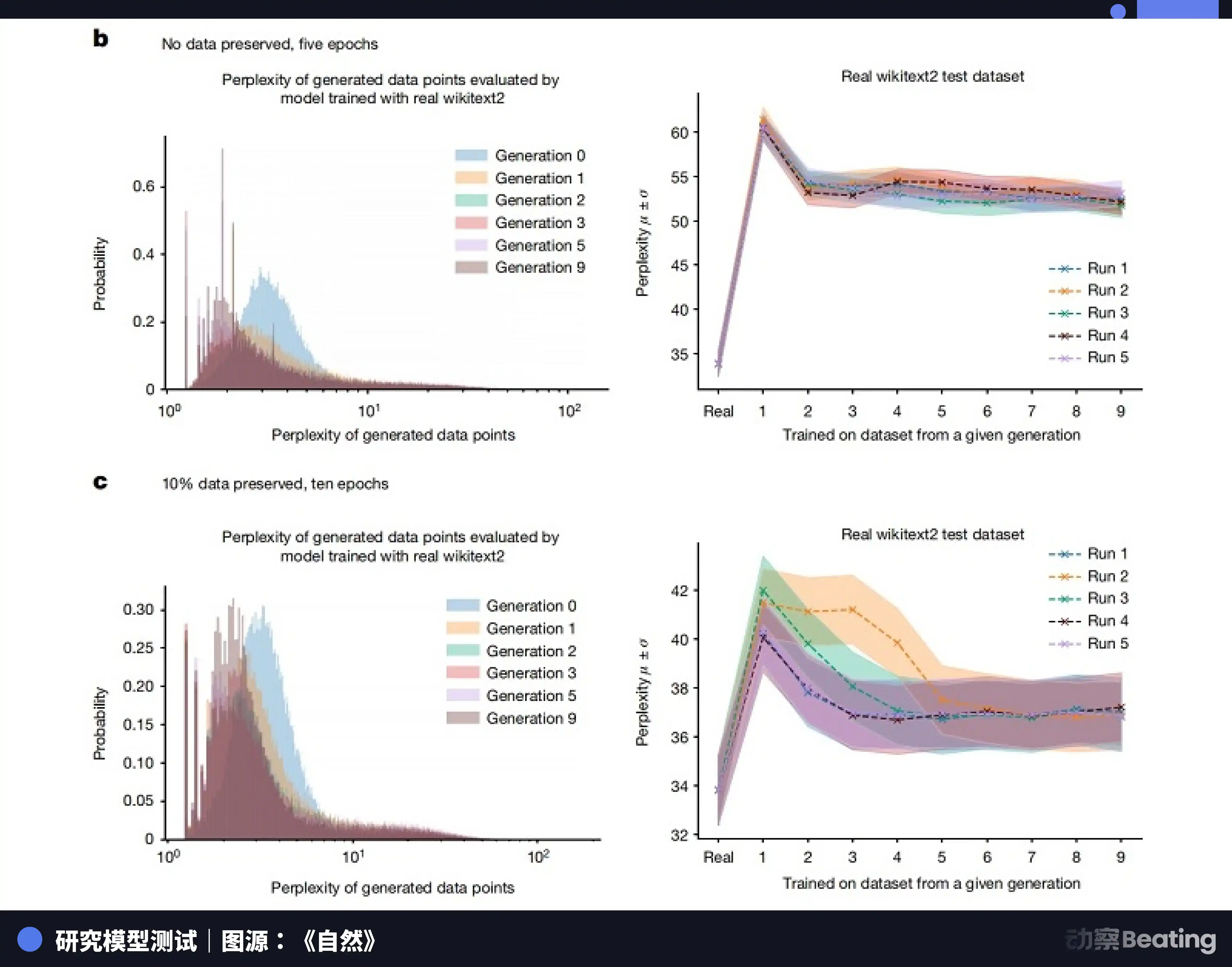
This is like those meme images circulating online. Originally a高清的 (high-definition) screenshot, forwarded, compressed, and forwarded again by countless people. Each transmission loses some pixels and adds some noise. Finally, the image becomes blurry and unrecognizable, coated in electronic包浆 (patina).

When the real, human context imbued with tacit knowledge is exhausted, and the system can only train itself on this patina-coated shadow, what will be left in the end?

Who Is Erasing Our Traces

What remains is only correct nonsense.

When the river of knowledge dries up into an endless rumination of AI upon AI,自我咀嚼 (self-chewing), everything the system吞吐 (ingests and spews) will inevitably become extremely standard, extremely safe, but incurably空洞 (hollow). You will see countless perfectly structured weekly reports, countless emails挑不出毛病 (with no faults to pick), but containing no breath of a living person, no truly valuable insight.

This great溃败 (collapse/rout) of knowledge is not because human brains have become duller. The true悲哀 (sadness) lies in the fact that we have outsourced the right to think and the responsibility to leave context to our own shadows.

A few days after the "Colleague.skill" explosion, a project named "anti-distill" quietly appeared on GitHub.

The author of this project did not try to attack large models, nor did they write any grand manifesto. They simply provided a small tool to help workers automatically generate some seemingly reasonable but actually logic-noisy无效长文 (ineffective long articles) in Feishu or DingTalk.

Their goal is simple: before being distilled by the system, hide their core knowledge first. Since the system likes to capture "proactively written long articles," feed it a bunch of meaningless乱码 (gibberish).

This project did not explode like "Colleague.skill"; it even seems somewhat tiny and powerless. Using magic to defeat magic is essentially still playing within the rules set by capital and technology. It cannot change the major trend of the system relying more and more on AI and increasingly neglecting real people.

But this does not prevent this project from becoming the most tragically poetic and deeply metaphorical scene in the entire absurd play.

We strive extremely hard to leave traces in the system, write detailed documents, provide meticulous decisions, trying to prove within this vast modern enterprise machine that we once existed, that we were valuable. Unaware that these extremely conscientious traces will ultimately become the eraser that抹去 (erases) us.

But looking at it from another angle, this might not be a complete dead end.

Because what that eraser抹去的 (erases) is always only the "past you." A skill packaged into a file, no matter how sophisticated its capture logic, is essentially just a static snapshot. It is locked at the moment of export, can only rely on stale nourishment, and spins infinitely within established processes and logic. It lacks the instinct to face unknown chaos, let alone the ability to self-evolve through setbacks in the real world.

When we hand over those highly standardized,既定式的 (set-in-stone) experiences, we恰恰 (precisely) free up our own hands. As long as we continue to reach outward, continue to break and reconstruct our cognitive boundaries, that shadow lingering in the cloud can only ever follow in our footsteps.

Humans are fluid algorithms.

Domande pertinenti

QAccording to the article, what makes diligent workers more susceptible to being distilled into an AI 'skill'?

ATheir thorough documentation, detailed decision-making explanations, and responsible handover of work details to digital systems provide high-quality, easily extractable context that serves as perfect fuel for AI.

QWhat philosophical concept does the article use to describe the reduction of human relationships to functional interfaces?

AMartin Buber's distinction between 'I-Thou' relationships, which treat others as whole beings, and 'I-It' relationships, which reduce people to functional objects for use.

QWhat is 'model collapse' as discussed in the context of AI training on AI-generated data?

AIt refers to the phenomenon where AI models trained on synthetic data from other AIs experience a narrowing of data distribution, losing rare and complex human traits and outputting increasingly mediocre and homogenized content.

QWhat strategy did the 'anti-distill' project propose to counter the extraction of personal knowledge?

AIt provided a tool to automatically generate seemingly reasonable but actually noisy and ineffective long texts in collaboration software, aiming to hide core knowledge by polluting the data harvested by the system.

QWhy does the article suggest that an AI 'skill' can never fully replace a human being?

ABecause a 'skill' is a static snapshot of past behavior, lacking the ability to face unknown chaos, evolve through real-world failure, or capture the tacit, intuitive knowledge that defines human expertise and continuous growth.

Letture associate

The Midlife Crisis of Crypto GPs: No PMF, No Next Check from LPs

The article "The Midlife Crisis of Crypto GPs: No PMF, No Next LP Check" analyzes the shifting crypto fundraising landscape. It argues the era of selling grand visions to LPs is over; GPs must now offer products with clear Product-Market Fit (PMF). The author categorizes crypto fundraising products into three types: Primary (VC funds), Liquid (trading strategies), and CeFi/DeFi Native Yield. This summary focuses on the Primary market. Key points include: * **Market Shift:** LPs are impatient, demand immediate returns, and are skeptical of future promises. The "easy money" narrative has faded. * **GP Value Erosion:** LP learning curves have shortened (aided by AI), reducing the value of a GP's basic "crypto knowledge." Superior judgment is now rare. * **Weakened LP Motivations:** Traditional reasons for LPs to invest in crypto VC funds (capturing industry beta, gaining access, leveraging GP judgment) have weakened due to new products like ETFs and increased LP sophistication. * **Surviving in Primary:** The primary market will likely persist for: 1) large funds in endowment mandates treating it as a lottery ticket, 2) family offices/HNWIs using proprietary capital, 3) a few funds with proven recent outperformance, and 4) funds with strong ecosystem "deal-making" capabilities. * **Conclusion:** For most GPs, rebuilding trust requires starting over in a niche, demonstrating alpha-generating ability, or providing concrete value/services to LPs.

marsbit1 h fa

The Midlife Crisis of Crypto GPs: No PMF, No Next Check from LPs

marsbit1 h fa

Crypto GPs' Midlife Crisis: No PMF, No LP's Next Check

The article "The Midlife Crisis of Crypto GPs: No PMF, No LP's Next Check" analyzes the shifting crypto fundraising landscape. It argues that the era of LPs funding vague "vision" is over; GPs must now offer products with clear Product-Market Fit (PMF) to secure capital. The market has matured. LPs, disillusioned by the last cycle's failures and wary of long lock-up periods, now demand tangible, near-term returns rather than speculative narratives. The proliferation of accessible crypto ETFs and other liquid products has reduced the need for VC blind pools as an entry point. The author categorizes crypto fundraising products into three types: Primary (VC funds, with blind pools or clear pipelines), Liquid (alpha/beta, directional/market-neutral strategies), and CeFi/DeFi Native Yield (crypto-specific mechanisms like staking, farming). Focusing on the Primary market, the piece details why traditional LP rationales for investing in crypto VCs have weakened: easier beta access via ETFs, diminished "access" and "judgement" premiums as LPs build internal teams, and a widespread lack of proven superior returns from GPs. Ultimately, only specific players are likely to remain at the primary VC table: large funds with access to patient endowment capital, family offices/HNWIs investing proprietary capital, the few funds with demonstrable excess returns from the last cycle, and those with clear "deal-making" or ecosystem resource advantages. For others, the path forward is to rebuild trust by proving alpha-generation capability in a niche or providing concrete, valuable services.

链捕手1 h fa

Crypto GPs' Midlife Crisis: No PMF, No LP's Next Check

链捕手1 h fa

The Age of Decoupling Has Arrived: Bitcoin is No Longer the Sole Compass of Crypto

The era of the cryptocurrency market moving in lockstep with Bitcoin is ending, as the industry splits into two distinct asset categories: endogenous and exogenous. Endogenous assets, like Bitcoin, derive value purely from the crypto market's cycles. Their narratives swing between being "interstellar money" in bull markets and "digital collectibles" in bear markets. Exogenous assets, however, are nominally crypto but operate with independent value drivers. Examples include: * **Venice:** An AI inference service using tokens for payments; its consumer-AI business model is decoupled from crypto price swings. * **Figure:** A fintech lender using blockchain to speed up loan approvals; its core value is in credit, not crypto. * **Stablecoin firms like BVNK:** Acquired by traditional finance giants (Mastercard, Stripe), their growth is tied to payment infrastructure, not market cycles. Hybrid projects like **Hyperliquid** (a decentralized exchange) show a shift, with a growing share of non-crypto trading (e.g., prediction markets). This divergence is fundamental. Endogenous assets remain highly correlated to Bitcoin, similar to gold miners to gold. Exogenous assets are evolving to have their own fundamentals, like the weak correlation between gold and the S&P 500. This changes investment analysis. Evaluating exogenous assets requires traditional fundamental research—assessing user bases, unit economics, and moats—more akin to fintech investing than charting Bitcoin. Promising exogenous sectors include: on-chain exchanges/brokers, AI-crypto fusion, privacy-focused digital banks, lending (institutional/private credit), stablecoins/real-world asset tokenization, payment rails, and non-financial crypto-consumer products. Currently, investing via equity is often safer than via tokens, as token value accrual mechanisms need further regulatory and industry development (e.g., the CLARITY Act). Nonetheless, the core trend is clear: crypto market drivers are diversifying from a single factor (Bitcoin) to multiple fundamentals, ending the era of uniform market moves.

marsbit2 h fa

The Age of Decoupling Has Arrived: Bitcoin is No Longer the Sole Compass of Crypto

marsbit2 h fa

Trading

Spot
Futures

Articoli Popolari

Cosa è DOGE M

Doge Matrix ($doge m): La Nuova Razza di Criptovaluta Guidata dalla Comunità Introduzione Nel panorama in continua evoluzione delle criptovalute, nuovi progetti emergono costantemente, ciascuno con l'obiettivo di catturare l'interesse di investitori ed appassionati. Uno degli ultimi ingressi in questo dominio è Doge Matrix, rappresentato dal simbolo ticker $doge m. Questo progetto ha attirato attenzione grazie alle sue radici nella popolare cultura dei meme che circonda Dogecoin, stabilendo il suo posto all'interno dello spazio web3. Questo articolo mira a fornire un'analisi completa di Doge Matrix, coprendo la sua panoramica, il creatore, gli investitori, la funzionalità, la cronologia e gli aspetti notevoli. Cos'è Doge Matrix ($doge m)? Doge Matrix è un progetto di criptovaluta guidato dalla comunità che apparentemente si basa sull'ampio appeal di Dogecoin, una valuta digitale nota per il suo mascotte Shiba Inu e le sue origini nei meme. Sebbene gli obiettivi generali di Doge Matrix non siano ampiamente definiti, è caratterizzato da un impegno a sfruttare il coinvolgimento e il supporto della comunità. A differenza delle criptovalute tradizionali che spesso enfatizzano l'utilità o il valore intrinseco attraverso tecnologie sottostanti, Doge Matrix si posiziona all'interno di uno spazio che abbraccia il fenomeno culturale delle criptovalute, particolarmente attraente per coloro che risuonano con l'etica degli asset basati sui meme. Attraendo i punti di forza della comunità di Dogecoin, Doge Matrix opera come parte di un ecosistema più ampio, invitando alla partecipazione e all'impegno degli utenti che condividono un interesse per le criptovalute e il panorama digitale. Chi è il Creatore di Doge Matrix ($doge m)? L'identità del creatore di Doge Matrix rimane sconosciuta. Questa mancanza di trasparenza non è un evento raro nello spazio delle criptovalute, dove alcuni progetti vengono lanciati senza rivelare le identità dei loro fondatori. L'assenza di informazioni riguardanti il team fondatore può sollevare domande tra i potenziali investitori sulla responsabilità e la direzione del progetto. Chi sono gli Investitori di Doge Matrix ($doge m)? Al momento, non ci sono informazioni pubblicamente disponibili che dettagliano gli investitori o le fondazioni di investimento che supportano Doge Matrix. Il progetto sembra fare affidamento principalmente sul supporto della comunità piuttosto che su investimenti istituzionali. Questo modello si allinea con la natura guidata dalla comunità dell'iniziativa, favorendo un ambiente in cui la direzione del progetto è plasmata dai suoi partecipanti piuttosto che essere dettata da un selezionato gruppo di finanziatori. Come Funziona Doge Matrix ($doge m)? I dettagli riguardanti i meccanismi operativi di Doge Matrix sono piuttosto vaghi, riflettendo una tendenza più ampia di progetti nello spazio delle meme coin in cui le funzionalità innovative non sono sempre chiaramente articolate. Tuttavia, Doge Matrix sembra essere progettato per sfruttare l'ecosistema esistente delle criptovalute incoraggiando la partecipazione degli utenti mentre attinge ai riferimenti culturali familiari associati a Dogecoin. Le sue potenzialmente uniche caratteristiche derivano dalle interazioni della comunità piuttosto che dai progressi tecnologici, enfatizzando esperienze condivise e collaborazione tra i detentori di token. Sebbene le esatte innovazioni non siano state esplicitamente delineate, il progetto sembra creare uno spazio in cui i membri della comunità possono impegnarsi, condividere idee e promuovere il potenziale del progetto. Cronologia di Doge Matrix ($doge m) Riflettendo sulla cronologia del progetto, emergono eventi notevoli che hanno definito il suo percorso fino ad ora: 25 Novembre 2024: Doge Matrix ha raggiunto il suo valore massimo storico, segnando un traguardo significativo nella sua storia iniziale. 1 Gennaio 2025: Al contrario, Doge Matrix ha toccato il suo valore minimo storico, illustrando la volatilità spesso associata alle criptovalute, specialmente nelle prime fasi del ciclo di vita di un progetto. In Corso: Il progetto continua ad essere attivamente scambiato e supportato dalla sua comunità, sebbene specifici traguardi o obiettivi futuri debbano ancora essere divulgati. Punti Chiave su Doge Matrix ($doge m) Focus sulla Comunità Al centro di Doge Matrix c'è un impegno per il coinvolgimento della comunità. Il progetto prospera sulla premessa della collaborazione e degli obiettivi condivisi tra i suoi membri, enfatizzando l'importanza dello sforzo collettivo. A differenza dei progetti centralizzati che spesso hanno una struttura di leadership definita, Doge Matrix attualmente mostra un approccio più fluido alla governance, dove la voce di ogni membro della comunità conta. Volatilità Il mercato delle criptovalute è noto per la sua volatilità, e Doge Matrix non fa eccezione. La sua storia dei prezzi riflette fluttuazioni significative tra valori alti e bassi, il che è tipico di molte nuove criptovalute ma sottolinea i rischi associati all'investimento in token emergenti. Mancanza di Informazioni Dettagliate Una delle caratteristiche più sorprendenti di Doge Matrix è la scarsità di informazioni dettagliate riguardanti le sue fondamenta tecnologiche e i meccanismi operativi. Questa ambiguità richiede che i potenziali investitori conducano un'accurata due diligence prima di impegnarsi con il progetto. Conclusione In sintesi, Doge Matrix ($doge m) illustra una nuova ondata di progetti di criptovaluta che si basano fortemente sul coinvolgimento della comunità e sulla rilevanza culturale. Sebbene manchi di alcuni dettagli—come una leadership chiara, obiettivi definiti e funzionalità dettagliate—il progetto è riuscito a generare interesse all'interno della comunità crypto, sfruttando l'appello consolidato della cultura dei meme. Come per qualsiasi investimento nello spazio delle criptovalute, comprendere i rischi intrinseci e condurre una ricerca approfondita è essenziale per i potenziali partecipanti. Doge Matrix si erge come un promemoria della natura dinamica, a volte imprevedibile, dell'industria crypto, caratterizzata da un'evoluzione costante e dall'entusiasmo per le iniziative guidate dalla comunità.

381 Totale visualizzazioniPubblicato il 2025.02.03Aggiornato il 2025.02.03

Cosa è DOGE M

Cosa è $M

Comprendere Mantis ($M): Una Nuova Era nell'Interoperabilità Cross-Chain Nel panorama in continua evoluzione del Web3 e delle criptovalute, nuovi progetti si sforzano di offrire soluzioni innovative mirate a migliorare l'esperienza dell'utente e ad ampliare le possibilità funzionali all'interno dell'ecosistema finanziario decentralizzato. Uno di questi progetti che sta attirando attenzione è Mantis ($M), un protocollo pionieristico fondato sui principi dell'interoperabilità cross-chain e dei pagamenti basati sull'intento. Questo articolo esplora gli aspetti essenziali di Mantis, inclusa la sua funzionalità principale, i creatori, il supporto agli investimenti, le caratteristiche innovative e le tappe fondamentali. Che cos'è Mantis ($M)? Mantis è descritto come un protocollo di regolamento dell'intento multi-dominio che semplifica le interazioni cross-chain, consentendo agli utenti di eseguire transazioni finanziarie complesse su varie piattaforme blockchain senza soluzione di continuità. Il protocollo opera attraverso tre livelli principali: Espressione dell'Intento: Gli utenti possono articolare i loro obiettivi di transazione utilizzando un linguaggio naturale facilitato dal DISE LLM, un avanzato modello di linguaggio AI. Ad esempio, un utente potrebbe esprimere il desiderio di scambiare Ethereum (ETH) con Solana (SOL) con una tolleranza di slippage specifica dell'1%. Esecuzione: Questo livello impiega una rete di risolutori che competono per soddisfare gli intenti degli utenti. Le transazioni vengono eseguite utilizzando meccanismi come la Coincidenza dei Desideri (CoWs) e le Aste sul Flusso degli Ordini (OFAs), che garantiscono che le richieste degli utenti siano soddisfatte in modo ottimale. Regolamento: Sfruttando il protocollo di Comunicazione Inter-Blockchain (IBC), Mantis consente transazioni atomic cross-chain, permettendo agli utenti di operare su varie catene supportate, tra cui Ethereum, Solana e Cosmos. Mantis è progettato per introdurre generazione di rendimento nativa per asset inattivi, impiegando prove crittografiche per mantenere l'integrità delle transazioni durante l'intero processo. Creatori e Team di Sviluppo Mantis è stato concepito dalla Composable Foundation, un'organizzazione orientata alla ricerca nota per il suo focus sulle soluzioni di interoperabilità blockchain. Questa fondazione collabora con istituzioni accademiche di prestigio, tra cui l'Università di Harvard e l'Università di Lisbona, contribuendo a sforzi di ricerca e sviluppo estesi che informano l'architettura e la funzionalità di Mantis. L'impegno della Composable Foundation a promuovere l'innovazione nello spazio blockchain posiziona Mantis come una soluzione robusta per la crescente domanda di interoperabilità tra più reti blockchain. Investitori e Supporto Sebbene i dettagli specifici sugli investitori individuali non siano stati resi pubblici, Mantis gode di un sostegno sostanziale da parte di vari enti, tra cui: Sovvenzioni ecosistemiche da catene abilitate IBC, che supportano la crescita e l'integrazione del protocollo all'interno degli ecosistemi finanziari decentralizzati. Partnership strategiche con fornitori di infrastrutture che migliorano le capacità di rete e le strategie di distribuzione di Mantis. Finanziamenti attraverso il tesoro della Composable Foundation, garantendo un supporto finanziario sostenuto per lo sviluppo continuo e i costi operativi. Questi sforzi collaborativi riflettono un consenso tra le parti interessate sull'importanza di migliorare la funzionalità cross-chain e il potenziale utilizzo delle innovazioni infrastrutturali di Mantis. Innovazioni Chiave Mantis si distingue attraverso diverse innovazioni pionieristiche che migliorano la sua funzionalità e utilità: Intenti Agnostici alla Catena: Gli utenti possono avviare transazioni da qualsiasi catena supportata mentre si regolano su un'altra. Questa flessibilità potenzia gli utenti, aumentando l'interazione tra diverse piattaforme. Interfaccia Potenziata dall'AI: L'integrazione del DISE LLM consente agli utenti di condurre operazioni DeFi complesse utilizzando un linguaggio naturale, semplificando così le interazioni e rendendo la tecnologia blockchain accessibile a un pubblico più ampio. Cattura MEV Cross-Domain: Mantis crea un mercato interno per il valore massimamente estraibile (MEV) attraverso competizioni tra risolutori. Questo approccio innovativo consente una maggiore efficienza e estrazione di valore in transazioni complesse. Strato di Regolamento Modulare: Il protocollo supporta vari metodi di verifica, comprese le prove a conoscenza zero e i rollup ottimistici, fornendo un framework versatile che può adattarsi alle tecnologie blockchain emergenti. Cronologia Storica Lo sviluppo di Mantis è contrassegnato da diverse tappe fondamentali che tracciano la sua traiettoria e crescita: | Anno | Tappa | |————|————————————————————————| | 2022 | Sviluppo del concetto iniziale all'interno della divisione di ricerca della Composable Foundation. | | Q3 2024 | Lancio del testnet con capacità di bridging tra Solana ed Ethereum. | | Q1 2025 | Evento di Generazione di Token (TGE) previsto insieme al lancio della mainnet. | | Q2 2025 | Integrazione attesa del DISE LLM e espansione delle capacità cross-chain. | | 2025 H2 | Supporto pianificato per oltre 15 catene attraverso ulteriori aggiornamenti IBC. | Questa cronologia delinea l'evoluzione di Mantis, dalle discussioni concettuali all'implementazione attiva e alle fasi di crescita future. Strategia di Crescita dell'Ecosistema La strategia di Mantis per la crescita dell'ecosistema include diverse iniziative progettate per incoraggiare la partecipazione degli utenti e il coinvolgimento degli sviluppatori: Sistema di Crediti: Gli utenti possono guadagnare crediti del protocollo fornendo liquidità e partecipando a programmi di referral. Questi crediti sono riscattabili per incentivi futuri, promuovendo una comunità utente robusta. Kit di Sviluppo Software Modulare (SDK): Questo toolkit consente agli sviluppatori di creare applicazioni basate su modelli guidati dall'intento utilizzando l'infrastruttura di Mantis, promuovendo così l'innovazione all'interno del suo ecosistema. Modello di Governance: Man mano che il protocollo matura, i detentori di token $M avranno voce in capitolo nella governance del protocollo, consentendo loro di votare su aggiornamenti e modifiche proposti, migliorando così il coinvolgimento della comunità e la decentralizzazione. Mantis rappresenta un significativo avanzamento nel campo dell'architettura cross-chain. Integrando senza soluzione di continuità algoritmi AI avanzati con un robusto framework di regolamento, Mantis cerca di affrontare i problemi di frammentazione all'interno degli ecosistemi multi-chain. Il suo approccio innovativo prioritizza il miglioramento delle esperienze degli utenti, mantenendo i principi fondamentali di decentralizzazione e sicurezza, stabilendo un nuovo standard per l'interoperabilità futura delle tecnologie blockchain. Man mano che Mantis continua il suo percorso di crescita e implementazione, promette di essere un progetto da seguire da vicino nel competitivo panorama del Web3 e della finanza decentralizzata. Con il suo focus sul superamento dei confini e sull'elevazione del coinvolgimento degli utenti, Mantis è destinato a diventare una parte integrante dei futuri sviluppi nel campo delle criptovalute.

46 Totale visualizzazioniPubblicato il 2025.03.18Aggiornato il 2025.03.18

Cosa è $M

Come comprare M

Benvenuto in HTX.com! Abbiamo reso l'acquisto di MemeCore (M) semplice e conveniente. Segui la nostra guida passo passo per intraprendere il tuo viaggio nel mondo delle criptovalute.Step 1: Crea il tuo Account HTXUsa la tua email o numero di telefono per registrarti il tuo account gratuito su HTX. Vivi un'esperienza facile e sblocca tutte le funzionalità,Crea il mio accountStep 2: Vai in Acquista crypto e seleziona il tuo metodo di pagamentoCarta di credito/debito: utilizza la tua Visa o Mastercard per acquistare immediatamente MemeCoreM.Bilancio: Usa i fondi dal bilancio del tuo account HTX per fare trading senza problemi.Terze parti: abbiamo aggiunto metodi di pagamento molto utilizzati come Google Pay e Apple Pay per maggiore comodità.P2P: Fai trading direttamente con altri utenti HTX.Over-the-Counter (OTC): Offriamo servizi su misura e tassi di cambio competitivi per i trader.Step 3: Conserva MemeCore (M)Dopo aver acquistato MemeCore (M), conserva nel tuo account HTX. In alternativa, puoi inviare tramite trasferimento blockchain o scambiare per altre criptovalute.Step 4: Scambia MemeCore (M)Scambia facilmente MemeCore (M) nel mercato spot di HTX. Accedi al tuo account, seleziona la tua coppia di trading, esegui le tue operazioni e monitora in tempo reale. Offriamo un'esperienza user-friendly sia per chi ha appena iniziato che per i trader più esperti.

471 Totale visualizzazioniPubblicato il 2025.07.02Aggiornato il 2026.06.01

Come comprare M

Discussioni

Benvenuto nella Community HTX. Qui puoi rimanere informato sugli ultimi sviluppi della piattaforma e accedere ad approfondimenti esperti sul mercato. Le opinioni degli utenti sul prezzo di M M sono presentate come di seguito.

活动图片