White House Pushes for Fast Crypto Deal as Senate Window Narrows and $1B Liquidations Rock Markets

bitcoinistPubblicato 2026-01-22Pubblicato ultima volta 2026-01-22

Introduzione

The White House is urging U.S. lawmakers to quickly pass crypto market structure legislation as the Senate faces challenges in securing bipartisan support. Patrick Witt, a key advisor, warns that delays could lead to harsher future policies and that legislation is inevitable. The push comes amid political pressure from upcoming midterm elections, which could further complicate legislative efforts. Meanwhile, crypto markets experienced significant turmoil with over $1 billion in liquidations, primarily from long positions in Bitcoin and Ethereum, amid falling prices and tightening global liquidity.

The White House is urging U.S. lawmakers to move quickly on legislation to reform the crypto market structure as political timelines tighten and digital asset markets face renewed volatility.

With the Senate struggling to secure bipartisan support and more than $1 billion in recent crypto liquidations, officials say the window for passing a workable regulatory framework may be closing.

Patrick Witt, executive director of the President’s Council of Advisors for Digital Assets, has warned that expecting the crypto industry to operate without clear rules is unrealistic. He argues that some form of legislation is “inevitable” and that delays could leave the sector exposed to harsher policies in the future.
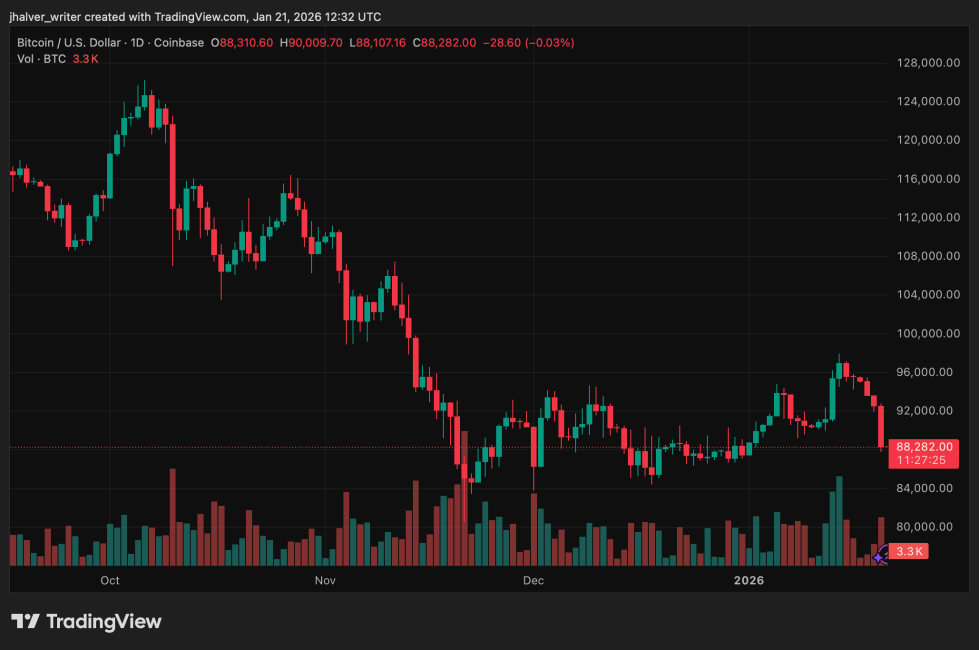
BTC's price trends to the downside on the daily chart. Source: BTCUSD on Tradingview

White House Presses for Action on Crypto Rules

The proposed Senate bill would define how the Securities and Exchange Commission (SEC) and the Commodity Futures Trading Commission (CFTC) oversee crypto markets, including stablecoins and decentralized finance protocols. However, disagreements over key provisions have slowed progress.

Both the Senate Banking and Agriculture Committees recently postponed markups as lawmakers worked to resolve disputes and gather enough support to advance the bill. Witt has been blunt in his message to the industry: accept compromise now or risk facing a less favorable outcome later.

He criticized Coinbase CEO Brian Armstrong for withdrawing support for the current version of the bill, after Armstrong said the company would “rather have no bill than a bad bill.”

Midterm Elections Add Pressure

The push for speed is also tied to the November U.S. midterm elections, which could reshape Congress. All House seats and 35 Senate seats are up for grabs, and polling and prediction markets suggest Democrats have a strong chance of flipping the House.

A divided Congress would likely slow or stall crypto legislation altogether. Witt has cautioned that the political alignment needed to pass a market structure bill may not be in place after the elections, making the coming months critical for any deal.

$1B Liquidations Highlight Market Stress

The policy debate comes as markets reel from a sharp deleveraging event. Today, more than 182,000 traders were liquidated in a single day, with total losses of over $1.08 billion. Most of the damage came from long positions in Bitcoin and Ethereum, as falling prices triggered cascading margin calls across major exchanges.

Bitcoin alone saw over $427 million in long liquidations, while Ethereum accounted for roughly $374 million. Technical indicators show many altcoins trading with RSI levels below 50, suggesting continued selling pressure.

Rising Japanese bond yields and renewed global risk-off sentiment have also tightened liquidity, prompting investors to shift away from volatile assets like crypto. Although Bitcoin later stabilized near $90,000, analysts say the recent rebound looks more like a pause after forced selling than a clear return to bullish momentum.

Cover image from ChatGPT, BTCUSD chart on Tradingview

Domande pertinenti

QWhy is the White House urging lawmakers to move quickly on crypto legislation?

AThe White House is pushing for speed due to tightening political timelines from the upcoming midterm elections and renewed market volatility, warning that the window for passing a workable regulatory framework may be closing.

QWhat is the main obstacle to passing the crypto market structure bill in the Senate?

AThe main obstacle is a lack of bipartisan support, with disagreements over key provisions causing postponed markups in committees as lawmakers work to resolve disputes.

QHow did Patrick Witt of the President’s Council respond to Coinbase CEO Brian Armstrong's stance on the bill?

APatrick Witt criticized Brian Armstrong for withdrawing support, after the Coinbase CEO said the company would 'rather have no bill than a bad bill.' Witt argued that accepting a compromise now is better than risking a less favorable outcome later.

QWhat event caused over $1 billion in crypto liquidations and which assets were most affected?

AA sharp deleveraging event caused over $1.08 billion in liquidations, with the majority of losses coming from long positions in Bitcoin ($427M) and Ethereum ($374M) as falling prices triggered margin calls.

QHow could the November midterm elections impact the future of crypto legislation?

AThe elections could reshape Congress, and if Democrats flip the House as predicted, it would likely result in a divided Congress that could slow or stall crypto legislation altogether, making the current political alignment critical for any deal.

Letture associate

South Korean Exchanges 'Battle' Regulators, Challenging the Boundaries of Enforcement and Legislation

South Korea's cryptocurrency industry is engaged in a rare, direct confrontation with regulators. The Financial Intelligence Unit (FIU), the primary anti-money laundering (AML) watchdog, has recently imposed heavy penalties on major exchanges like Upbit and Bithumb for alleged violations involving unregistered overseas VASPs and AML procedures. However, exchanges are now actively challenging these actions in court and through industry associations. In a significant shift, the Seoul Administrative Court ruled in favor of Upbit's operator, Dunamu, overturning part of an FIU-ordered business suspension. The court found the FIU's penalty criteria and justification insufficiently clear. Similarly, the court suspended the enforcement of a six-month business suspension against Bithumb pending a final ruling, citing potential irreversible harm to the exchange. Beyond legal battles, the industry is contesting proposed legislative amendments. The Digital Asset eXchange Alliance (DAXA) strongly opposes a draft rule that would mandate Suspicious Transaction Reports (STRs) for all crypto transfers over 10 million KRW (~$6,800). DAXA argues this "poison pill" clause violates legal principles and would overwhelm the STR system, increasing reports from 63,000 to an estimated 5.45 million annually for major exchanges, thereby crippling effective AML monitoring. This conflict highlights a structural tension in South Korea's crypto governance: comprehensive digital asset laws are still developing, while regulators rely heavily on AML enforcement. The industry's move from passive compliance to active legal and legislative challenges signifies a new phase, pressing for clearer rules and more proportionate enforcement. While short-term disputes may intensify, this clash could ultimately lead to a more mature and sustainable regulatory framework for South Korea's vibrant crypto market.

marsbit25 min fa

South Korean Exchanges 'Battle' Regulators, Challenging the Boundaries of Enforcement and Legislation

marsbit25 min fa

After 50x Storage Surge, Justin Sun Always Looks to the Next Decade

Sun Yuchen, known for his controversial stunts like a $30 million lunch with Warren Buffett (canceled due to a kidney stone) and eating a $6.2 million duct-taped banana, is often overshadowed by a significant fact: his decade-long track record of spotting major investment trends. In 2016, he famously advised young people to invest in Bitcoin, Nvidia, Tesla, and Tencent instead of buying property. A hypothetical $20,000 investment in Nvidia and Tesla from that list would now be worth over 50 million RMB. His latest major call was on November 6, 2025, predicting a "50x storage opportunity" tied to the AI boom, which materialized with Sandisk's stock surging nearly 50-fold by 2026. Looking ahead, Sun now focuses on the next frontier: Physical AI. He identifies four key areas: 1. **Embodied AI/Robotics**: He sees this reaching its "iPhone moment," with companies like UBTech and Galaxy General leading in commercialization. 2. **Drones**: Viewed as the first commercially viable form of Physical AI, revolutionizing sectors from warfare (e.g., AeroVironment's Switchblade) to logistics. 3. **Spatial Computing**: Beyond VR, it's about AI understanding physical space, a foundational technology for robotics and autonomous systems, exemplified by Apple's Vision Pro. 4. **Space Exploration**: After a 2025 suborbital flight with Blue Origin, Sun advocates for space as the ultimate frontier, discussing blockchain's potential role in space asset management and data transactions. His investment philosophy involves betting on entire, inevitable trends rather than single companies. For robotics, he sees Tesla (the body/manufacturer) and Nvidia (the brain/AI platform) as complementary plays. In defense drones, he highlights companies making tanks obsolete (AeroVironment) and those augmenting fighter jets (Kratos). For space, he participated in Blue Origin's flight and anticipates SpaceX's potential IPO to redefine the sector's valuation. Sun Yuchen's vision frames the next two decades not as a revolution in information flow (like the internet), but in the fundamental operation of the physical world through AI-powered robots, autonomous systems, and spatial intelligence, ultimately extending human and AI activity into space. While many still focus on conventional assets, he continues to look toward the next technological horizon.

marsbit1 h fa

After 50x Storage Surge, Justin Sun Always Looks to the Next Decade

marsbit1 h fa

The Billionaires Behind the Most Expensive Midterm Election in History

"The Most Expensive Midterm Elections and Their Billionaire Backers" This analysis details the unprecedented scale of spending in the 2026 midterm elections, highlighting the key billionaire donors shaping the political landscape. Jeff Yass, founder of Susquehanna International Group, has contributed over $81 million, ranking third among individual donors behind George Soros ($102.6M) and Elon Musk ($84.8M). Yass is a major donor to Trump's MAGA Inc. and supports school choice and various candidates. Overall, federal committees have raised over $4.7 billion this cycle, with political ad spending projected to reach $10.8 billion. Republican-aligned groups are significantly out-raising their Democratic counterparts. "Dark money" from undisclosed sources continues to grow. The core stakes involve control of Congress and policy direction for Trump's final term. Donors are also motivated by specific issues: Sergey Brin and Chris Larsen are funding opposition to a proposed California wealth tax and supporting crypto-friendly policies. Other top donors include OpenAI's Greg Brockman and his wife Anna ($50M total to MAGA Inc. and an AI-focused PAC), Richard Uihlein ($45.3M to conservative causes), venture capitalists Marc Andreessen and Ben Horowitz (each over $44M to crypto/AI PACs and MAGA Inc.), Miriam Adelson ($42.6M to GOP leadership PACs), Paul Singer ($33.9M), and Diane Hendricks ($25.8M to MAGA Inc.). The article notes that the peak fundraising period is still ahead, with major primaries approaching.

marsbit1 h fa

The Billionaires Behind the Most Expensive Midterm Election in History

marsbit1 h fa

The Largest IPO in History Is Approaching, Surpassing SpaceX, 28 Years of AI Self-Iteration, Countdown to Intelligence Explosion

"Anthropic Nears Trillion-Dollar IPO, Fueled by Explosive Growth and 2028 'Intelligence Explosion' Warning Anthropic is considering a deal valuing the AI company near $1 trillion, potentially leading to one of the largest IPOs ever and surpassing SpaceX. Its revenue has skyrocketed, with Annual Recurring Revenue (ARR) reaching $45 billion in May 2026—a 500% increase in just five months. This vertical growth curve is attributed to its key products, Claude Code and Cowork, dominating AI coding and enterprise collaboration. Beyond commercial success, co-founder Jack Clark issued a pivotal warning in an interview: there is a greater than 50% chance that by the end of 2028, AI systems will achieve recursive self-improvement—the ability to autonomously build a 'better version' of themselves, initiating an 'intelligence explosion.' This prophecy underpins the company's astronomical valuation, as the market prices in the potential for transformative and disruptive AI. Further signaling its ambition, Anthropic formed a $1.5 billion joint venture with Goldman Sachs and Blackstone, aiming to disrupt traditional consulting firms like McKinsey by deploying Claude AI for complex strategic work. This move tests AI's capacity to replace high-level cognitive labor, a precursor to its predicted autonomous evolution. The narrative presents a dual future: unprecedented economic opportunity alongside significant risks like economic restructuring and security threats. Anthropic's meteoric rise and Clark's 2028 prediction frame the coming years as a countdown to a potential technological singularity."

marsbit1 h fa

The Largest IPO in History Is Approaching, Surpassing SpaceX, 28 Years of AI Self-Iteration, Countdown to Intelligence Explosion

marsbit1 h fa

Trading

Spot
Futures

Articoli Popolari

Come comprare HOUSE

Benvenuto in HTX.com! Abbiamo reso l'acquisto di Housecoin (HOUSE) semplice e conveniente. Segui la nostra guida passo passo per intraprendere il tuo viaggio nel mondo delle criptovalute.Step 1: Crea il tuo Account HTXUsa la tua email o numero di telefono per registrarti il tuo account gratuito su HTX. Vivi un'esperienza facile e sblocca tutte le funzionalità,Crea il mio accountStep 2: Vai in Acquista crypto e seleziona il tuo metodo di pagamentoCarta di credito/debito: utilizza la tua Visa o Mastercard per acquistare immediatamente HousecoinHOUSE.Bilancio: Usa i fondi dal bilancio del tuo account HTX per fare trading senza problemi.Terze parti: abbiamo aggiunto metodi di pagamento molto utilizzati come Google Pay e Apple Pay per maggiore comodità.P2P: Fai trading direttamente con altri utenti HTX.Over-the-Counter (OTC): Offriamo servizi su misura e tassi di cambio competitivi per i trader.Step 3: Conserva Housecoin (HOUSE)Dopo aver acquistato Housecoin (HOUSE), conserva nel tuo account HTX. In alternativa, puoi inviare tramite trasferimento blockchain o scambiare per altre criptovalute.Step 4: Scambia Housecoin (HOUSE)Scambia facilmente Housecoin (HOUSE) nel mercato spot di HTX. Accedi al tuo account, seleziona la tua coppia di trading, esegui le tue operazioni e monitora in tempo reale. Offriamo un'esperienza user-friendly sia per chi ha appena iniziato che per i trader più esperti.

260 Totale visualizzazioniPubblicato il 2025.04.27Aggiornato il 2025.04.27

Come comprare HOUSE

Discussioni

Benvenuto nella Community HTX. Qui puoi rimanere informato sugli ultimi sviluppi della piattaforma e accedere ad approfondimenti esperti sul mercato. Le opinioni degli utenti sul prezzo di HOUSE HOUSE sono presentate come di seguito.

活动图片