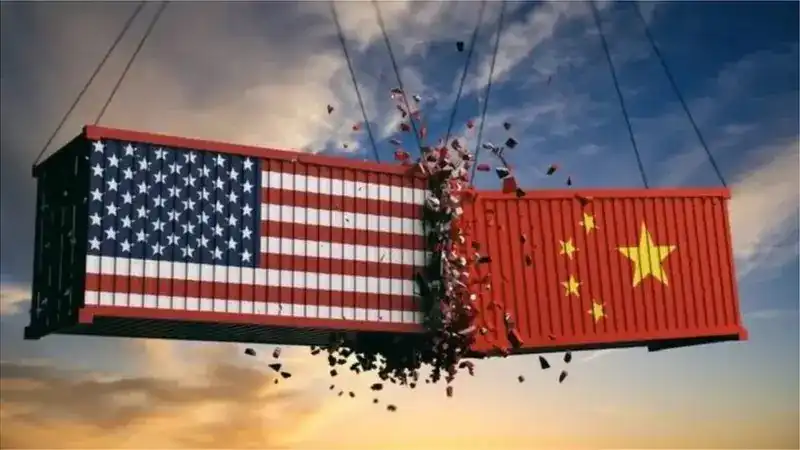
White House Ignites, BSC Spreads Like Wildfire: A Meme Carnival Bidding Farewell to the 'Imperial Decree Model'

Odaily星球日报Pubblicato 2026-01-21Pubblicato ultima volta 2026-01-21

Introduzione

White House Ignites, BSC Rallies: A Meme Carnival Moving Beyond the "Imperial Decree" Model The meme market witnessed another sensational surge when the White House official account on X posted about "victory, eviction operations, and memes" on January 21. Within minutes, meme tokens named "memes" were launched on both Solana and BSC chains, sparking a race between the two ecosystems. Contrary to expectations that Solana’s earlier launch and active ecosystem would dominate, the BSC version outperformed in market cap and holder engagement. At its peak, the BSC meme reached a market cap of $28 million with 7,300 holders, while Solana’s version capped at $3.6 million with 3,900 holders. Real-time user data from GMGN also showed significantly higher engagement on BSC. This outcome challenges the long-standing perception that BSC memes rely heavily on endorsements from figures like CZ and He Yi—a pattern often mocked as "crypto Shandong style." In fact, both CZ and He Yi have recently expressed caution against "wordplay memes" created by parsing their social posts. CZ explicitly warned users against buying tokens based on his tweets, while He Yi discouraged the community from treating such meme creation as meaningful contribution. The success of the BSC-based "memes" token—inspired by the White House rather than internal figures—suggests a possible shift in BSC’s meme culture. He Yi’s now-deleted retweet of the White House post may have contributed to its visibility, though th...

Original | Odaily Planet Daily (@OdailyChina)

Author | Golem (@web 3_golem)
The meme market today once again witnessed a "golden dog" legend.

On January 21 at 11:10, the official White House account posted on X platform mentioning "victory, eviction operations, and memes". One minute later, a Meme coin named memes quickly appeared on the Solana chain; 20 minutes later, the BSC chain version was also born. A Meme race between the two chains officially began.

According to empiricism, the Solana version should have the advantage—not only is the ecosystem active, but it also conforms to the consensus of "First is first". However, the result was unexpected: the BSC chain's memes surpassed in market capitalization. According to GMGN data, the BSC version's market cap reached a high of $28 million, with 7,300 holding addresses; while the Solana version's peak was only $3.6 million, with 3,900 holding addresses.

The new feature of GMGN also reveals where players' attention lies: 3 hours after the token's birth, the number of simultaneous online users for the Solana version remained below 1,000, while the BSC version once approached 3,000.

Although some questioned whether the BSC version's market cap was due to "whales pumping, aiming to harvest", the real market attention does not lie—this time, BSC indeed won.

The community often joked that BSC's Meme model was "Shandong Study in the crypto circle", where only projects related to CZ and He Yi had a way out, which once raised concerns about the ecosystem's sustainability. However, BSC's victory in this Meme race not only caused a wave of "slapping thighs" regret for missing out but also prompted the community to rethink the evolution of its Meme model. As GMGN founder Haze said: "The BSC 3.0 era has arrived." (Odaily Note: Haze holds 1.93% of BSC chain memes, ranking second on the holdings list.)

CZ and He Yi Publicly State They Do Not Support "Word-Picking Memes"

I once expressed my thoughts on the BSC Meme model at an Odaily editorial tea party, believing that CZ and He Yi were actually already "kidnapped" by the community. The current BSC Meme model, which relies on "imperial decrees" for cold start, deceives continuous interaction, gets listed on Binance Alpha, and finally gets "poured out", is actually a consensus of the BSC community. Although this model started with CZ's unintentional actions in early 2025, they actually don't like it. However,发展到如今, CZ and He Yi are also powerless to reverse the situation.

When I published this view, it was merely a conjecture, but recent public statements from CZ and He Yi have proven this to be a fact. On January 13, CZ posted saying that although he likes Meme coins, if players blindly follow the trend and buy Meme coins "picked" from his tweets, they are almost destined to lose money.

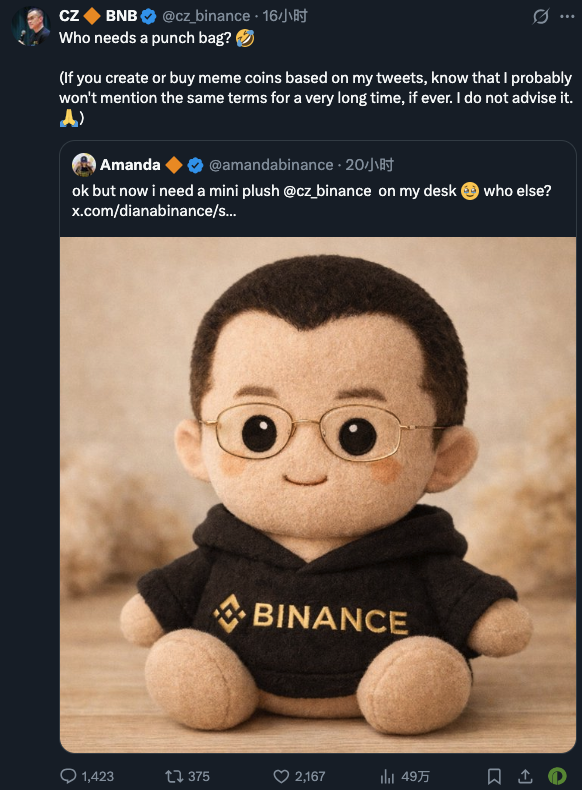
To prevent everyone from blindly chasing these "word-picking Memes", CZ's tweets have started to become cautious. Yesterday, CZ reposted a plush toy created by a user based on his image, which was an ordinary matter, but CZ still specifically noted: If you create or buy Meme coins based on my tweets, please note that I may not mention the same words again for a long time, maybe never. I do not recommend you do this. He even added a 🙏 icon at the end, showing CZ's concern for the community.
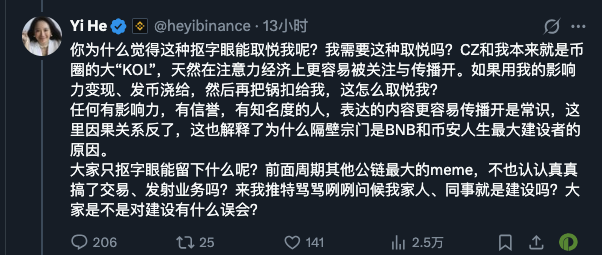
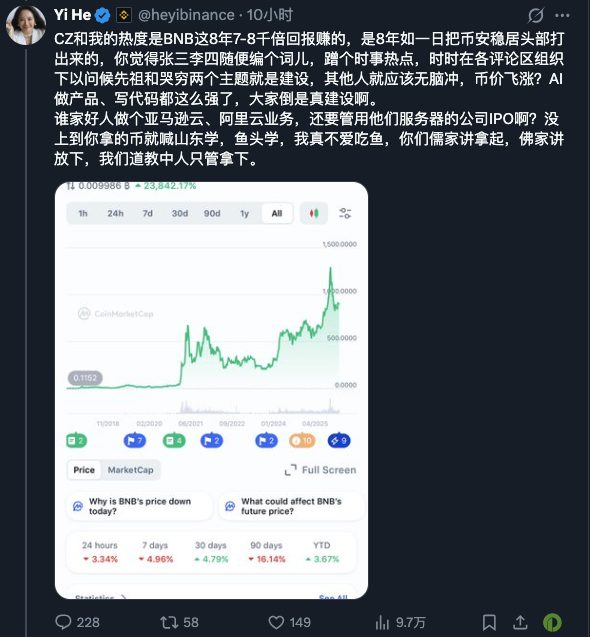
Compared to CZ's euphemism, He Yi's attitude towards the community's "word-picking Memes" is more straightforward. In the early morning of January 21, under a user's post, He Yi not only said that she would severely punish all internal Binance insider trading and bribery, but also "domineeringly" stated that she does not need to rely on Binance Alpha listing Memes that pick words from her tweets to gain pleasure, and also advised the community to focus on real building, not to regard "word-picking and flattery" as real building and be moved by themselves. He Yi also stated that she does not like eating fish, and players should not call it Shandong Study just because Binance Alpha did not list the tokens she supported.
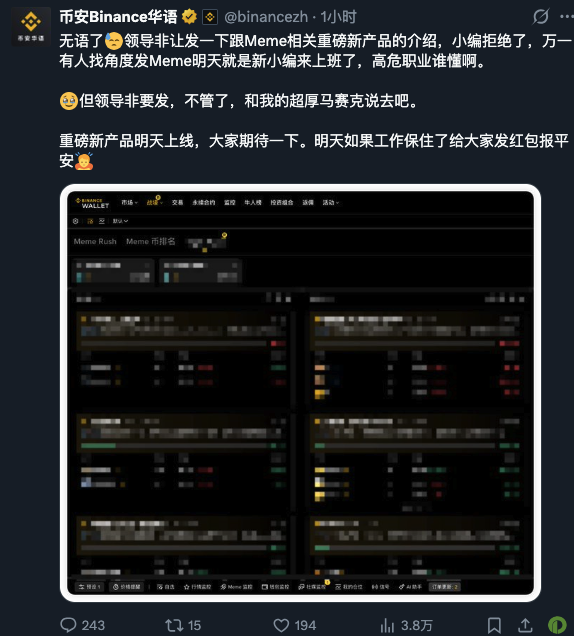
Under the influence of CZ and He Yi's public statements not supporting "word-picking Memes", Binance's official announcements about Memes have also started to become cautious. On January 21, Binance's Chinese account posted that it will launch a new Meme product feature, but to prevent the community from finding angles to issue Meme coins, the editor特意打了超厚马赛克 (specifically applied a very thick mosaic). Although somewhat戏谑 (mockingly), it is enough to see the cautious attitude of the entire Binance team, whether towards Meme coins that pick words from CZ and He Yi's tweets, or those that pick words from Binance's official announcements.
Is BSC Meme Finally Going to Be Different?

Outsiders watch the热闹 (excitement), insiders watch the门道 (tricks). He Yi's remarks not only feel very "alive", but experienced Meme players have realized that the previous BSC Meme model is collapsing from the top down. The successfully outperforming BSC chain memes on the morning of January 21 might be an appetizer. Ironically, memes was also born from the art of "word-picking", but this time it was the White House.

Additionally, after the White House posted, He Yi reposted it (now deleted). This repost, which was unrelated to Binance and He Yi, seemed slightly突兀 (abrupt) in her homepage timeline, and the community was also confused about the reason for He Yi's repost. How much credit He Yi's repost deserves for the BSC's memes, launched 20 minutes later, outperforming Solana's memes is also worth a question mark.

Finally, we might still have to ask that unchanging question, will BSC really be different this time?


Crypto di tendenza

Domande pertinenti

QWhat was the unexpected outcome in the meme coin race between Solana and BSC following the White House's post?

AContrary to the expectation that the Solana version would dominate due to its active ecosystem and the 'first is first' consensus, the BSC version of the 'memes' token surpassed it in market capitalization, reaching a high of $28 million compared to Solana's $3.6 million.

QHow did the founders of Binance, CZ and He Yi, publicly express their stance on 'wordplay Meme' coins?

ACZ stated that while he likes meme coins, he warned that blindly buying coins created from words in his tweets would almost certainly lead to losses and explicitly advised against it. He Yi was more direct, stating she does not need to rely on such coins for pleasure and advised the community to focus on real development instead of 'wordplay and flattery'.

QWhat new cautious behavior did the official Binance account demonstrate regarding meme-related announcements?

AThe official Binance Chinese account posted about launching a new meme product feature but added very thick mosaics to the announcement to prevent the community from finding angles to create new meme coins, showing a cautious attitude towards both coins based on CZ/He Yi's words and those based on official Binance announcements.

QWhat does the article suggest the success of the BSC 'memes' token might indicate about the future of BSC's meme model?

AThe article suggests that the success of the BSC 'memes' token, which was sparked by an external source (the White House) rather than internal figures like CZ or He Yi, might signal a shift away from the top-down 'edict model' and the beginning of a new, more sustainable 'BSC 3.0' for meme coins on the chain.

QWhat metric from GMGN highlighted the difference in user attention between the Solana and BSC versions of the 'memes' token?

AGMGN data showed that the number of simultaneous online users for the Solana version remained below 1,000 three hours after launch, while the BSC version一度接近 (once approached) nearly 3,000, indicating significantly higher market attention on the BSC chain.

Letture associate

Analyzing the Impact of AI on Economic Growth and Productivity

**Title: Analyzing AI's Impact on Economic Growth and Productivity** This article examines three contrasting views on AI's influence on economic growth and productivity. **The Optimistic View** posits that AI, especially through automating R&D ("recursive self-improvement"), could dramatically accelerate growth, even triggering a technological "singularity" with explosive, potentially infinite, economic expansion. **The Moderate/Mainstream View** acknowledges AI's productivity benefits but emphasizes significant real-world constraints that could limit its impact. These include: limited cost savings per task, structural ceilings on which jobs and industries are "exposed" to AI, adoption bottlenecks (e.g., compute, energy, regulatory hurdles), and the "weak link" effect where non-automatable tasks cap overall gains. Consequently, the realized AI dividend may be far lower than optimistic projections, with estimates typically ranging from 0.1% to 1.3% annual productivity growth. **The Pessimistic View** stems from two strands. The first aligns with the moderate view but applies extremely conservative assumptions about task exposure and efficiency gains, yielding minimal projected impact. The second introduces a demand-side critique: if AI primarily replaces rather than augments labor, it could depress labor's share of income, weaken consumer demand, and create a "demand trap" that ultimately stifles growth, unless offset by redistribution policies. **The authors' assessment** is nuanced: * **Short-term (1-2 years):** AI will support growth primarily through investment spending, not significant productivity gains. * **Medium-term (3-5 years):** Three potential paths emerge based on AI demand and bottleneck severity: 1. **"Optimistic Path":** High demand, few bottlenecks. Rapid productivity gains but risk of major job displacement and social conflict without redistribution. 2. **"Moderate Path" (most likely):** High demand but significant, surmountable bottlenecks. Leads to moderate productivity gains, financial market volatility (K-shaped returns), and sectoral job losses. 3. **"Pessimistic Path":** Low demand or severe bottlenecks. Minimal productivity and growth impact, triggering financial market corrections but allowing a smoother societal transition with less labor disruption. * **Long-term:** AI holds potential for a major productivity revolution and prosperity. The conclusion stresses that no path is smooth. Technologically "optimistic" outcomes could be socially detrimental, while "pessimistic" technological diffusion might be more socially stable. Policymakers must monitor developments and prepare balanced responses to manage economic, financial, and social sustainability.

marsbit6 min fa

Analyzing the Impact of AI on Economic Growth and Productivity

marsbit6 min fa

The New Cold War is a Tech Stock War

The New Cold War is a Tech Stock War The article argues that the contemporary geopolitical and economic rivalry between the US and China represents a "New Cold War," but one fundamentally fought through technology and financial markets, not physical barriers or conventional trade. Historically, US dominance was secured through financial systems. The Soviet Union, reliant on the rigid "Transferable Ruble," was ultimately undermined by its dependency on the US dollar for oil trade. Later, Japan's semiconductor challenge was countered not just by tariffs (e.g., Plaza Accord, 301 investigations) but by binding it to US Treasury bonds. China presents a more complex, "embedded" challenger. While it holds vast dollar reserves and US debt like Japan, its industrial base is stronger and more diversified than the Soviet Union's. Surviving the initial 2018 trade war phase, the conflict has evolved into a "tech-financial war." The core battlefield is now the stock market. US tech stocks (AI, semiconductors) are treated as sovereign assets, buoyed by bipartisan national will. China is pushing to strengthen its own financial markets to convert industrial strength into financial power and fund its tech ambitions. Companies like ChangXin (semiconductors), Moonshot AI, and DJI compete not just for market share but as financial proxies for their respective systems. The new paradigm is moving from globally efficient monopolies (Apple, Google) towards companies that achieve monopolistic profits within their respective geopolitical spheres. This competition over "pricing power" and financial valuation in segmented markets defines the current era, making the stock market the primary arena for this tech-centric struggle.

marsbit15 min fa

The New Cold War is a Tech Stock War

marsbit15 min fa

RWA Weekly: Ten European Financial Institutions Establish Tokenized Asset Cooperative; Ondo Launches New Execution Network Ondo Network

RWA Weekly: European Banks Form Tokenized Asset Cooperative; Ondo Launches New Execution Network Ondo Network Covering July 24-31, 2026, the RWA sector saw a steady on-chain total value locked (TVL) of $36.8 billion, with holder count hitting a record high. However, stablecoin transfer volumes fell sharply (~30%), indicating low on-chain settlement demand. Key regulatory moves include South Korea advancing stablecoin legislation and a push to scrap crypto taxes, Kenya lowering capital requirements for stablecoin issuers, and Zimbabwe approving seven projects for its crypto sandbox. In project developments, BIS-led Project Agorá successfully tested cross-border payments with tokenized funds across six currencies. Ten major European financial institutions formed the RL1 blockchain cooperative to build tokenized asset infrastructure. Other notable updates: Aviva launched a tokenized dollar liquidity fund on XRPL, POSCO International tokenized commercial invoices on Injective, and a Brazilian farmer used tokenized cattle as collateral for a loan. Additional progress includes BNY Mellon migrating its core transfer agent operations to blockchain, Securitize gaining SEC investment advisor registration, and Tether’s compliant stablecoin USA₮ launching on Celo. Ondo Finance introduced Ondo Network, a new execution layer focused on speed and privacy, moving away from its initial chain plans. An analysis highlights that despite the growing scale of on-chain RWAs (~$32B), approximately 90% remain underutilized in DeFi, pointing to a critical challenge in unlocking liquidity and fostering real-world application beyond mere issuance.

marsbit16 min fa

RWA Weekly: Ten European Financial Institutions Establish Tokenized Asset Cooperative; Ondo Launches New Execution Network Ondo Network

marsbit16 min fa

South Korean Stock Market Sees Sharp Rebound After Forceful De-leveraging, SK Hynix Rises 30%

On July 31, South Korean stocks staged a historic rebound. The benchmark KOSPI index surged 18.27%, with chipmaker SK Hynix hitting a 30% gain limit. This followed a brutal, near-40% decline in the KOSPI over the previous month, driven largely by a deleveraging spiral involving leveraged ETFs. Analysts attributed the sharp sell-off to structural liquidity issues rather than deteriorating corporate fundamentals. The rally was triggered by a confluence of positive catalysts. Firstly, strong earnings from U.S. cloud giants Microsoft and Amazon alleviated fears of an "AI bubble burst," boosting global tech sentiment. Secondly, SK Group Chairman Chey Tae-won made a rare personal purchase of SK Hynix shares, seen as a strong vote of confidence. Thirdly, the South Korean government announced a 20 trillion won ($139 billion) AI investment fund. In response to the market turmoil, South Korean regulators are tightening controls on leveraged ETFs, admitting oversight shortcomings. Measures include raising minimum cash保证金 requirements for散户 investors and suspending new product launches. While the rebound signals eased liquidity pressure, analysts note deep structural issues remain. The market's future stability is seen as dependent on global tech capital expenditure trends and memory chip price cycles, with some viewing the surge as a technical correction rather than a definitive trend reversal.

marsbit36 min fa

South Korean Stock Market Sees Sharp Rebound After Forceful De-leveraging, SK Hynix Rises 30%

marsbit36 min fa

Trading

Spot

Articoli Popolari

Cosa è MEME 2.0

Memecoin 2.0: L'Ascesa di $MEME 2.0 nel Mondo delle Criptovalute Introduzione Nel panorama in continua evoluzione delle criptovalute, è emerso un nuovo contendente. Memecoin 2.0, simboleggiato come $MEME 2.0, porta il concetto di meme coin a un livello emozionante. Come prodotto derivato dal Memecoin originale, questo progetto ha catturato l'attenzione della comunità crypto spostando il focus da incentivi finanziari tipici a un'esperienza coinvolgente e divertente. Operando sulla blockchain di Ethereum, Memecoin 2.0 ridefinisce audacemente l'impegno della comunità nella sfera crypto. Che cos'è Memecoin 2.0, $MEME 2.0? Alla base, Memecoin 2.0 è un progetto di criptovaluta che dà priorità allo spirito di comunità e al divertimento associato alla cultura meme. A differenza delle criptovalute convenzionali, che si concentrano su casi d'uso pratici e benefici tangibili, Memecoin 2.0 si distingue abbracciando il lato più leggero della moneta digitale. Il progetto esiste senza promesse di utilità, una roadmap strutturata o ritorni finanziari, concentrandosi invece sulla creazione di una comunità vibrante incentrata sui meme e sul divertimento condiviso. Facendo così, attinge alla crescente tendenza della cultura meme nello spazio online, rendendola un giocatore unico nel mondo degli asset digitali. Creatore di Memecoin 2.0, $MEME 2.0 Nonostante ricerche approfondite sulle origini di Memecoin 2.0, l'identità esplicita del suo creatore rimane sconosciuta. Questa anonimità non è rara nella comunità crypto, dove molti progetti sono guidati da individui o gruppi che preferiscono rimanere dietro le quinte. La mancanza di informazioni pubblicamente disponibili sul creatore potrebbe essere vista come una mossa strategica, mettendo in evidenza l'impegno della comunità piuttosto che la notorietà individuale all'interno dello spazio. Investitori di Memecoin 2.0, $MEME 2.0 Le informazioni riguardanti gli investitori o il supporto finanziario per Memecoin 2.0 sono scarse. Questa assenza di dettagli potrebbe suggerire che il progetto sia autofinanziato o che il suo focus sulla comunità piuttosto che sulle strutture d'investimento tradizionali abbia attratto un tipo diverso di sostenitore. Poiché il mondo delle meme coin coinvolge tipicamente un maggior coinvolgimento di base piuttosto che investimenti istituzionali, questo approccio si allinea con l'etica dei progetti guidati dalla comunità. Come funziona Memecoin 2.0, $MEME 2.0? Memecoin 2.0 opera interamente sulla blockchain di Ethereum, capitalizzando le sue robuste caratteristiche di sicurezza e scalabilità. Sfruttando i punti di forza di Ethereum, Memecoin 2.0 può offrire un ambiente sicuro per le interazioni degli utenti garantendo che le transazioni siano sia efficienti che convenienti. Uno degli attributi unici di Memecoin 2.0 risiede nella sua struttura guidata dalla comunità. Il valore e la popolarità del token $MEME 2.0 derivano dalla partecipazione attiva dei suoi utenti, piuttosto che dalla utilità intrinseca. Questo design rinforza il focus del progetto sull'aspetto dell'intrattenimento delle criptovalute, implicando che la risata e l'impegno della comunità siano le vere monete che guidano il suo successo. Inoltre, il progetto si inserisce all'interno dell'ecosistema più ampio delle meme coin, dove il valore di ciascuna meme coin oscilla in base alla cultura, alle tendenze e all'impegno della comunità piuttosto che ai principi economici tradizionali. Cronologia di Memecoin 2.0, $MEME 2.0 Per comprendere meglio l'evoluzione e le pietre miliari di Memecoin 2.0, ecco una cronologia che evidenzia eventi significativi nella sua storia: 2024: L'inizio di Memecoin 2.0 è riconosciuto come un ramo del Memecoin originale, affermandosi all'interno del contesto fiorente delle meme coin mentre opera sulla blockchain di Ethereum. 13 luglio 2024: Memecoin 2.0 si posiziona ufficialmente come una meme coin incentrata sulla comunità sulla rete Ethereum, enfatizzando il suo approccio centrato sull'intrattenimento che invita gli utenti a impegnarsi e partecipare alla sua crescita. Punti Chiave su Memecoin 2.0, $MEME 2.0 Diverse caratteristiche critiche definiscono Memecoin 2.0: Approccio Centrico alla Comunità: La missione principale di Memecoin 2.0 è creare un'esperienza comunitaria divertente e coinvolgente, capitalizzando il piacere collettivo derivante dalla cultura memetica. Costruita su Ethereum: Operare sulla blockchain di Ethereum fornisce al progetto un'infrastruttura essenziale che garantisce sicurezza e scalabilità. Mancanza di Utilità o Roadmap: In una marcata deviazione dalle criptovalute tradizionali, Memecoin 2.0 non promette alcuna caratteristica utilitaria o ritorni finanziari, riaffermando il suo impegno per il coinvolgimento della comunità e l'impegno sociale. Focus sulla Cultura Memetica: Abbracciando gli aspetti umoristici e culturali del fenomeno meme, Memecoin 2.0 offre una piattaforma per gli utenti per interagire con la crypto offline e online. Ulteriore Contesto: L'Importanza delle Meme Coin Le meme coin sono emerse come una classe distinta di criptovaluta, spesso guidata dall'umorismo e da un approccio spensierato al trading. Queste monete generalmente mancano di significative utilità o roadmap di sviluppo, attirando gli utenti con la promessa di divertimento, interazione comunitaria e rilevanza culturale. Nel panorama del più ampio ecosistema crypto, le meme coin rianimano l'importanza dell'impegno della comunità, opponendosi ad approcci esclusivamente orientati al profitto. Progetti come Memecoin 2.0 danno il via a un'era in cui l'intrattenimento può armonizzarsi con le aspirazioni finanziarie, trasformando la blockchain in un parco giochi per la creatività e l'interazione sociale. Conclusione Memecoin 2.0, o $MEME 2.0, incarna una nuova ondata di criptovaluta che dà priorità all'impegno della comunità rispetto a rigidi strutture finanziarie. Con un focus sull'umorismo e l'interazione sociale, capitalizza sulla fascinazione circondante la cultura meme. Operando sulla blockchain di Ethereum, Memecoin 2.0 sfrutta le capacità della tecnologia mantenendo fermo il suo impegno per il valore ricreativo della valuta digitale. Mentre lo spazio delle criptovalute continua a evolversi, Memecoin 2.0 serve come testimonianza della nozione che il futuro degli asset digitali potrebbe ben dipendere da esperienze condivise, risate e solidi legami comunitari. Nel mondo imprevedibile delle crypto, forse la gioia può essere altrettanto preziosa quanto il guadagno finanziario tradizionale.

146 Totale visualizzazioniPubblicato il 2024.04.04Aggiornato il 2024.12.03

Cosa è MEME 2.0

Come comprare MEME

Benvenuto in HTX.com! Abbiamo reso l'acquisto di Memeland (MEME) semplice e conveniente. Segui la nostra guida passo passo per intraprendere il tuo viaggio nel mondo delle criptovalute.Step 1: Crea il tuo Account HTXUsa la tua email o numero di telefono per registrarti il tuo account gratuito su HTX. Vivi un'esperienza facile e sblocca tutte le funzionalità,Crea il mio accountStep 2: Vai in Acquista crypto e seleziona il tuo metodo di pagamentoCarta di credito/debito: utilizza la tua Visa o Mastercard per acquistare immediatamente MemelandMEME.Bilancio: Usa i fondi dal bilancio del tuo account HTX per fare trading senza problemi.Terze parti: abbiamo aggiunto metodi di pagamento molto utilizzati come Google Pay e Apple Pay per maggiore comodità.P2P: Fai trading direttamente con altri utenti HTX.Over-the-Counter (OTC): Offriamo servizi su misura e tassi di cambio competitivi per i trader.Step 3: Conserva Memeland (MEME)Dopo aver acquistato Memeland (MEME), conserva nel tuo account HTX. In alternativa, puoi inviare tramite trasferimento blockchain o scambiare per altre criptovalute.Step 4: Scambia Memeland (MEME)Scambia facilmente Memeland (MEME) nel mercato spot di HTX. Accedi al tuo account, seleziona la tua coppia di trading, esegui le tue operazioni e monitora in tempo reale. Offriamo un'esperienza user-friendly sia per chi ha appena iniziato che per i trader più esperti.

335 Totale visualizzazioniPubblicato il 2024.12.12Aggiornato il 2026.06.02

Come comprare MEME

Discussioni

Benvenuto nella Community HTX. Qui puoi rimanere informato sugli ultimi sviluppi della piattaforma e accedere ad approfondimenti esperti sul mercato. Le opinioni degli utenti sul prezzo di MEME MEME sono presentate come di seguito.

活动图片