When Tokens Cost More Than People, 'AI Narrative' Runs Into Trouble

marsbitPubblicato 2026-05-29Pubblicato ultima volta 2026-05-29

Introduzione

Title: When Tokens Cost More Than People, the "AI Narrative" Hits Trouble The economic sustainability of corporate AI adoption is under scrutiny as token consumption soars while measurable business value remains elusive. Major companies like Uber and Microsoft report struggling to justify rising AI costs, with executives coining terms like "tokenmaxxing" to describe wasteful usage. Data reveals a stark picture: for every dollar spent on AI tokens, only 18 cents translates to user-facing value, with the rest consumed by bug fixes, rework, and friction. The debate splits into bullish and bearish camps. Bulls, like Goldman Sachs analysts, see current inefficiencies as growing pains, predicting a 24-fold increase in token demand by 2030 and a shift towards healthier metrics like "cost per effective action." They point to indicators of real productivity gains and argue current tech valuations are not in bubble territory. Bears, however, highlight an unsustainable model where value is heavily concentrated in semiconductor companies like Nvidia, funded by cloud giants taking on massive debt. Studies show 95% of firms investing in generative AI see zero return. A deeper concern is the circular financial structure between cloud providers (hyperscalers) and AI labs like OpenAI and Anthropic. Billions in cloud service commitments are tied to these labs, which are partly funded by the hyperscalers' own investment. This creates a loop where cloud revenue depends on labs securing contin...

Author: Bao Yilong

Source: Wall Street News

The justification for corporate AI spending is facing a severe test, as Token consumption continues to climb, yet quantifiable commercial value remains elusive.

On May 22, Uber's Chief Operating Officer Andrew Macdonald, whose company is valued at over $200 billion, stated publicly on a podcast that the link between the growth in token consumption and substantial product improvement "doesn't exist yet."

Macdonald pointed out that companies are finding it increasingly difficult to rationalize the continuously rising AI expenditures. He even coined a term for the wasteful phenomenon within engineering teams: "tokenmaxxing."

Earlier in mid-May, Microsoft began cutting internal Claude Code licenses, citing token bills as "unsustainable."
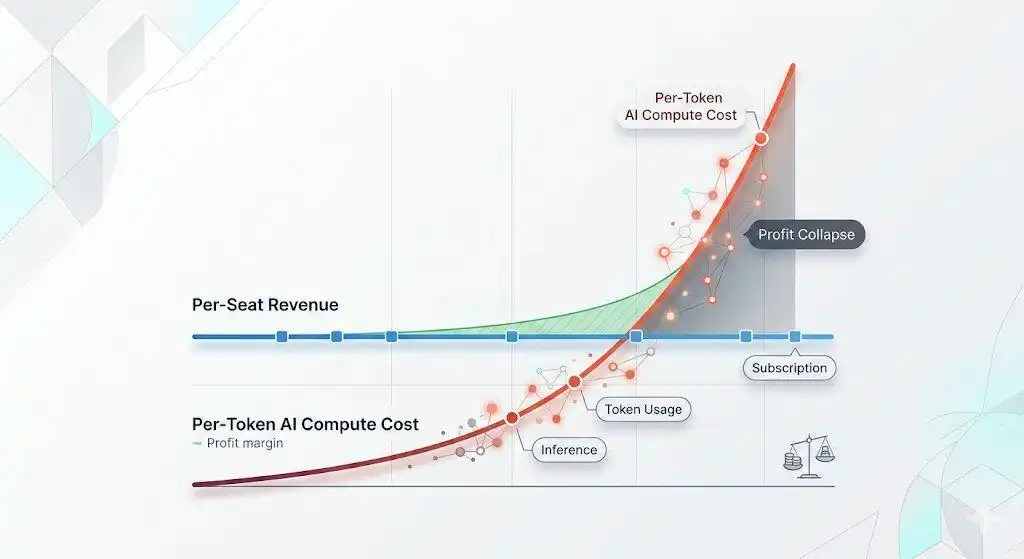
The combination of these two events forces the market to confront a previously overlooked variable. Token economics, specifically the unit economics of token consumption at enterprise scale, has evolved from a peripheral issue to the central load-bearing pillar of the entire AI investment thesis.

Five Data Points, Painting a New Picture

Since April, multiple data points have emerged successively, collectively sketching an alarming picture.

In April this year, Uber's Chief Technology Officer publicly stated that the company had burned through its annual Claude Code budget in just four months.

Among 5,000 engineers, monthly usage rates ranged from 84% to 95%, with individual monthly bills varying from $150 to $2,000. The CTO himself reportedly consumed $1,200 worth of tokens during a two-hour internal demonstration.

Macdonald described being "speechless" upon hearing this number.

Regarding Microsoft, according to a report in The Verge's Tom Warren's Notepad newsletter, Claude Code quickly became popular among Microsoft's internal engineering teams. However, the token-based billing model made scaled spending unsustainable, prompting Microsoft to proceed with cutting related licenses.

GitHub announced that starting June 1, all Copilot plans would shift from a fixed subscription model to usage-based billing.

The official discussion thread garnered nearly 900 downvotes, as users calculated that a single AI programming session typically consumes $30 to $40, meaning a $10 monthly subscription could be exhausted in a single use.

Developer productivity platform Entelligence.AI aggregated data from 2,444 companies and found:

  • For every $1 spent on AI token costs, only 18 cents generated actual value reaching users.
  • 44 cents were used to fix bugs introduced by the AI itself; 27 cents went to rework; 11 cents were consumed by review friction.

According to Bloomberg's Silicon Data LLM Token Expenditure Index, token prices have risen about 65% since the end of February this year, and US AI software prices have increased by 20% to 37% cumulatively over the past year.

Bull vs. Bear Debate: One Fact, Two Interpretations

The same data points to starkly different conclusions under different analytical frameworks.

The bullish view argues that the current chaos is merely the growing pains of a successful transformation.

According to Goldman Sachs' Jim Schneider in early May, by 2030, agentic AI will drive a 24-fold increase in token consumption, reaching approximately 120 sextillion tokens per month. The gross margins of hyperscale cloud providers and model vendors will turn positive within the next 3 to 12 months.

Goldman's Rich Privorotsky believes that Q1 2026 might have been the peak for "token maximization" as a KPI. The industry is shifting from pursuing consumption volume to the healthier metric of "cost per effective action."

JP Morgan's economic research also found a jump in new and updated Python packages on PyPI in early 2026, a trend not seen when ChatGPT launched in 2022, indicating that real productivity gains are occurring.

Furthermore, the Magnificent 7 currently trades at about 20 times forward earnings, far below the 52 times at the peak of the 2000 tech bubble, 67 times for Japan in 1989, and 34 times during the "Nifty Fifty" era. By historical bubble standards, this does not constitute a bubble.

The bearish view was most systematically articulated by Goldman Sachs semiconductor analyst Jim Covello in an April report.

He pointed out that almost all value in the AI supply chain flows to semiconductor companies, a phenomenon unprecedented and unsustainable in history. Chip companies should benefit when their customers benefit, but in this cycle, their prosperity comes at the expense of consumption across the entire upstream industry chain.

Nvidia's net profit has grown about 20-fold since ChatGPT's launch; major hyperscale cloud providers have burned through their operating cash flow and are turning to debt—data center-related debt issuance in 2025 was approximately $182 billion, doubling from 2024.

MIT Nanda research shows 95% of enterprises investing in generative AI see zero return. This decoupling may persist for a while, but cannot last forever.

Concerns of the Circular Financing Structure

This discussion touches on a more complex level: the financial loop between hyperscale cloud providers and AI labs.

According to corporate disclosure documents compiled by The Information, OpenAI and Anthropic account for more than half of the approximately $2 trillion in future cloud service commitments from Microsoft, Oracle, Google, and Amazon. Specifically:

  • Of Microsoft's $627 billion cloud service backlog, $280 billion is tied to OpenAI;
  • Of Oracle's $553 billion pipeline business, 54% (approx. $300 billion) is committed by OpenAI;
  • Of Google's $467.6 billion, Anthropic accounts for 43% (approx. $200 billion);
  • Amazon's corresponding exposure also reaches 51% of its $464 billion backlog.
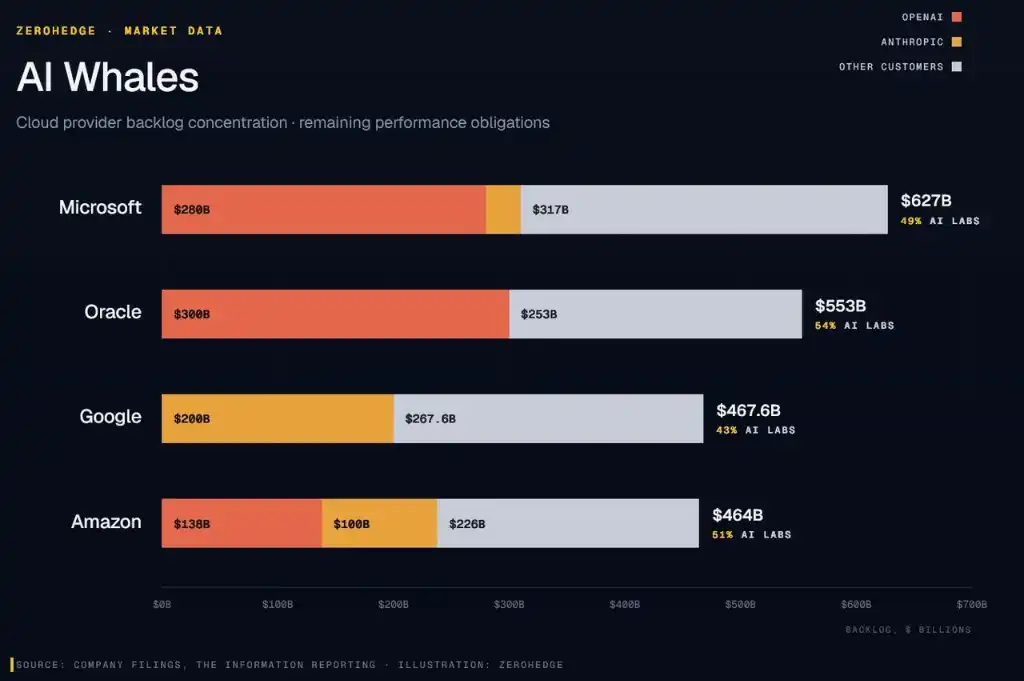
This financing structure is inherently circular. Microsoft's $13 billion investment in OpenAI was largely delivered in the form of Azure credits, which OpenAI used to purchase Azure compute. Microsoft then booked this as cloud revenue.

The same hyperscale cloud providers are both equity investors in the AI labs and service providers collecting compute bills.

This structure is also reflected in profit data. Alphabet reported a record Q1 profit of $62.6 billion, of which about $28.7 billion, nearly half, came from the paper appreciation of its Anthropic stake.

Amazon's Q1 profit of $30.3 billion included $16.8 billion in pre-tax unrealized gains from Anthropic, while its free cash flow plummeted 95% to $1.2 billion due to data center capital expenditures of $44.2 billion in the same period.
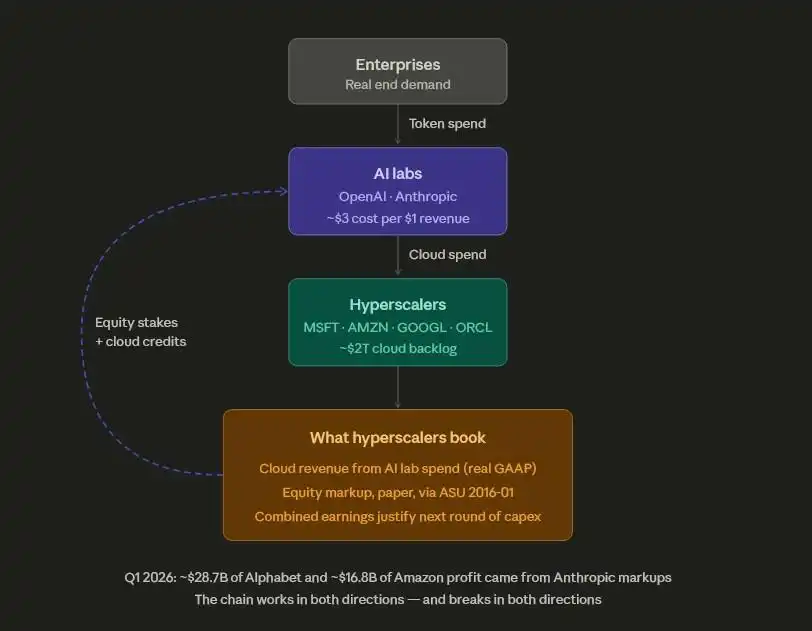
The sustainability of this system depends on AI labs' continued ability to secure external financing to fulfill cloud computing commitments, which in turn relies on enterprise customers' continued willingness to pay rising token bills.

It is reported that Anthropic currently incurs costs of $3 for every $1 of revenue. Once the pace of financing slows, the credibility of cloud revenue projections will decline, and the valuation multiples of hyperscale cloud vendors will also face re-evaluation pressure.

This chain transmits in both directions and will break in both directions.

This Isn't 1999, But the Problem is Real

The current situation does not constitute a typical bubble setup.

From a valuation multiple perspective, the Tech 7 currently trades at about 20 times forward price-to-earnings, far below the 52 times at the peak of the 2000 tech bubble, 67 times for the Japanese market in 1989, or the 34 times during the "Nifty Fifty" era.

AI technology itself is real. For heavy user groups, data on productivity gains is verifiable. OpenAI has an annualized revenue of about $20 billion, Anthropic about $4.3 billion; these two labs are not going to disappear.

Today, token cost (compute expense) has become the key determinant of AI success or failure. Six months ago, people weren't even discussing this topic.

Back then, people only cared about "whether the technology works." Now the answer is clear: in the eyes of specific jobs and specific people, the technology indeed works.

But a new question arises: Can the money saved by downstream companies using AI be transmitted upward in time to outrun the valuation window the capital market has left for AI labs and cloud giants?

Those bullish on AI believe that as long as the technology continues to mature, corporate ROI (Return on Investment) will turn positive within 1 to 1.5 years.

The bearish believe more executives will follow Macdonald's lead, publicly complaining about low AI ROI and starting to cut budgets.

Both scenarios are playing out; the outcome is undecided. The only certainty is that the old lie—"as long as token consumption is rising, it means the AI transformation is successful"—has been shattered.

High token consumption does not equal commercial value; this bubble must eventually be squeezed out. The bill for AI has come due, but who will ultimately pay for it? That remains an unknown for now.


Crypto di tendenza

Domande pertinenti

QAccording to the article, what is the major problem that enterprise AI spending is currently facing?

AThe major problem is that token consumption is rapidly increasing, but quantifiable business value is hard to find. The article states that 'the line between the growth of token consumption and substantive product improvement... does not yet exist.' Executives are finding it difficult to justify the escalating costs.

QWhat key finding did the developer platform Entelligence.AI discover regarding the value generated from AI token spending?

AEntelligence.AI found that for every dollar spent on AI token fees, only 18 cents generated tangible value that reached end-users. The rest was consumed by other costs: 44 cents for fixing AI-introduced bugs, 27 cents for rework, and 11 cents for review friction.

QWhat is the critical concern regarding the financial structure between hyperscale cloud providers and AI labs, as described in the article?

AThe concern is a potentially unsustainable, cyclical financing structure. Hyperscale cloud providers (like Microsoft, Amazon) are both equity investors in and service providers for AI labs (like OpenAI, Anthropic). The labs use cloud credits from the investments to purchase cloud compute, which the providers book as revenue. This structure depends on continuous external funding for the labs, which itself relies on enterprise clients' willingness to pay rising token bills.

QBased on the bull argument presented, what metric is the AI industry supposedly shifting towards from 'tokenmaxxing'?

AAccording to the bull argument, the industry is shifting from focusing on 'tokenmaxxing' (maximizing token consumption as a KPI) towards a healthier metric: the 'cost per effective action' or the return on investment (ROI) of AI deployments.

QWhat does the article conclude is the 'new question' now that the technical capability of AI is proven for specific tasks?

AThe new question is: 'Can the money saved by downstream companies using AI be transmitted upwards quickly enough to outpace the valuation window that capital markets have left for AI labs and cloud giants?' In other words, can the business value and cost savings materialize fast enough to justify the high costs and valuations before investor patience runs out?

Letture associate

Annual Salary of Millions Competing for Electricians, Meta Rushes to Open Its Own Technical School

The AI boom is facing an unexpected bottleneck: a severe shortage of skilled construction workers and electricians. As tech giants like Meta, OpenAI, and Alphabet race to build massive data centers—such as OpenAI's $16 billion "Stargate" project—they are hitting a critical labor wall. The U.S. needs an estimated 130,000 more electricians, 240,000 construction workers, and 150,000 supervisors by 2030 for AI infrastructure alone, but tens of thousands of electrician jobs go unfilled each year. While AI companies offer high premiums, with electricians earning up to $280,000 annually, worker scarcity still causes massive losses—delays on a single project can cost $14.2 million per month. The complexity of building AI data centers, which require immense power (equivalent to powering hundreds of thousands of homes), sophisticated electrical systems, and advanced liquid cooling solutions, demands highly skilled technicians who are in short supply. To combat this, companies are investing heavily in training. Meta has committed $115 million to a free training school offering tuition, housing, and stipends, targeting 5,000 new workers. OpenAI is partnering with unions to secure skilled labor. These efforts are paying off, with a significant rise in Gen Z interest in trade schools over college. However, the power demands are staggering. AI data centers are driving a rapid surge in electricity consumption, projected to account for up to 12% of U.S. power use by 2028 and raising costs for consumers. Furthermore, the construction boom is project-based, leading to a potential future glut of trained workers once building peaks, which could depress wages industry-wide. The race for AI supremacy now depends as much on skilled hands as on advanced chips.

marsbit28 min fa

Annual Salary of Millions Competing for Electricians, Meta Rushes to Open Its Own Technical School

marsbit28 min fa

OpenAI No Longer Sells Its Most Expensive Model for Profit

OpenAI is shifting its business strategy away from promoting its most expensive, flagship models for every task. Recent price cuts—80% for GPT-5.6 Luna and 20% for Terra—signal a deeper change: the company now actively advises users that many tasks don't require the most powerful model. Instead, OpenAI recommends a tiered approach: use the high-end GPT-5.6 Sol for complex planning and analysis, then delegate execution to cheaper models like Luna. This mirrors moves by Anthropic, which recently launched Claude Opus 5 at half the price of its top model, Fable 5. Both companies are de-emphasizing flagship models as primary revenue drivers, using them instead for brand prestige and technological showcases. The industry is entering a "mass-market" phase, similar to automotive, where high-volume, cost-effective models handle daily operations and drive scale. OpenAI's price reductions are partly enabled by AI models themselves optimizing underlying code and infrastructure, creating a self-reinforcing cycle of efficiency gains and cost reduction. Competition is shifting from "who is smartest" to "who offers the best value." The goal is no longer selling individual models but fostering widespread API adoption and ecosystem lock-in. By making AI calls cheap and ubiquitous, companies like OpenAI aim to become the indispensable, utility-like infrastructure powering automated workflows—the "water and electricity" of software, quietly embedded everywhere.

marsbit28 min fa

OpenAI No Longer Sells Its Most Expensive Model for Profit

marsbit28 min fa

Will the Fed Definitely Raise Interest Rates in September? How Will Crypto and U.S. Stocks Withstand the Pressure?

The market's expectation for a September Fed rate hike surged dramatically in early August, jumping from under 50% to over 80% within a week. This shift followed a contentious July FOMC meeting, where a 9-3 vote to hold rates revealed growing dissent from hawkish members advocating for an immediate hike to combat persistent inflation. The primary catalyst for this repricing is rising oil prices, driven by renewed geopolitical tensions around the Strait of Hormuz, which threaten global supply. Energy costs directly influence inflation metrics, making the upcoming July CPI report (due August 12th) a critical data point. If it shows inflation reaccelerating, the probability of a September hike will solidify. For Bitcoin and crypto assets, this is typically bearish news. Bitcoin continues to behave as a high-beta, liquidity-sensitive risk asset. A rate hike raises the opportunity cost of holding non-yielding assets and could drive capital toward money markets, pressuring crypto prices in the short term. However, historical patterns suggest that if a hike is perceived as the end of a tightening cycle rather than the start, any negative price impact may be brief. U.S. stocks, particularly crypto-linked equities like Coinbase and growth-oriented tech stocks, are also vulnerable. Higher rates increase discount rates in valuation models, putting pressure on high-multiple companies. This coincides with a pivotal tech earnings season where investor focus has shifted from massive AI capital expenditure to tangible revenue and cash flow generation. Companies with negative cash flow and weak growth narratives could face heightened volatility if borrowing costs rise in September. In summary, a September Fed hike has evolved into a mainstream market scenario. Key factors to watch are oil prices, the July CPI report, and Fed communications, which will determine the final decision and its impact on volatile crypto and equity markets.

marsbit39 min fa

Will the Fed Definitely Raise Interest Rates in September? How Will Crypto and U.S. Stocks Withstand the Pressure?

marsbit39 min fa

Trading

Spot

Articoli Popolari

Come comprare PEOPLE

Benvenuto in HTX.com! Abbiamo reso l'acquisto di ConstitutionDAO (PEOPLE) semplice e conveniente. Segui la nostra guida passo passo per intraprendere il tuo viaggio nel mondo delle criptovalute.Step 1: Crea il tuo Account HTXUsa la tua email o numero di telefono per registrarti il tuo account gratuito su HTX. Vivi un'esperienza facile e sblocca tutte le funzionalità,Crea il mio accountStep 2: Vai in Acquista crypto e seleziona il tuo metodo di pagamentoCarta di credito/debito: utilizza la tua Visa o Mastercard per acquistare immediatamente ConstitutionDAOPEOPLE.Bilancio: Usa i fondi dal bilancio del tuo account HTX per fare trading senza problemi.Terze parti: abbiamo aggiunto metodi di pagamento molto utilizzati come Google Pay e Apple Pay per maggiore comodità.P2P: Fai trading direttamente con altri utenti HTX.Over-the-Counter (OTC): Offriamo servizi su misura e tassi di cambio competitivi per i trader.Step 3: Conserva ConstitutionDAO (PEOPLE)Dopo aver acquistato ConstitutionDAO (PEOPLE), conserva nel tuo account HTX. In alternativa, puoi inviare tramite trasferimento blockchain o scambiare per altre criptovalute.Step 4: Scambia ConstitutionDAO (PEOPLE)Scambia facilmente ConstitutionDAO (PEOPLE) nel mercato spot di HTX. Accedi al tuo account, seleziona la tua coppia di trading, esegui le tue operazioni e monitora in tempo reale. Offriamo un'esperienza user-friendly sia per chi ha appena iniziato che per i trader più esperti.

577 Totale visualizzazioniPubblicato il 2024.12.12Aggiornato il 2026.06.02

Come comprare PEOPLE

Discussioni

Benvenuto nella Community HTX. Qui puoi rimanere informato sugli ultimi sviluppi della piattaforma e accedere ad approfondimenti esperti sul mercato. Le opinioni degli utenti sul prezzo di PEOPLE PEOPLE sono presentate come di seguito.

活动图片












