When Even the Shovel Sellers Borrow to Buy Shovels: The US Stock AI Sector Evaporates Trillions in a Week, as the Market Begins Pricing AI's 'Bill'

marsbitPubblicato 2026-06-11Pubblicato ultima volta 2026-06-11

Introduzione

Last week saw a sharp sell-off in the US AI sector, erasing trillions in market value despite companies reporting record financials. Key events included Alphabet's massive equity raise despite having over $1.2 trillion in cash, Broadcom's stock plummeting after its quarterly report, a 4% Nasdaq drop, and Oracle's stock falling even after posting record revenue and backlog. The market's focus shifted from stellar income statements to cash flow and balance sheets, questioning the massive and increasingly leveraged capital expenditures required to fund the AI infrastructure race. Analysts point out that while growth is strong, profitability and the visibility of AI monetization are now under scrutiny. The financing chain stretches from cash-rich giants like Alphabet raising debt and equity, to chipmakers like Broadcom facing margin pressure, to cloud providers like Oracle with negative free cash flow funding via debt, and finally to unprofitable AI labs like OpenAI and Anthropic—who are the ultimate customers for much of this infrastructure. The market is beginning to price the risk of this concentrated, leveraged bill coming due, with the upcoming SpaceX IPO serving as the next test for this financing ecosystem.

Author: Ada, Deep Tide TechFlow

Over the past week, the US stock AI sector presented a strange picture, with records being broken one after another and stocks being sold off one after another.

On June 1, Alphabet, sitting on hundreds of billions in cash, announced one of the largest equity financings in history; On June 3 after market close, Broadcom delivered its best-ever quarterly report, only for its stock to crash the next day; On June 5, the Nasdaq plunged 4% in a single day, with the semiconductor sector shedding roughly $1 trillion in market value in one session; On June 10 after market close, Oracle reported record revenue and backlog, yet its stock still fell; On June 11, the pricing moment arrived for what is set to be the largest SpaceX IPO in history. The financial numbers themselves are not the issue; the problem is the way these numbers are being achieved: more and more money is being borrowed into this AI infrastructure race through increasingly complex means. When the market began tallying up this bill, even record-breaking numbers couldn't save stock prices.

The Same Script: Record First, Then Get Sold Off

Broadcom went first. According to its earnings report and multiple media outlets, for its fiscal Q2 ended May 3, Broadcom's revenue reached $22.219 billion, up 48% year-over-year; AI chip revenue was $10.8 billion, surging 143% year-over-year; and earnings per share exceeded Wall Street expectations. But the market focused solely on one gap: the company's AI chip revenue guidance for the next quarter is $16 billion, below analyst expectations, and CEO Hock Tan did not raise the full-year AI revenue target, mentioning that Google might diversify its chip supply chain. Nonetheless, Broadcom's stock plummeted about 15% the next day, erasing nearly $280 billion in market value in a single day, making it one of the largest single-day market cap losses in Wall Street history.

Oracle's turn came a week later. According to its earnings report and CNBC, for its fiscal Q4 ended May 31, Oracle's revenue was $19.2 billion, up 21% year-over-year; cloud infrastructure revenue was $5.8 billion, up 93% year-over-year; adjusted EPS was $2.11, beating analyst expectations of $1.95. The backlog was even more staggering: Remaining Performance Obligations (RPO) reached $638 billion, skyrocketing 363% year-over-year, far exceeding analyst expectations of $595.7 billion. Yet the stock also didn't find favor, dropping about 9% in after-hours trading.

Sandwiched between these two earnings reports was a broad sell-off on June 5. According to TheStreet and CNBC, the Nasdaq Composite Index fell 4% that day, its worst single-day performance since the April 2025 tariff turmoil, triggered by Broadcom's cautious AI chip outlook, with AMD and Intel leading the decline across the entire semiconductor sector.

It is worth noting that the June 5 plunge wasn't solely about "AI skepticism." That day, US non-farm payrolls added 172,000 jobs, far exceeding expectations, pushing up rate hike expectations and triggering a rotation from high-valuation growth stocks into defensive sectors like healthcare and consumer staples. AI stocks, having the highest valuations, fell the hardest. In other words, macroeconomic interest rates and sector rotation were one driver, while concerns over AI capital expenditures were another. The two factors compounded, rather than having a single cause.

What's Being Sold Off Isn't the Income Statement, It's the Cash Flow Statement

Putting these three market segments together reveals a commonality: the income statement is still recording "record-breaking" numbers, but the market has already switched to reading the cash flow statement and the balance sheet. The pricing focus has shifted from "how much was earned" to "how much more will be burned and borrowed to earn this."

Oracle is the most straightforward case study. According to its earnings report, for the full FY2026, operating cash flow reached a record $32 billion, up 54% year-over-year, but free cash flow was negative $23.7 billion. For the year, the company has already raised $43 billion in debt and $5 billion in equity. What truly broke investor sentiment was its forward-looking language. According to CNBC, Oracle plans to raise approximately $40 billion more in FY2027 through a combination of debt and equity. A company that just raised nearly $50 billion, with negative free cash flow, and now forecasts another $40 billion financing round—when this appears alongside "record-breaking" numbers, the market chose to price the former.

Broadcom's logic is similar, but manifests elsewhere. According to Barron's, Broadcom lowered its Q3 gross margin guidance from 77% to 74%, attributing it to a higher revenue mix from lower-margin AI chips. Coupled with a retreat from "selling complete systems" to "selling only chips," and customers demanding chip leases to pass on financing pressure, the market sees a business with explosive growth, but deteriorating margins and capital intensity.

Goldman Sachs provided a framework for this shift. According to its research report, investors' tolerance for capital expenditure growth depends on earnings strength and the visibility of AI monetization; the same report noted that Alphabet's stock rose due to raising its profit guidance, while Meta's fell due to flat guidance. The market is no longer indiscriminately rewarding "growth," but differentiating winners from losers based on "the ability to monetize."

The Financing Chain Takes Center Stage: Even the Most Cash-Rich Players Are Borrowing

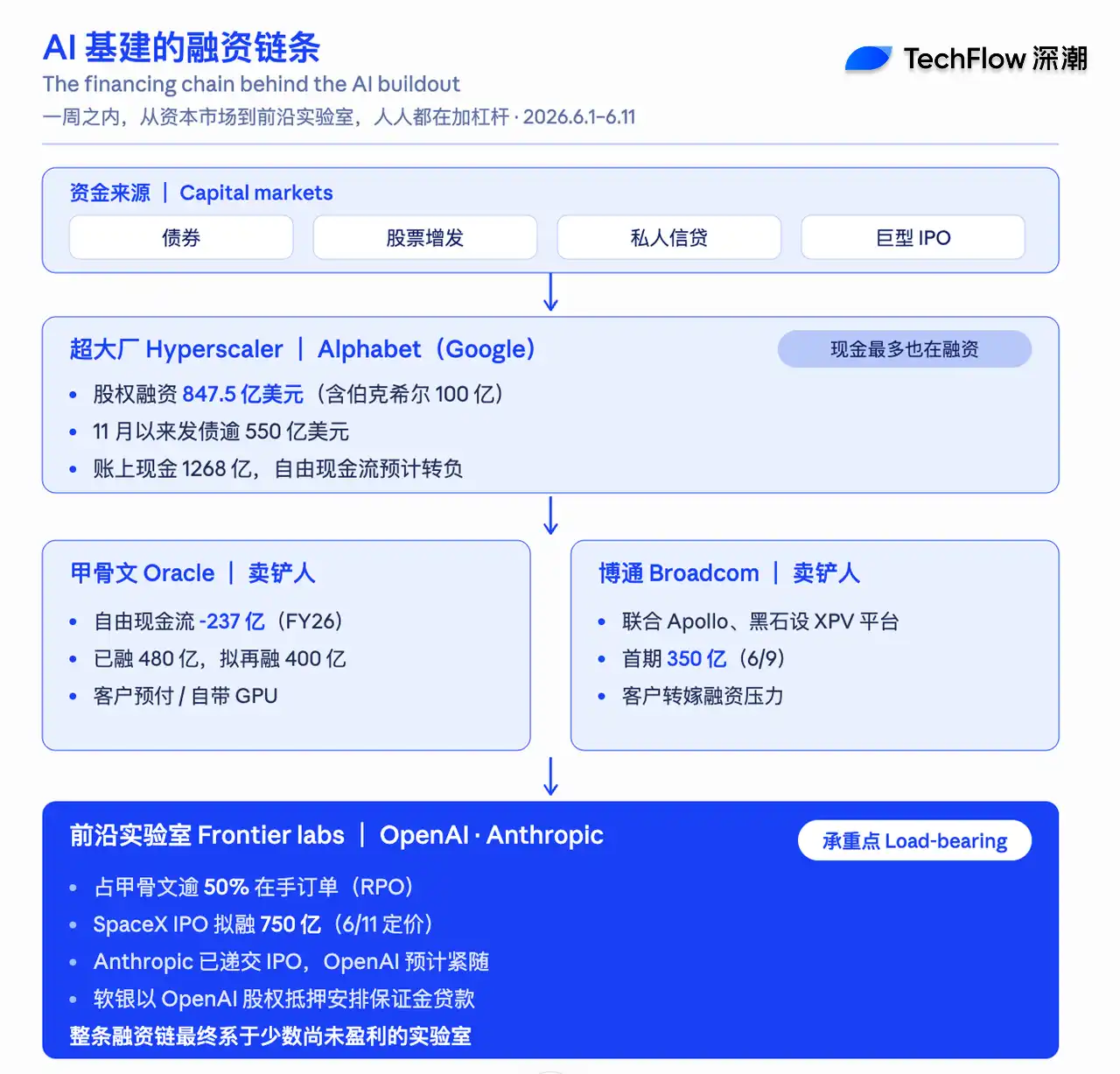
If the income statement is the surface, the financing chain is the true protagonist of this past week. From the very upstream to the very downstream, almost every link is paying for this same AI infrastructure build-out by leveraging up or diluting equity.

The most convincing case study is Alphabet. According to its SEC filing, on June 1, it announced an $80 billion equity financing; on June 2, it upsized and priced the deal at $84.75 billion, including a $10 billion private investment from Berkshire Hathaway. The anomaly is that this company is not short on cash at all. According to multiple media reports, Alphabet had $126.8 billion in cash as of March 2026, annual operating cash flow of $174 billion, and has issued over $55 billion in new debt since November. Despite this, Melius Research estimates Google's free cash flow will turn negative in the coming years. Investor Dan Niles' commentary on this is that capital is not infinite, and the fact that Google, with "the strongest technology stack in all of AI," still needs to raise massive amounts of financing precisely illustrates the intensity of this round of investment.

Looking downstream, every link on the chain is doing the same. New cloud vendor Oracle has negative free cash flow, relies on dual-track debt and equity financing, and asks customers to prepay for GPU costs or bring their own GPUs to reduce its own construction capital outlay; the chip "shovel sellers" like Broadcom, on June 9, partnered with Apollo and Blackstone to establish the AI XPV Platform, with an initial $35 billion targeting over 20 gigawatts of computing power by 2028, serving frontier labs including Anthropic and OpenAI. And at the very end of the chain, the labs are simultaneously employing even more aggressive tools: there were previous reports of SoftBank arranging margin loans secured by OpenAI equity; now SpaceX is rushing towards a Nasdaq IPO targeting $75 billion, Anthropic has confidentially filed for an IPO, and OpenAI is expected to follow closely.

The total scale of this investment is also rapidly inflating. According to CreditSights, the combined capital expenditure for mega-cap companies in 2026 is estimated at around $750 billion, up about 67% from 2025; Goldman Sachs' alternative metric puts the 2026 capex forecast for mega-caps at $518 billion, revised up from $314 billion at the start of the year. Whichever metric is used, the direction is consistent: expenditures are accelerating, the portion that can be covered by operating cash flow is shrinking, and the gap needs to be filled by capital markets.
The Chain's Pressure Point Rests on a Few Unprofitable Labs

Leverage itself isn't terrifying; what's terrifying is who the leverage ultimately rests upon. Pulling this financing chain to its end reveals that its pressure point is highly concentrated.

Oracle's $638 billion backlog seems impregnable, but according to Bank of America, over 50% comes from OpenAI alone; simultaneously, Oracle also disclosed that most of the RPO growth in the past two quarters came from large AI contracts, with customers either prepaying GPU costs or procuring GPUs themselves before handing them to Oracle. Broadcom's six major custom chip customers are similarly concentrated among a handful like Google, Meta, Anthropic, and OpenAI. In other words, from the financing of the mega-caps, to the orders of the "shovel sellers," to the injection of private credit and insurance funds, the ultimate payer for the entire chain converges onto a small group of unprofitable frontier labs like OpenAI and Anthropic, who are themselves queuing up for funding.

The record-breaking revenue is real, and the $638 billion backlog is real; but the buyers of these orders are highly concentrated, are themselves sustained by financing, and the leverage of the entire chain is being re-examined by the market. This past week, the market did not deny AI's growth; it simply started demanding to see clearly who will pay the bill for this growth, and how. SpaceX is set to price after market close on June 11 and list on the Nasdaq at $135 per share, with a valuation of approximately $1.77 trillion on June 12. Whether this largest-ever IPO can be digested smoothly will be the next stress test for this financing chain.


Crypto di tendenza

Domande pertinenti

QWhat were the main reasons behind the significant sell-off in the AI sector of the U.S. stock market over the past week?

AThe sell-off was driven by a combination of macroeconomic factors and sector-specific concerns. The stronger-than-expected U.S. non-farm payrolls data raised interest rate expectations, triggering a rotation from high-valuation growth stocks (like AI) into defensive sectors. Simultaneously, the market began to reassess the massive capital expenditure required for AI infrastructure. Companies like Broadcom and Oracle reported record revenues but also signaled the need for continued heavy investment and financing, leading to a market focus on negative free cash flow and growing debt, which caused their stock prices to fall despite strong earnings.

QHow did the market's valuation focus shift for AI companies like Oracle and Broadcom, according to the article?

AThe market's valuation focus shifted from the income statement (profit and revenue growth) to the cash flow statement and balance sheet. Investors are no longer just rewarding 'record' earnings; they are now pricing in the significant capital required to generate those earnings. For example, Oracle's record $638 billion backlog and revenue were overshadowed by its negative free cash flow and plans for further large-scale debt and equity financing. For Broadcom, the market focused on the declining gross margin guidance and the increased capital intensity of its AI chip business, even as AI revenue soared.

QWhy did Alphabet, despite having a massive cash reserve, conduct a major equity financing round?

AAlphabet announced an $84.75 billion equity financing round even with $1268 billion in cash and strong annual operating cash flow because, according to analyst estimates (like from Melius Research), its free cash flow is projected to turn negative in the coming years due to the immense intensity of AI infrastructure investment. As noted by investor Dan Niles, this move by a company with the 'strongest technology stack in AI' highlights the enormous scale of capital required for this buildout, suggesting that even the most cash-rich players need to tap external funding to sustain the AI arms race.

QWhat is the common weak point or 'pressure point' in the AI infrastructure financing chain identified in the article?

AThe common weak point or 'pressure point' in the AI financing chain is its heavy reliance on a small group of unprofitable, frontier AI labs like OpenAI and Anthropic. A significant portion of the record orders for companies like Oracle (over 50% from OpenAI alone) and Broadcom's major custom chip customers are concentrated with these labs. These labs are themselves dependent on continued fundraising (e.g., private credit, impending IPOs) to pay their bills. This creates a concentrated risk where the entire chain's viability depends on the financial health and ability of a few non-profitable entities to keep raising capital.

QWhat upcoming event does the article suggest will be the next major test for the AI financing chain?

AThe article suggests that SpaceX's upcoming IPO, scheduled to price on June 11 and list on Nasdaq on June 12 with a target valuation of approximately $1.77 trillion, will be the next major test for the AI financing chain. As the largest IPO in history, its success in being absorbed by the market will serve as a crucial indicator of investor appetite and capacity to fund the massive capital requirements at the end of the AI infrastructure investment chain.

Letture associate

Bitcoin Mining Farms Are Becoming AI Factories

Bitcoin mines are transforming into AI factories. This shift is driven by the convergence of three key assets from the previous crypto cycle: infrastructure, talent, and capital. Crypto mining companies like Crusoe, CoreWeave, and Bitdeer are repurposing their core competency—securing power, land, and grid connections in remote locations—to build data centers for AI clients. These firms are signing multi-billion dollar, long-term contracts with companies like Anthropic, AWS, and Microsoft, as AI's demand for reliable, high-capacity compute surpasses the profitability of Bitcoin mining. Simultaneously, crypto entrepreneurs and engineers are applying their skills to new AI ventures. Examples include OpenSea's co-founder launching OpenRouter (an AI model aggregator), and former Coinbase engineers building Fal.ai (a generative media infrastructure platform). Their experience in building scalable, global software networks translates effectively to the AI space. Furthermore, capital accumulated during the crypto boom is now fueling AI. Figures like Jed McCaleb (co-founder of Ripple) funded Voltage Park, a large-scale GPU cloud provider. Notably, some crypto investments, like FTX's early bets on Anthropic and Cursor, have generated astronomical paper returns, demonstrating how high-risk crypto capital flowed into AI before it became mainstream. The transition is not just about repurposing hardware, but about redirecting critical resources—power infrastructure, distributed systems expertise, and venture funding—to the next technological frontier: artificial intelligence.

链捕手1 h fa

Bitcoin Mining Farms Are Becoming AI Factories

链捕手1 h fa

Morpho Launches Fixed-Rate Product Midnight: Lenders and Borrowers Set Their Own Rates, Ending the Era of Interest Rate Models

Morpho Launches Fixed-Rate Product Midnight: Lenders and Borrowers Set Their Own Rates, Ending the Era of Algorithmic Interest Models On-chain lending has grown to $60 billion but remains minuscule compared to traditional finance's $200 trillion annual credit volume. Morpho identifies the lack of fixed rates and maturity dates as key bottlenecks. Institutions need predictability, not the passive floating rates set by algorithmic models. Midnight allows lenders and borrowers to directly quote rates, set terms, and become price makers, not takers. Fixed-rate lending is now viable due to cheaper, faster blockchains and the entry of institutions demanding control and certainty over returns, costs, and duration. Morpho Blue previously gave users control over risk; Midnight adds control over interest rates. Past attempts at on-chain fixed-rate lending failed primarily because they were built on top of floating-rate pools (creating unpredictability) or lacked sufficient active participants. Midnight avoids these pitfalls as a standalone primitive with fixed rates at its core, built upon Morpho Blue's existing large and active user base. Midnight offers distinct value: institutions gain predictable term structures and full control; fintech companies can offer tailored fixed-rate products; lenders/borrowers achieve predictability and efficiency; and curators can now differentiate by configuring both risk and interest rates. Morpho Midnight is not a replacement for Morpho Blue. The Morpho network will now feature two complementary market structures: floating-rate/open-term (Blue) for flexibility and fixed-rate/fixed-term (Midnight) for predictability. Liquidity can flow between them. The launch will be gradual, prioritizing security. Initially, it will support direct lending on Base network with one trading pair (cbBTC/USDC) and limited maturity dates. Advanced features like auto-rollovers will be introduced later.

marsbit1 h fa

Morpho Launches Fixed-Rate Product Midnight: Lenders and Borrowers Set Their Own Rates, Ending the Era of Interest Rate Models

marsbit1 h fa

Trading

Spot

Articoli Popolari

Come comprare BILL

Benvenuto in HTX.com! Abbiamo reso l'acquisto di Billions Network (BILL) semplice e conveniente. Segui la nostra guida passo passo per intraprendere il tuo viaggio nel mondo delle criptovalute.Step 1: Crea il tuo Account HTXUsa la tua email o numero di telefono per registrarti il tuo account gratuito su HTX. Vivi un'esperienza facile e sblocca tutte le funzionalità,Crea il mio accountStep 2: Vai in Acquista crypto e seleziona il tuo metodo di pagamentoCarta di credito/debito: utilizza la tua Visa o Mastercard per acquistare immediatamente Billions NetworkBILL.Bilancio: Usa i fondi dal bilancio del tuo account HTX per fare trading senza problemi.Terze parti: abbiamo aggiunto metodi di pagamento molto utilizzati come Google Pay e Apple Pay per maggiore comodità.P2P: Fai trading direttamente con altri utenti HTX.Over-the-Counter (OTC): Offriamo servizi su misura e tassi di cambio competitivi per i trader.Step 3: Conserva Billions Network (BILL)Dopo aver acquistato Billions Network (BILL), conserva nel tuo account HTX. In alternativa, puoi inviare tramite trasferimento blockchain o scambiare per altre criptovalute.Step 4: Scambia Billions Network (BILL)Scambia facilmente Billions Network (BILL) nel mercato spot di HTX. Accedi al tuo account, seleziona la tua coppia di trading, esegui le tue operazioni e monitora in tempo reale. Offriamo un'esperienza user-friendly sia per chi ha appena iniziato che per i trader più esperti.

300 Totale visualizzazioniPubblicato il 2026.05.07Aggiornato il 2026.06.02

Come comprare BILL

Discussioni

Benvenuto nella Community HTX. Qui puoi rimanere informato sugli ultimi sviluppi della piattaforma e accedere ad approfondimenti esperti sul mercato. Le opinioni degli utenti sul prezzo di BILL BILL sono presentate come di seguito.

活动图片











