When Ethereum Pays Interest to TradFi: Staking Hits New Highs, Exit Queue Clears, Is ETH at a Structural Turning Point?

marsbitPubblicato 2026-01-21Pubblicato ultima volta 2026-01-21

Introduzione

Ethereum Staking Enters TradFi: A Structural Turning Point for ETH? The recent distribution of staking rewards by Grayscale's Ethereum Staking ETF (ETHE) marks a historic milestone, representing the first time a U.S. spot crypto ETF has distributed native staking yields to shareholders. This event signals a pivotal shift, as Ethereum's consensus-generated yield is now packaged within a traditional financial product, making it accessible to mainstream investors without requiring technical knowledge of private keys or blockchain operations. This development coincides with significant on-chain data: over 30% of ETH's circulating supply (36 million ETH) is now staked, a new all-time high, indicating a move from speculative asset to a long-term, yield-generating instrument. Concurrently, the validator exit queue has nearly cleared, while the entry queue is growing, suggesting strong demand to lock ETH for its stable returns. Together, these trends suggest Ethereum is evolving from a volatile asset into a recognized "yield-bearing asset" within traditional finance (TradFi). The maturation of this staking economy, despite ongoing regulatory uncertainties, points towards potential adoption by large-scale institutional capital, fundamentally altering ETH's role in the global financial landscape.

Can holding an Ethereum ETF also allow you to receive regular interest, just like holding bonds?

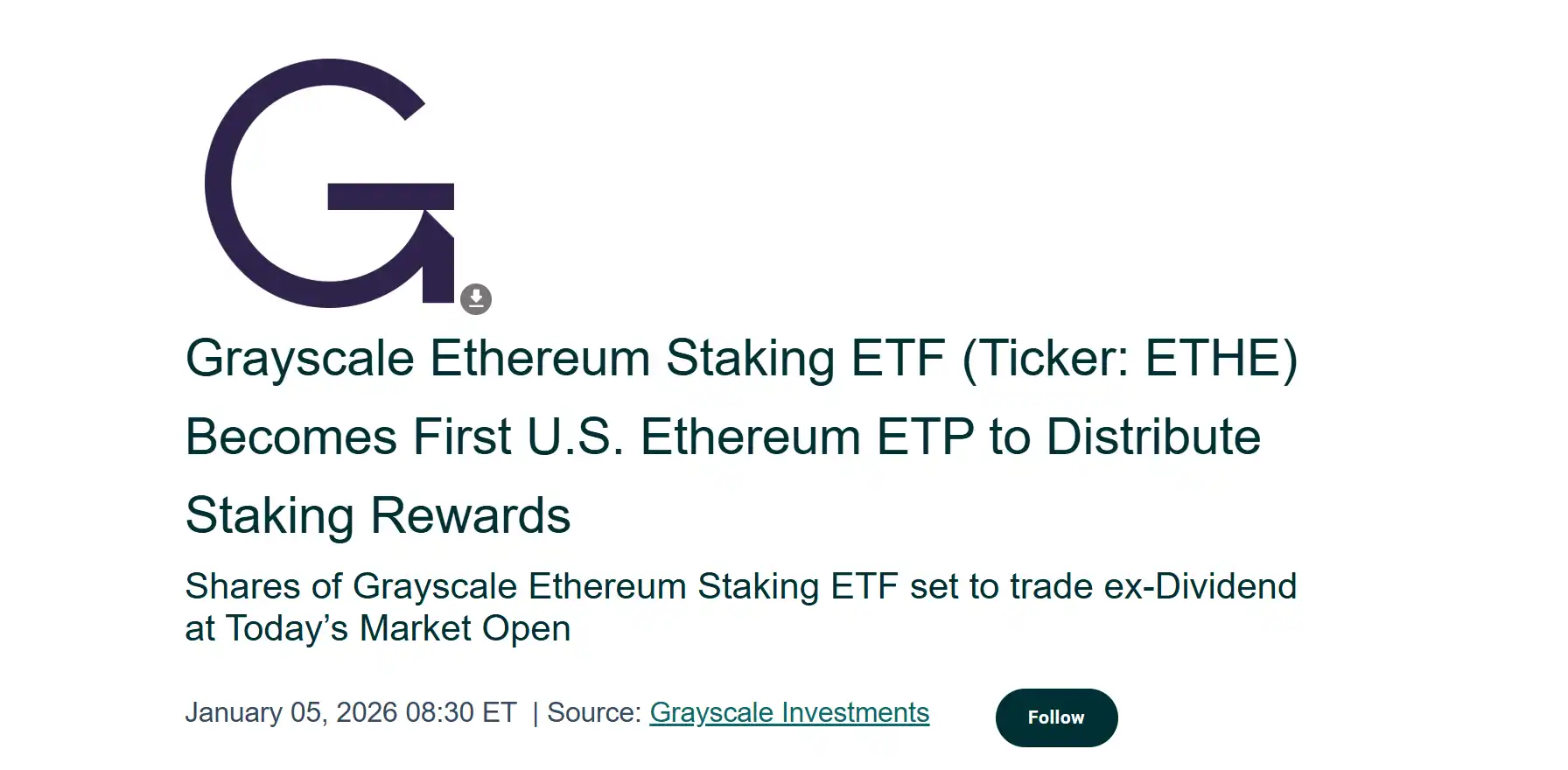
Just at the beginning of the month, Grayscale announced that its Grayscale Ethereum Staking ETF (ETHE) has distributed to existing shareholders the income earned by the fund through staking during the period from October 6, 2025, to December 31, 2025. This also marks the first time a U.S. spot crypto asset exchange-traded fund has distributed staking income to its holders.

Although this move may seem like a routine on-chain operation to Web3 native players, in the history of crypto finance, it marks the first time Ethereum's native yield has been packaged into the standard shell of traditional finance, undoubtedly representing a milestone.

More notably, this is not an isolated event. At the on-chain data level, a series of changes are occurring simultaneously: the Ethereum staking rate continues to climb, the validator exit queue is gradually being digested, and the entry queue is re-accumulating.

These seemingly scattered signals are collectively pointing to a deeper question: Is Ethereum gradually evolving from an asset primarily configured for price volatility into an "interest-bearing asset" accepted by long-term capital and possessing stable yield attributes?
I. ETF Yield Distribution: Traditional Investors' First 'Taste' of Staking

Objectively speaking, for a long time, Ethereum staking resembled a technical experiment with a somewhat geeky气质, confined to the "on-chain world."

It not only required users to possess basic crypto knowledge like wallets and private keys but also to understand validator mechanisms, consensus rules, lock-up periods, and slashing logic. Although Liquid Staking Derivative (LSD) protocols like Lido Finance significantly lowered the participation barrier, the staking yield itself remained primarily within the crypto-native context (via wrapped tokens like stETH).

Ultimately, for most Web2 investors, this system was neither intuitive nor directly accessible—it was an insurmountable gap.

Now, this gap is being bridged by ETFs. According to Grayscale's distribution plan, ETHE holders will receive $0.083178 per share held. This amount reflects the income the fund earned through staking and subsequently sold during the relevant period. The distribution will occur on January 6, 2026 (the Payable Date), for investors holding ETHE shares as of January 5, 2026 (the Record Date).

In short, this income does not come from corporate operations but from network security and consensus participation itself. In the past, this yield almost exclusively existed within the crypto industry. Now, it is beginning to be packaged into the familiar financial shell of an ETF. Through a standard stock brokerage account, traditional 401(k) or mutual fund investors can access the native yield generated by the Ethereum network's consensus (in USD form) without ever touching a private key.

It is important to emphasize that this does not mean Ethereum staking has achieved full regulatory compliance, nor does it represent a unified regulatory stance on ETF staking services. However, a key change has occurred in economic fact: Non-crypto-native users have, for the first time, indirectly obtained the native yield produced by the Ethereum network's consensus without needing to understand nodes, private keys, or on-chain operations.

From this perspective, the ETF yield distribution is not an isolated event but the first step for Ethereum Staking to enter the view of broader markets.
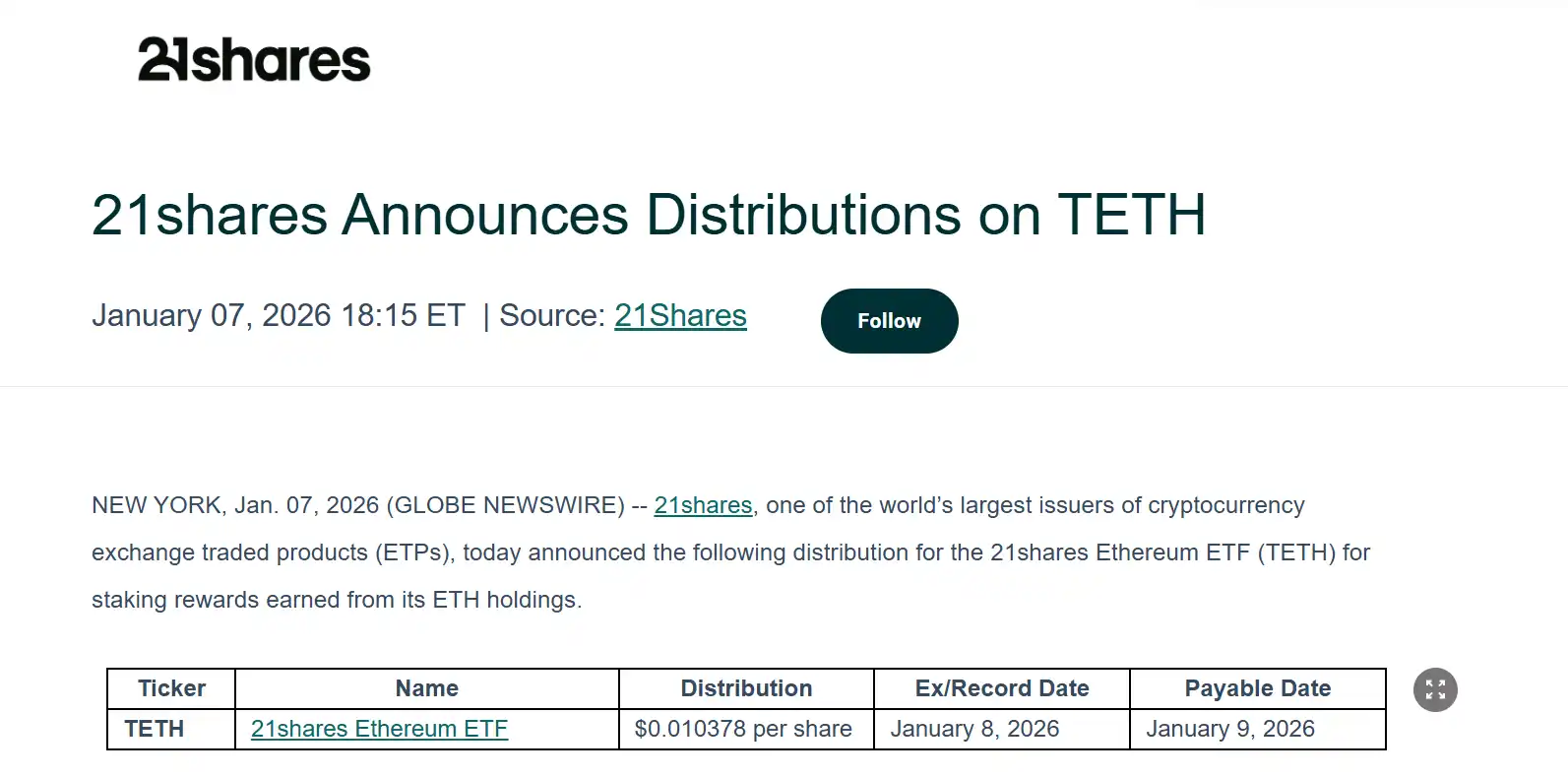
Grayscale is also quickly not alone. The Ethereum ETF from 21Shares also announced it will distribute to its existing shareholders the income earned through staking ETH. This distribution amount is $0.010378 per share, and the corresponding ex-dividend and payment processes have been disclosed simultaneously.

This undoubtedly sets a strong precedent, especially for institutions like Grayscale and 21Shares, which have influence in both TradFi and Web3 spheres. The demonstrative effect goes far beyond a single dividend distribution itself and is sure to drive the de facto activation and popularization of institutional Ethereum staking and yield distribution. It also marks Ethereum ETFs no longer being just shadow assets tracking price fluctuations, but genuine financial products with cash flow generation capabilities.

Looking at a longer cycle, as this model is validated, it is not unthinkable that traditional asset management giants like BlackRock and Fidelity might follow suit, potentially injecting hundreds of billions in long-term allocation capital into Ethereum.

II. Record-High Staking Ratio, and the Vanishing 'Exit Queue'

If ETF yield is more of a breakthrough in narrative, then the changes in the total staking ratio and staking queues more directly reflect the behavior of capital itself.

First, the Ethereum staking ratio has hit a record high. Data from The Block shows that over 36 million ETH are currently staked on the Ethereum Beacon Chain, accounting for nearly 30% of the network's circulating supply. The staked value exceeds $118 billion, setting a new historical record. The previous highest record for the percentage of circulating supply was 29.54%, reached in July 2025.
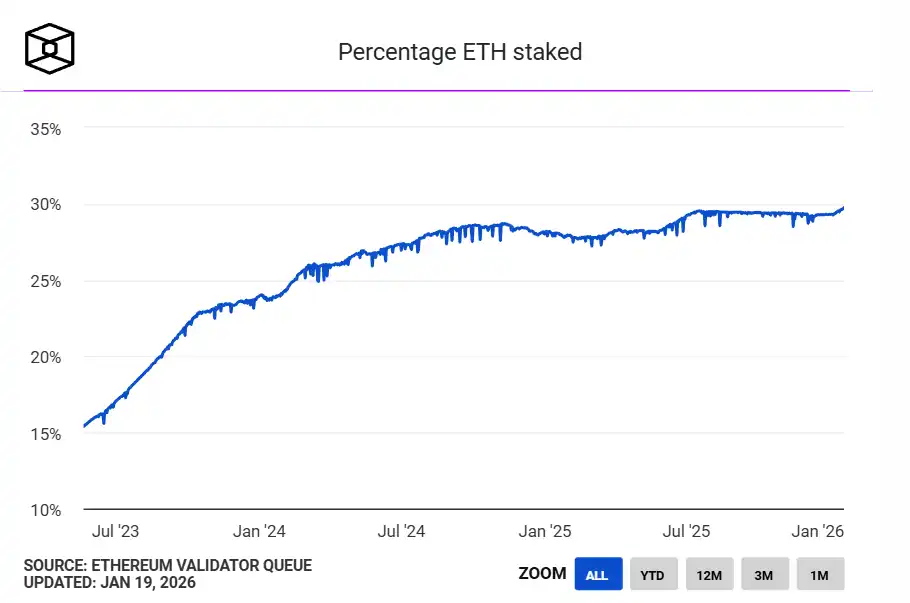
Source: The Block

From a supply and demand perspective, a large amount of ETH being staked means it is temporarily withdrawn from the freely circulating market. It also indicates that a significant portion of circulating ETH is shifting from high-frequency trading assets to long-term allocation assets playing a functional role.

In other words, ETH is no longer just Gas, a medium of exchange, or a speculative tool, but is taking on the role of a "means of production"—it participates in network operation through staking and continuously generates yield.

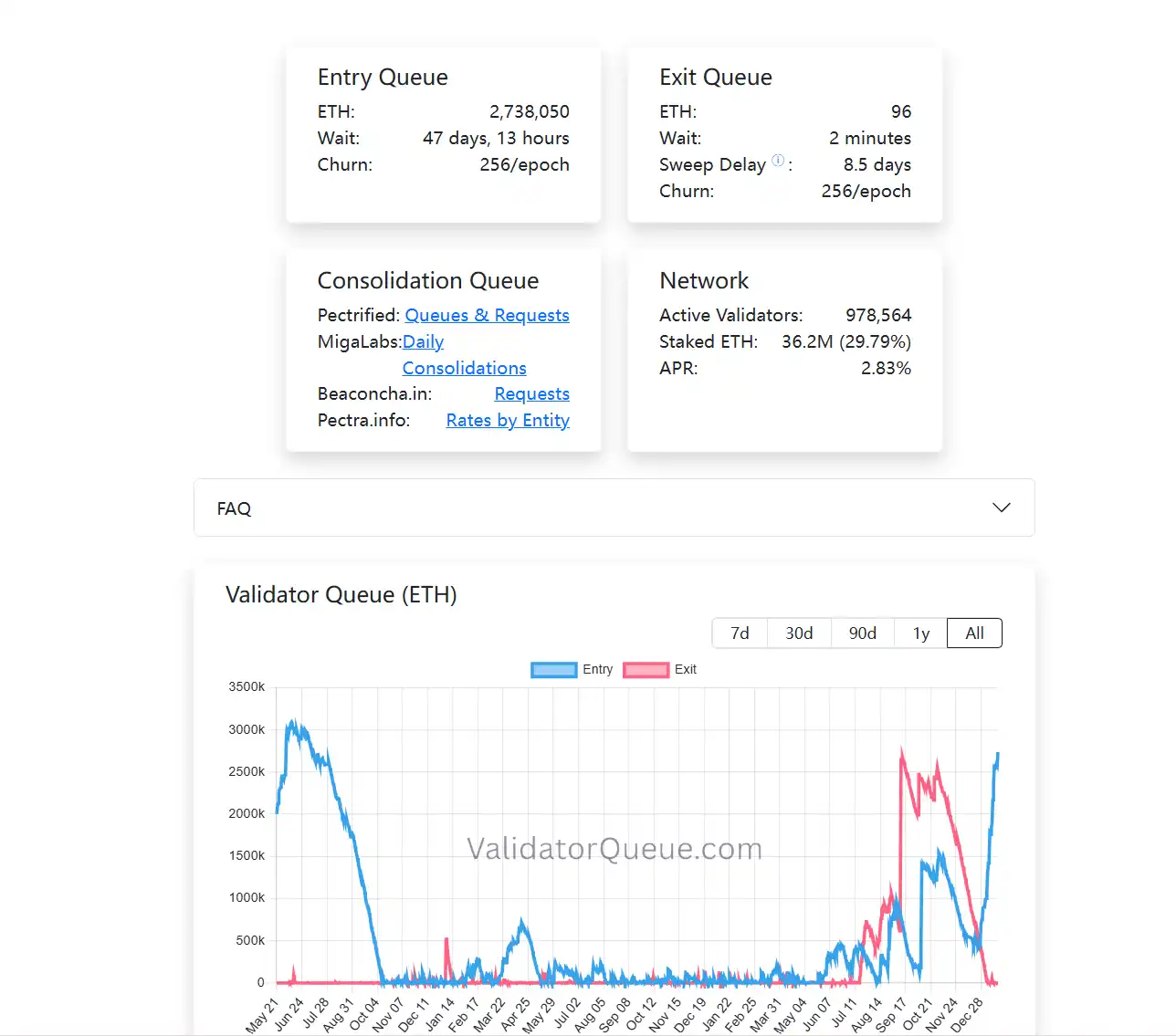
At the same time, intriguing changes have occurred in the validator queues. As of writing, the staking exit queue for Ethereum PoS is nearly cleared, while the queue to enter staking continues to grow (exceeding 2.73 million ETH). In short, a significant amount of ETH is currently choosing to be locked into this system long-term (Extended reading: 《Penetrating the Noise of Ethereum 'Degeneration': Why is the 'Ethereum Value Proposition' the Widest Moat?》).

Unlike trading behavior, staking itself is a low-liquidity, long-cycle allocation method emphasizing stable returns. The willingness of capital to re-enter the staking queue signifies at least one thing: at the current stage, more and more participants are willing to accept the opportunity cost for this long-term lock-up.
If we consider the institutional ETF yield distribution, the record-high staking ratio, and the changing queue structure together, a relatively clear trend emerges: Ethereum staking is evolving from an early adopter bonus for on-chain participants into a structural yield layer within TradFi, gradually accepted by the traditional financial system and re-evaluated by long-term capital.

Looking at any single one is insufficient to form a trend judgment, but together, they are outlining the maturing contours of the Ethereum Staking economy.

III. The Future of an Accelerating Maturation of the Staking Market

However, this does not mean staking has turned ETH into a "risk-free asset." On the contrary, as the participant structure changes, the types of risks faced by staking are shifting. Technical risks are gradually being digested, while structural risks, liquidity risks, and the cost of understanding the mechanisms are becoming more important.

As is well known, during the last regulatory cycle, the U.S. Securities and Exchange Commission (SEC) frequently wielded its enforcement power, taking action against several liquid staking-related projects. This included charges against MetaMask/Consensys, Lido/stETH, and Rocket Pool/rETH for unregistered securities offerings, which once cast uncertainty over the long-term development of Ethereum ETFs.

From a practical path perspective, whether and how an ETF participates in staking is essentially more a matter of product process and compliance structure design, rather than a negation of the Ethereum network itself. As more institutions explore the boundaries in practice, the market is also voting with real capital.

For example, BitMine has staked over 1 million ETH into Ethereum PoS, reaching 1.032 million ETH, valued at approximately $3.215 billion. This represents a quarter of its total ETH holdings (4.143 million).

In summary, Ethereum staking has come a long way and is no longer a niche game for geeks.

As ETFs begin to distribute yield steadily, as long-term capital is willing to queue for 45 days to enter the consensus layer, and as 30% of ETH is transformed into a security barrier, we are witnessing Ethereum formally constructing a native yield system accepted by the global capital markets.

And understanding this change itself is perhaps as important as participating in it.

Domande pertinenti

QWhat is the distribution of staking rewards by Grayscale's Ethereum Staking ETF (ETHE) to its shareholders?

AGrayscale distributed $0.083178 per share to ETHE holders, representing the fund's staking rewards earned from October 6, 2025, to December 31, 2025.

QWhat percentage of Ethereum's circulating supply is currently staked on the Beacon Chain, according to The Block's data?

AOver 30% of Ethereum's circulating supply, more than 36 million ETH, is staked on the Beacon Chain, with a staking market value exceeding $118 billion.

QWhat significant change in the Ethereum validator queues is highlighted in the article?

AThe exit queue for Ethereum validators is nearly empty, while the entry queue for new validators has grown to over 2.73 million ETH, indicating strong demand to stake.

QHow does the article characterize the evolution of Ethereum's role in the financial markets?

AThe article suggests Ethereum is evolving from a price-volatile speculative asset into a long-term, yield-generating 'income asset' that is being accepted by traditional finance (TradFi).

QWhich other major asset manager, besides Grayscale, is mentioned as having announced a distribution of staking rewards from its Ethereum ETF?

A21Shares announced it would distribute staking rewards from its Ethereum ETF, with a payout of $0.010378 per share to its shareholders.

Letture associate

Has the 'Digital Gold' Narrative for BTC Failed?

**Title: Has the "Digital Gold" Narrative for Bitcoin Failed?** The article argues that Bitcoin's "digital gold" narrative remains valid despite a recent sharp price decline (from a peak near $126k in Oct 2025 to briefly under $61k in Feb 2026). It presents a long-term investment framework based on three core points: **1. Viewing Bitcoin as an Asset:** Bitcoin is presented as a superior potential store of value compared to gold. Key arguments are its absolute scarcity (21 million cap), superior portability, and transparent auditability via its public ledger. While acknowledging its current use in early, volatile stages (~3-4% global adoption), the author draws parallels to the early, disruptive phases of the internet and e-commerce. **2. Understanding the Recent Downturn:** The current ~50% correction is framed as a predictable, consensus-driven cycle following its post-halving peak (the 2024 halving preceded the Oct 2025 high). A crucial factor is a historic "changing of hands": the influx of new institutional buyers via ETFs allowed early, low-cost holders (miners, OG believers) to take profits. The author notes that while severe, Bitcoin's historical drawdowns (e.g., 93% in 2011, 77% in 2021-22) have been progressively smaller, suggesting maturing holder structure and decreasing volatility over time. **3. The Long-Term Perspective:** The long-term thesis hinges on Bitcoin capturing a portion of gold's market value. With Bitcoin's market cap at ~$1.4 trillion (at $70k) versus gold's ~$20 trillion, significant upside potential exists if the "digital gold" narrative is partially realized. However, the author strongly cautions that short-term risks remain, the bottom is unpredictable, and high volatility is inherent. The real risk is not Bitcoin failing but poor personal position management (over-leverage, wrong capital) and a lack of deep understanding, which can force investors out during severe downturns. The conclusion uses Amazon's 95% crash post-2000 dot-com bubble and subsequent 42x recovery as an analogy. The ultimate question is not if Bitcoin's price will rise, but if an investor's strategy and conviction can withstand the volatility to see the long-term play out. The recent divergence (gold up, Bitcoin down) is posed not as a narrative failure, but as potential evidence of this ongoing, painful transition from a speculative asset to a mainstream allocation.

marsbit6 h fa

Has the 'Digital Gold' Narrative for BTC Failed?

marsbit6 h fa

Has BTC's 'Digital Gold' Narrative Failed?

The article discusses Bitcoin's "digital gold" narrative, its recent price drop, and long-term outlook through the perspective of "Jason". It argues the narrative is not a failure but that Bitcoin represents a superior, new asset class due to its fixed supply (21 million), portability, and auditability. The piece compares its current ~3-4% global adoption rate to early internet/e-commerce, suggesting significant growth potential. Regarding the 2025-2026 price decline (from ~$126k to briefly under $61k), the author views it as a predictable, consensus-driven sell-off within Bitcoin's ~4-year cycle post-halving, exacerbated by a major "handover" from early, low-cost holders to new institutional buyers via ETFs. A key observation is that historical peak-to-trough drawdowns have lessened over time (e.g., 93% in 2011 to ~50% in 2026), indicating maturing volatility as holder structure changes. For the long term, the author uses a simple framework: Bitcoin's total market cap (~$1.4T at $70k) is only about 7% of gold's (~$20T). Even capturing 30-50% of gold's value would imply substantial upside. However, the article strongly cautions against viewing this as investment advice, emphasizing extreme volatility and the critical importance of risk management, position sizing, and deep fundamental understanding to survive severe drawdowns. It concludes by drawing a parallel to Amazon's 95% crash in 2000 and subsequent 42x recovery, stressing that the key is surviving market cycles to realize long-term potential.

链捕手6 h fa

Has BTC's 'Digital Gold' Narrative Failed?

链捕手6 h fa

From Code to Cognition: A Ten-Thousand-Word Guide to the Evolution of the Robot Brain

"From Code to Cognition: The Evolution of Robot Brains" The journey of robotic intelligence has shifted dramatically from manually coded systems to AI-driven brains. For decades, robots relied on layered software stacks—perception, state estimation, planning, control—each handcrafted. While predictable, they lacked adaptability. The 2010s saw deep learning revolutionize perception (e.g., object detection) and control (via reinforcement learning), but learned skills remained narrow. The arrival of Large Language Models (LLMs) marked a turning point. LLMs acted as high-level planners, interpreting natural language instructions and generating sequences of actions for traditional robotic systems to execute. However, true integration came with Visual-Language-Action (VLA) models, which fused vision, language, and motion prediction into a single network. Pioneered by models like RT-2 and open-source projects like OpenVLA, VLAs enable robots to reason and act directly from visual input and commands. The most advanced humanoid robots now employ a "dual-brain" architecture: a slow-thinking, large VLA (System 2) for reasoning and planning, and a fast-reacting, small network (System 1) for high-frequency motion control, sometimes with an even lower-level System 0 for balance. This split balances cognition with the physics of real-time movement. Computation is split between onboard hardware (e.g., NVIDIA Jetson) for safety-critical control loops and cloud/edge servers for non-critical tasks like learning and interfaces. A crucial driver is the open-source ecosystem—models like GR00T and OpenVLA allow startups to build upon pre-trained brains and fine-tune them with their own data, accelerating development. Despite progress, current systems struggle with recovery from errors, sample inefficiency, and long-horizon tasks. This has spurred the rise of **World Models**—neural networks that predict the consequences of actions. By simulating possible futures before acting (like NVIDIA Cosmos or Meta V-JEPA), robots can plan, recover, and generalize better. This represents the next frontier: shifting intelligence from learned reactions to an internal model of physics and cause-and-effect. The field is rapidly evolving. While not yet at its "ChatGPT moment," the convergence of cheaper hardware, scalable simulation, and world models points toward robots that are increasingly capable, adaptive, and useful. The question is shifting from "what can robots do?" to "what *should* they do?"

marsbit7 h fa

From Code to Cognition: A Ten-Thousand-Word Guide to the Evolution of the Robot Brain

marsbit7 h fa

Trading

Spot
Futures

Articoli Popolari

Cosa è ETH 3.0

ETH3.0 e $eth 3.0: Un'Analisi Approfondita del Futuro di Ethereum Introduzione Nel panorama in rapida evoluzione delle criptovalute e della tecnologia blockchain, ETH3.0, spesso indicato come $eth 3.0, è emerso come un argomento di considerevole interesse e speculazione. Il termine comprende due concetti principali che warrantono chiarimenti: Ethereum 3.0: Questo rappresenta un potenziale futuro aggiornamento volto ad aumentare le capacità dell'attuale blockchain di Ethereum, concentrandosi principalmente sul miglioramento della scalabilità e delle prestazioni. ETH3.0 Meme Token: Questo progetto di criptovaluta distinto cerca di sfruttare la blockchain di Ethereum per creare un ecosistema incentrato sui meme, promuovendo il coinvolgimento all'interno della comunità delle criptovalute. Comprendere questi aspetti di ETH3.0 è essenziale non solo per gli appassionati di criptovalute, ma anche per coloro che osservano tendenze tecnologiche più ampie nello spazio digitale. Che cos'è ETH3.0? Ethereum 3.0 Ethereum 3.0 è pubblicizzato come un aggiornamento proposto per la rete Ethereum già stabilita, che è stata la spina dorsale di molte applicazioni decentralizzate (dApps) e contratti smart sin dalla sua nascita. I miglioramenti previsti si concentrano principalmente sulla scalabilità, integrando tecnologie avanzate come lo sharding e le prove a conoscenza zero (zk-proofs). Queste innovazioni tecnologiche mirano a facilitare un numero senza precedenti di transazioni al secondo (TPS), potenzialmente raggiungendo milioni, affrontando così una delle limitazioni più significative della tecnologia blockchain attuale. Il miglioramento non è meramente tecnico, ma anche strategico; è volto a preparare la rete Ethereum per un'adozione e un'utilità diffuse in un futuro contrassegnato da un aumento della domanda di soluzioni decentralizzate. ETH3.0 Meme Token Al contrario di Ethereum 3.0, l'ETH3.0 Meme Token si avventura in un dominio più leggero e giocoso, combinando la cultura dei meme di internet con la dinamica delle criptovalute. Questo progetto consente agli utenti di acquistare, vendere e scambiare meme sulla blockchain di Ethereum, fornendo una piattaforma che promuove il coinvolgimento della comunità attraverso la creatività e interessi condivisi. L'ETH3.0 Meme Token mira a dimostrare come la tecnologia blockchain possa intersecarsi con la cultura digitale, creando casi d'uso che siano sia divertenti che finanziariamente praticabili. Chi è il Creatore di ETH3.0? Ethereum 3.0 L'iniziativa verso Ethereum 3.0 è principalmente propulsa da un consorzio di sviluppatori e ricercatori all'interno della comunità di Ethereum, tra cui Justin Drake. Conosciuto per le sue intuizioni e contributi all'evoluzione di Ethereum, Drake è stato una figura di spicco nelle discussioni riguardanti la transizione di Ethereum verso un nuovo livello di consenso, chiamato “Beam Chain.” Questo approccio collaborativo allo sviluppo significa che Ethereum 3.0 non è il prodotto di un creatore singolo, ma piuttosto una manifestazione di ingegno collettivo focalizzato sul progresso della tecnologia blockchain. ETH3.0 Meme Token I dettagli riguardanti il creatore dell'ETH3.0 Meme Token sono attualmente non rintracciabili. La natura dei token meme conduce spesso a una struttura più decentralizzata e guidata dalla comunità, il che potrebbe spiegare la mancanza di attribuzione specifica. Questo si allinea con l'etica della comunità crypto più ampia, dove l'innovazione spesso nasce da sforzi collaborativi piuttosto che individuali. Chi sono gli Investitori di ETH3.0? Ethereum 3.0 Il supporto per Ethereum 3.0 proviene principalmente dalla Ethereum Foundation insieme a una comunità entusiasta di sviluppatori e investitori. Questa associazione fondamentale fornisce un considerevole grado di legittimità e migliora le prospettive di implementazione di successo poiché sfrutta la fiducia e la credibilità costruite nel corso degli anni di operazioni della rete. Nel clima in rapida evoluzione delle criptovalute, il supporto della comunità gioca un ruolo cruciale nello sviluppo e nell'adozione, posizionando Ethereum 3.0 come un serio contenditore per i futuri progressi della blockchain. ETH3.0 Meme Token Sebbene le fonti attualmente disponibili non forniscano informazioni esplicite riguardo ai fondamenti o alle organizzazioni di investimento che sostengono l'ETH3.0 Meme Token, ciò è indicativo del modello di finanziamento tipico per i token meme, che spesso si basa sul supporto di base e sul coinvolgimento della comunità. Gli investitori in tali progetti sono tipicamente individui motivati dal potenziale per innovazioni guidate dalla comunità e dallo spirito di cooperazione trovato all'interno della comunità crypto. Come Funziona ETH3.0? Ethereum 3.0 Le caratteristiche distintive dell'Ethereum 3.0 risiedono nella sua proposta di implementazione della tecnologia di sharding e zk-proof. Lo sharding è un metodo di partizionamento della blockchain in pezzi più piccoli e gestibili o “shard,” che possono elaborare transazioni in modo concorrente piuttosto che sequenziale. Questa decentralizzazione dell'elaborazione aiuta a prevenire la congestione e garantisce che la rete rimanga reattiva anche sotto un carico pesante. La tecnologia delle prove a conoscenza zero (zk-proof) contribuisce con un ulteriore livello di sofisticazione consentendo la validazione delle transazioni senza rivelare i dati sottostanti coinvolti. Questo aspetto non solo migliora la privacy, ma aumenta anche l'efficienza complessiva della rete. Si parla anche di incorporare una macchina virtuale Ethereum a conoscenza zero (zkEVM) in questo aggiornamento, amplificando ulteriormente le capacità e l'utilità della rete. ETH3.0 Meme Token L'ETH3.0 Meme Token si distingue capitalizzando sulla popolarità della cultura dei meme. Stabilisce un mercato per gli utenti che desiderano partecipare al trading di meme, non solo per divertimento, ma anche per potenziale guadagno economico. Integrando funzioni come lo staking, la fornitura di liquidità e meccanismi di governance, il progetto promuove un ambiente che incentiva l'interazione e la partecipazione della comunità. Offrendo una miscela unica di intrattenimento e opportunità economica, l'ETH3.0 Meme Token mira ad attrarre un pubblico variegato, che va dagli appassionati di crypto ai semplici intenditori di meme. Timeline di ETH3.0 Ethereum 3.0 11 Novembre 2024: Justin Drake accenna al prossimo aggiornamento ETH 3.0, incentrato sui miglioramenti della scalabilità. Questo annuncio segna l'inizio delle discussioni formali riguardo l'architettura futura di Ethereum. 12 Novembre 2024: La proposta attesa per Ethereum 3.0 dovrebbe essere svelata a Devcon a Bangkok, preparando il terreno per un feedback più ampio della comunità e potenziali passi successivi nello sviluppo. ETH3.0 Meme Token 21 Marzo 2024: L'ETH3.0 Meme Token viene ufficialmente elencato su CoinMarketCap, segnando il suo ingresso nel dominio pubblico delle criptovalute e aumentando la visibilità per il suo ecosistema basato sui meme. Punti Chiave In conclusione, Ethereum 3.0 rappresenta una significativa evoluzione all'interno della rete Ethereum, concentrandosi sul superamento delle limitazioni riguardanti scalabilità e prestazioni attraverso tecnologie avanzate. I suoi aggiornamenti proposti riflettono un approccio proattivo alle future esigenze e usabilità. D'altra parte, l'ETH3.0 Meme Token incarna l'essenza della cultura guidata dalla comunità nello spazio delle criptovalute, sfruttando la cultura dei meme per creare piattaforme coinvolgenti che incoraggiano la creatività e la partecipazione degli utenti. Comprendere gli scopi e le funzionalità distinte di ETH3.0 e $eth 3.0 è fondamentale per chiunque sia interessato ai continui sviluppi nello spazio crypto. Con entrambe le iniziative che tracciano percorsi unici, esse sottolineano collettivamente la natura dinamica e multifacetica dell'innovazione blockchain.

173 Totale visualizzazioniPubblicato il 2024.04.04Aggiornato il 2024.12.03

Cosa è ETH 3.0

Cosa è ETHEREUM

HarryPotterTrumpHomerSimpson777Inu: Panoramica di un Progetto Crypto Web3 Introduzione Nel mondo in rapida evoluzione delle criptovalute e della finanza decentralizzata, progetti innovativi emergono frequentemente, catturando l'interesse della comunità degli investitori e degli appassionati di crypto. Uno di questi progetti è HarryPotterTrumpHomerSimpson777Inu, una criptovaluta che si trova all'incrocio tra cultura popolare e tecnologia blockchain. Questo token guidato dalla comunità mescola personaggi e figure politiche ben noti, con l'obiettivo di creare una piattaforma coinvolgente e promuovere un'adozione diffusa. Che cos'è HarryPotterTrumpHomerSimpson777Inu? HarryPotterTrumpHomerSimpson777Inu è un token costruito sulla blockchain di Ethereum, progettato per essere accessibile e divertente per un pubblico diversificato. L'unicità di questo progetto deriva dal suo approccio tematico, che intreccia elementi di fantasia, politica e intrattenimento. Sfruttando il fascino nostalgico di personaggi amati, il progetto cerca di creare un'esperienza di criptovaluta coinvolgente, incoraggiando il coinvolgimento e la partecipazione della comunità. L'obiettivo principale di HarryPotterTrumpHomerSimpson777Inu è stabilire un token che risuoni con gli utenti a livello personale, promuovendo sia il divertimento che il coinvolgimento nell'ambito crypto. Questo branding distintivo mira ad attrarre individui che in precedenza potrebbero non essersi interessati alle criptovalute, facilitando un nuovo punto di ingresso per utenti potenziali. Creatore di HarryPotterTrumpHomerSimpson777Inu L'identità del creatore dietro HarryPotterTrumpHomerSimpson777Inu rimane sconosciuta. Questa non è una pratica rara nel dominio delle criptovalute, dove l'anonimato è spesso preferito dai fondatori come mezzo di protezione della privacy e promozione di un ethos decentralizzato. Questa oscurità non diminuisce il valore del progetto; al contrario, riflette una tendenza più ampia all'interno del settore, dove molti progetti di successo sono emersi da origini anonime. Investitori di HarryPotterTrumpHomerSimpson777Inu Le informazioni pubbliche riguardo agli investitori di HarryPotterTrumpHomerSimpson777Inu sono limitate. La natura del progetto, incentrata sul coinvolgimento della comunità, suggerisce una dipendenza da investimenti di piccole dimensioni da parte di singoli appassionati piuttosto che da sostegni sostanziali da fondazioni di investimento consolidate o corporation. Questo livello di trasparenza nel finanziamento è tipico di molti progetti di criptovaluta guidati dalla comunità, dove il supporto spesso proviene da movimenti di base piuttosto che da investitori istituzionali. Come Funziona HarryPotterTrumpHomerSimpson777Inu? Operando sulla blockchain di Ethereum, HarryPotterTrumpHomerSimpson777Inu sfrutta la sua solida infrastruttura per facilitare transazioni e promuovere interazioni tra gli utenti all'interno della comunità. Ciò che distingue questo progetto è il suo posizionamento tematico: canalizzando il carisma di personaggi iconici provenienti da diversi ambiti culturali, crea un'identità di marca distintiva. Questo approccio non solo attrae gli utenti, ma coltiva anche una comunità fedele attorno al token. Le meccaniche operative del progetto si concentrano sul coinvolgimento della comunità. Adotta un modello decentralizzato che incoraggia la partecipazione, consentendo agli utenti di interagire attraverso vari canali mentre promuovono lo scambio di idee e esperienze. Inoltre, il progetto abbraccia i principi del Web3, privilegiando la sovranità degli utenti e la decentralizzazione, che sono i pilastri del futuro di Internet. Timeline di HarryPotterTrumpHomerSimpson777Inu La storia di HarryPotterTrumpHomerSimpson777Inu è segnata da diversi eventi decisivi: 12 agosto 2023: L'inizio di HarryPotterTrumpHomerSimpson777Inu, segnando il suo ingresso nell'ecosistema delle criptovalute. Fase di Sviluppo: Un periodo focalizzato sulla costruzione di una strategia completa per stimolare la crescita guidata dalla comunità e il coinvolgimento degli utenti. Listing sugli Scambi: Sebbene i dettagli specifici di listing non siano stati divulgati, il progetto è stato reso accessibile su vari scambi di criptovalute, migliorando la sua visibilità nel mercato. Coinvolgimento della Comunità: Sforzi continui per coinvolgere attivamente la comunità, stabilendo canali di dialogo e promuovendo la partecipazione attraverso varie attività, tra cui concorsi, discussioni e votazioni comunitarie. Aspetti Chiave di HarryPotterTrumpHomerSimpson777Inu Focus sulla Comunità Un tratto distintivo di HarryPotterTrumpHomerSimpson777Inu è la sua forte enfasi sul coinvolgimento della comunità. Il progetto incoraggia attivamente gli utenti a partecipare a discussioni, condividere idee e contribuire all'evoluzione del progetto. Questa interazione coltiva un senso di appartenenza e di ownership tra i membri della comunità, essenziale per la sostenibilità a lungo termine del token. Utilizzo della Blockchain di Ethereum La scelta di costruire sulla blockchain di Ethereum consente a HarryPotterTrumpHomerSimpson777Inu di sfruttare le sue caratteristiche di sicurezza ben consolidate e architettura decentralizzata. Questa base garantisce affidabilità per le transazioni e fornisce un framework affidabile su cui sviluppare varie funzionalità. Approccio Tematico Unico Fusione di elementi della cultura pop nella sua identità, HarryPotterTrumpHomerSimpson777Inu crea una narrazione coinvolgente che lo differenzia da altre criptovalute. L'amalgama di personaggi e temi genera riconoscimento e intrigo immediati, rendendo il token relazionabile a un'ampia gamma di utenti potenziali. Anonimato nello Sviluppo Il creatore anonimo del progetto rimane una caratteristica ricorrente in molte iniziative di criptovaluta. Questo aspetto evidenzia un ethos di decentralizzazione, introducendo anche un livello di mistero che potrebbe affascinare un segmento della comunità crypto, attirando l'attenzione sul progetto e invitando l'impegno da parte di utenti che supportano l'idea di un'iniziativa decentralizzata e gestita dalla comunità. Conclusione HarryPotterTrumpHomerSimpson777Inu si presenta come un'aggiunta distintiva al panorama delle criptovalute, combinando il fascino della cultura popolare con le meccaniche innovative della tecnologia blockchain. Sebbene i dettagli riguardanti il creatore e gli investitori specifici rimangano non divulgati, il focus del progetto sulla comunità e il suo approccio tematico lo contraddistinguono come un potenziale attore influente nel contesto del Web3 e delle criptovalute. Man mano che l'ecosistema delle criptovalute continua ad espandersi, iniziative come HarryPotterTrumpHomerSimpson777Inu ci ricordano le molteplici modalità in cui la blockchain può connettere le comunità globali attraverso narrazioni e valori condivisi.

909 Totale visualizzazioniPubblicato il 2024.04.06Aggiornato il 2024.12.03

Cosa è ETHEREUM

Come comprare ETH

Benvenuto in HTX.com! Abbiamo reso l'acquisto di Ethereum (ETH) semplice e conveniente. Segui la nostra guida passo passo per intraprendere il tuo viaggio nel mondo delle criptovalute.Step 1: Crea il tuo Account HTXUsa la tua email o numero di telefono per registrarti il tuo account gratuito su HTX. Vivi un'esperienza facile e sblocca tutte le funzionalità,Crea il mio accountStep 2: Vai in Acquista crypto e seleziona il tuo metodo di pagamentoCarta di credito/debito: utilizza la tua Visa o Mastercard per acquistare immediatamente EthereumETH.Bilancio: Usa i fondi dal bilancio del tuo account HTX per fare trading senza problemi.Terze parti: abbiamo aggiunto metodi di pagamento molto utilizzati come Google Pay e Apple Pay per maggiore comodità.P2P: Fai trading direttamente con altri utenti HTX.Over-the-Counter (OTC): Offriamo servizi su misura e tassi di cambio competitivi per i trader.Step 3: Conserva Ethereum (ETH)Dopo aver acquistato Ethereum (ETH), conserva nel tuo account HTX. In alternativa, puoi inviare tramite trasferimento blockchain o scambiare per altre criptovalute.Step 4: Scambia Ethereum (ETH)Scambia facilmente Ethereum (ETH) nel mercato spot di HTX. Accedi al tuo account, seleziona la tua coppia di trading, esegui le tue operazioni e monitora in tempo reale. Offriamo un'esperienza user-friendly sia per chi ha appena iniziato che per i trader più esperti.

2.9k Totale visualizzazioniPubblicato il 2024.12.10Aggiornato il 2026.06.02

Come comprare ETH

Discussioni

Benvenuto nella Community HTX. Qui puoi rimanere informato sugli ultimi sviluppi della piattaforma e accedere ad approfondimenti esperti sul mercato. Le opinioni degli utenti sul prezzo di ETH ETH sono presentate come di seguito.

活动图片