When Asia-Pacific Stock Markets Plunge Below Circuit Breaker, Why Does Bitcoin Stand Out?

marsbitPubblicato 2026-03-05Pubblicato ultima volta 2026-03-05

Introduzione

Amid escalating Middle East tensions that triggered a historic sell-off in Asia-Pacific equities on March 4, Bitcoin demonstrated unexpected resilience. While South Korea’s KOSPI plummeted 12%, its worst drop in history, and Japan’s Nikkei 225 fell 3.7%, Bitcoin rebounded after a brief dip, surging past $74,000 to a two-week high. The divergence stems from structural and fundamental differences between traditional equities and crypto. Asia-Pacific markets, heavily reliant on energy imports, faced direct economic risks from soaring oil prices due to disruptions in the Strait of Hormuz. In contrast, Bitcoin’s fixed supply and decentralized nature positioned it as a hedge against inflation and currency devaluation. Crypto markets, operating 24/7, priced in geopolitical risks ahead of traditional markets, reflecting higher pricing efficiency. Additionally, equities entered the crisis with high valuations and leverage, whereas crypto had undergone prior corrections, reducing speculative excess. Institutional participation via Bitcoin ETFs also provided stability, dampening volatility. This episode underscores a shift in asset perception: crypto is increasingly seen as a global, non-sovereign store of value amid geopolitical turmoil, while regionally tethered assets face heightened vulnerability.

Author: Jae, PANews

On March 4, as the Middle East situation suddenly deteriorated, global financial markets instantly entered a "wartime state." For global investors, this was a trading day that would go down in history.

The obstruction of shipping in the global energy choke point, the Strait of Hormuz, triggered a sharp surge in international oil prices. Panic quickly swept through traditional capital markets, and Asia-Pacific stock markets faced an epic wave of selling.

South Korea's KOSPI plummeted 12% in a single day, marking its largest drop in history; Japan's Nikkei 225 fell sharply by 3.7%, its worst performance in five months; Middle Eastern stock markets plunged nearly 5% in a catch-up decline; major European and U.S. stock indices closed lower across the board.

However, an unusual phenomenon quietly emerged amid this selling wave.

The crypto market, typically seen as "high-risk, high-volatility," the asset class that would be the first to collapse in any geopolitical crisis, actually held steady this time.

After a brief panic sell-off, Bitcoin quickly rebounded, briefly breaking through $74,000 to hit a two-week high. On the same day, investors in Seoul watched as the KOSPI fell below the circuit breaker line.

This is no longer a simple dichotomy of "safe haven" versus "risk," but a deep reassessment of asset nature, pricing logic, and market structure.

Asia-Pacific Stock Markets Become the Epicenter, South Korea's KOSPI Plunges 12%

After the outbreak of war, global stock markets entered a "race to the bottom." Due to their high dependence on external energy, Asia-Pacific markets became the hardest hit.

South Korean stocks fell the most.

The Korea Composite Stock Price Index (KOSPI) closed down more than 12%, its largest single-day drop in history. The day before (March 3), it had already fallen 7%. Over two trading days, the cumulative decline was nearly 20%, with a total market capitalization evaporation of approximately $430 billion, marking the worst two-day decline since the 2008 global financial crisis.

South Korea's Kosdaq index fared even worse, plunging 14%, triggering multiple circuit breakers during the day.

Why South Korea?

South Korea is the world's eighth-largest crude oil consumer, with about 70% of its oil imports coming from the Middle East. Net oil imports account for 2.7% of its GDP. Its economy is manufacturing-oriented and highly sensitive to energy prices.

The blockade of the Strait of Hormuz and the resulting surge in oil prices mean soaring corporate costs, declining profit expectations, and intensified inflationary pressures. For this export-oriented economy, missiles in the Middle East war are not distant news but numbers directly impacting financial reports.

Even more critical is the market structure. Foreign investors hold over 30% of South Korean stocks, and retail margin trading accounts for nearly 80%. When panic strikes, foreign capital withdrawal, leveraged positions blowing up, and quantitative stop-losses occur simultaneously, leading to a stampede-like sell-off.

Japan followed closely.

The Nikkei 225 index closed down 3.7%, its largest single-day drop in nearly five months; the Topix index fell even more sharply, closing down 4%.

Japan is also a major energy importer. Trump's statement that "larger military action against Iran may be taken" was enough to make traders in Tokyo nervous.

The Middle East itself was at the eye of the storm.

After a two-day closure, UAE markets reopened, with the Dubai Financial Market General Index falling 4.7% in early trading, a rare drop in recent years. Saudi Arabia's benchmark index fell nearly 5% in the early stages of the conflict. The Kuwait Stock Exchange simply suspended trading to avoid a collapse-like sell-off.

For Gulf countries, war means uncertainty in oil revenues, stagnation in tourism and aviation, and accelerated capital flight.

The ripple effects of the Middle East conflict quickly spread to global financial markets, with European and U.S. stocks also weakening. Although the declines were somewhat moderated, major indices still closed lower.

Global Stocks Keep Falling, Crypto Market Rebounds "Ahead"

While global stock markets were in turmoil, the performance of the crypto market surprised many.

After the initial panic sell-off, Bitcoin quickly stabilized and rebounded, rising above $74,000 on March 5 to hit a two-week high.

This divergence is not accidental. It is the result of multiple factors, including pricing efficiency, valuation misalignment, inflation risks, anchoring mechanisms, and participant structure.

When the war broke out over the weekend, the crypto market was the only market that could trade.

No market closures, no circuit breakers, no delays. From the first explosion in Tehran, global investors could express their judgments in the crypto market.

This means that when Asia-Pacific stock markets opened on Monday morning, the crypto market had already completed several rounds of price discovery, digesting and pricing in most of the risks in advance. Bitcoin's "first decline, then rise" price movement is a reflection of this pricing efficiency.

At certain moments, the highly sensitive crypto market may be becoming the leading indicator for all assets.

Additionally, before this "black swan" event, stock and crypto markets were in different valuation cycles.

Global major stock markets had been rising steadily since the beginning of the year, with the Nikkei 225 repeatedly hitting new historical highs, the South Korean KOSPI near a five-year high, and the three major U.S. stock indices oscillating near all-time highs. Global major stock markets had accumulated significant profits, and valuation bubbles were building.

Once a "black swan" event occurred, profit-taking concentrated, combined with stop-loss selling, leading to a暴跌行情 (plunge).

In contrast, the crypto market had experienced multiple deep corrections since October 2025. The valuation and leverage levels of mainstream assets had fallen back to reasonable ranges, with profits fully realized and risks released in advance.

When panic strikes, the reactions of a market with泡沫高杠杆 (bubbles and high leverage) and a market that has been squeezed dry and is undervalued are naturally different.

The macro risk variable brought by the Middle East war is inflation.

Soaring energy prices will increase inflation stickiness, forcing global central banks to delay interest rate cut cycles or even maintain high rates. For stocks, this is a "valuation + earnings" double whammy. Interest rates suppress valuations, and costs squeeze profits.

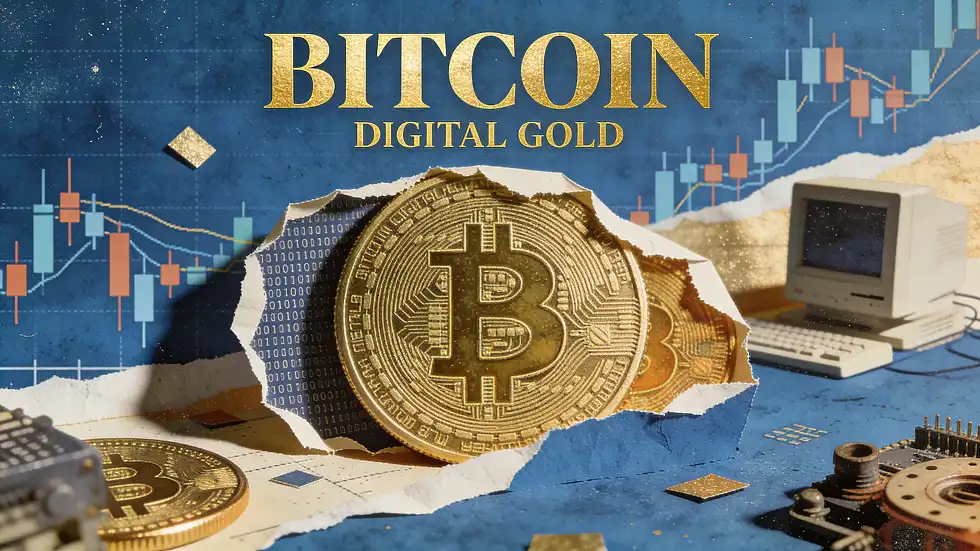
For Bitcoin, the logic of inflation is恰恰相反 (exactly the opposite). Its fixed supply of 21 million coins makes it seen as "digital gold" in an environment of fiat money over-issuance and high inflation.

Against the backdrop of geopolitical conflicts加剧 (intensifying) fiat currency credit fluctuations, more and more investors are using it as a tool to hedge against inflation and fiat depreciation.

Simultaneously, local capital in the Middle East faces a triple困境 (dilemma) of fiat depreciation, stock market crashes, and intensified geopolitical risks. They need to find borderless, jurisdiction-agnostic safe-haven assets, and cryptocurrencies have become one of the main destinations. This influx of incremental capital also offset some of the safe-haven selling pressure.

Stock market pricing is anchored to the real economy and corporate profits, while crypto market pricing is anchored to global liquidity and decentralized attributes.

For export-oriented, energy-import-dependent economies like Japan and South Korea, the Middle East war directly impacts their economic fundamentals. Soaring crude oil prices push up production costs, and against the backdrop of weak global demand, companies find it difficult to fully pass on cost pressures, significantly compressing profit margins.

Conversely, the fiat depreciation and cross-border capital controls triggered by the Middle East situation反而突出 (instead highlight) the decentralized attributes of crypto assets, making them an optional target for global capital to hedge geopolitical risks.

This is the fundamental reason for the截然不同 (starkly different) reactions of stock and crypto markets to the same geopolitical risk.

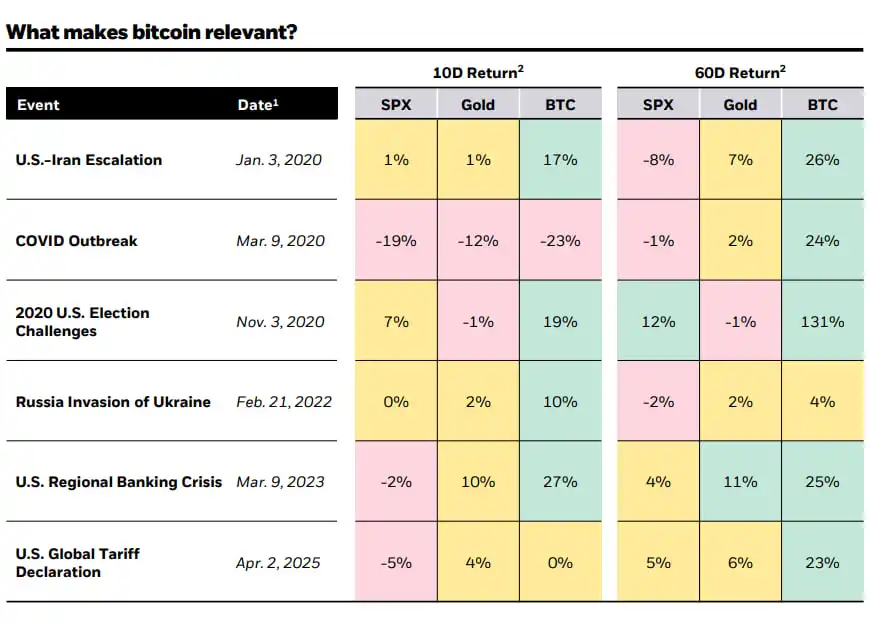
BlackRock's research has pointed out that Bitcoin's performance in the face of geopolitical shocks is better than that of gold and stocks. So far, this conclusion still holds.
Market participant structure determines volatility.

The sharp fall in the South Korean stock market exposed the fragility of its market structure: high foreign ownership, crowded leveraged trading, and program trading dominance.

When panic strikes, these three factors resonate, directly triggering stampede and circuit breakers.

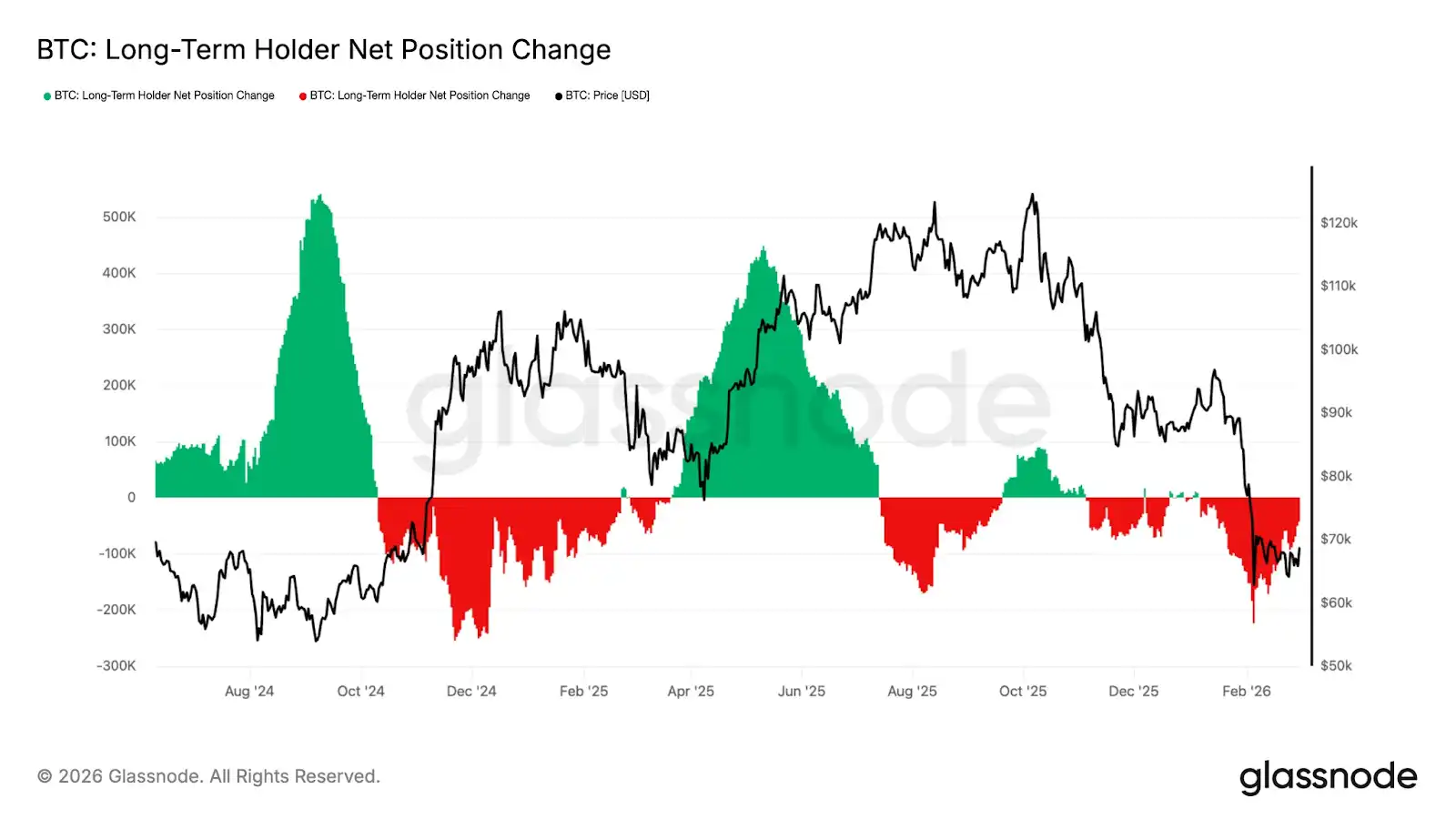
The participant structure of the crypto market has fundamentally changed. Glassnode data shows that the net position changes of Bitcoin long-term holders have趋于缓和 (tended to moderate), indicating that selling intensity is weakening.
U.S. spot Bitcoin ETFs have also brought stable institutional funds. Part of the pricing power has been transferred to institutions, which typically have more professional risk control capabilities and longer-term investment perspectives, forming a underlying liquidity support.

More importantly, the crypto market had completed multiple rounds of deleveraging before this "black swan" event爆发 (erupted). The derivatives market did not see large-scale cascading liquidations, further reducing volatility.

War is a human tragedy and a touchstone for market resilience.

Yesterday's global selling wave taught all investors a lesson.

What is "high-risk" may not truly be high risk. While the crypto market held its ground amid volatility, the traditionally "relatively stable" stock market was experiencing暴跌与熔断 (plunges and circuit breakers).

Whether this is a temporary misalignment or a change in deep logic and a rewriting of asset labels仍需时间验证 (still requires time to verify).

But in an era of normalized geopolitical risks, the pricing anchors of assets are shifting. Assets tied to a single economy will become increasingly fragile, while assets anchored to global liquidity will become increasingly resilient.

The divergence between stock and crypto markets during this U.S.-Iran war once again proves that crypto assets are gradually becoming an alternative medium that cannot be ignored in global geopolitical games.

For many countries, the Middle East war is an unavoidable economic shock. For the crypto market, the same war is a confirmation of its value logic.

When the storm comes, what matters is not where you stand, but what your anchor is tied to.

Crypto di tendenza

Domande pertinenti

QWhy did the Asia-Pacific stock markets, particularly South Korea's KOSPI, experience a significant decline on March 4th?

AThe Asia-Pacific stock markets, especially South Korea's KOSPI, plummeted due to heightened geopolitical tensions in the Middle East, which caused a sharp surge in international oil prices. South Korea, being highly dependent on Middle Eastern oil imports and having an export-oriented economy, faced increased production costs and inflation pressures. Additionally, its market structure, with high foreign ownership and leveraged retail trading, led to a cascade of selling, including foreign capital flight, leveraged position liquidations, and quantitative stop-loss triggers.

QHow did Bitcoin perform amidst the global stock market sell-off, and what was its key price movement?

ABitcoin initially experienced a brief panic sell-off but quickly stabilized and rebounded, surging past $74,000 at one point and hitting a two-week high. This contrasted sharply with the sharp declines in traditional stock markets.

QWhat factors contributed to Bitcoin's resilience and ability to rebound during the market turmoil?

ASeveral factors contributed to Bitcoin's resilience: its market operates 24/7, allowing for immediate price discovery and risk digestion before traditional markets opened; it had undergone multiple deep corrections previously, reducing valuation bubbles and leverage; it is seen as a hedge against inflation and fiat devaluation due to its fixed supply; it benefits from its decentralized, borderless nature appealing to capital seeking refuge from geopolitical risks; and its participant structure has shifted with more institutional investors through ETFs providing stable liquidity and better risk control.

QHow does the pricing anchor differ between traditional stock markets and the cryptocurrency market according to the article?

ATraditional stock markets are anchored to实体经济 and corporate earnings, meaning their value is tied to the economic fundamentals and profitability of companies within specific economies. In contrast, the cryptocurrency market, particularly Bitcoin, is anchored to global liquidity and its decentralized attributes, making it less dependent on any single economy's performance and more responsive to broader monetary policies and geopolitical shifts that affect fiat currencies.

QWhat did the market reaction during this event suggest about the changing role of crypto assets in global finance?

AThe event suggested that crypto assets are increasingly being recognized as an alternative hedge and a resilient asset class during geopolitical crises. Their performance, which contrasted with traditional markets, indicates a potential shift in asset pricing logic, where decentralized, globally anchored assets may offer more stability in times of regional economic shocks, challenging the conventional risk perceptions of cryptocurrencies.

Letture associate

Playnance’s $GCOIN Lists on KoinBX Amid Rapid Growth in India

Playnance's native token, $GCOIN, has been listed on the cryptocurrency exchange KoinBX as of June 18. This move aims to enhance accessibility for its rapidly growing community, particularly in India, where the blockchain-powered Web3 iGaming ecosystem has gained significant traction. Over 130 partners in Playnance's "Be the Boss" program have built communities engaging thousands of active players in the region. The "Be the Boss" model allows participants to create and manage their own gaming communities, earning rewards tied to community activity. CEO Pini Peter noted India's high engagement, with community leaders successfully building player networks. One partner, Dr. Nicolas, reported earning over $57,000 through the program in recent months, highlighting both the financial rewards and the opportunity to grow an engaged community. $GCOIN serves as the ecosystem's core utility token, incentivizing participation and aligning the interests of players and community leaders ("Bosses"). The listing on KoinBX is part of Playnance's strategy to expand globally, increasing the token's utility and accessibility by combining community ownership, gamified engagement, and blockchain-based incentives. Founded in 2020, Playnance is a Web3 iGaming infrastructure company focused on creating live, non-custodial, on-chain products to onboard mainstream users. It currently processes approximately one million transactions daily, aiming to simplify the user experience while maintaining full on-chain transparency.

TheNewsCrypto38 min fa

Playnance’s $GCOIN Lists on KoinBX Amid Rapid Growth in India

TheNewsCrypto38 min fa

STRC Hits Historic Low, Saylor's Perpetual Motion Machine Grinds to a Halt

STRC, the perpetual preferred stock issued by MicroStrategy to fund its Bitcoin purchases, hit a historic low of $85.32, a 17% discount to its $100 par value. Designed as a "digital credit engine" to trade stably near par and enable continuous share issuance for buying Bitcoin, its plunge signals a breakdown in this model. Three key factors drove the decline: 1. Bitcoin's price fell over 50% from its peak, trading around $63,000 amid hawkish Fed signals. 2. MicroStrategy's cash reserves were depleted after a $1.5 billion convertible note repayment, slashing the dividend coverage for STRC's 11.5% yield to ~7 months. The company then sold 32 BTC to cover dividends—Michael Saylor's first Bitcoin sale since 2022—damaging the "never sell" narrative. 3. A competing Bitcoin-backed preferred stock, Strive's SATA, offers a higher yield (~13%) and daily dividends, drawing investors away from STRC. The drop triggers a negative cycle: STRC below par halts ATM share issuances, cutting off a key funding source for Bitcoin buys and potentially forcing more BTC sales for dividends, further eroding confidence. While Saylor argues the model is mathematically sound—needing only 2.3% annual Bitcoin growth to sustain itself—the market is testing the resilience of the leveraged Bitcoin treasury strategy in a bear market. The STRC price now reflects rising skepticism about this financial machinery's durability during downturns.

marsbit59 min fa

STRC Hits Historic Low, Saylor's Perpetual Motion Machine Grinds to a Halt

marsbit59 min fa

A Guide to Grayscale’s ‘Bottom Fishing’: Using Cash Flow to Assess Cryptocurrency Value

**Title:** Grayscale's Guide to Bottom-Fishing: Valuing Cryptoassets Using Cash Flows **Summary:** This report by Grayscale Research presents a fundamental valuation framework for cryptocurrency assets, moving beyond pure speculation to analyze those with underlying cash flows. It distinguishes between "commodity-like" assets (e.g., Bitcoin) and "cash-flow" assets, primarily within DeFi. Using the leading decentralized lending protocol Aave as a case study, the analysis applies traditional financial methodologies like Discounted Cash Flow (DCF) and Price-to-Earnings (P/E) multiples. Key findings indicate that AAVE tokens are currently undervalued. Despite recent challenges, the protocol's strong revenue growth, ~50% net profit margin, and diversified treasury support a fundamental valuation range of $80-$100 per token (compared to a ~$75 market price at the time of writing). In a base-case scenario driven by stablecoin adoption and regulatory clarity, the fair value could rise to around $175 within a year. The report emphasizes that protocol success does not automatically translate to token value. It critically examines the "value capture" mechanisms—such as buybacks, burns, and staking rewards—that channel protocol profits to token holders. Furthermore, it addresses the legal and governance complexities of Decentralized Autonomous Organizations (DAOs), noting their difference from traditional corporate equity but highlighting how robust, transparent governance can align protocol economics with holder interests. The conclusion is that the crypto market is maturing, with capital increasingly flowing towards projects with demonstrable fundamentals, real adoption, and disciplined capital allocation, creating opportunities for value-based investors.

marsbit2 h fa

A Guide to Grayscale’s ‘Bottom Fishing’: Using Cash Flow to Assess Cryptocurrency Value

marsbit2 h fa

After semiconductors lead the gains, are funds buying into AI orders or a macroeconomic rebound?

After US-Iran talks led to a temporary ceasefire and framework for reopening the strategic Strait of Hormuz, U.S. stocks rose on June 18, with the Nasdaq gaining 1.9%. The semiconductor and AI hardware sectors outperformed. This rally stemmed primarily from reduced geopolitical risk, which lowered oil prices and inflation expectations, easing discount rate pressure on high-valuation growth stocks like tech. The key question is not whether tech rebounded, but the nature of the rebound. The market appears to be selectively repricing AI infrastructure plays rather than broadly chasing AI narratives. Gains were concentrated in chips, optical interconnects, memory, and domestic manufacturing—segments tied to tangible data center build-outs and capital expenditure. Intel's ~10% surge, fueled by a Trump statement about potential Apple collaboration, exemplifies this mixed dynamic. It reflects policy catalysts and domestic manufacturing sentiment more than confirmed fundamentals. Meanwhile, strong earnings from companies like Astera Labs (revenue up 93% YoY) provided concrete evidence of AI-driven demand in hardware. In essence, the rally represents a risk-premium recalibration. Lower Middle East tensions opened a valuation repair window, and capital flowed first into AI infrastructure segments with visible near-term revenue streams. The sustainability of this move hinges on upcoming Q2 earnings, specifically continued strength in cloud provider capex, AI server orders, and hardware company guidance. Policy hopes alone are insufficient; the cycle needs validation from orders and financials.

marsbit2 h fa

After semiconductors lead the gains, are funds buying into AI orders or a macroeconomic rebound?

marsbit2 h fa

Trading

Spot
Futures

Articoli Popolari

Come comprare 4

Benvenuto in HTX.com! Abbiamo reso l'acquisto di 4 (4) semplice e conveniente. Segui la nostra guida passo passo per intraprendere il tuo viaggio nel mondo delle criptovalute.Step 1: Crea il tuo Account HTXUsa la tua email o numero di telefono per registrarti il tuo account gratuito su HTX. Vivi un'esperienza facile e sblocca tutte le funzionalità,Crea il mio accountStep 2: Vai in Acquista crypto e seleziona il tuo metodo di pagamentoCarta di credito/debito: utilizza la tua Visa o Mastercard per acquistare immediatamente 44.Bilancio: Usa i fondi dal bilancio del tuo account HTX per fare trading senza problemi.Terze parti: abbiamo aggiunto metodi di pagamento molto utilizzati come Google Pay e Apple Pay per maggiore comodità.P2P: Fai trading direttamente con altri utenti HTX.Over-the-Counter (OTC): Offriamo servizi su misura e tassi di cambio competitivi per i trader.Step 3: Conserva 4 (4)Dopo aver acquistato 4 (4), conserva nel tuo account HTX. In alternativa, puoi inviare tramite trasferimento blockchain o scambiare per altre criptovalute.Step 4: Scambia 4 (4)Scambia facilmente 4 (4) nel mercato spot di HTX. Accedi al tuo account, seleziona la tua coppia di trading, esegui le tue operazioni e monitora in tempo reale. Offriamo un'esperienza user-friendly sia per chi ha appena iniziato che per i trader più esperti.

359 Totale visualizzazioniPubblicato il 2025.10.20Aggiornato il 2026.06.02

Come comprare 4

Discussioni

Benvenuto nella Community HTX. Qui puoi rimanere informato sugli ultimi sviluppi della piattaforma e accedere ad approfondimenti esperti sul mercato. Le opinioni degli utenti sul prezzo di 4 4 sono presentate come di seguito.

活动图片