What Will End the AI Bull Market: Positioning or Narrative?

marsbitPubblicato 2026-05-14Pubblicato ultima volta 2026-05-14

Introduzione

Who Will End the AI Bull Market: Overcrowded Positions or the Narrative Itself? The US stock market's relentless rally, led by AI-themed stocks, faces a growing contradiction. Technically, positioning appears dangerously stretched: the S&P 500's six-week winning streak is historically extreme, and Goldman Sachs's Risk Appetite Indicator signals potential for a pullback. Many hot sectors are in extreme overbought territory, with mechanical fund flows suggesting the market is at or near maximum long positioning, limiting upside and creating pressure for a reset. However, shorting is difficult due to volatile exit timing and the risk of a sharp short squeeze. Fundamentally, the AI narrative remains robust, propping up sentiment. Strong corporate earnings, contained inflation concerns, and absorbed geopolitical risks provide no clear catalyst for a bear market. Yet, market performance has become excessively concentrated. Without AI contributions, broader market returns would be mediocre; semiconductors alone accounted for nearly 40% of gains since March. The market has shifted into a "greed mode," overlooking previous concerns about AI costs, energy bottlenecks, pricing wars, and security issues. The core risk is the interplay between these two factors. Nomura strategist Charlie McElligott warns that a sudden, DeepSeek-style negative catalyst could trigger a Nasdaq limit-down event, with semiconductor ETFs potentially plunging 15% in a day. The same mechanical flows that fuele...

Author: Long Yue

Source: Wall Street News

The sharper the market rallies, the harder it becomes to find reasons for a decline — but the risks have not disappeared; they are merely hidden deeper.

On May 14, Bloomberg market analyst Jon-Patrick Barnert pointed out in an article that while the current U.S. stock market rally has surged significantly, the cost and timing for shorting remain difficult to gauge. More troublingly, even the question of "what the most compelling reason to short is" has become blurry.

The core contradiction of this rally is: positioning has become extremely crowded, yet the fundamental narrative — especially AI — continues to support market sentiment. Between these two, which will crack first?

Positioning: The Market is Approaching "Max Long"

From a pure price action perspective, signals for a pullback are already quite evident.

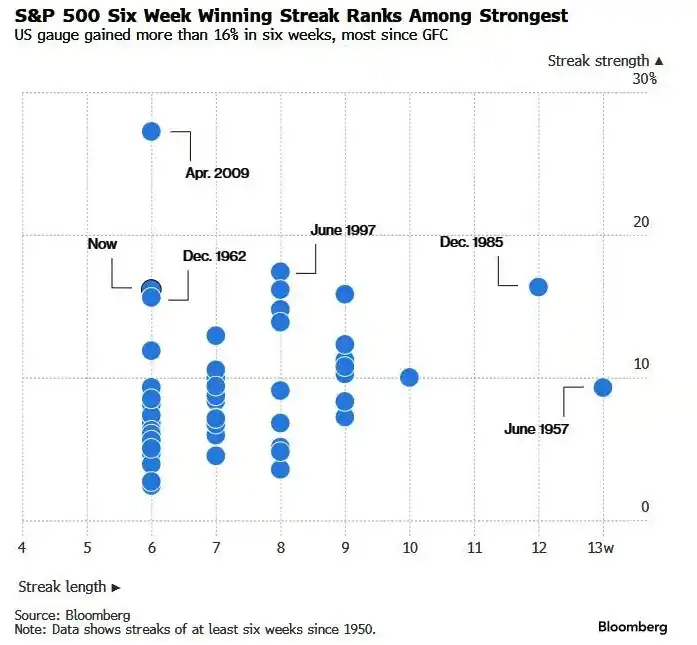
The S&P 500's six-week winning streak is not only one of the longest such runs in over 70 years, but the magnitude of gains also ranks among the strongest in history. Barnert stated that "taking a breather" would be perfectly normal for this market.
Goldman Sachs's Risk Appetite Indicator has risen back to 1, the first time since the beginning of the year. It is extremely rare for this indicator to exceed 1, and historically, it has often signaled a potential pullback. The last time it breached this threshold was in 2021, after which the market entered a bear phase.

Looking at the hottest thematic stocks, Barnert describes a market where "everything is overbought," with some of the most popular sectors reaching extreme overbought levels. Combined with mechanical fund inflows — which currently appear to be at or near maximum long positioning — the overall picture is: limited upside, and significant potential pressure from positioning resets.
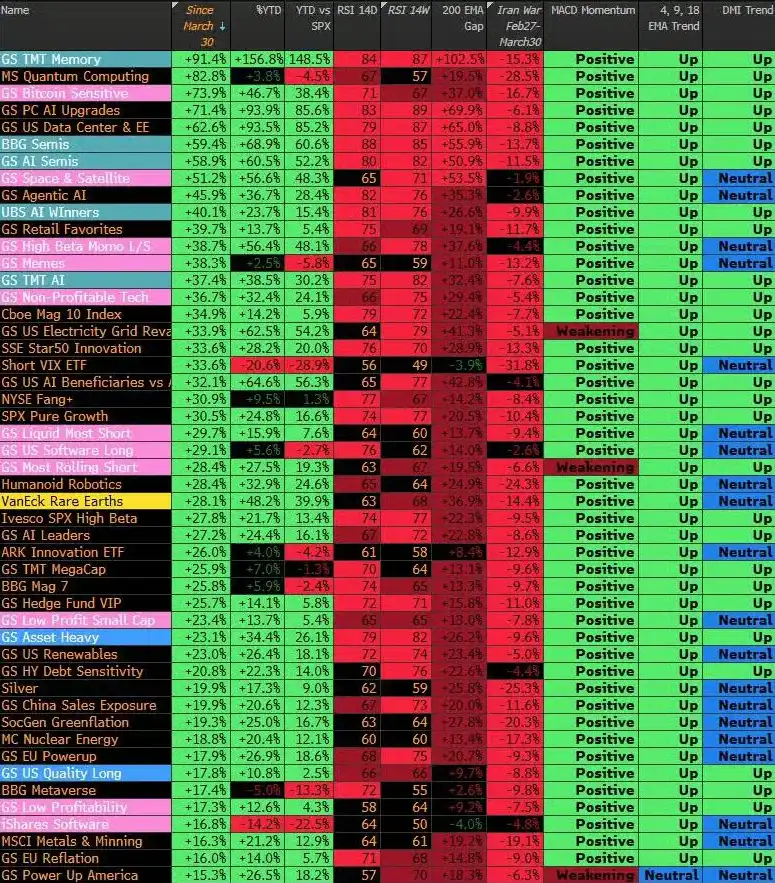
However, shorting is not easy. Barnert points out that position adjustments can be completed within a single day, making the entry and exit timing for short trades extremely difficult to manage. If the market chooses to "decline slowly," volatility positions would quietly become ineffective in a mild environment. A more likely scenario is: overall sentiment remains bullish, and if short sellers are forced to cover their positions, it could trigger another round of short squeezes, pushing prices higher and faster than anyone expected.

Fund flows in some popular ETFs have begun to show subtle shifts — leaning towards "locking in gains" rather than "chasing highs." But Barnert also admits this trend has persisted for weeks and has not yet had a material impact on market direction.

Narrative: Without AI, The Market is Nothing

If positioning is a technical vulnerability, the narrative level currently appears even more solid.

Barnert notes that there is currently a lack of clear signals triggering a fundamental bear market. Corporate earnings remain strong, inflation expectations have risen slightly but not to extreme levels. The market has digested the shocks of high oil prices and Middle East tensions, and the latest U.S. jobs data has alleviated recession fears. As for interest rate hike expectations, they are no longer a catalyst suppressing stocks.
But one issue cannot be ignored: the concentration of this rally has become highly focused on "the concentration itself."

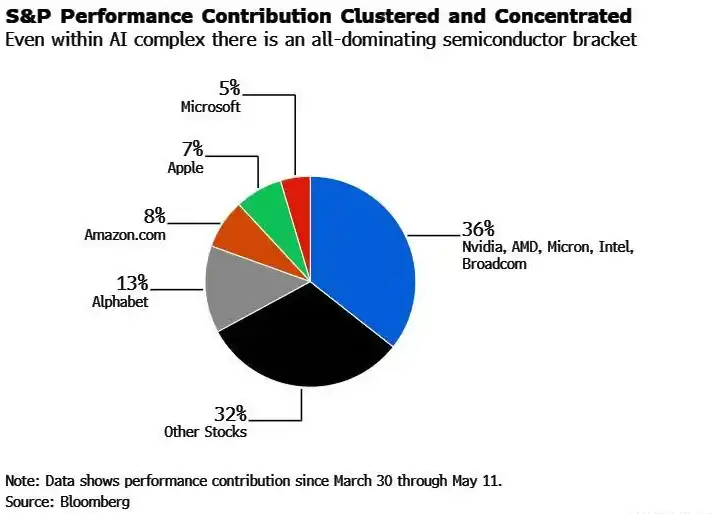
Barnert points out that whether comparing the performance of indices with and without AI, or dissecting the sources of gains since March, the conclusion points in the same direction: without AI, this market's performance can only be described as "mediocre." More notably, the semiconductor sector alone contributed nearly 40% of the gains since March.
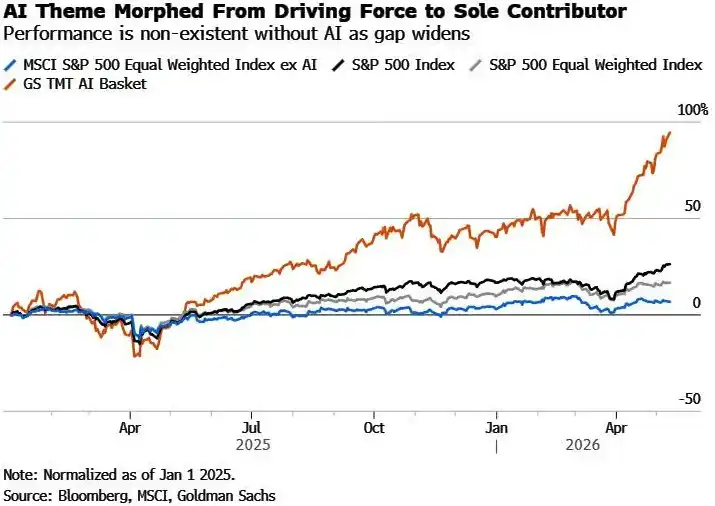
The market narrative surrounding AI has once again entered a "greed mode," a stage of pursuing unreasonable returns rather than rational, reasonable gains. The concerns widely discussed just months ago — whether AI computing costs can be offset by layoff savings, data center energy supply bottlenecks, AI pricing wars eroding profit margins, new competitors disrupting the landscape with lower costs, massive growth in capital expenditures while stock buybacks stall, AI security risks — now seem to have been collectively forgotten by the market.

The Risk of a "DeepSeek Moment" Repeat

Nomura Securities strategist Charlie McElligott issued the most direct warning on this matter.

He stated: "Given the current market structure and thematic overlap, if another fully-fledged, system-wide shock catalyst like a 'DeepSeek-style' event emerges one day, it could directly trigger a Nasdaq-level limit-down style of trade."

McElligott further noted that in such a scenario, semiconductor ETFs could easily drop 15% in a single day — because "the hypothetical reversal of reflexive, mechanical fund flows would create large-scale overshooting on the downside."

In other words, the very same mechanical fund flows (like CTA strategies, risk parity funds, etc.) that kept buying on the way up would, once triggered to reverse, become amplifiers accelerating the decline.

The AI bull market faces two major risks: one technical (overly crowded positioning), and one narrative-based (whether the AI story can hold). The former could trigger at any time; the latter, once broken, would deliver a deeper shock. Combined, they constitute the most noteworthy structural vulnerability in the current market.


Domande pertinenti

QAccording to the article, what are the two core competing factors that could end the current AI bull market?

AThe two core competing factors are: 1) Market Positioning / Overcrowded long positions, and 2) The Sustainability of the Fundamental AI Narrative.

QWhat does the Goldman Sachs Risk Appetite Indicator reading of 1, and its historical behavior, suggest about the market's near-term risk?

AThe Goldman Sachs Risk Appetite Indicator reaching 1, its highest level since the start of the year, is an extremely rare occurrence. Historically, readings above this threshold have often signaled an impending market correction. The last time it breached this level was in 2021, which preceded a bear market.

QHow does the article describe the market's dependence on AI-related stocks for its overall performance?

AThe article states that the market's performance is highly concentrated on AI. It points out that without AI, the market's performance would be 'mediocre' or 'nothing'. Specifically, the semiconductor sector alone contributed nearly 40% of the market's gains since March.

QWhat scenario does Nomura strategist Charlie McElligott warn could trigger a severe market downturn?

ACharlie McElligott warns that another widespread 'DeepSeek-style' shock catalyst could directly trigger a Nasdaq-level limit-down (trading halt) event. In such a scenario, semiconductor ETFs could easily fall 15% in a single day due to a reversal of reflexive, mechanical capital flows leading to a large-scale overshoot on the downside.

QWhy is it difficult to profit from a short-selling strategy in the current market environment, as per analyst Jon-Patrick Barnert?

AShort-selling is difficult because: 1) Position adjustments could happen within a single day, making timing entry and exit extremely hard. 2) If the market declines slowly, volatility-based short positions could quietly expire worthless. 3) The prevailing bullish sentiment means any short squeeze could trigger another rapid rally, moving faster than expected and causing losses for shorts.

Letture associate

GitHub, Transfixed by AI

On the night of February 9th, GitHub suffered a major outage caused by a simple configuration change—reducing a cache refresh interval from 12 to 2 hours—that triggered a cascade of failures. This was not an isolated event, but part of a broader pattern. In early 2026, GitHub experienced at least 8 major incidents, failing to meet its promised 99.9% availability. These outages stemmed from structural issues: explosive growth in load, tight service coupling, and insufficient protection against abnormal traffic. This unprecedented load is driven by AI Agents. In 2025, GitHub handled ~1 billion commits. By 2026, weekly commits reached 275 million, projecting to ~14 billion for the year—a 14x increase. AI tools like Claude Code now contribute 4.5% of all public repository commits, with weekly submissions surging 25x in just three months. AI-generated pull requests jumped from 4 million to 17 million per month in half a year. Unlike human developers, AI Agents work continuously, generating commits at a scale that overwhelms infrastructure designed for human rhythms. The surge also shattered GitHub's business model. Copilot's flat-rate pricing, based on assisting human developers, became unsustainable as Agentic AI sessions consumed resources worth hundreds of dollars for a few dollars in fees. In response, GitHub imposed usage limits and, by June 1st, shifted to a pay-per-use "AI Credits" system. Facing this new reality, GitHub realized a 10x scaling plan was insufficient. It announced a need to *redesign* its architecture for 30x current scale—decoupling services, adding fault isolation, and improving change management to prevent cascading failures. Other platforms like Stripe and AWS are facing similar challenges with AI Agents. Fundamentally, GitHub is transitioning from a human collaboration platform to an "exhaust pipe" for automated AI workflows. Its detailed post-mortem reports aim to maintain trust during this turbulent rebuild. The February outage was not just a technical glitch, but a signal of the software industry's entry into a new, AI-driven era.

marsbit15 min fa

GitHub, Transfixed by AI

marsbit15 min fa

Both Suffer Massive Losses Exceeding $90 Billion, Which Is in Greater Peril: Strategy or Bitmine?

Facing massive paper losses exceeding $90 billion each amidst a sharp market downturn, "Digital Asset Treasury" (DAT) giants Strategy and Bitmine find themselves in a precarious position, but with different underlying risks. Strategy, heavily invested in Bitcoin (BTC), faces significant financial strain. Its strategy relies heavily on debt, including convertible notes and preferred stock (STRC) requiring substantial dividend payments. With its cash reserves dwindling and BTC offering no staking yield for cash flow, Strategy's high leverage makes it vulnerable. A continued price decline could force asset sales to meet obligations, potentially creating a negative feedback loop. Its market value has already fallen sharply. In contrast, Bitmine, an Ethereum (ETH) holder, appears on firmer financial ground. It primarily funds its purchases through equity offerings (like ATM programs), avoiding debt pressure. It also generates income by staking a large portion of its ETH holdings. While not immune to market drops and shareholder dilution concerns, Bitmine maintains more flexibility, recently announcing a new preferred share offering to raise further capital. The core divergence lies in their financing: Bitmine uses equity (investor money), while Strategy uses debt (borrowed money). Consequently, Bitmine currently faces less immediate liquidity pressure than Strategy, which must navigate the dual challenge of servicing debt/dividends and a declining core asset (BTC) price.

marsbit22 min fa

Both Suffer Massive Losses Exceeding $90 Billion, Which Is in Greater Peril: Strategy or Bitmine?

marsbit22 min fa

Where the AI Bubble Really Is: Which Layer of Players Are Naked

AI Bubble: Where It Really Is and Who's Swimming Naked This analysis dissects the AI industry not as a single entity but as a five-layer pyramid, arguing that bubbles are concentrated in specific tiers, not uniformly distributed. **Key Distinction from the 2000 Dot-com Bubble:** Unlike 2000, where companies had stock prices before revenue, today's leading AI players have massive, contract-backed revenue driving their valuations. Core infrastructure demand is real, with every GPU running at full capacity for paying customers. **The Five-Layer Pyramid & Bubble Assessment:** * **L0 (Fab/Manufacturing) & Top L4 (Leading AI Apps): NO BUBBLE.** Companies like TSMC, NVIDIA, major cloud providers (Microsoft, Google, Meta, Amazon), and top AI labs have real revenues and orders. Supply is tightly constrained by TSMC's disciplined capacity control and physical limits like power/land for data centers, preventing a supply glut. * **L1 (Memory): BATTLEGROUND.** Sky-high HBM margins could signal a new structural cycle or a classic "boom before bust." The oligopoly of three major players may enforce supply discipline, making this a high-stakes bet. * **L2 (Interconnect/Optical Modules): BUBBLE TERRITORY.** Companies like Lumentum and AAOI have seen stock surges (4-10x) far outpacing revenue growth. This hardware segment has lower physical barriers to expansion than fabs, allowing speculation. It mirrors the 2000 bubble's epicenter—optics. * **L3 (Infrastructure/"GPU Landlords"): VULNERABLE.** GPU leasing companies profit from the current compute shortage but own no long-term moat. Their business model relies on a temporary bottleneck that will ease as big tech expands and new tech (e.g., potential space-based data centers) emerges. * **L4 Long Tail (VC-backed Startups): STRONG BUBBLE SIGNALS.** VC funding concentration in AI is twice that of the 1999 peak. Many startups with little revenue use the valuation logic of successful giants to justify their own, creating high risk of a "valuation crunch" when funding dries up. **Critical Risks to Monitor:** 1. **GPU Depreciation & Accounting:** Companies extending the assumed useful life of GPUs artificially boost profits. The true economic life depends on future generational leaps from NVIDIA. 2. **"GPU Credit" & Off-Balance-Sheet Leverage:** Emerging structures where shell companies borrow to buy GPUs and lease them out (with chipmakers sometimes investing) move debt off major balance sheets. This echoes the "vendor financing" of 2000 and the securitization risks of 2008, though currently small-scale. 3. **TSMC Abandoning Caution:** If the primary supply bottleneck (TSMC's conservative capacity planning) breaks, runaway supply could trigger a bust. 4. **Algorithmic Efficiency Breakthrough:** A major leap in software efficiency could drastically reduce the need for raw compute hardware, undermining the investment thesis. **Conclusion:** The AI boom is expensive and has frothy areas, but its core is underpinned by real demand and physical supply constraints. The bubble risk is layered: most present in optical components, GPU leasing, and the long-tail startup ecosystem, while the foundational chip manufacturing and leading application layers remain relatively solid—for now.

marsbit35 min fa

Where the AI Bubble Really Is: Which Layer of Players Are Naked

marsbit35 min fa

Trading

Spot
Futures
活动图片




