What Will End the AI Bull Market: Positioning or Narrative?

marsbitPubblicato 2026-05-14Pubblicato ultima volta 2026-05-14

Introduzione

Who Will End the AI Bull Market: Overcrowded Positions or the Narrative Itself? The US stock market's relentless rally, led by AI-themed stocks, faces a growing contradiction. Technically, positioning appears dangerously stretched: the S&P 500's six-week winning streak is historically extreme, and Goldman Sachs's Risk Appetite Indicator signals potential for a pullback. Many hot sectors are in extreme overbought territory, with mechanical fund flows suggesting the market is at or near maximum long positioning, limiting upside and creating pressure for a reset. However, shorting is difficult due to volatile exit timing and the risk of a sharp short squeeze. Fundamentally, the AI narrative remains robust, propping up sentiment. Strong corporate earnings, contained inflation concerns, and absorbed geopolitical risks provide no clear catalyst for a bear market. Yet, market performance has become excessively concentrated. Without AI contributions, broader market returns would be mediocre; semiconductors alone accounted for nearly 40% of gains since March. The market has shifted into a "greed mode," overlooking previous concerns about AI costs, energy bottlenecks, pricing wars, and security issues. The core risk is the interplay between these two factors. Nomura strategist Charlie McElligott warns that a sudden, DeepSeek-style negative catalyst could trigger a Nasdaq limit-down event, with semiconductor ETFs potentially plunging 15% in a day. The same mechanical flows that fuele...

Author: Long Yue

Source: Wall Street News

The sharper the market rallies, the harder it becomes to find reasons for a decline — but the risks have not disappeared; they are merely hidden deeper.

On May 14, Bloomberg market analyst Jon-Patrick Barnert pointed out in an article that while the current U.S. stock market rally has surged significantly, the cost and timing for shorting remain difficult to gauge. More troublingly, even the question of "what the most compelling reason to short is" has become blurry.

The core contradiction of this rally is: positioning has become extremely crowded, yet the fundamental narrative — especially AI — continues to support market sentiment. Between these two, which will crack first?

Positioning: The Market is Approaching "Max Long"

From a pure price action perspective, signals for a pullback are already quite evident.

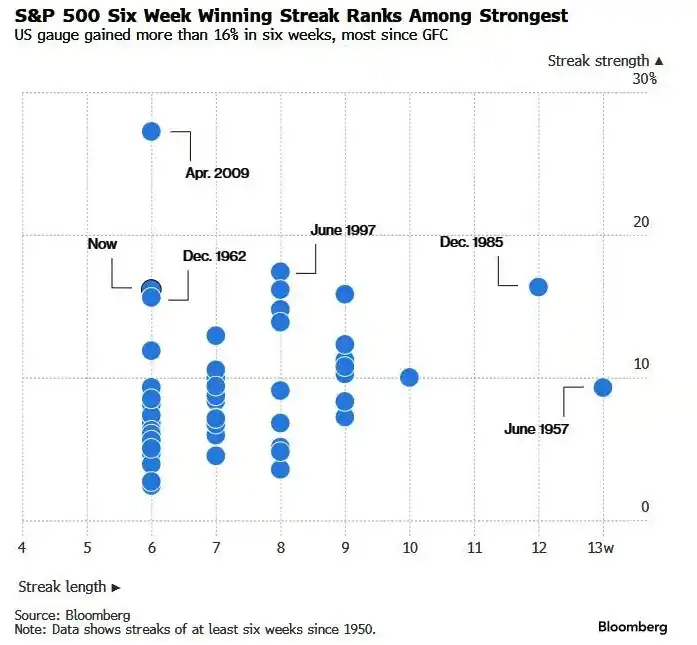
The S&P 500's six-week winning streak is not only one of the longest such runs in over 70 years, but the magnitude of gains also ranks among the strongest in history. Barnert stated that "taking a breather" would be perfectly normal for this market.
Goldman Sachs's Risk Appetite Indicator has risen back to 1, the first time since the beginning of the year. It is extremely rare for this indicator to exceed 1, and historically, it has often signaled a potential pullback. The last time it breached this threshold was in 2021, after which the market entered a bear phase.

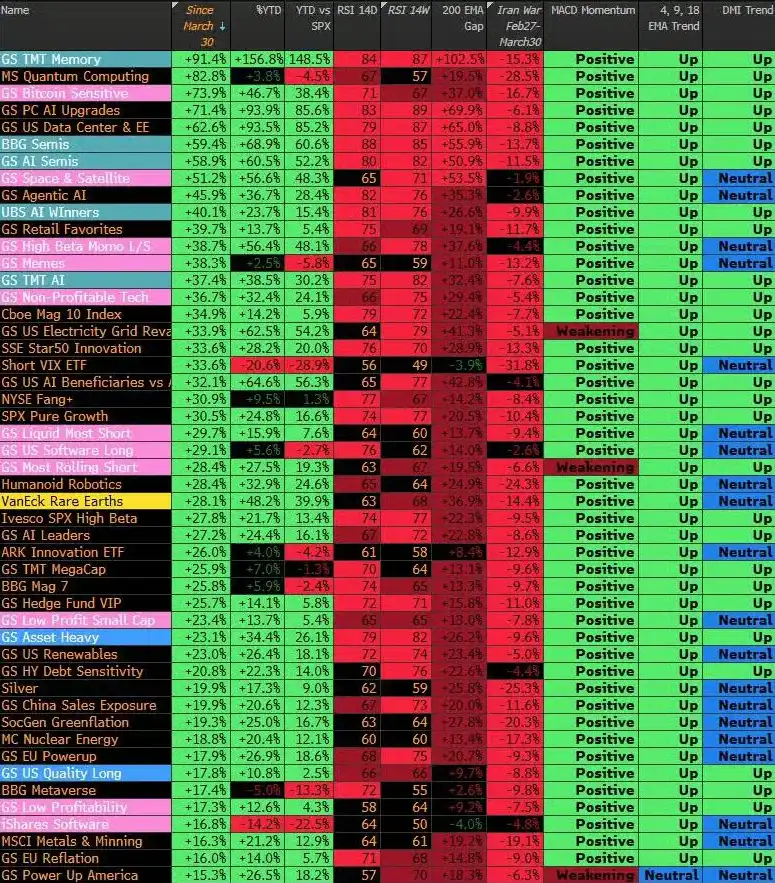
Looking at the hottest thematic stocks, Barnert describes a market where "everything is overbought," with some of the most popular sectors reaching extreme overbought levels. Combined with mechanical fund inflows — which currently appear to be at or near maximum long positioning — the overall picture is: limited upside, and significant potential pressure from positioning resets.
However, shorting is not easy. Barnert points out that position adjustments can be completed within a single day, making the entry and exit timing for short trades extremely difficult to manage. If the market chooses to "decline slowly," volatility positions would quietly become ineffective in a mild environment. A more likely scenario is: overall sentiment remains bullish, and if short sellers are forced to cover their positions, it could trigger another round of short squeezes, pushing prices higher and faster than anyone expected.

Fund flows in some popular ETFs have begun to show subtle shifts — leaning towards "locking in gains" rather than "chasing highs." But Barnert also admits this trend has persisted for weeks and has not yet had a material impact on market direction.

Narrative: Without AI, The Market is Nothing

If positioning is a technical vulnerability, the narrative level currently appears even more solid.

Barnert notes that there is currently a lack of clear signals triggering a fundamental bear market. Corporate earnings remain strong, inflation expectations have risen slightly but not to extreme levels. The market has digested the shocks of high oil prices and Middle East tensions, and the latest U.S. jobs data has alleviated recession fears. As for interest rate hike expectations, they are no longer a catalyst suppressing stocks.
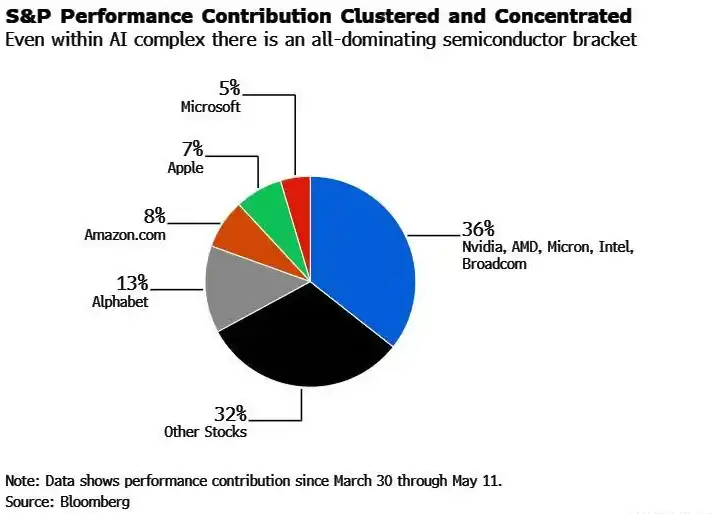
But one issue cannot be ignored: the concentration of this rally has become highly focused on "the concentration itself."

Barnert points out that whether comparing the performance of indices with and without AI, or dissecting the sources of gains since March, the conclusion points in the same direction: without AI, this market's performance can only be described as "mediocre." More notably, the semiconductor sector alone contributed nearly 40% of the gains since March.
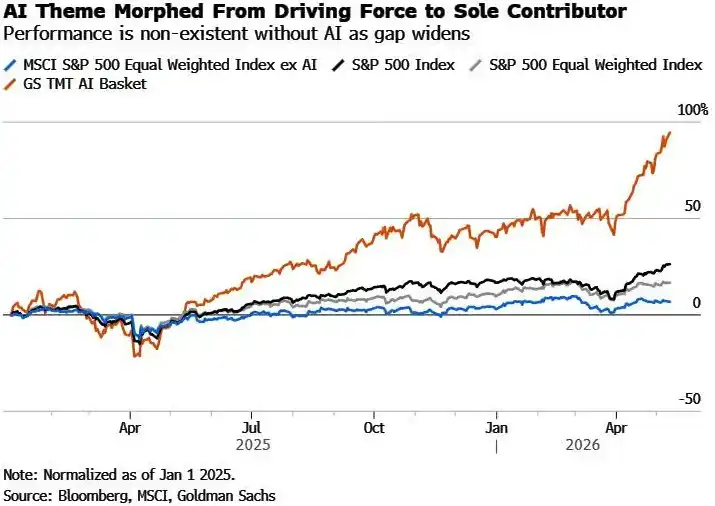
The market narrative surrounding AI has once again entered a "greed mode," a stage of pursuing unreasonable returns rather than rational, reasonable gains. The concerns widely discussed just months ago — whether AI computing costs can be offset by layoff savings, data center energy supply bottlenecks, AI pricing wars eroding profit margins, new competitors disrupting the landscape with lower costs, massive growth in capital expenditures while stock buybacks stall, AI security risks — now seem to have been collectively forgotten by the market.

The Risk of a "DeepSeek Moment" Repeat

Nomura Securities strategist Charlie McElligott issued the most direct warning on this matter.

He stated: "Given the current market structure and thematic overlap, if another fully-fledged, system-wide shock catalyst like a 'DeepSeek-style' event emerges one day, it could directly trigger a Nasdaq-level limit-down style of trade."

McElligott further noted that in such a scenario, semiconductor ETFs could easily drop 15% in a single day — because "the hypothetical reversal of reflexive, mechanical fund flows would create large-scale overshooting on the downside."

In other words, the very same mechanical fund flows (like CTA strategies, risk parity funds, etc.) that kept buying on the way up would, once triggered to reverse, become amplifiers accelerating the decline.

The AI bull market faces two major risks: one technical (overly crowded positioning), and one narrative-based (whether the AI story can hold). The former could trigger at any time; the latter, once broken, would deliver a deeper shock. Combined, they constitute the most noteworthy structural vulnerability in the current market.


Domande pertinenti

QAccording to the article, what are the two core competing factors that could end the current AI bull market?

AThe two core competing factors are: 1) Market Positioning / Overcrowded long positions, and 2) The Sustainability of the Fundamental AI Narrative.

QWhat does the Goldman Sachs Risk Appetite Indicator reading of 1, and its historical behavior, suggest about the market's near-term risk?

AThe Goldman Sachs Risk Appetite Indicator reaching 1, its highest level since the start of the year, is an extremely rare occurrence. Historically, readings above this threshold have often signaled an impending market correction. The last time it breached this level was in 2021, which preceded a bear market.

QHow does the article describe the market's dependence on AI-related stocks for its overall performance?

AThe article states that the market's performance is highly concentrated on AI. It points out that without AI, the market's performance would be 'mediocre' or 'nothing'. Specifically, the semiconductor sector alone contributed nearly 40% of the market's gains since March.

QWhat scenario does Nomura strategist Charlie McElligott warn could trigger a severe market downturn?

ACharlie McElligott warns that another widespread 'DeepSeek-style' shock catalyst could directly trigger a Nasdaq-level limit-down (trading halt) event. In such a scenario, semiconductor ETFs could easily fall 15% in a single day due to a reversal of reflexive, mechanical capital flows leading to a large-scale overshoot on the downside.

QWhy is it difficult to profit from a short-selling strategy in the current market environment, as per analyst Jon-Patrick Barnert?

AShort-selling is difficult because: 1) Position adjustments could happen within a single day, making timing entry and exit extremely hard. 2) If the market declines slowly, volatility-based short positions could quietly expire worthless. 3) The prevailing bullish sentiment means any short squeeze could trigger another rapid rally, moving faster than expected and causing losses for shorts.

Letture associate

Why Haven't Forex Stablecoins Taken Off?

Why FX Stablecoins Never Took Off: A Path Forward via Synthetic FX Despite the explosive growth of stablecoin-powered digital banking, which has seen ~$6B in VC investment and a 24x surge in crypto card spending in under a year, a major limitation persists: these banks are essentially dollar-only accounts. This leaves 95-99% of global accounts, which are denominated in non-USD currencies, underserved. Attempts to create native foreign currency (FX) stablecoins (like EURC) have largely failed, with total FX stablecoin TVL at ~$600M compared to $400B for USD stablecoins—a 700x gap. These FX tokens face critical challenges: fragile pegs due to low liquidity, limited exchange/FinTech acceptance, poor on/off-ramps, complex regional compliance, and a chicken-and-egg adoption problem. The article argues that the solution lies not in competing with entrenched USD stablecoin networks (USDT/USDC), but in adopting a synthetic FX model inspired by traditional finance. Specifically, it advocates for Mark-to-Market Non-Deliverable Forwards (NDFs)—cash-settled FX derivatives that allow users to maintain underlying USD stablecoin holdings while having their account balance and P&L denominated in a foreign currency. This approach offers key advantages: strong oracle-based pegs, retention of deep USD stablecoin liquidity and yield, superior on/off-ramps, scalability to any currency with a reliable feed, and capital efficiency. It mirrors how modern institutional FX markets operate. Primary use cases for on-chain NDFs include: 1. **Digital Banks/Wallets:** Enabling multi-currency accounts for international users without leaving the USD stablecoin ecosystem, boosting deposits and retention. 2. **FX Carry Trade Vaults:** Offering access to sovereign interest rate differentials (e.g., earning yield on BRL) in a more stable and scalable format than crypto-native products like Ethena. 3. **Global Enterprise Payments:** Allowing merchants to receive payments in local currency equivalents while settling in USD stablecoins, similar to services offered by Stripe for fiat. The conclusion is that synthetic FX, not native FX stablecoins, is the viable path to integrating foreign exchange into the growing stablecoin digital banking landscape, potentially unlocking the next phase of institutional DeFi and multi-trillion-dollar global adoption.

链捕手28 min fa

Why Haven't Forex Stablecoins Taken Off?

链捕手28 min fa

IOSG Founder: Web3 Is 'Losing Blood,' How Can Practitioners Survive Better?

IOSG Founder: Web3 Is "Bleeding Out" – How Can Practitioners Survive Better? In a candid reflection, the founder of IOSG Ventures voices deep concerns about the current state of Web3, describing an ecosystem experiencing severe "blood loss." Despite the recent MuShanghai event showcasing a successful pivot towards a more diverse, global community, a somber reality persists: many crypto-native attendees were there exploring exits or new labels in biotech, AI, and robotics. The core issue is identified as a breakdown in the ecosystem's positive feedback loop. Alarmingly, underestimated "low-probability bad events" are occurring simultaneously: a significant brain drain of Chinese developers to AI, a lack of breakout applications despite massive funding, and a widening credibility gap for practitioners globally, often stigmatized as scam artists. This has created a dire接班人 (successor) problem, with the next generation seeing little professional prestige or financial upside in crypto compared to fields like AI. A significant portion of the critique focuses on Ethereum and Vitalik Buterin. While not pessimistic about Ethereum's technology, the founder worries that critical development windows were missed by focusing on niche technical narratives like ZK and L2 instead of mass-market applications. A more urgent concern is that Vitalik may be isolated in an "information bubble," shielded from the grassroots community's hardships by layers of intermediaries, preventing crucial feedback from reaching him. The call is for Vitalik to return to a founder's mindset, re-engage directly with the community, and rally efforts for the next decade. The divergence between U.S. and Chinese OG (Original Gangster) ecosystems is stark. While many U.S. builders reinvest their wealth into the ecosystem, the Chinese scene suffers from a severe lack of "造血能力" (blood-making ability), with most market-driven funds struggling and many early success stories cashing out entirely. This threatens the entire Asian Web3 ecosystem's survival. For individual practitioners, survival advice is pragmatic: find your core "why," maintain life balance beyond token prices, continuously learn new skills (like AI), form small, trusted alliances for mutual support, and practice self-compassion. The industry's greatest need is not money or tech, but lighthouses—individuals at all levels who offer mentorship, grants, referrals, and honest reflection to guide others. The piece concludes with a direct appeal: OGs must pay forward the opportunities the industry gave them; founders must not struggle alone; and builders must continue their work, ensuring it remains a viable profession. The survival of Web3's "cathedral" depends not on any single leader but on the collective responsibility of everyone who remains.

marsbit1 h fa

IOSG Founder: Web3 Is 'Losing Blood,' How Can Practitioners Survive Better?

marsbit1 h fa

Deficits, Inflation, and the New Fed: The Deep Logic Behind US Bond Yields Breaking 5% and the Market Reset

In the week of May 15-19, 2026, U.S. long-term Treasury yields surged to multi-year highs, with the 30-year yield hitting 5.2%, a level unseen since 2007, and the 10-year yield climbing to 4.687%. Equity markets declined in response. Four primary factors are driving the rise in yields. First, stubborn inflation persists, with April wholesale prices rising 6% year-over-year, fueling expectations of potential future Fed rate hikes instead of cuts. Second, newly confirmed Fed Chair Kevin Warsh inherits a complex inflation battle, with markets closely awaiting his first FOMC meeting. Third, deteriorating U.S. fiscal health, marked by large deficits and rising debt servicing costs, is eroding the traditional "safe-haven" premium for Treasuries. Fourth, the "One Big Beautiful Bill" tax cuts are projected to add trillions to the national debt, contributing to Moody's recent credit rating downgrade. Rising yields pressure stocks through several channels: a higher discount rate reduces the present value of future earnings (especially for growth stocks); rising risk-free rates compress equity risk premiums, making bonds relatively more attractive; higher borrowing costs impact consumers and corporations; and a stronger dollar affects multinational earnings. For investors, the environment favors value and financial stocks over long-duration growth stocks. Bond investors find attractive yields in short to intermediate maturities, while income investors see the best fixed-income opportunities in over a decade. Key developments to watch include Chair Warsh's first FOMC meeting, upcoming inflation data, Treasury auction demand, and whether the 30-year yield approaches 6%, a level that could trigger a more sustained equity valuation reset. The bond market's message is clear: the era of cheap government borrowing is over, posing a central challenge for markets in late 2026.

marsbit1 h fa

Deficits, Inflation, and the New Fed: The Deep Logic Behind US Bond Yields Breaking 5% and the Market Reset

marsbit1 h fa

Is MicroStrategy Selling Bitcoin Not a Bearish Signal? Deconstructing the 5 Financial Logics Behind Corporate Bitcoin Divestment

The article "Is Strategy Selling Bitcoin Not a Bearish Signal? Decoding 5 Financial Logics Behind Corporate Bitcoin Divestment" analyzes why companies might sell their bitcoin holdings, arguing it's not necessarily negative. It begins by noting the market's surprise at Strategy's potential sale, contrasting its previous "never sell" stance. The core argument is that corporate decisions prioritize shareholder value, and selling bitcoin can be a rational strategic choice. The article outlines five key financial reasons for such sales: 1. **Increase Bitcoin Holdings Per Share:** Companies can use proceeds from bitcoin sales to repurchase shares when the stock price is undervalued relative to its bitcoin assets. This reduces the outstanding share count, potentially increasing the bitcoin amount backing each remaining share. 2. **Optimize Capital Structure & Reduce Financing Costs:** Building cash reserves through bitcoin sales can improve credit ratings (as favored by agencies like S&P), leading to lower future borrowing costs. Repaying debt with sale proceeds also reduces financial leverage. 3. **Legitimate Tax Planning:** In the absence of wash-sale rules for bitcoin in the US, companies can sell to realize capital losses, then repurchase, lowering the tax basis of their holdings and creating tax offsets. 4. **Counter Negative Market Narratives:** A controlled, non-disruptive sale could demonstrate market resilience and disprove fears that corporate selling would crash the market, thereby normalizing bitcoin as a corporate treasury asset. 5. **Repurchase Preferred Stock at a Discount:** If a company's preferred stock trades significantly below its face value, using bitcoin sale proceeds to repurchase it can retire expensive liabilities at a profit, saving on future dividend payments. The conclusion emphasizes that bitcoin's monetary properties offer flexibility. Strategic sales can protect corporate and shareholder interests, making asset utilization more important than rigid "hold" mandates.

marsbit1 h fa

Is MicroStrategy Selling Bitcoin Not a Bearish Signal? Deconstructing the 5 Financial Logics Behind Corporate Bitcoin Divestment

marsbit1 h fa

Trading

Spot
Futures
活动图片




