What To Expect For The Bitcoin Price This Week After Psychological Breakdown

bitcoinistPubblicato 2026-01-19Pubblicato ultima volta 2026-01-19

Introduzione

A crypto analyst, Doctor Profit, presents a bearish outlook for Bitcoin this week, expecting a continued downtrend. He notes that Bitcoin has been in a prolonged consolidation phase since November 2025, viewing this sideways movement as a precursor to a potential drop below $80,000. The analyst maintains short positions initiated between $115,000 and $125,000, with additional shorts planned only if Bitcoin revisits the $97,000-$107,000 range. He highlights January 21, 2026, as a key date due to the expected release of the CLARITY Act, which could provide regulatory clarity and impact the market. Doctor Profit remains extremely bearish, forecasting a possible decline to the $70,000-$75,000 range, representing a drop of over 20% from current levels.

A crypto analyst has delivered a detailed psychological breakdown outlining what investors, traders, and market watchers should expect from the Bitcoin price this week. The report focuses on market behavior that has remained largely unchanged and could most likely continue its bearish streak to new lows.

Bitcoin Price Expectation For The Week

Crypto market expert Doctor Profit has released a compelling report examining the Bitcoin price movement this week. In this analysis posted on X, he explained that Bitcoin has seen almost no meaningful price movement since November 2025. Price action remains stuck in a sideways consolidation, which the analyst views as a bearish sign that could eventually lead to another crash below the $80,000 zone.

Doctor Profit revealed that he had anticipated Bitcoin’s current consolidation months earlier. He warned that sideways movement would dominate the market before BTC faces a sharper pullback. That warning still stands, signaling a cautious, bearish outlook for the leading cryptocurrency.

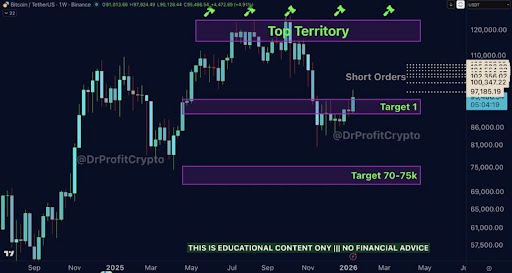
Because he expects Bitcoin to move lower, the analyst confirmed that he is still holding his short position from $115,000 and $125,000. He noted that additional shorts would only be considered if BTC revisits the $97,000-$107,000 range, and nowhere earlier. Doctor Profit also revealed that his first short, around $97,000, has already been filled, with another positioned near $98,000.

The analyst shared a detailed price chart showing all his short positions and Bitcoin’s “top territory” near $120,000. Several additional orders have also been placed between $97,000 and $110,000 to manage risk during the cryptocurrency’s prolonged consolidation phase.
Source: X

Beyond technical structures, the report highlighted January 21, 2026, as a key date for the crypto market, as it marks the expected release of the CLARITY Act bill. Doctor Profit stressed that once the bill is published, it would give institutions and traders a clear view of the regulatory framework, showing who regulates crypto, how exchanges would be treated, and whether the new rules would favor or restrict the industry.

Even without an immediate vote by the US Senate Banking Committee, Doctor Profit noted that the bill’s release alone could move markets. He explained that clarity eliminates uncertainty in the market, which is a powerful catalyst for price action. Notably, the vote on the bill has been scheduled for January 27, with its outcome set to shape the future of crypto regulations and also influence price movements.

Analyst Remains Extremely Bearish On Bitcoin

Doctor Profit has said in his report that he remains extremely bearish on the market, expecting another leg down that would officially confirm his bear market thesis. He stated that there have been no relevant updates to invalidate his outlook or support a new bullish narrative. His chart forecasts a potential drop toward the $70,000- $75,000 range. With Bitcoin currently trading above $92,500, that would mean a decline of over 20%.

BTC sees sharp crash | Source: BTCUSD on Tradingview.com

Domande pertinenti

QWhat is the crypto analyst Doctor Profit's overall outlook for Bitcoin's price this week?

ADoctor Profit maintains an extremely bearish outlook, expecting Bitcoin to continue its bearish streak and potentially drop to new lows, with a forecasted decline toward the $70,000-$75,000 range.

QWhat key date does the analyst highlight as important for the crypto market and why?

AThe analyst highlights January 21, 2026, as a key date because it is the expected release date of the CLARITY Act bill, which will provide regulatory clarity for the crypto industry and could move markets.

QWhat trading position is Doctor Profit currently holding based on his analysis?

ADoctor Profit confirmed he is still holding his short positions from $115,000 and $125,000, with additional shorts only considered if Bitcoin revisits the $97,000-$107,000 range.

QAccording to the report, what has been the dominant pattern in Bitcoin's price action since November 2025?

ABitcoin's price action has been dominated by a sideways consolidation with almost no meaningful movement, which the analyst views as a bearish sign.

QWhat is the significance of the CLARITY Act bill's release, even without an immediate vote?

AThe mere release of the bill is significant because it eliminates market uncertainty by providing clarity on the regulatory framework, which is a powerful catalyst for price action, regardless of an immediate vote.

Letture associate

a16z: AI's 'Amnesia', Can Continuous Learning Cure It?

The article "a16z: AI's 'Amnesia' – Can Continual Learning Cure It?" explores the limitations of current large language models (LLMs), which, like the protagonist in the film *Memento*, are trapped in a perpetual present—unable to form new memories after training. While methods like in-context learning (ICL), retrieval-augmented generation (RAG), and external scaffolding (e.g., chat history, prompts) provide temporary solutions, they fail to enable true internalization of new knowledge. The authors argue that compression—the core of learning during training—is halted at deployment, preventing models from generalizing, discovering novel solutions (e.g., mathematical proofs), or handling adversarial scenarios. The piece introduces *continual learning* as a critical research direction to address this, categorizing approaches into three paths: 1. **Context**: Scaling external memory via longer context windows, multi-agent systems, and smarter retrieval. 2. **Modules**: Using pluggable adapters or external memory layers for specialization without full retraining. 3. **Weights**: Enabling parameter updates through sparse training, test-time training, meta-learning, distillation, and reinforcement learning from feedback. Challenges include catastrophic forgetting, safety risks, and auditability, but overcoming these could unlock models that learn iteratively from experience. The conclusion emphasizes that while context-based methods are effective, true breakthroughs require models to compress new information into weights post-deployment, moving from mere retrieval to genuine learning.

marsbit2 h fa

a16z: AI's 'Amnesia', Can Continuous Learning Cure It?

marsbit2 h fa

Can a Hair Dryer Earn $34,000? Deciphering the Reflexivity Paradox in Prediction Markets

An individual manipulated a weather sensor at Paris Charles de Gaulle Airport with a portable heat source, causing a Polymarket weather market to settle at 22°C and earning $34,000. This incident highlights a fundamental issue in prediction markets: when a market aims to reflect reality, it also incentivizes participants to influence that reality. Prediction markets operate on two layers: platform rules (what outcome counts as a win) and data sources (what actually happened). While most focus on rules, the real vulnerability lies in the data source. If reality is recorded through a specific source, influencing that source directly affects market settlement. The article categorizes markets by their vulnerability: 1. **Single-point physical data sources** (e.g., weather stations): Easily manipulated through physical interference. 2. **Insider information markets** (e.g., MrBeast video details): Insiders like team members use non-public information to trade. Kalshi fined a剪辑师 $20,000 for insider trading. 3. **Actor-manipulated markets** (e.g., Andrew Tate’s tweet counts): The subject of the market can control the outcome. Evidence suggests Tate’sociated accounts coordinated to profit. 4. **Individual-action markets** (e.g., WNBA disruptions): A single person can execute an event to profit from their pre-placed bets. Kalshi and Polymarket handle these issues differently. Kalshi enforces strict KYC, publicly penalizes insider trading, and reports to regulators. Polymarket, with its anonymous wallet-based system, has historically been more permissive, arguing that insider information improves market accuracy. However, it cooperated with authorities in the "Van Dyke case," where a user traded on classified government information. The core paradox is reflexivity: prediction markets are designed to discover truth, but their financial incentives can distort reality. The more valuable a prediction becomes, the more likely participants are to influence the event itself. The market ceases to be a mirror of reality and instead shapes it.

marsbit3 h fa

Can a Hair Dryer Earn $34,000? Deciphering the Reflexivity Paradox in Prediction Markets

marsbit3 h fa

Trading

Spot
Futures
活动图片





