What The Rise In Open Interest Means For The Dogecoin Price

bitcoinistPubblicato 2025-12-29Pubblicato ultima volta 2025-12-29

Introduzione

Dogecoin's open interest, which had reached all-time highs in September, crashed to 2024 lows by mid-December, reflecting declining investor participation amid a falling price. However, it has since recovered, climbing back above $1.5 billion, suggesting traders are returning. Historically, rising open interest has often preceded price recoveries, as seen in September when it peaked alongside a near $0.3 DOGE price. This trend indicates a potential price bottom is forming. Despite this, daily trading volume remains at yearly lows, consistent with broader crypto market bearishness and extreme fear, where low liquidity suppresses prices.

After the Dogecoin open interest hit new all-time highs back in September, it has seen a significant crash, culminating in the open interest dropping to levels not seen since 2024. This was a reflection of the decline in market participation from investors due to the rapid drop in the Dogecoin price. However, the open interest seems to have put in a bottom, and there has been a recovery in this major metric, something that could carry positive implications for the meme coin’s price.

Dogecoin Open Interest Recovers Above $1.5 Billion

On December 19, the Dogecoin open interest fell below the $1.3 billion mark, following the decline in participation. But the performance so far suggests that this could be a possible bottom. The week following this bottom saw a significant spike in the open interest, as it jumped above the $1.5 billion mark, as shown on Coinglass.

Since then, the Dogecoin price interest has consistently come in above $1.5 billion, suggesting that crypto traders are moving back into the meme coin. This is because the open interest measures the total outstanding futures or options contracts for a particular asset, and as the open interest rises, it means investors are opening more positions on Dogecoin.
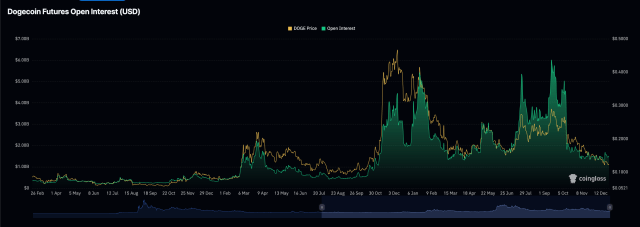
Source: Coinglass

This carries a positive implication, going by historical performance, because times when the open interest has risen have often coincided with times when the price has seen a recovery. An example is the Dogecoin price reaching close to $0.3 back in September when the open interest rose to its current peak of $6.01 billion.

Given this trend, if the Dogecoin open interest continues to rise, then it is likely that the price will follow the same trajectory. Therefore, the DOGE price could be getting ready to mark a bottom, especially as the crypto market readies to usher in a new year.

Volume Refuses To Bugde

While the open interest has seen a recovery, the Dogecoin daily trading volume remains low. According to Coinglass data, the daily trading volume is sitting at one of the lowest points for the year 2025. This also plays into the fact that participation has been muted for the digital asset.

However, this muted volume is not relegated to Dogecoin lately, given that the entire crypto market has been in a bearish trend. The Crypto Fear & Greed Index is currently sitting at a score of 24 at the time of this writing. This shows that there is Extreme Fear in the market, and it is a time when liquidity is low, leading to lower prices.

DOGE stages another recovery | Source: DOGEUSDT on Tradingview.com

Domande pertinenti

QWhat does the recent recovery in Dogecoin's open interest suggest about investor behavior?

AThe recovery in Dogecoin's open interest above $1.5 billion suggests that crypto traders are moving back into the meme coin, as it indicates investors are opening more futures or options positions.

QWhat was the lowest point for Dogecoin open interest mentioned in the article, and when did it occur?

AThe Dogecoin open interest fell below the $1.3 billion mark on December 19, which was identified as a possible bottom.

QAccording to the article, what historical correlation exists between Dogecoin's open interest and its price?

AHistorically, times when the Dogecoin open interest has risen have often coincided with times when the price has seen a recovery, such as when the price reached close to $0.3 in September as open interest hit a peak.

QHow does the current Dogecoin daily trading volume compare to its performance in 2025?

AThe Dogecoin daily trading volume is sitting at one of the lowest points for the year 2025, indicating muted participation.

QWhat is the current reading of the Crypto Fear & Greed Index, and what does it imply for the market?

AThe Crypto Fear & Greed Index is currently at a score of 24, indicating Extreme Fear in the market, which is a time when liquidity is low and leads to lower prices.

Letture associate

Agents Take Over Traffic Distribution Power: What Are Tencent, ByteDance, and Alibaba Competing For?

In the race to dominate the AI era's entry point, China's tech giants—Tencent, ByteDance, and Alibaba—are aggressively deploying AI Agents to control the future of traffic distribution. Alibaba is pursuing a dual-track "closed loop + openness" strategy. Its Qianwen app is evolving into a super-Agent integrated across its ecosystem (Taobao, Alipay, etc.) to handle complex tasks like travel planning. Concurrently, it is opening its platform to external brands (Luckin Coffee, KFC) and has launched a B2B Agent platform, "Wukong," targeting enterprise automation. Its other flagship, Quark, aims to be an "AI super search box" for information and tasks. ByteDance is executing an omnipresent "sprawl strategy." Its Doubao app boasts over 300 million monthly active users and is evolving into a default AI entry point for daily life, with plans for paid versions and e-commerce integration. Its core weapon is the Kouzi platform, a visual "AI assembly factory" for developers to build custom Agents. ByteDance is also pushing hardware integration, collaborating on AI phones and developing smart glasses to embed Doubao everywhere. Tencent is playing its long-held "ultimate card" by quietly embedding an AI Agent directly into WeChat. This Agent, accessible via a swipe, can understand user commands and automatically execute tasks by calling upon WeChat's millions of mini-programs (e.g., finding and ordering coffee). This leverages WeChat's unparalleled 1.4-billion-user ecosystem to position the app as an AI-powered "service operating system," a move that could dramatically reshape the competitive landscape. The core battleground is shifting from competing for "user screen time" to competing to be the "default execution layer" for user intent. The business model is evolving from an "attention economy" to an "intent economy," where the Agent that can most efficiently fulfill a user's need gains control over service access and token flow. This represents a fundamental change in how users connect with digital services, making the fight for the Agent入口 (entry point) a pivotal moment for redefining industry leadership in the AI age.

marsbit28 min fa

Agents Take Over Traffic Distribution Power: What Are Tencent, ByteDance, and Alibaba Competing For?

marsbit28 min fa

From Banning Doubao to Embracing Honor: Why Did WeChat Suddenly 'Change Its Face'?

The article explores the sudden shift in WeChat's strategy towards AI assistants from mobile phone manufacturers, transitioning from strict opposition to active collaboration. For over a year, WeChat fiercely resisted attempts by phone AI assistants (like ByteDance's Doubao in late 2025) to control its features via GUI automation ("simulated clicking"), citing security and data control concerns. This stance created a significant barrier for system-level AI integration. Now, Tencent has initiated A2A (Agent-to-Agent) partnerships with major phone brands like Honor, Xiaomi, OPPO, and vivo. This model allows a phone's system AI (e.g., Honor's YOYO) to parse a user's voice command and send a structured request directly to WeChat's own internal AI agent via secure APIs. WeChat then executes the action (e.g., sending a message) and returns the result. The article attributes Tencent's "change of face" to strategic pressure. While leading in social app usage, Tencent trails rivals like ByteDance and Alibaba in standalone AI app popularity. WeChat, with its vast mini-program ecosystem, is Tencent's key asset for an AI comeback. The upcoming WeChat AI agent aims to handle tasks like booking and payments within the app. However, phone system assistants remain the primary AI entry point for most users. The A2A collaboration allows Tencent to extend WeChat's AI reach to this crucial system layer while maintaining control over its core functions and data. For phone manufacturers, embracing A2A is a pragmatic move. The GUI route proved unviable due to WeChat's blocks. A2A offers a compliant path to integrate a vital service, enhancing their AI assistants' usefulness. It allows them to focus on developing their own AI ecosystems for other services while cooperating on WeChat access. The collaboration is framed as a mutual, strategic necessity: Tencent gains a distribution channel, and manufacturers gain a key functionality. The partnership relies on a "dual authorization" mechanism for security, requiring both user and app consent for each action. While questions about long-term data privacy practices remain, experts note A2A is more secure and compliant than GUI automation. Ultimately, this cooperation is seen as a tentative, calculated truce. Tencent's long-term goal is to make WeChat an AI-powered "service OS." Phone manufacturers aim to make their system AI the central user interface. Their paths may converge or clash in the future, but for now, the A2A deal represents the opening chapter in the battle for the AI-era user入口, driven by necessity and strategic calculus on both sides.

marsbit2 h fa

From Banning Doubao to Embracing Honor: Why Did WeChat Suddenly 'Change Its Face'?

marsbit2 h fa

Trading

Spot
Futures

Articoli Popolari

Come comprare OPEN

Benvenuto in HTX.com! Abbiamo reso l'acquisto di OpenLedger (OPEN) semplice e conveniente. Segui la nostra guida passo passo per intraprendere il tuo viaggio nel mondo delle criptovalute.Step 1: Crea il tuo Account HTXUsa la tua email o numero di telefono per registrarti il tuo account gratuito su HTX. Vivi un'esperienza facile e sblocca tutte le funzionalità,Crea il mio accountStep 2: Vai in Acquista crypto e seleziona il tuo metodo di pagamentoCarta di credito/debito: utilizza la tua Visa o Mastercard per acquistare immediatamente OpenLedger OPEN.Bilancio: Usa i fondi dal bilancio del tuo account HTX per fare trading senza problemi.Terze parti: abbiamo aggiunto metodi di pagamento molto utilizzati come Google Pay e Apple Pay per maggiore comodità.P2P: Fai trading direttamente con altri utenti HTX.Over-the-Counter (OTC): Offriamo servizi su misura e tassi di cambio competitivi per i trader.Step 3: Conserva OpenLedger (OPEN)Dopo aver acquistato OpenLedger (OPEN), conserva nel tuo account HTX. In alternativa, puoi inviare tramite trasferimento blockchain o scambiare per altre criptovalute.Step 4: Scambia OpenLedger (OPEN)Scambia facilmente OpenLedger (OPEN) nel mercato spot di HTX. Accedi al tuo account, seleziona la tua coppia di trading, esegui le tue operazioni e monitora in tempo reale. Offriamo un'esperienza user-friendly sia per chi ha appena iniziato che per i trader più esperti.

146 Totale visualizzazioniPubblicato il 2024.12.12Aggiornato il 2026.06.02

Come comprare OPEN

Discussioni

Benvenuto nella Community HTX. Qui puoi rimanere informato sugli ultimi sviluppi della piattaforma e accedere ad approfondimenti esperti sul mercato. Le opinioni degli utenti sul prezzo di OPEN OPEN sono presentate come di seguito.

活动图片












