What Kind of DeFi Does Wall Street Want?

marsbitPubblicato 2026-04-02Pubblicato ultima volta 2026-04-02

Introduzione

Wall Street's vision for DeFi has shifted from simple asset tokenization to building a programmable, restructurable fixed-income infrastructure that enables yield financialization. The key driver is no longer retail speculation but institutional capital and Real-World Assets (RWA), with DeFi TVL surging from ~$115B to over $237B in 2025, while active wallets declined—indicating large, infrequent institutional inflows. RWA, now valued at $27.5B (up 2.4x YoY), is used as collateral in protocols like Aave Horizon, Maple Finance, and Centrifuge, creating an on-chain repo and rehypothecation flywheel. These structures function like institutional money-market funds, offering 4–6% yields from tokenized treasuries and stablecoin pools. Crucially, institutions are moving beyond holding assets to actively managing yield and risk. Protocols like Pendle Finance allow yield tokenization—splitting assets into Principal Tokens (PT) and Yield Tokens (YT)—enabling fixed-rate exposure, speculation, and on-chain interest rate hedging using mechanisms like yield AMMs. However, major barriers remain: public blockchain transparency exposes positions and liquidation levels, creating adversarial risks, and compliance (KYC, sanctions screening, audit trails) must be natively embedded into protocols—not added externally. Zero-knowledge proofs could offer a solution by enabling regulatory verification without leaking sensitive data. In summary, Wall Street wants a DeFi that integrates with global c...

Author: Chloe, ChainCatcher

For years, tokenization has been positioned as the bridge for cryptocurrencies to reach Wall Street. The logic behind putting treasury bonds on-chain, issuing tokenized funds, and digitizing stocks has always pointed to one idea: once assets are on-chain, institutional capital will naturally follow.

But tokenization itself has never been the endgame. DWF Ventures believes that the real key to unlocking the institutional market is not digitizing assets, but financializing yield.

Since 2025, the Total Value Locked (TVL) in DeFi has climbed from approximately $115 billion to over $237 billion. The main driver behind this is no longer purely speculative retail investors, but real institutional capital and Real-World Assets (RWA). Institutions are no longer just watching; they are starting to see DeFi as infrastructure for deploying capital.

It can be said that the DeFi Wall Street truly wants to see has shifted from "putting assets on-chain" to a "programmable, recomposable, interest-rate-risk-hedgeable" fixed-income infrastructure. Today, we can glimpse this transformation through TVL and RWA data, institutional protocol examples, yield tokenization theory, and the implementation of privacy and compliance.

TVL and Institutional Data: Which Layer Are Institutions Filling?

In Q3 2025, DeFi's TVL climbed from about $115 billion at the start of the year to $237 billion. Meanwhile, the number of active wallets on-chain decreased by 22% in the same period. DappRadar data clearly shows that the push behind this rally is not from retail investors, but from "high-value, low-frequency" institutional capital.

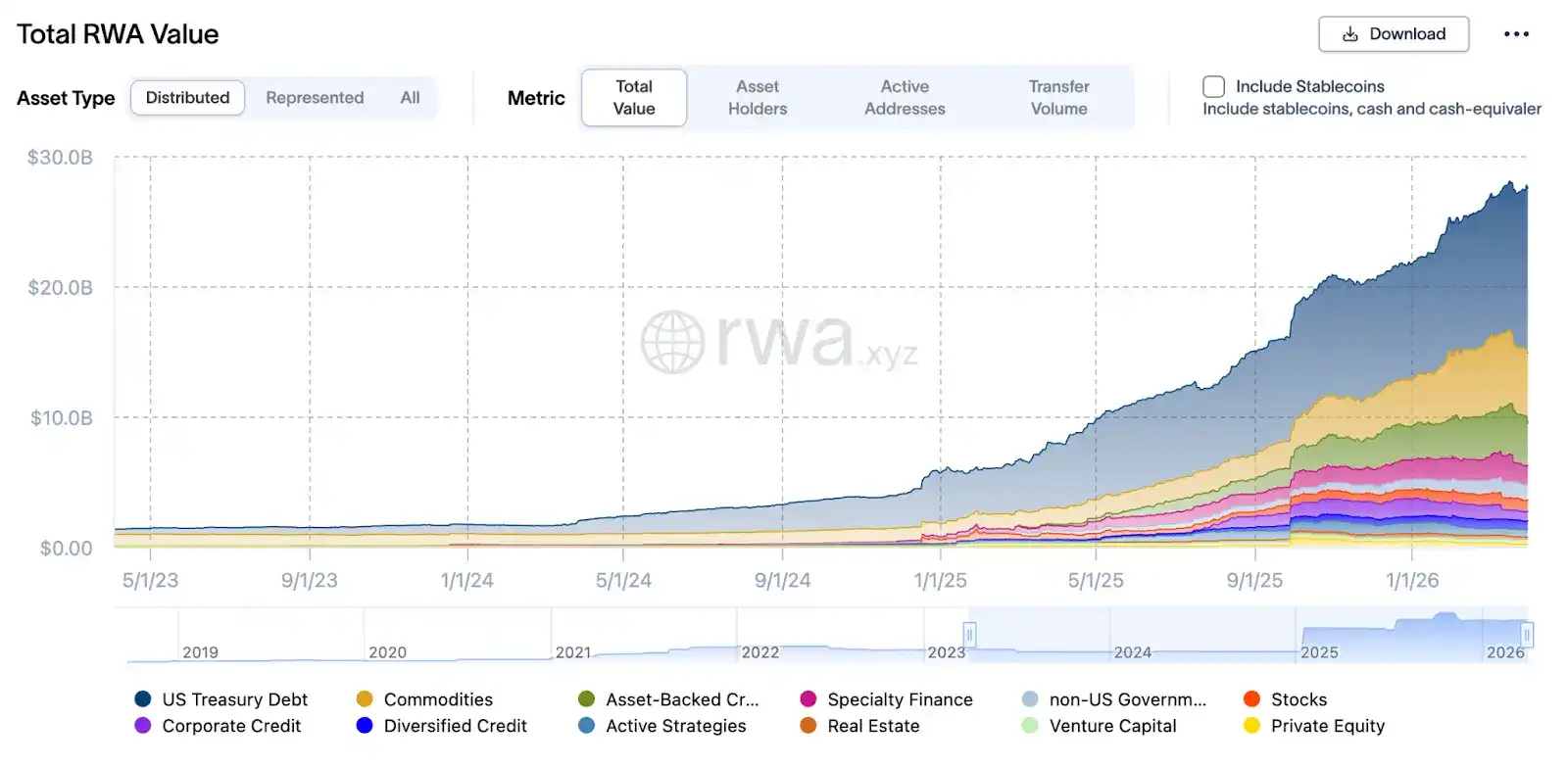
In this structure, the most crucial part is RWA: As of the end of March 2026, the total value of RWA had reached $27.5 billion, a growth of over 2.4 times compared to $8 billion in March 2025. These assets are primarily used by institutions as collateral for stablecoin loans through protocols like Aave Horizon, Maple Finance, and Centrifuge, forming an "on-chain repo (repurchase agreement)" re-collateralization flywheel.
Taking Aave Horizon as an example, its RWA market had accumulated an asset size of about $540 million by the end of 2025. This includes stablecoins like Superstate's USCC, RLUSD, and Aave's GHO, as well as various US Treasury assets (like VBILL), with annualized yields ranging between 4-6%. This structure is essentially an "institutional version of a money market fund": the front end consists of tokenized treasury bonds and bills, the back end is a stablecoin liquidity pool, and smart contracts automatically handle interest payments, refinancing, and liquidation in the middle.

From "Holding" to "Operating": Are Institutions Playing On-Chain Repo or Fixed Income?

In the traditional fixed income market, bonds are not just tools for holding and collecting interest; they are used for repo (repurchase agreements), re-collateralization, splitting, and embedding into structured products, forming a flywheel of capital efficiency. By 2025, DeFi had begun replicating this logic.

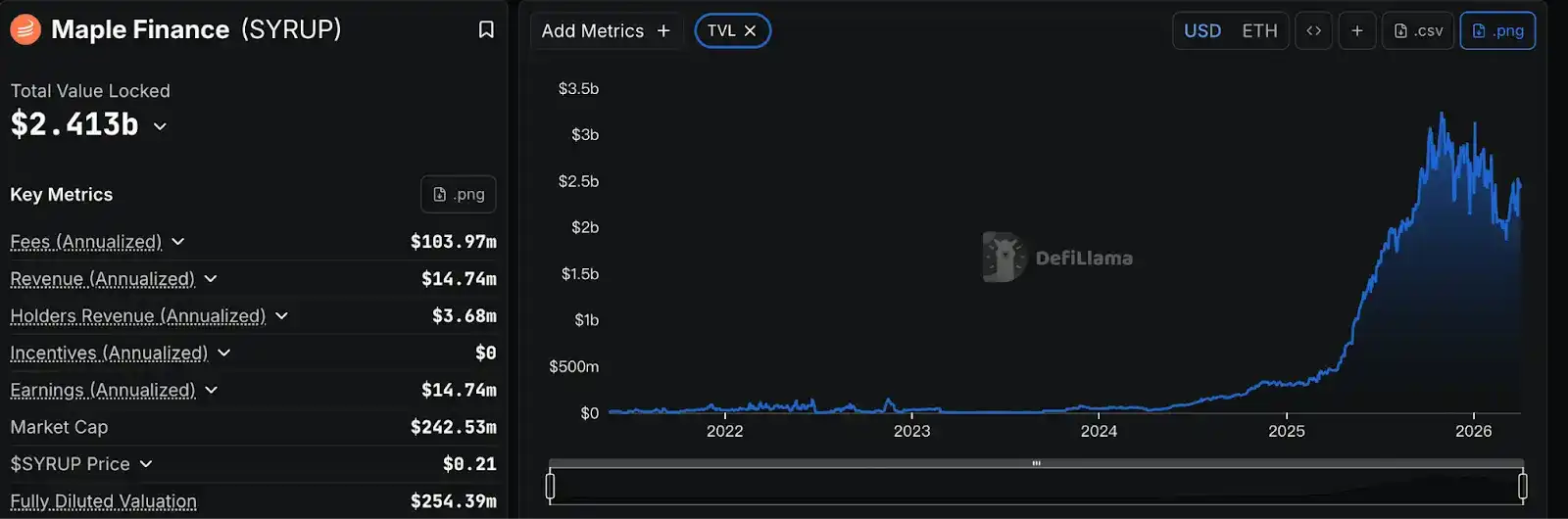
Maple Finance's TVL surged from $297 million in 2025 to over $3.1 billion, at times approaching $3.3 billion. The main driver was institutions entering the RWA lending market, tokenizing private loans and corporate loans for "over-the-counter" stablecoin lending and refinancing.
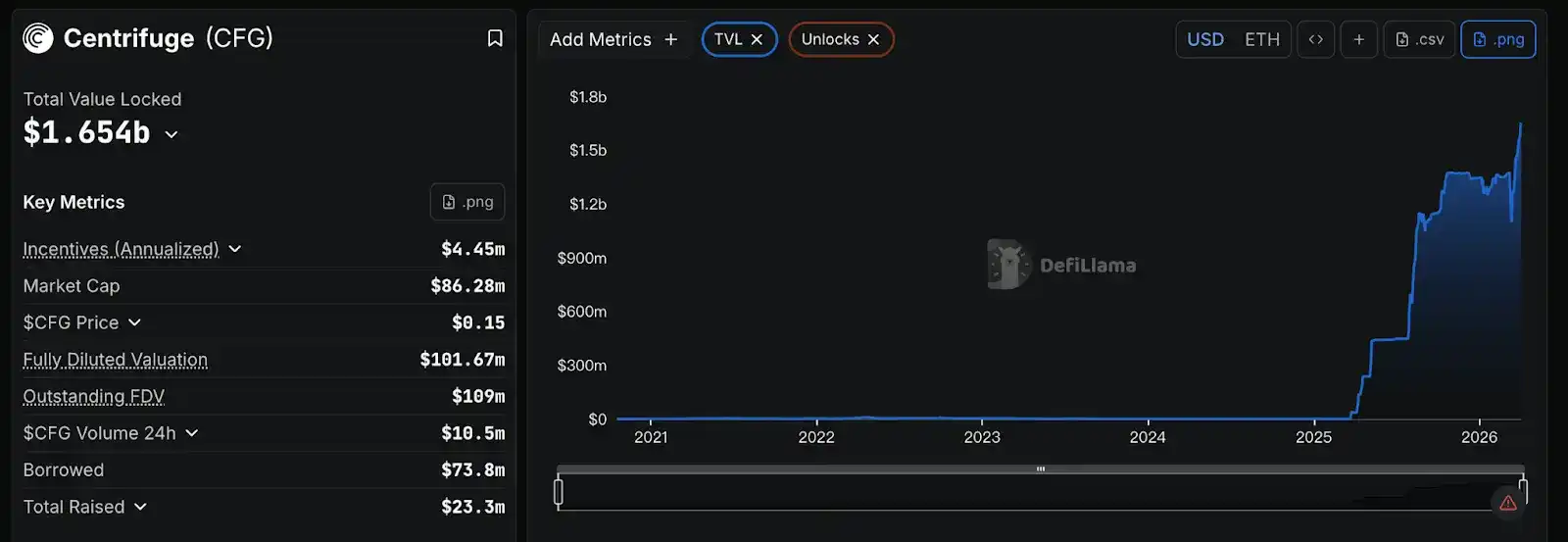
Centrifuge, on the other hand, focuses on converting Small and Medium Enterprise (SME) loans, trade finance, and accounts receivable into on-chain assets. To date, its ecosystem manages over $1 billion in TVL and has successfully developed multiple diversified asset pools, extending from private credit to highly liquid US Treasury bonds.

Simultaneously, Centrifuge has also integrated deeply with top DeFi protocols, such as Sky (formerly MakerDAO). Through its collaboration with Centrifuge, MakerDAO can invest its reserves in real-world enterprise loans, providing substantial yield support for the stablecoin DAI. There's also Aave; the two joined forces to create a dedicated RWA market, allowing KYCed institutional investors to use Centrifuge's asset tokens as collateral, achieving cross-protocol liquidity cycles.
Yield Tokenization and Yield Trading Markets: Can Interest Rate Risk Be Hedged?

If you were to map the structure of Wall Street's fixed income market, you would see several key modules: principal and interest can be separated (e.g., zero-coupon bonds, stripped coupons), interest rate risk can be independently traded and hedged, and liquidity and compliance can be separated but reconnected through middleware.

In May 2025, a paper titled "Split the Yield, Share the Risk: Pricing, Hedging and Fixed rates in DeFi" on arXiv first proposed a formal framework for "yield tokenization": splitting yield-bearing assets into "Principal Tokens (PT)" and "Yield Tokens (YT)", and using SDEs (Stochastic Differential Equations) and a no-arbitrage framework to price and hedge interest rate risk.

This design has already been implemented in some protocols. Take Pendle Finance as an example. Pendle uses a specially designed Yield AMM whose price curve adjusts over time (time decay factor), ensuring the PT price converges to its redemption value at maturity. These mechanisms allow market participants to allocate liquidity based on risk preferences (e.g., fixed-rate seekers buy PT, yield speculators buy YT).

For institutions, this means yield structures can be "modularized" and directly plugged into traditional asset allocation models (e.g., duration, DV01, interest rate risk contribution); interest rate risk no longer needs to be hedged solely with off-chain futures or IRS (Interest Rate Swaps). Instead, it can be adjusted directly on-chain by trading "yield tokens," enabling instant and transparent interest rate risk hedging and significantly improving capital efficiency.

Two Major Real-World Challenges: Privacy and Compliance

Even as DeFi's TVL breaks through tens of billions of dollars, the large-scale inflow of institutional capital is still hindered by two key challenges: privacy and compliance.

First Challenge: Public Chain Holdings Are Transparent, Liquidation Points Are Exposed

On mainstream public chains, every transaction and address's holdings are publicly visible, which poses an extremely high risk for institutions. Trading strategies, leverage levels, and liquidation points can be completely known by counterparties, potentially leading to targeted shorting and liquidation. Once a liquidity crunch or price volatility occurs, malicious actors can place orders targeting specific addresses, amplifying losses. This is one reason institutional capital is hesitant to fully commit to DeFi.

Here, zero-knowledge proofs (ZKPs) may become a key solution. They would allow institutions to prove their legitimacy to regulators without leaking information publicly. Specifically, regulators could verify that an institution complies with regulatory requirements, while other market participants cannot see the institution's complete holdings or liquidation points. This is the privacy layer Wall Street truly wants—not "complete anonymity," but "meeting compliance requirements without disclosing business secrets."

Second Challenge: KYC, Sanctions Screening, and Auditing Must Be Embedded in the Protocol Itself

Another red line for institutions is: compliance is not an afterthought patch, but natively built-in. In traditional finance, KYC, sanctions screening, and audit requirements are already embedded in settlement systems and trading processes. But in many DeFi protocols, these checks still remain at the "front-end gateway" or rely on "intermediary institutions," rather than being written directly into the protocol logic.

What institutions expect is: KYC and sanctions screening are no longer just about "users uploading ID documents, followed by pure trust," but rather a module or middleware that can verify identity and sanctions lists on-chain without exposing complete data; and audit and regulatory requirements can also be directly written as "verifiable rules," e.g., a transaction must execute only under certain compliance conditions, or an address's exposure must not exceed a certain limit.

The IOSCO, in its November 2025 report "Tokenization of Financial Assets," explicitly emphasized the need to establish "verifiable compliance rules" and "transparent but controlled audit trails" on DLT (Distributed Ledger Technology). Some institutional DeFi platforms have begun experimenting with "compliance modules," embedding KYC, AML, sanctions screening, and regulatory reporting directly into the protocol layer, rather than relying on external tools or post-hoc patches.

Conclusion: What Kind of DeFi Does Wall Street Want?

Returning to the initial question, what kind of DeFi does Wall Street want? First, a more advanced asset clearing and servicing system that can seamlessly integrate with global compliance infrastructure, building an institutional-grade moat. Second, in terms of yield structure, the ability to precisely replicate the traditional fixed income market's logic of yield decomposition and hedging, achieving risk modularization. Third, in terms of compliance and security, using zero-knowledge proofs to embed "verifiable compliance" and "programmatic risk control" into the protocol's foundation, achieving a balance between privacy and regulation.

Replacing traditional finance has never been an option for Wall Street. Instead, it's about having an additional parallel world where capital, risk, and returns can be reassembled more flexibly in a programmable way.

Domande pertinenti

QWhat is the key factor that DWF Ventures believes is crucial for unlocking the institutional market in DeFi, according to the article?

ADWF Ventures believes the key to unlocking the institutional market is not the digitization of assets, but the financialization of yield.

QWhat does the data from DappRadar indicate about the recent surge in DeFi's Total Value Locked (TVL)?

ADappRadar data shows that the recent surge in DeFi TVL, which rose from about $115 billion to over $237 billion, was driven by 'high-value, low-frequency' institutional capital, not retail speculators, as the number of active wallets decreased by 22% in the same period.

QHow does the article describe the role of protocols like Pendle Finance in addressing institutional needs?

AProtocols like Pendle Finance implement a 'yield tokenization' framework, splitting yield assets into Principal Tokens (PT) and Yield Tokens (YT). This allows for the modularization of yield structures, enabling institutions to directly hedge interest rate risk on-chain by trading these tokens, which improves capital efficiency and fits into traditional asset allocation models.

QWhat are the two main obstacles preventing large-scale institutional inflow into DeFi, as outlined in the article?

AThe two main obstacles are privacy and compliance. Specifically: 1) The transparency of public blockchains exposes institutional trading strategies and liquidation points. 2) The need for KYC, sanctions screening, and auditing to be natively embedded into the protocol logic itself, not just handled at the front-end or by intermediaries.

QAccording to the article's conclusion, what does Wall Street ultimately want from DeFi?

AWall Street wants a DeFi that is a more advanced asset clearing and servicing system that can seamlessly integrate with global compliance infrastructure. It also seeks a yield architecture that can replicate the interest rate decomposition and hedging logic of traditional fixed-income markets for modular risk, and it requires embedded 'verifiable compliance' and 'programmatic risk control' at the protocol level using technologies like zero-knowledge proofs to balance privacy and regulation.

Letture associate

South Korean Exchanges 'Battle' Regulators, Challenging the Boundaries of Enforcement and Legislation

South Korea's cryptocurrency industry is engaged in a rare, direct confrontation with regulators. The Financial Intelligence Unit (FIU), the primary anti-money laundering (AML) watchdog, has recently imposed heavy penalties on major exchanges like Upbit and Bithumb for alleged violations involving unregistered overseas VASPs and AML procedures. However, exchanges are now actively challenging these actions in court and through industry associations. In a significant shift, the Seoul Administrative Court ruled in favor of Upbit's operator, Dunamu, overturning part of an FIU-ordered business suspension. The court found the FIU's penalty criteria and justification insufficiently clear. Similarly, the court suspended the enforcement of a six-month business suspension against Bithumb pending a final ruling, citing potential irreversible harm to the exchange. Beyond legal battles, the industry is contesting proposed legislative amendments. The Digital Asset eXchange Alliance (DAXA) strongly opposes a draft rule that would mandate Suspicious Transaction Reports (STRs) for all crypto transfers over 10 million KRW (~$6,800). DAXA argues this "poison pill" clause violates legal principles and would overwhelm the STR system, increasing reports from 63,000 to an estimated 5.45 million annually for major exchanges, thereby crippling effective AML monitoring. This conflict highlights a structural tension in South Korea's crypto governance: comprehensive digital asset laws are still developing, while regulators rely heavily on AML enforcement. The industry's move from passive compliance to active legal and legislative challenges signifies a new phase, pressing for clearer rules and more proportionate enforcement. While short-term disputes may intensify, this clash could ultimately lead to a more mature and sustainable regulatory framework for South Korea's vibrant crypto market.

marsbit24 min fa

South Korean Exchanges 'Battle' Regulators, Challenging the Boundaries of Enforcement and Legislation

marsbit24 min fa

After 50x Storage Surge, Justin Sun Always Looks to the Next Decade

Sun Yuchen, known for his controversial stunts like a $30 million lunch with Warren Buffett (canceled due to a kidney stone) and eating a $6.2 million duct-taped banana, is often overshadowed by a significant fact: his decade-long track record of spotting major investment trends. In 2016, he famously advised young people to invest in Bitcoin, Nvidia, Tesla, and Tencent instead of buying property. A hypothetical $20,000 investment in Nvidia and Tesla from that list would now be worth over 50 million RMB. His latest major call was on November 6, 2025, predicting a "50x storage opportunity" tied to the AI boom, which materialized with Sandisk's stock surging nearly 50-fold by 2026. Looking ahead, Sun now focuses on the next frontier: Physical AI. He identifies four key areas: 1. **Embodied AI/Robotics**: He sees this reaching its "iPhone moment," with companies like UBTech and Galaxy General leading in commercialization. 2. **Drones**: Viewed as the first commercially viable form of Physical AI, revolutionizing sectors from warfare (e.g., AeroVironment's Switchblade) to logistics. 3. **Spatial Computing**: Beyond VR, it's about AI understanding physical space, a foundational technology for robotics and autonomous systems, exemplified by Apple's Vision Pro. 4. **Space Exploration**: After a 2025 suborbital flight with Blue Origin, Sun advocates for space as the ultimate frontier, discussing blockchain's potential role in space asset management and data transactions. His investment philosophy involves betting on entire, inevitable trends rather than single companies. For robotics, he sees Tesla (the body/manufacturer) and Nvidia (the brain/AI platform) as complementary plays. In defense drones, he highlights companies making tanks obsolete (AeroVironment) and those augmenting fighter jets (Kratos). For space, he participated in Blue Origin's flight and anticipates SpaceX's potential IPO to redefine the sector's valuation. Sun Yuchen's vision frames the next two decades not as a revolution in information flow (like the internet), but in the fundamental operation of the physical world through AI-powered robots, autonomous systems, and spatial intelligence, ultimately extending human and AI activity into space. While many still focus on conventional assets, he continues to look toward the next technological horizon.

marsbit1 h fa

After 50x Storage Surge, Justin Sun Always Looks to the Next Decade

marsbit1 h fa

The Billionaires Behind the Most Expensive Midterm Election in History

"The Most Expensive Midterm Elections and Their Billionaire Backers" This analysis details the unprecedented scale of spending in the 2026 midterm elections, highlighting the key billionaire donors shaping the political landscape. Jeff Yass, founder of Susquehanna International Group, has contributed over $81 million, ranking third among individual donors behind George Soros ($102.6M) and Elon Musk ($84.8M). Yass is a major donor to Trump's MAGA Inc. and supports school choice and various candidates. Overall, federal committees have raised over $4.7 billion this cycle, with political ad spending projected to reach $10.8 billion. Republican-aligned groups are significantly out-raising their Democratic counterparts. "Dark money" from undisclosed sources continues to grow. The core stakes involve control of Congress and policy direction for Trump's final term. Donors are also motivated by specific issues: Sergey Brin and Chris Larsen are funding opposition to a proposed California wealth tax and supporting crypto-friendly policies. Other top donors include OpenAI's Greg Brockman and his wife Anna ($50M total to MAGA Inc. and an AI-focused PAC), Richard Uihlein ($45.3M to conservative causes), venture capitalists Marc Andreessen and Ben Horowitz (each over $44M to crypto/AI PACs and MAGA Inc.), Miriam Adelson ($42.6M to GOP leadership PACs), Paul Singer ($33.9M), and Diane Hendricks ($25.8M to MAGA Inc.). The article notes that the peak fundraising period is still ahead, with major primaries approaching.

marsbit1 h fa

The Billionaires Behind the Most Expensive Midterm Election in History

marsbit1 h fa

The Largest IPO in History Is Approaching, Surpassing SpaceX, 28 Years of AI Self-Iteration, Countdown to Intelligence Explosion

"Anthropic Nears Trillion-Dollar IPO, Fueled by Explosive Growth and 2028 'Intelligence Explosion' Warning Anthropic is considering a deal valuing the AI company near $1 trillion, potentially leading to one of the largest IPOs ever and surpassing SpaceX. Its revenue has skyrocketed, with Annual Recurring Revenue (ARR) reaching $45 billion in May 2026—a 500% increase in just five months. This vertical growth curve is attributed to its key products, Claude Code and Cowork, dominating AI coding and enterprise collaboration. Beyond commercial success, co-founder Jack Clark issued a pivotal warning in an interview: there is a greater than 50% chance that by the end of 2028, AI systems will achieve recursive self-improvement—the ability to autonomously build a 'better version' of themselves, initiating an 'intelligence explosion.' This prophecy underpins the company's astronomical valuation, as the market prices in the potential for transformative and disruptive AI. Further signaling its ambition, Anthropic formed a $1.5 billion joint venture with Goldman Sachs and Blackstone, aiming to disrupt traditional consulting firms like McKinsey by deploying Claude AI for complex strategic work. This move tests AI's capacity to replace high-level cognitive labor, a precursor to its predicted autonomous evolution. The narrative presents a dual future: unprecedented economic opportunity alongside significant risks like economic restructuring and security threats. Anthropic's meteoric rise and Clark's 2028 prediction frame the coming years as a countdown to a potential technological singularity."

marsbit1 h fa

The Largest IPO in History Is Approaching, Surpassing SpaceX, 28 Years of AI Self-Iteration, Countdown to Intelligence Explosion

marsbit1 h fa

Trading

Spot
Futures
活动图片