What happened in crypto today: Hormuz tensions, oil prices impact the market

ambcryptoPubblicato 2026-03-23Pubblicato ultima volta 2026-03-23

Introduzione

Trump’s 48-hour ultimatum over the Strait of Hormuz triggered a crypto market downturn, reinforcing Bitcoin’s role as a macro stress outlet. BTC swung between $68,265 and $71,051 before settling near $69,195, down 2.2%, with over $123 million in liquidations. Ethereum fell 2.1%, and the Fear and Greed Index dropped to 9, indicating rising fear. The sell-off spread to altcoins like XRP and SOL, with total market cap falling to $2.37 trillion. Bitcoin dominance rose to 58.2%, showing a defensive shift into BTC rather than altcoins. Spot Bitcoin ETFs saw $163 million in outflows on March 18, reversing prior inflows, though cumulative inflows remain above $56 billion. The market appears reactive, with fragile liquidity and no significant new capital entering.

Trump’s 48-hour ultimatum over the Strait of Hormuz quickly spilled into crypto, reinforcing Bitcoin’s [BTC] role as the first macro stress outlet. Within hours, BTC swung between $68,265 and $71,051 before settling near $69,195, down 2.2%.

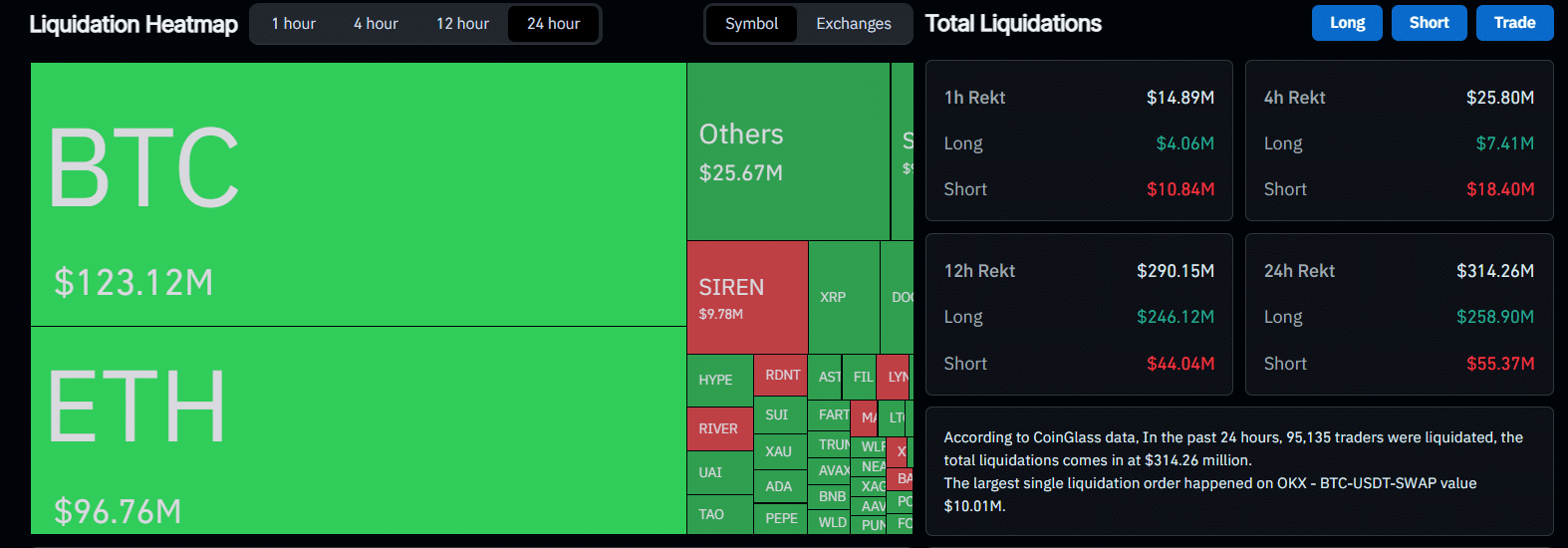
In fact, this sharp range expansion signals rapid repricing rather than stable demand. At the same time, liquidations surged to over $300 million, an 80% increase, with over $123 million from BTC, indicating that forced unwinds dominated price action.
Source: CoinGlass

Meanwhile, Ethereum [ETH] fell 2.1%, confirming broad risk sensitivity. As volatility increased, the Fear and Greed Index dropped to 9, while shorts rose to 51.7%.

This setup implies that traders are shifting toward protection rather than accumulation, which suggests fragile liquidity and a market driven more by reaction than conviction.

Market-wide correction unfolds in tandem

Bitcoin’s drop set off a broader reaction, as altcoins moved lower in tandem but with varying intensity. Ethereum fell 3.01% to $2,091, while Ripple [XRP] dropped 3.04% and Solana [SOL] declined 2.86%, showing coordinated but uneven pressure.

In fact, this spread highlights how altcoins amplify downside when liquidity tightens, yet still track Bitcoin’s direction closely. Meanwhile, total market cap slipped to $2.37 trillion, signaling capital outflows, although not a full breakdown in structure.

At the same time, the CoinMarketCap 20 Index fell 2.5%, confirming broad weakness across large caps. This setup implies risk appetite is softening, while capital becomes more selective, meaning altcoins remain vulnerable but can stabilize quickly if Bitcoin regains momentum.

Bitcoin reflects macro stress amid oil-driven risks

As Hormuz tensions intensified, Bitcoin remained aligned with risk assets, not a safe-haven shift. Bitcoin dominance rose to 58.2%, up 0.27%, signaling rotation into BTC over altcoins rather than broad inflows.

This reflects defensive positioning within crypto, not renewed risk appetite. Meanwhile, ETF flows reflected shifting conviction across the market. On the 17th of March, Spot Bitcoin ETFs recorded $199 million in net inflows.

However, this trend quickly reversed. On the 18th of March, flows flipped to $163 million in outflows, signaling short-term uncertainty.

Even so, cumulative inflows still exceed $56 billion. As a result, underlying institutional interest continues to persist despite recent fluctuations.

As the price holds near $68,700–$69,000, stability appears conditional rather than strong. At the same time, stablecoin supply shows no sharp expansion, indicating limited fresh liquidity entering the market.


Domande pertinenti

QWhat was the immediate impact of Trump's 48-hour ultimatum over the Strait of Hormuz on the cryptocurrency market?

AThe news caused Bitcoin's price to swing between $68,265 and $71,051, ultimately settling near $69,195 with a 2.2% drop, and triggered over $300 million in liquidations.

QHow did the broader altcoin market react to Bitcoin's price drop?

AAltcoins moved lower in tandem, with Ethereum falling 3.01%, Ripple (XRP) dropping 3.04%, and Solana (SOL) declining 2.86%, showing coordinated but uneven pressure.

QWhat did the rise in Bitcoin dominance to 58.2% signify about market sentiment?

AIt signaled a defensive rotation of capital into Bitcoin over altcoins, reflecting risk-off positioning within crypto rather than a broad shift into crypto as a safe-haven or renewed overall risk appetite.

QWhat was the trend in Spot Bitcoin ETF flows around March 17th and 18th?

ANet inflows of $199 million were recorded on March 17th, but this quickly reversed to $163 million in outflows on March 18th, indicating short-term uncertainty among investors.

QWhat does the lack of a sharp expansion in stablecoin supply indicate about the market?

AIt suggests that there is limited fresh liquidity entering the cryptocurrency market, meaning recent price action is more driven by existing capital repositioning than by new money flowing in.

Letture associate

The Entire Internet Hails Noam's Joining, But OpenAI's Loss Bill Just Got Thicker

While the AI community celebrates Noam Shazeer, co-author of the "Attention Is All You Need" paper, joining OpenAI as Head of Architectural Research, the company's audited financials reveal a starkly different reality. In 2025, OpenAI reported $13.07 billion in revenue but a massive $20.92 billion operating loss. Even excluding a one-time accounting charge, the cash burn is severe, with $3.7 billion consumed in Q1 2026 alone. This high-profile hiring occurs against a backdrop of significant internal research talent drain, with key founders and researchers departing as the company's focus shifts from exploratory research to product iteration. Meanwhile, OpenAI's fundamental business model faces a deep crisis. It paid Microsoft $10.59 billion for compute in 2025, while its vast user base of 9 billion weekly actives includes only 50 million paying customers, making growth a direct driver of escalating costs. The article argues Shazeer's recruitment is less about technical necessity and more about crafting a compelling narrative for OpenAI's upcoming IPO, aiming to justify a rumored $1 trillion valuation to future public market investors. It contrasts OpenAI's strategy with Anthropic's reported path to profitability, which relies on a strong enterprise customer base and cost control, rather than star-powered narratives. Ultimately, the piece concludes that while Shazeer's architectural work may take 1-2 years to materialize, OpenAI's financial clock is ticking much faster, with its massive losses undercutting the celebratory headlines.

marsbit1 h fa

The Entire Internet Hails Noam's Joining, But OpenAI's Loss Bill Just Got Thicker

marsbit1 h fa

Market Trend (June 19): US-Iran Deal Drives Out Geopolitical Premium; Chip Stocks Soar to New Highs; Energy Sector Leads Declines

U.S. Market Trends (June 19): U.S.-Iran Deal Eases Tensions, Chip Stocks Soar, Energy Sector Leads Declines. U.S. stocks rallied on Thursday as the signing of a temporary U.S.-Iran deal in Geneva de-escalated Middle East tensions, with Saudi oil tankers transiting the Strait of Hormuz. This geopolitical relief helped markets recover from recent Fed-driven volatility. The S&P 500 rose over 1%, the Nasdaq gained nearly 2%, and the Dow Jones Industrial Average closed at another record high. The Philadelphia Semiconductor Index surged over 6% to a historic peak. Chip stocks were the standout performers. Reports of an Apple-Intel design and foundry deal for certain products, alongside mentions of potential Nvidia and SpaceX collaborations with Intel, propelled the sector. Intel surged ~10.5%, while memory chip makers like Micron also saw significant gains, highlighting sustained confidence in long-term AI capital expenditure. In contrast, the energy sector was the day's sole loser, with the S&P 500 energy sub-index declining as WTI crude fell ~2% to around $74.29/barrel. The reopening of key shipping routes erased prior geopolitical risk premiums. SpaceX extended losses for a second day on news of a potential large bond offering. Market volatility (VIX) dropped sharply, indicating a swift reversal of post-Fed jitters. Treasury yields dipped slightly but remained elevated. The focus now shifts to upcoming economic data, including next week's PCE inflation report and Micron's earnings, which will serve as a key test for the AI trade's durability.

marsbit2 h fa

Market Trend (June 19): US-Iran Deal Drives Out Geopolitical Premium; Chip Stocks Soar to New Highs; Energy Sector Leads Declines

marsbit2 h fa

Trading

Spot
Futures
活动图片