What Does The SpaceX IPO Have To Do With The Dogecoin Price?

bitcoinistPubblicato 2026-03-30Pubblicato ultima volta 2026-03-30

Introduzione

SpaceX's potential IPO has drawn significant attention to Dogecoin (DOGE) due to Elon Musk's well-known affinity for the meme cryptocurrency. Speculation around the public listing, which could be the largest IPO ever at an $80 billion raise and a $1.75 trillion valuation, briefly pushed DOGE near the $0.10 mark. The connection stems from Musk’s influence and ongoing projects like the DOGE-1 lunar mission, as well as potential integration of DOGE payments into the X platform (formerly Twitter) under Musk’s ownership. Crypto analyst Javon Marks suggests DOGE has one of the strongest market setups and could reach $7 in the next bull run (2027–2028), significantly exceeding its current all-time high. At the time of writing, DOGE is trading around $0.0927, up 2% in 24 hours.

The imminent SpaceX IPO has drawn attention to DOGE, with eyes on how the Dogecoin price could react to the public listing of Elon Musk’s company. This is because of the affinity that the world’s richest man has for the foremost meme coin, which has brought about a connection between DOGE and developments around him.

Dogecoin Price Briefly Rises On SpaceX IPO Speculations

The Dogecoin price notably rose close to the psychological $0.10 level following reports that Elon Musk’s SpaceX could file for an IPO soon. According to a Reuters report, the space company is reportedly looking to raise up to $80 billion at a $1.75 trillion valuation. This could make the IPO the largest ever, topping Saudi Aramco’s 2019 IPO.

The Dogecoin price reacts to developments surrounding a potential SpaceX IPO, given Elon Musk’s relationship with DOGE. As such, the meme coin has been known to react to developments around the world’s richest man. It is also worth noting that DOGE has a direct connection to SpaceX through the long-planned DOGE-1 lunar mission, which aims to send a physical Dogecoin to the moon.

Elon Musk recently revived talks about the mission, stating that it could maybe happen next year. As such, the SpaceX IPO represents a huge positive for the Dogecoin price. DOGE also has a connection with SpaceX through the X social media platform, which is now part of SpaceX following its acquisition of xAI.

X is planning to roll out its payment services, with speculations that the social media platform could integrate DOGE payments. The Dogecoin price rose when Musk announced that X Money will launch to the public next month. A potential integration could serve as the catalyst to send the Doge price higher.

DOGE Has One Of The Best Setups Right Now

Ahead of the SpaceX IPO, crypto analyst Javon Marks said in an X post that the Dogecoin price has one of the best setups in the market right now. His accompanying chart showed that DOGE could soon bottom and rally to as high as $7 in the next bull run, marking a new all-time high (ATH) for the meme coin, surpassing its current ATH of $0.73.

This Dogecoin price rally to $7 is expected to happen between 2027 and 2028, which could mark the start of the next bull run. Marks made this prediction based on DOGE’s historical performance in past bull runs. The foremost meme coin notably saw gains of over 8,000% and 30,000% in the 2017 and 2021 bull runs, respectively.
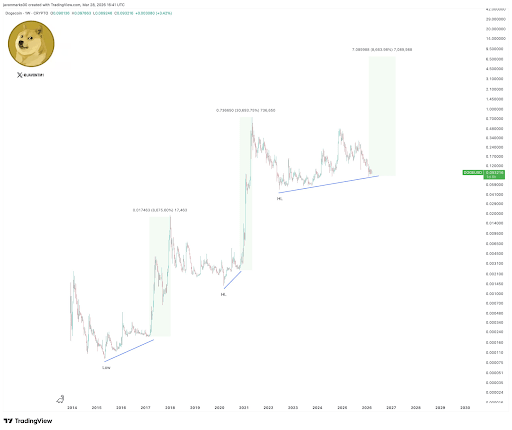
Source: Chart from Javon Marks on X

At the time of writing, the Dogecoin price is trading at around $0.09270, up almost 2% in the last 24 hours, according to data from CoinMarketCap.

DOGE trading at $0.09 on the 1D chart | Source: DOGEUSDT on Tradingview.com

Domande pertinenti

QWhat is the connection between the SpaceX IPO and the Dogecoin price?

AThe connection exists because of Elon Musk's well-known affinity for Dogecoin. The Dogecoin price has historically reacted to developments around him, and the SpaceX IPO is a major event for his company. Additionally, there is a direct link through the planned DOGE-1 lunar mission and the potential integration of DOGE payments on the X platform, which is now part of SpaceX.

QHow did the Dogecoin price react to the SpaceX IPO speculation?

AThe Dogecoin price notably rose, approaching the psychological $0.10 level, following reports that SpaceX could file for an IPO soon.

QWhat is the DOGE-1 lunar mission and its significance to Dogecoin?

AThe DOGE-1 lunar mission is a long-planned project that aims to send a physical Dogecoin to the moon. Elon Musk recently revived talks about the mission, suggesting it could happen next year, which creates a positive connection between SpaceX and the Dogecoin price.

QAccording to analyst Javon Marks, what is the potential price target for Dogecoin in the next bull run?

ACrypto analyst Javon Marks predicted that the Dogecoin price could rally to as high as $7 in the next bull run, which would be a new all-time high, surpassing its current ATH of $0.73. This is expected to happen between 2027 and 2028.

QWhat is the potential role of the X platform (formerly Twitter) in the future of Dogecoin?

AThe X platform, now part of SpaceX, is planning to roll out payment services. There is speculation that it could integrate DOGE payments, which could act as a catalyst to send the Dogecoin price higher.

Letture associate

$30 Billion DeFi Capital Exodus: LayerZero Stumbles, Chainlink Feasts

Following the major DeFi security incident involving Kelp DAO, a significant migration of funds is underway from the cross-chain protocol LayerZero to Chainlink's CCIP (Cross-Chain Interoperability Protocol). Over $30 billion in Total Value Locked (TVL) from protocols like Kelp DAO, Solv Protocol, Re, and Tydro has moved to Chainlink in the past week, driven by security concerns. LayerZero is facing a severe trust crisis after the attack. Initially denying responsibility, LayerZero Labs has now issued a public apology, acknowledging management oversights. These include a vulnerable "1/1" single-node configuration for its Decentralized Verification Network (DVN) and past misuse of a multi-signature wallet by a team member. The protocol's weekly bridge volume has slumped to near-historic lows of around $470 million. In contrast, Chainlink is experiencing a surge in adoption and activity. Its independent active addresses recently hit multi-month highs, and whales have been accumulating LINK tokens. Beyond DeFi, Chainlink is securing partnerships with traditional finance giants like DTCC, European stock exchange operator SIX Group, and asset manager Amundi. While LayerZero has announced security upgrades—such as migrating to stronger multi-signature configurations and developing a second DVN client—and contributed to a rescue fund, the event underscores that security is becoming a decisive competitive factor as DeFi matures.

marsbit25 min fa

$30 Billion DeFi Capital Exodus: LayerZero Stumbles, Chainlink Feasts

marsbit25 min fa

The $13 Trillion Repo Market Is Quietly Being Rewritten by Blockchain

The $13 trillion repurchase agreement (repo) market, a crucial artery for global short-term funding, is experiencing a significant transformation through blockchain technology. After years of limited impact in finance, blockchain is finding substantial adoption in repo transactions. Major institutions like JPMorgan Chase, HSBC, and Broadridge are deploying tokenized repo platforms, with daily volumes already reaching tens of billions of dollars. Traditional repo markets operate with fixed hours, rely on intermediaries, and involve manual, time-consuming processes. Tokenized repos, by contrast, use blockchain to create digital tokens representing cash and securities collateral. This enables near-instantaneous settlement, 24/7 trading, automated execution, and enhanced auditability. The key drivers for adoption include maturing technology, more receptive regulators, and growing client recognition of tangible benefits like reduced operational friction and capital efficiency. Analyses, such as one from Broadridge, indicate that moving a portion of repo activity onto blockchain can significantly reduce a bank's required liquidity buffers, potentially freeing up billions in capital. The infrastructure is also seen as foundational for a future of round-the-clock trading for traditional assets. Challenges remain, including the existence of fragmented blockchain networks, the need for stress testing under extreme market conditions, and the loss of operational flexibility compared to manual processes. However, the industry consensus is that these are implementation hurdles. Tokenized repo has moved beyond pilot stages to become one of blockchain's most concrete and impactful applications in traditional finance, marking a pivotal shift in how a core market functions.

marsbit26 min fa

The $13 Trillion Repo Market Is Quietly Being Rewritten by Blockchain

marsbit26 min fa

From Gas Limit to 'Keyed Nonces', How to Understand the Next Step in Ethereum Scalability?

Ethereum’s scalability efforts are shifting toward a user-centric approach—focusing not only on higher TPS, but on translating technical upgrades into lower costs, smoother operations, and better wallet experiences. Two recent developments highlight this direction: - **Raising the Gas Limit to 200 million**: Following the Fusaka upgrade that increased it to 60 million, a consensus has formed around a potential future increase to 200 million. This would boost Ethereum’s execution capacity, but it is planned alongside other upgrades—such as ePBS, Block-Level Access Lists (BAL), and EIP-8037—to manage state growth and keep node operation viable for average participants. - **Keyed Nonces (EIP-8250)**: This proposal aims to improve how transactions are queued. Instead of a single linear nonce per account, it introduces multiple independent nonce domains. This prevents different types of transactions—such as private payments, session keys, or batch operations—from blocking each other. Vitalik Buterin views this as a foundational step toward better privacy support and more flexible state scalability. Together, these upgrades are part of a broader move to push complexity from wallets, DApps, and relays back into the protocol layer. For everyday users, this means future Ethereum interactions could become less congested, more intuitive, and safer—especially as core improvements in account abstraction, cross-L2 interoperability, and node decentralization continue to progress. Ultimately, Ethereum is evolving to handle not just more transactions, but more varied and complex on-chain use cases while preserving its decentralized foundation.

marsbit48 min fa

From Gas Limit to 'Keyed Nonces', How to Understand the Next Step in Ethereum Scalability?

marsbit48 min fa

Trading

Spot
Futures
活动图片





