The profit from a single hard drive has suddenly become akin to that of an AI chip.
According to the latest FY2026 Q4 earnings release from American storage company Western Digital, revenue stood at $3.747 billion. Under US Generally Accepted Accounting Principles (GAAP), earnings per share were $8.21. As noted in the company's announcement, the fair value adjustment gain from its retained stake in SanDisk was also included in the income statement.
This gives Western Digital's results two layers of interpretation. The first layer is its core HDD business after the flash memory spinoff, which is selling more and becoming more profitable. The second layer is the fluctuation in the value of its retained SanDisk equity, pushing the GAAP profit to a level unsuitable for directly measuring the hard drive business.
This Isn't a One-Quarter Spike
Let's start with the most fundamental question. Is this growth confined to a single quarter?
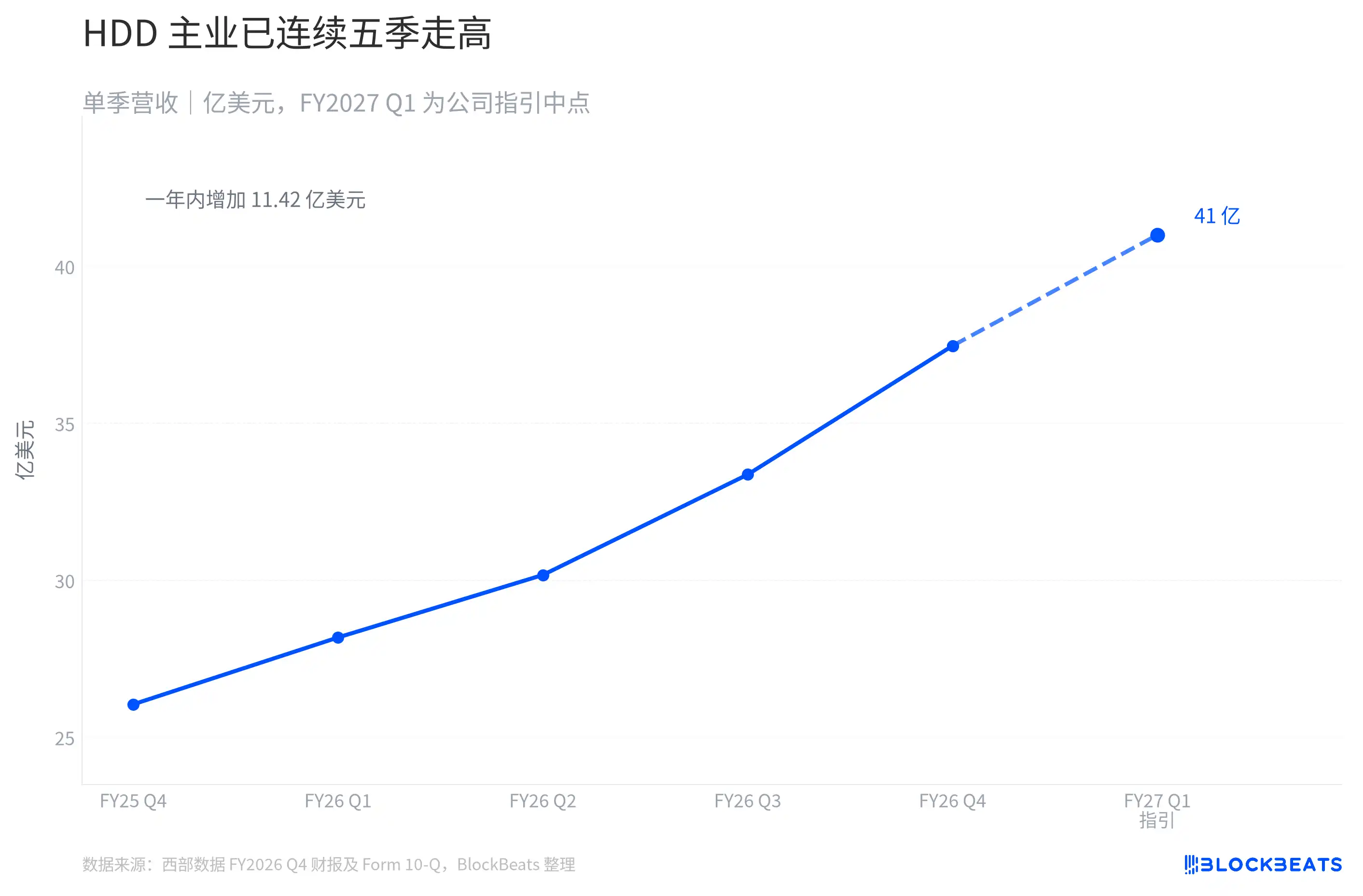
Based on Western Digital's FY2026 Q4 earnings release and previous Form 10-Q filings, the revenue curve from FY2025 Q4 to FY2026 Q4 shows no downturn. It rose consistently from $2.605 billion to $3.747 billion, forming a continuous upward trend across five actual quarters.
This line is worth examining because the reporting basis has changed. Western Digital completed the spinoff of its flash memory business in February 2025. The independent SanDisk is no longer consolidated into continuing operations. The latest earnings release also restated prior comparable periods under the HDD continuing operations basis. The growth in the chart is not the result of re-incorporating the SSD business, but rather the purer hard drive business expanding.
According to the company's earnings presentation on the same day, the cloud market accounted for 89% of Q4 revenue. This end-market label is not equivalent to AI revenue, but it indicates that Western Digital's primary revenue now comes from hyperscale cloud providers and cloud service providers. The hard drive's role in this chain is not to provide computing power, but to offer high-capacity data storage.
According to the company's FY2026 Q4 earnings release, the midpoint of the FY2027 Q1 revenue guidance is $4.1 billion. For readers, a more important reminder than the solid line is that guidance should only be seen as the company's current outlook, not as a predetermined fact for the next quarter.
Selling More, and Keeping More Profit
A larger revenue doesn't automatically mean a better business. This is especially true in the hard drive industry, where during an upcycle, shipments, prices, inventory, and capacity utilization all converge on a single income statement. What truly matters is how much is retained from every $100 of revenue.
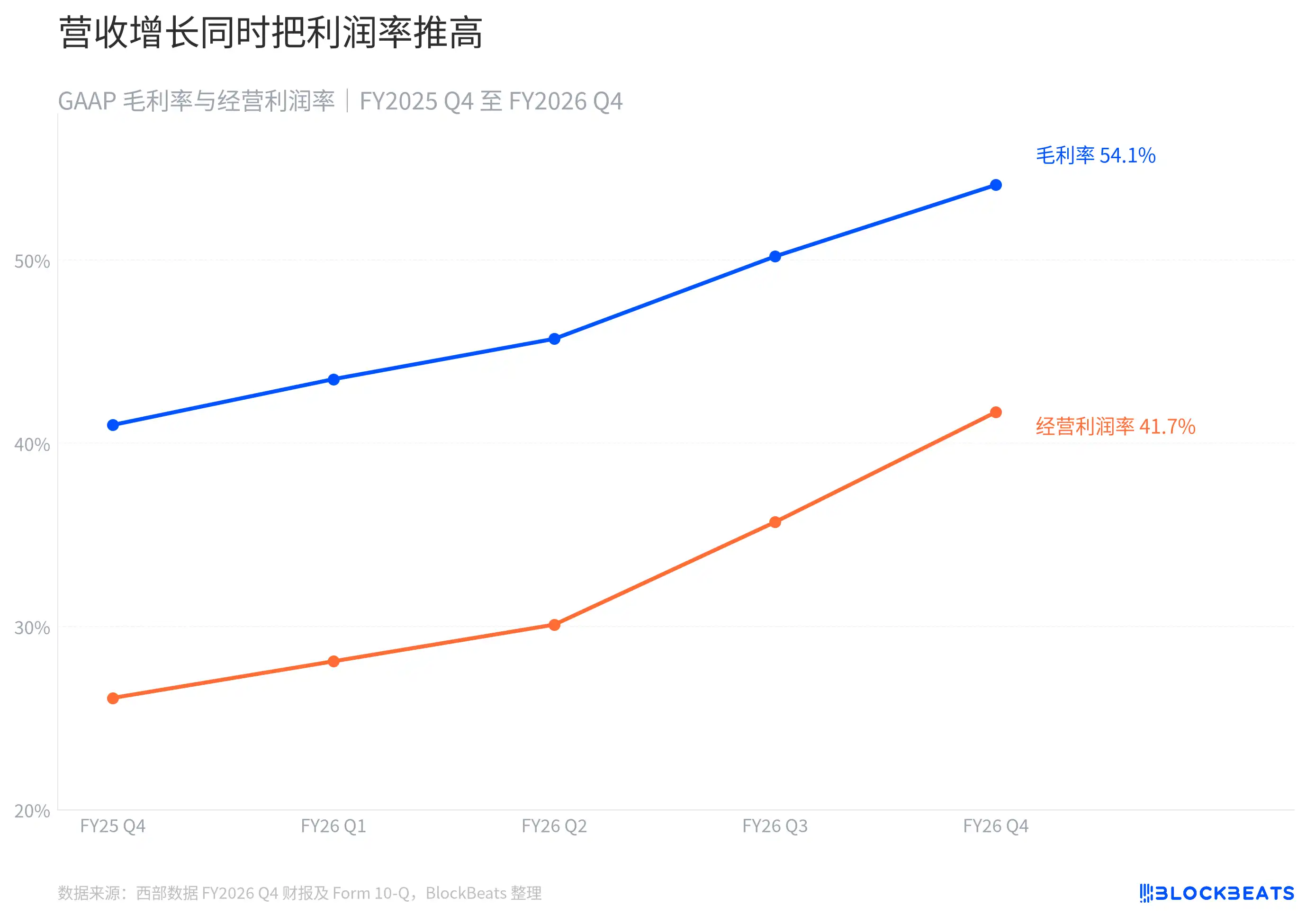
According to the company's financial reports, the GAAP gross margin for FY2026 Q4 reached 54.1%. Put more intuitively, for every $100 of storage products sold, the money left after deducting direct manufacturing costs now exceeds half.
Compared to a year ago, approximately $13 more in gross profit is retained from every $100 of revenue. The operating margin curve in the chart also rose at a similar slope, meaning R&D, sales, and administrative expenses did not consume the new gross profit gains.
We cannot simplistically attribute these two lines to any single product or customer. The earnings release itself only tells the market that cloud and other data-intensive workloads are expanding, driving increased demand for Western Digital's products. It does not break out "AI" as a separately auditable revenue line. What is certain is that revenue growth and margin expansion occurred simultaneously over the five quarters, and the new revenue clearly translated into operating margin.
Cash flow provides an additional layer of validation for this improvement. Free cash flow for FY2026 Q4 was $1.281 billion. According to the earnings release, cash flow from operating activities was $1.389 billion. Hard drives remain part of a manufacturing industry requiring equipment, materials, and inventory turnover. Cash keeping pace with profits offers another form of verification for these quarterly operating results. While it cannot alone prove the trend will last forever, it brings us closer to the funds the enterprise can actually deploy than looking solely at the income statement.
Where Did the EPS Actually Come From?
So, why does the GAAP EPS appear more exaggerated than the improvement in the core business? The answer lies in the final chart.
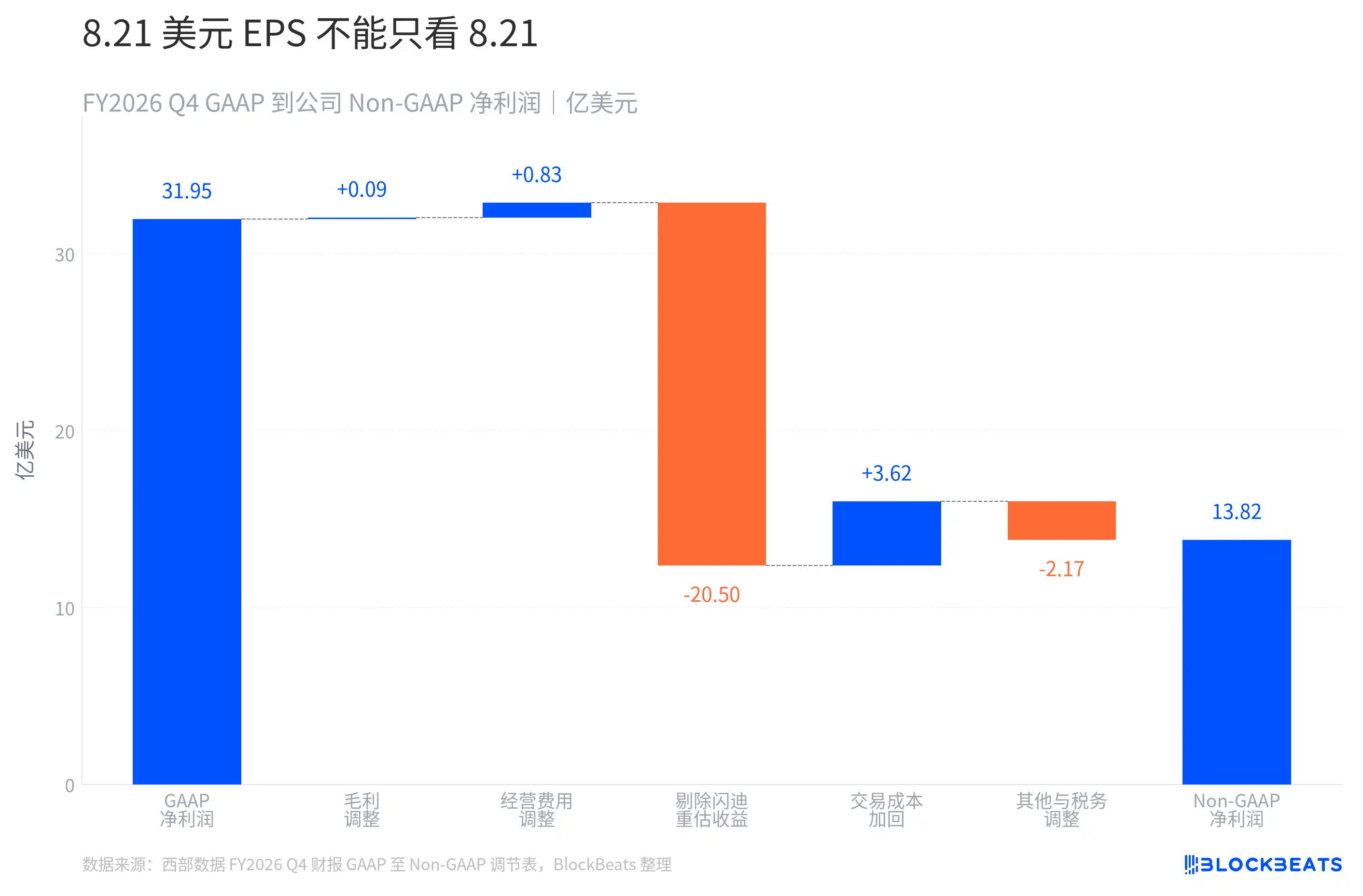
GAAP net income attributable to continuing operations for FY2026 Q4 was $3.195 billion. Under the company-defined Non-GAAP measure, this figure was $1.382 billion. The difference isn't an accounting error; it's because the company excluded several items from the latter that it does not consider reflective of ongoing operating performance.
The largest item is the $2.050 billion gain from the retained SanDisk equity. This came from the fair value adjustment of Western Digital's stake in SanDisk, not from direct revenue generated by selling more hard drives this quarter. In the same reconciliation table, the company also added back costs related to debt and equity transactions, and made adjustments for taxes, share-based compensation, and restructuring items.
This doesn't mean Non-GAAP is the only "true profit." It remains a company-defined comparative measure and must be read alongside GAAP. Its value lies in separating the changes in equity market value from the operating performance derived from manufacturing and selling hard drives. Focusing solely on the $8.21 figure risks conflating two fundamentally different types of earnings.
The most intriguing aspect of Western Digital's earnings report isn't that a hard drive suddenly acquired a valuation narrative like a chip, but that after the flash spinoff, both the revenue and profit margins of the core HDD business have indeed thickened. The SanDisk stake makes the GAAP profit appear brighter, but setting it aside reveals that the remaining hard drive business is already different from its state in the previous cycle.