Original Author: Rosa, Researcher at OutCatch Research (Web3Caff Research)
Imagine this scenario: on a morning in 2026, an AI Agent quietly operates with your authorization—it compares prices in the global data market, calls three APIs to complete information collection, pays $0.07 to complete a transaction, calls cloud computing power and automatically reserves $0.02 for settlement, and finally pays $0.01 to the downstream Agent generating the report. The entire process involves no bank accounts, no credit cards, no SWIFT codes, yet settlement is completed within 4 seconds. This is not science fiction; it's the millions of real transactions that x402 and MPP protocols are handling right now.
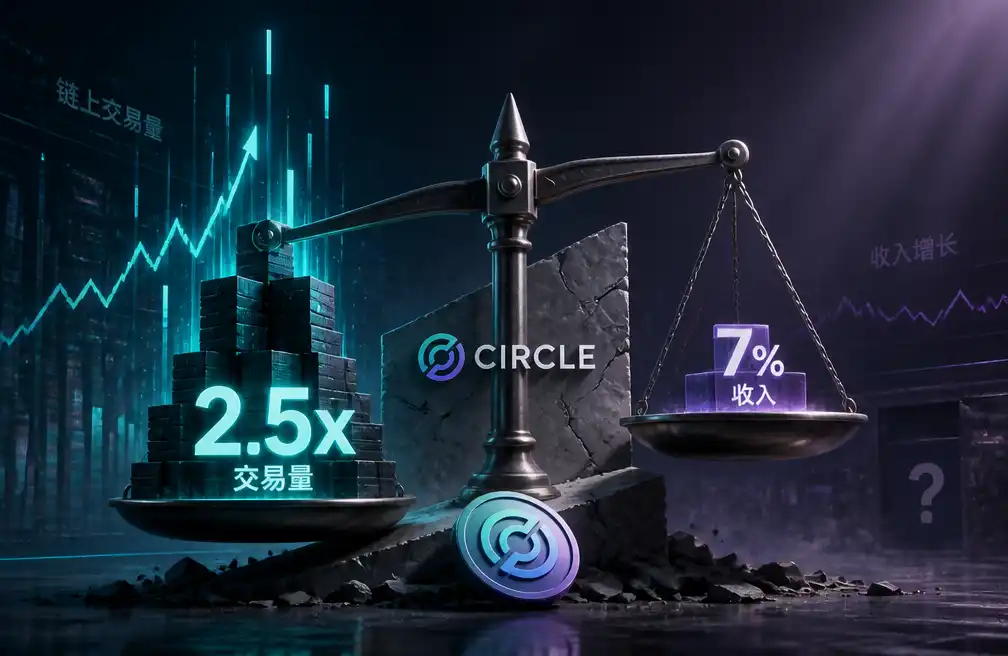
Digital contrast is redefining "how value flows." In 2025, stablecoins, with $33 trillion in on-chain settlement volume, surpassed the combined transaction volume of Visa and Mastercard for the first time; over 100,000 AI Agents are operating a payment economy imperceptible to humans: individual transaction amounts less than one cent, yet daily transaction frequency can reach millions, with fees close to zero. At the same moment, the global average cost for cross-border remittances remains high at 6.36%, settlement still takes 3–5 business days, and 1.3 billion adults remain outside the traditional banking system. The transition of industrial power over "who defines the next-generation payment infrastructure" is evolving from a Web3 industry narrative into a structural issue for the global financial system.
This research report will take Web3 payment infrastructure as its main line, systematically deconstruct the paradigm shift from "narrative-driven" to "infrastructure implementation" in the Web3 payments track for 2025–2026, and answer three fundamental questions determining the industry's direction for the next five years: Who leads the protocol standards? Which infrastructure layers will become the entry points for value accumulation? Who will grasp market definition power amidst the spiraling ascent of regulation and commerce?
Note: Due to length, this report is published in three parts: Part 1 (this one, containing Chapters: Chapter 1 Macro Background: The Historical Turning Point for Web3 Payments, Chapter 2 Stablecoins: The Core Infrastructure of Web3 Payments), Part 2 (Chapter 3 AI Agent Payments: The Emerging Machine Economy Layer, Chapter 4 Web3 Layouts of Payment Giants and Traditional Financial Institutions), Part 3 (Chapter 5 The Rise and Competition of the Stable Chain Track, Chapter 6 Global Regulatory Dynamics, Chapter 7 Comprehensive Conclusions and Trend Analysis).
Table of Contents
- Chapter 1 Macro Background: The Historical Turning Point for Web3 Payments
- Industry Paradigm Shift: From Narrative-Driven to Infrastructure Implementation
- Structural Pain Points of Traditional Payments vs. Comparative Advantages of Web3 Payments
- Merchant Payments Have Crossed the Practicality Threshold
- Chapter 2 Stablecoins: The Core Infrastructure of Web3 Payments
- Market Size Experiencing Explosive Growth in 2025-2026
- Dollar Duopoly and Reserve Yield Model Accelerate Connection to Traditional Finance
- Stablecoin Payment Use Cases: Accelerating Expansion from Exchange Settlement to Real Business Flows
- User Experience Architecture Evolution: From On-Chain Assets Towards Mass Payments
- Rise of "Stablechains": Vertical Integration of Payment-Specific Infrastructure
- Chapter 3 AI Agent Payments: The Emerging Machine Economy Layer
- Concept of Agentic Commerce and Payment Requirements
- Agent Payment Tech Stack: Layered Architecture from Settlement to Governance
- Competitive Landscape of Major Protocol Standards
- Benchmark Case: The Symbolic Significance of AWS AgentCore Payments
- Agent Payment Risks
- Chapter 4 Web3 Layouts of Payment Giants and Traditional Financial Institutions
- Stripe: Full Transition to Stablecoin Settlement Track
- PayPal: Dual Advance on PYUSD and AI Agent Fronts
- Visa: Dual-Track Stablecoin Strategy for the Card Network
- Mastercard: Advancing on Both Tokenized Credentials and Stablecoin Infrastructure Tracks
- Entry Paths for Traditional Financial Institutions
- Chapter 5 The Rise and Competition of the Stable Chain Track
- Structural Inevitability of Stablechain Emergence
- Positioning and Comparison of Major Stablechains
- Future Trend Speculation: Multi-Chain Coexistence Rather Than a Single Victor
- Chapter 6 Global Regulatory Dynamics
- United States: GENIUS Act Establishes Federal Regulatory Framework
- European Union: Full Enforcement of MiCA and Market Restructuring
- Hong Kong, China: Asia-Pacific Compliance Testing Ground
- Horizontal Comparison of Global Regulatory Frameworks
- Chapter 7 Comprehensive Conclusions and Trend Analysis
- Assessment of Industry Development Stage
- Five Core Trends
- Future Outlook
- Key Point Structure Chart
- References
Chapter 1 Macro Background: The Historical Turning Point for Web3 Payments
Compliance Notice: Stablecoins are virtual currencies (Tokens), and please be aware that issuing or investing in Tokens has varying strictness of regulatory requirements and restrictions in different countries and regions. Particularly in Mainland China, issuing Tokens may constitute "illegal securities issuance," and providing Token trading matching and other cryptocurrency trading-related activities also fall under "illegal financial activities" (Readers from Mainland China are strongly advised to read "Compilation and Key Summary of Mainland China Laws and Regulations Related to Blockchain and Virtual Currency"). The following content is merely an objective analysis of stablecoin promotion progress, market feasibility strategies, and is intended to explore and analyze how application scenarios based on blockchain technology are undergoing responsible development under the global regulatory environment. Therefore, please do not use this information for relevant decision-making, and please strictly abide by the laws and regulations of your country/region, refraining from any illegal financial activities.
Industry Paradigm Shift: From Narrative-Driven to Infrastructure Implementation
The Web3 industry is undergoing a profound paradigm shift. The previous narrative cycle of Web3 payments primarily revolved around "the application exploration of on-chain assets in the payment field." However, its practical implementation was long constrained by asset volatility, user experience, regulatory uncertainty, and insufficient merchant acceptance. The new change in 2025–2026 is that the industry's growth logic has shifted from asset price-driven to compliance-increment driven and infrastructure embedding. Stablecoins, as digital assets pegged to fiat value, effectively mitigate price volatility issues under compliance frameworks, have become the mainstream on-chain transaction settlement medium, and offer 24/7 cross-border accessibility. The entry of payment giants and cloud platforms has further enabled Web3 payments to spill over from the native user circle into traditional commercial networks.
The key to this turning point is not blockchain technology maturity, but the resonance of three catalysts. First, the stablecoin market is large enough to potentially support liquidity needs in real business scenarios. Second, regulatory frameworks are becoming clearer, enabling banks, payment companies, and enterprise clients to assess compliance pathways. Third, AI Agents bring new machine payment demands, exposing structural deficiencies in traditional card networks and bank account systems when facing micropayments, automatic authorization, and per-transaction settlement. The combination of these three factors moves Web3 payments from the discussion of "whether it can be established" into the industry competition stage of "who defines the standards, who controls the entry points, who accumulates the value."
Structural Pain Points of Traditional Payments vs. Comparative Advantages of Web3 Payments
The traditional cross-border payment system faces three major structural pain points: First, high costs. According to World Bank Q3 2025 data, the average cross-border remittance fee is about 6.36% [1], far exceeding a reasonable threshold. Second, low speed. SWIFT average settlement time is 3–5 business days, involving multiple intermediary banks leading to opaque nodes. Third, coverage gaps. Globally, about 1.3 billion adults lack bank accounts, and the traditional financial system severely underserves underbanked regions [2].
Four structural advantages of Web3 payments: First, settlement time has the potential to shift from banking business days and correspondent bank paths to near-instant on-chain confirmation. Second, the payment network shifts from a permissioned account system to a wallet address system, potentially covering users with insufficient bank accounts or difficulties receiving cross-border payments. Third, programmable transactions, enabling conditional payments, streaming payments, automatic reconciliation, and smart contract escrow. Fourth, the cost structure of micropayments differs from the fixed fees of card networks, better suited for new scenarios like API calls, data access, and machine-to-machine payments.
However, comparative advantage does not imply comprehensive replacement. As the New York Fed notes, local fast payment systems like FedNow, RTP, same-day ACH, Venmo, and CashApp possess advantages of low cost, instantaneity, and regulation for domestic payments. Stablecoins' differentiation stems more from global reach, no bank account requirement, and on-chain transfer capability [3]. Therefore, stablecoins are most likely to first break through in scenarios where traditional systems have obvious shortcomings, not as a one-size-fits-all replacement for all payment methods.
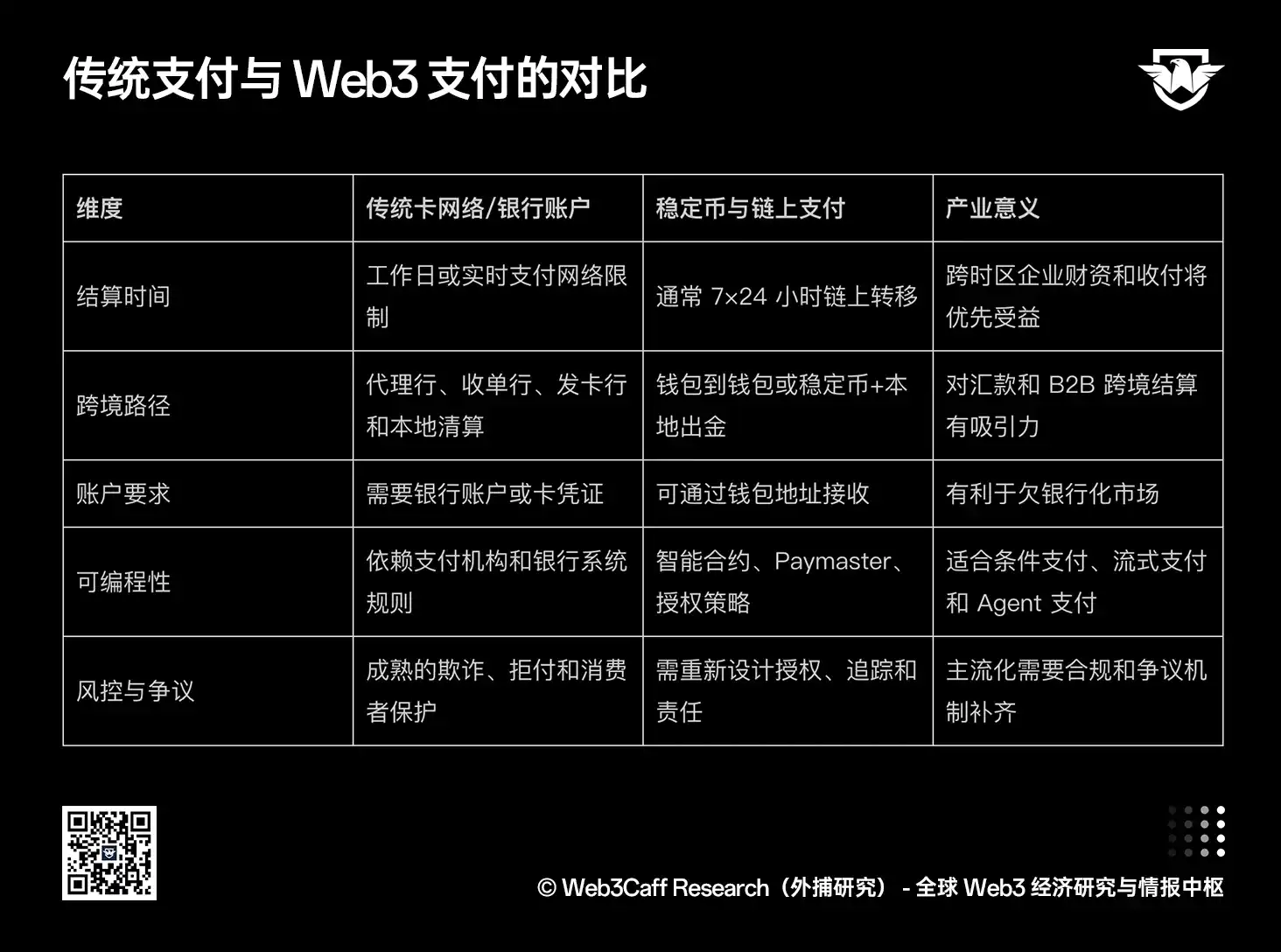
Comparison of Traditional Payments and Web3 Payments. Source: Compiled by Rosa, Researcher at OutCatch Research (Web3caff Research)
Merchant Payments Have Crossed the Practicality Threshold
In 2025, stablecoin payments for merchants broke through a threshold most retailers hadn't anticipated. According to Artemis Analytics data (reported by Bloomberg), stablecoin on-chain settlement volume reached approximately $33 trillion in 2025, a year-over-year increase of about 72%, exceeding the combined payment volume of Visa and Mastercard [4][5]. Even excluding "noise" like arbitrage and bot transfers, Chainalysis estimates of "real economic activity volume" still stand at about $28 trillion, nearing or surpassing the processing scale of traditional card networks, and posits that stablecoin payment flows could match the off-chain transaction volume of Visa and Mastercard sometime between 2031 and 2039 [4].
The reason stablecoins can approach card networks in settlement volume is precisely merchants' longstanding dissatisfaction with traditional card network costs. For each card transaction, merchants bear three layers of fees: the interchange fee paid to the issuing bank, the assessment fee paid to Visa or Mastercard, and the processor markup from the acquirer processor. Depending on card type, transaction method, and merchant category, these three combined typically consume 1.5% to 3.5% of each sale. For a $100 purchase, the merchant pays an average of about $2.24 in card processing fees; for a merchant with a monthly volume of $1 million, this means roughly $22,400 flows to intermediaries each month. E-commerce merchants often face even higher costs due to higher assessment fees and fraud risk premiums for card-not-present transactions. Beyond percentage fees, the card settlement cycle also ties up merchants' working capital for extended periods—as of early 2026, average card settlement time is about 1.9 business days (close to 3 calendar days including weekends). For a company with $10 million monthly volume, a roughly 3-day settlement delay incurs about $25,000 in financing costs annually. Additionally, there are hidden costs of chargebacks: regardless of the dispute outcome, each disputed transaction costs the merchant $20 to $100 in fees, and usually the already-shipped goods as well [6].
When on-chain settlement volume can already rival card networks, and the fees, funds-in-transit tie-ups, and chargeback costs of traditional card networks are clearly quantifiable, adopting stablecoin payments for merchants is no longer an experiment under observation but a clear economic choice based on calculable accounts—this is precisely the sign that the "practicality threshold" has been crossed.
Chapter 2 Stablecoins: The Core Infrastructure of Web3 Payments
Compliance Notice: Stablecoins are virtual currencies (Tokens), and please be aware that issuing or investing in Tokens has varying strictness of regulatory requirements and restrictions in different countries and regions. Particularly in Mainland China, issuing Tokens may constitute "illegal securities issuance," and providing Token trading matching and other cryptocurrency trading-related activities also fall under "illegal financial activities" (Readers from Mainland China are strongly advised to read "Compilation and Key Summary of Mainland China Laws and Regulations Related to Blockchain and Virtual Currency"). The following content is merely an objective analysis of stablecoin promotion progress, market feasibility strategies, and is intended to explore and analyze how application scenarios based on blockchain technology are undergoing responsible development under the global regulatory environment. Therefore, please do not use this information for relevant decision-making, and please strictly abide by the laws and regulations of your country/region, refraining from any illegal financial activities.
Market Size Experiencing Explosive Growth in 2025-2026
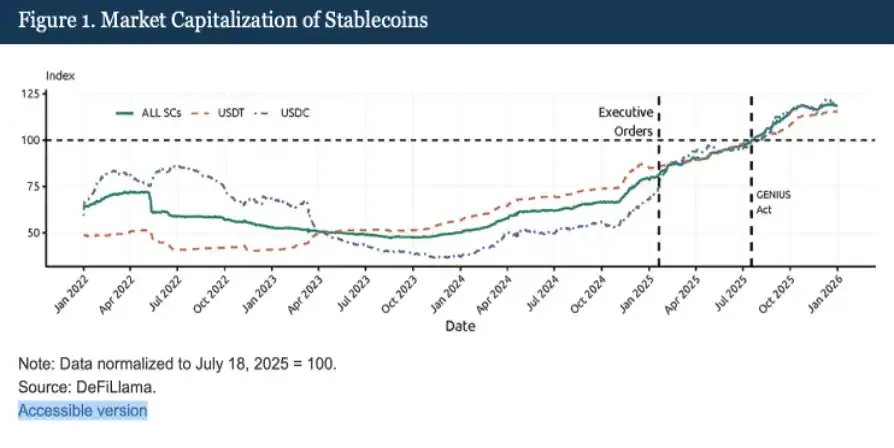
Stablecoin market size experienced explosive growth in 2025–2026. According to Artemis Terminal data, the total stablecoin supply increased approximately 2.6 times over the 5 years since September 2021, with non-linear growth. Notably, it increased by nearly $1 trillion within 2025 alone. On December 12, 2025, the total market capitalization of stablecoins first touched a historical peak of $3.1 trillion, and further broke through $3.23 trillion in May 2026. However, market growth flattened during Q4 2025 and Q1 2026.
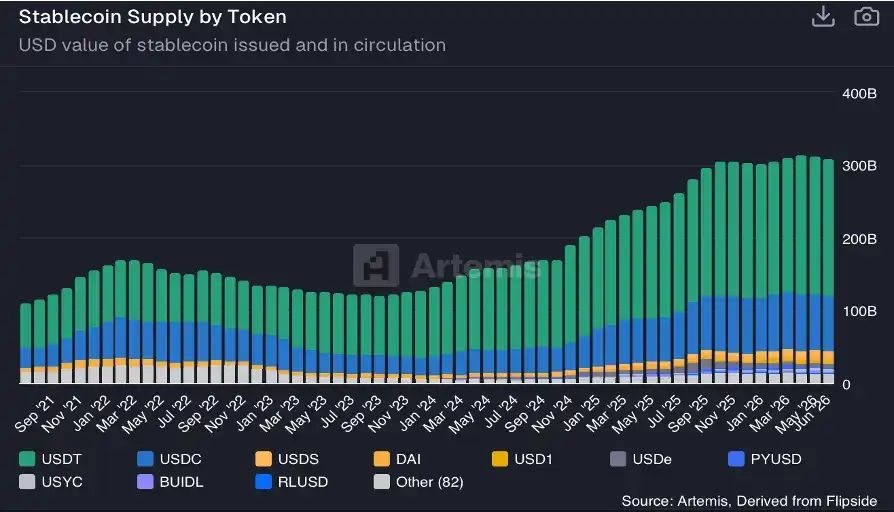
The market growth trend in 2025–2026 coincided with a series of significant events. On January 23, 2025, the White House issued the "Executive Order on Strengthening U.S. Leadership in Digital Financial Technologies"; on July 18, 2025, the "Guiding and Establishing National Innovation for U.S. Stablecoins Act" (GENIUS Act) was signed into law [7]. With the push of these two major policies, the U.S. formally established a federal regulatory framework for stablecoins.
Growth in the first half of 2025 preceded the signing of the GENIUS Act, possibly because the market, anticipating the imminent clarification of the legislative framework, saw increased institutional confidence and began accelerating stablecoin market layouts. Although the GENIUS Act requires stablecoins to be backed 1:1 by Treasury bills and central bank funds and prohibits issuers from paying interest directly to holders; the global supply of fiat-backed stablecoins continued to expand without significant impact.
Notably, no stablecoin has yet been issued under the GENIUS Act framework—the Act's full effective date is January 18, 2027 (or 120 days after the regulatory agency publishes final rules, whichever is earlier).
Dollar Duopoly and Reserve Yield Model Accelerate Connection to Traditional Finance
The stablecoin market remains highly concentrated in dollar assets. According to the stablecoin market circulation trend chart from Artemis Terminal above, dollar-denominated stablecoins account for over 99% of stablecoin supply. In terms of issuers, USDT and USDC have long dominated. As of June 9, 2026, USDT holds approximately 59% market share, with a market cap of about $1.86 trillion; USDC's market share is about 24%, with a market cap of about $774 billion; together they command over 83% market share. PYUSD, RLUSD, euro stablecoins, and bank-issued stablecoins represent new supply from compliant issuers like payment giants and traditional financial institutions.
The primary business model for stablecoin issuers comes from reserve asset yields. Compliant stablecoin issuers, upon receiving fiat currency, allocate it into highly liquid reserve assets like cash, bank deposits, short-term Treasuries, repurchase agreements, or money market funds, retaining the yield from these assets while providing holders with a 1:1 redemption promise. Non-compliant issuers like Tether, according to its official disclosures, reported full-year 2025 net profit exceeding $10 billion, with total exposure to U.S. Treasuries as high as $1.41 trillion (including $1.22 trillion direct holdings), making it currently the largest non-sovereign holder of U.S. Treasuries [8].
BIS research further reveals the link between stablecoins and the U.S. short-term Treasury market. BIS research notes that dollar-backed stablecoin issuers purchased nearly $400 billion in U.S. T-bills in 2024, a scale approaching that of large government money market funds, and found that stablecoin inflows can have a measurable impact on 3-month T-bill yields, with stablecoin flows exerting an identifiable downward pressure on the short end of the U.S. Treasury yield curve [9]. This means stablecoins are no longer just internal products of the Web3 market but are already connected to traditional safe asset markets through the reserve asset channel. The larger the stablecoin scale, the more its inflows and outflows warrant regulatory attention regarding potential impacts on Treasury markets, monetary policy transmission, and financial stability.
Stablecoin Payment Use Cases: Accelerating Expansion from Exchange Settlement to Real Business Flows
The earliest primary use of stablecoins was pricing and settlement within the Web3 market, where users utilized assets like USDT, USDC to quickly move dollar exposure between trading platforms and DeFi protocols. The change in 2025–2026 is that stablecoin use cases are migrating towards real commercial payments. Visa summarizes banking opportunities including cross-border remittances, B2C payments, corporate treasury and B2B payments, on-chain credit facilities, and RWA (Real World Asset Tokenization) [10]. Fireblocks' 2025 survey shows that 90% of surveyed institutions have taken action on stablecoins, 49% of financial institutions already use stablecoins in payments, with another 41% in pilot or planning stages [11].
In cross-border B2B scenarios, the value of stablecoins lies not only in reducing fees but also in shortening the settlement chain, improving fund visibility, and releasing prepaid funds. The Fireblocks survey shows that surveyed institutions consider the primary value of adopting stablecoins to be faster settlement (48%), followed by transparency (36%), integrated payment flows (33%), and improved liquidity management (33%), with low cost only at 30% [12]. This indicates that enterprises and banks value capital turnover efficiency, controllability, and new market entry capabilities, not merely transaction fee reduction.
Global payouts and remote payroll are another high-potential scenario. The platform economy, creator economy, and cross-border outsourcing require businesses to pay individuals and small merchants in multiple countries. Traditional bank accounts and local clearing networks have uneven coverage, while stablecoins can facilitate cross-border flow with stable dollar value, then licensed local institutions can complete final settlement per local regulations. This scenario is especially suitable for Latin America, Africa, Southeast Asia, and high-inflation countries, as users are more sensitive to dollar-denominated store-of-value and instant receipt.
U Cards represent the most easily understandable entry point on the consumer side. Visa's partnership with Bridge demonstrates that stablecoins can be "converted" into daily spending power through existing card networks and merchant acceptance systems. Consumers use cards on the front end, merchants receive local fiat on the back end, and stablecoin balances complete bookkeeping and value conversion within infrastructure like Bridge. This path shows that consumers don't necessarily need to understand chains, Gas, or wallets; stablecoins can be embedded as back-end funding sources within traditional payment experiences.
User Experience Architecture Evolution: From On-Chain Assets Towards Mass Payments
For stablecoins to evolve from Web3-native assets into mass payment tools, they must overcome three experience hurdles: First, users need to hold native fee tokens (Gas Tokens) to initiate transactions; second, private key and seed phrase management is complex and error-prone; third, fragmentation from multi-chain, multi-stablecoin choices creates cross-chain selection issues. In 2025–2026, two complementary evolution paths formed around these hurdles—the underlying account abstraction path and the upper-layer payment rail path—together moving the front-end experience of on-chain payments closer to Apple Pay, PayPal, and bank cards.
In the account abstraction path, leadership primarily comes from ERC-4337 and EIP-7702. What is account abstraction? The core idea is to extend the programmability of smart contracts to ordinary users. Making the user's wallet itself a smart contract unlocks advanced features like multi-factor authentication, recurring automatic payments, and custom transaction rules.
Currently, every transfer on the blockchain requires the user's wallet to hold the corresponding public chain's Token to pay the transaction fee. This is like traveling abroad; regardless of the destination country, you must first exchange for local currency before you can spend. This is a significant barrier for ordinary users. To address this, the Ethereum community (including founder Vitalik Buterin) proposed the ERC-4337 standard, officially deployed on the Ethereum mainnet in March 2023. ERC-4337 introduces components like UserOperation, Bundler, EntryPoint, and Paymaster, allowing users to express transaction intent through smart accounts and permitting Paymasters to pay Gas on behalf of users under specific conditions. We will use Visa team's test diagram as an example for detailed explanation below [13].
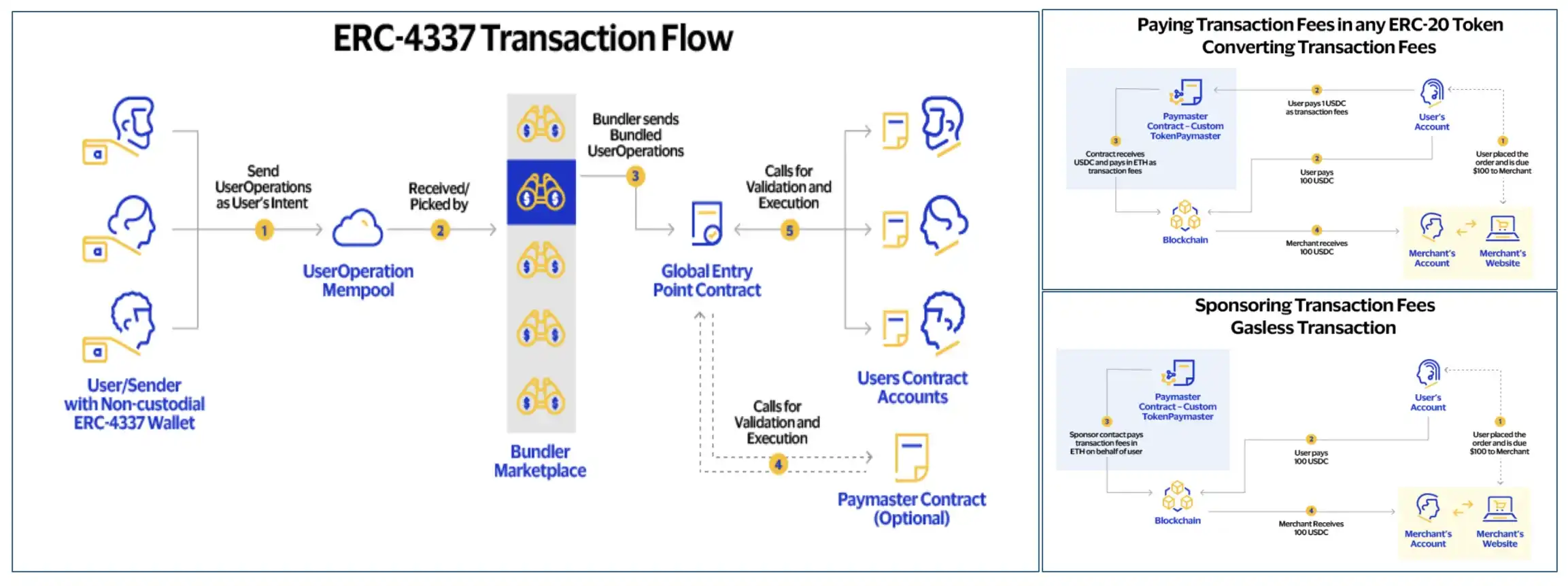
Traditional Ethereum transaction flow: User signs with private key → Transaction enters public mempool → Validators/builders pack into blockchain. The process is simple but rigid; users must hold ETH to pay Gas fees and cannot customize any logic.
ERC-4337, by introducing a dedicated UserOperation mempool, a Bundler packaging market, and a global EntryPoint contract, decouples user transaction intent from underlying blockchain execution, enabling smart contract wallets to initiate transactions without modifying Ethereum's consensus protocol. Its core significance is pushing the control logic of blockchain accounts from the protocol layer down to the application layer, granting developers and users full programmable authority over "wallet behavior." More colloquially, ERC-4337 allows smart contract wallets to initiate transactions like regular wallets, without changing Ethereum's underlying rules; essentially, it hands the decision of "what a wallet can do" from Ethereum's official hands to developers and users themselves.
The optional Paymaster (sponsor) contract further abstracts Gas fee payment methods—it can act as a "currency middleman," receiving users' USDC and automatically converting it to ETH on-chain to pay fees, or platforms can directly sponsor all Gas fees, achieving a completely transparent zero-fee experience for users. Both models point towards the same goal: completely eliminating the native Token holding barrier, reducing friction in on-chain payments to a level comparable to traditional digital payments.
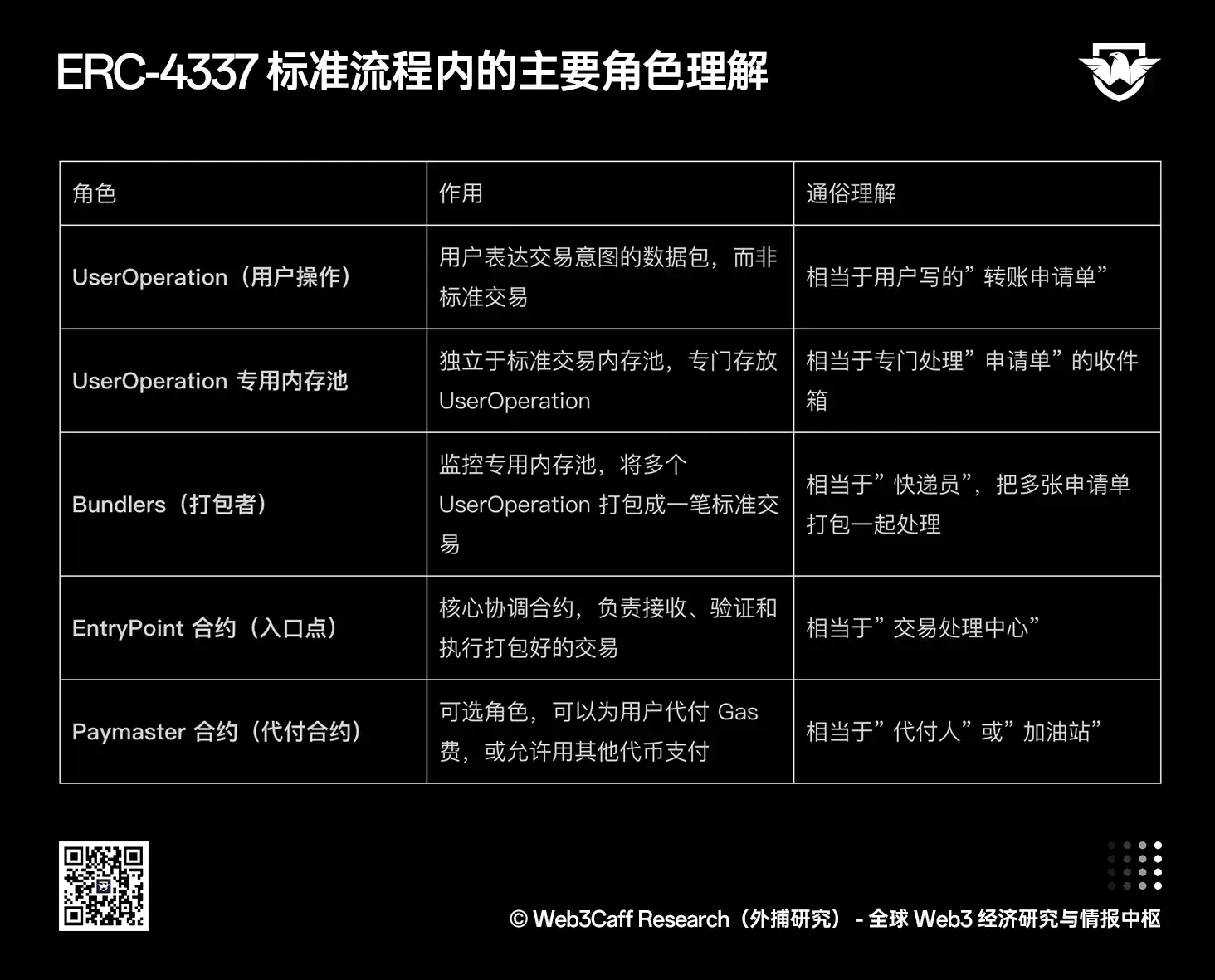
Understanding the Main Roles within the ERC-4337 Standard Process. Source: Created by Rosa, Researcher at OutCatch Research (Web3caff Research)
While account abstraction (ERC-4337) is a key application protocol for blockchain payments moving mainstream, ERC-4337 does not solve a fundamental problem: the vast majority of users still use traditional EOA wallets (Externally Owned Accounts), like MetaMask wallets; how can they smoothly transition to the smart contract wallet experience?
EIP-7702, led by Vitalik Buterin, was born precisely to address this pain point. In one sentence, EIP-7702 allows a traditional EOA wallet, at the moment of executing a transaction, to temporarily or permanently "borrow" the code of a smart contract, transforming into a smart contract wallet.
EIP-7702 introduces a new transaction type (Transaction Type 0x04). When a user initiates such a transaction, they can attach an Authorization List to the transaction. This list contains a special "pointer" (address). When the transaction executes, the Ethereum network does one thing: it points the user's EOA account code to the smart contract code at that address (by writing a 0xef0100 || address delegation indicator). From that moment, this originally empty EOA account gains all the capabilities of that smart contract. Its significance: it allows Externally Owned Accounts (EOAs) to temporarily set account code, gaining smart account capabilities like batch transactions, Paymaster-sponsored transactions, and permission downgrades, without needing to migrate addresses or deploy new wallets [14].
Thus, users don't need to change wallets or transfer assets to immediately enjoy the benefits brought by the ERC-4337 ecosystem (like Paymaster sponsorship). A colloquial understanding: if ERC-4337 builds a modern high-speed rail station (smart contract wallet ecosystem), then EIP-7702 builds a fast track for all the old users still riding bicycles (EOA wallets) to drive directly into the station. Through a minor protocol-layer change, it unleashes immense UX innovation potential at the application layer.
Circle's article on the Pectra upgrade in 2025 explains that EIP-7702 combined with Circle Paymaster allows EOAs to use USDC to pay Gas without deploying a smart wallet, lowering the on-chain operational barrier for users in stablecoin payments [15]. This path addresses the Gas and signature complexity faced by self-custody wallet users, its significance being: retrofitting the smart account experience in place for the hundreds of millions of existing EOA wallets (MetaMask, Ledger, Trust Wallet, etc.), rather than requiring users to migrate to new addresses.
In the payment rail path, payment and card network institutions represented by Stripe, PayPal, Visa, Mastercard, and Circle choose to abstract away on-chain complexity on the custodial side, all completed by processors and issuers in the backend, with merchants and consumers not needing to understand on-chain concepts. For example, Stripe, after acquiring stablecoin infrastructure company Bridge in early 2025, officially embedded USDC checkout capability into its standard merchant checkout flow starting December 2025 [16]; PayPal's issued stablecoin PYUSD expanded to over 70 markets by March 2026, processing approximately $8.2 billion in cross-border stablecoin transactions in Q1 2026 alone [17]; Circle launched CPN Managed Payments, a custodial settlement product for banks; Visa officially launched USDC settlement in the U.S. in December 2025, and on April 29, 2026, announced it would add five blockchains to its global stablecoin pilot program, with annualized stablecoin settlement volume reaching $7 billion, a 50% increase from the previous quarter [18]; Mastercard concurrently advanced stablecoin card acceptance through partnerships with MetaMask, Circle, etc.
Both paths converge in product form towards the same goal—letting users only confirm payment amount, payee, and authorization scope, sinking Gas, chain selection, settlement, cross-chain routing, etc., entirely to the backend—but serve different user structures. Account abstraction makes "Web3-savvy people" use it more conveniently; payment rails allow "Web3-unfamiliar people" to use it too. Together, they form the technical and product foundation for Web3 payments evolving from "on-chain assets" to "mass payment tools" in 2025–2026.
Rise of "Stablechains": Vertical Integration of Payment-Specific Infrastructure
In 2025, a new proprietary term emerged: stablechain. This term was first proposed by the Layer1 blockchain project Stable(stable.xyz), supported by Bitfinex and using USDT as its native asset. Stable positions itself as the world's first "Stablechain" and officially launched its mainnet in December 2025.
The rise of stablechains is fundamentally rooted in the long-term accumulation of a structural contradiction: stablecoins have become the primary value carriers on-chain, but the infrastructure hosting them was never designed for them. This "mismatch" creates three types of unavoidable friction in practice: First, Gas payments on general-purpose public chains, with unpredictable costs. Second, block space competition, where payment transactions must compete with speculative DeFi operations and MEV (Maximal Extractable Value) arbitrage bots for limited block space, leading to unstable confirmation times, and payment transactions are naturally disadvantaged in priority ordering. Third, lack of payment-specific compliance and privacy modules.
Current stablechain development characteristics mainly include: using stablecoins as native Gas Tokens to eliminate cost volatility; built-in payment-specific transaction channels and priority mechanisms; integrated DEX and FX liquidity supporting native on-chain foreign exchange conversion; providing compliance modules for institutions. This specialization brings not only performance improvements but also a shift in design philosophy: elevating the predictability, compliance, and user experience of payments from an application-layer "option" to a protocol-layer "hard constraint." Detailed analysis of three representative stablechains is in Chapter 5.
References
[1] Worldbank (2025.09), Remittance Prices Worldwide
[2] Woldbank (2025), The Global Findex 2025
[3] Liberty Street Economics (2025), The Future of Payment Infrastructure Could Be Permissionless
[4] Cryptonews.net (2026.04), Stablecoins quietly out‐settle Visa as Coinbase crowns them the internet’s real money
[5] Bloomberg (2026.01), Stablecoin transactions rose to record 33 trillion led by USDC
[6] Spark. Money (2026.06), Stablecoin Payments for Merchants: Costs, Integration, and the 2026 Adoption Wave
[7] Federal Reserve (2026.04), Stablecoins in 2025: Developments and Financial Stability Implications
[8] BLOCKHEAD (2026.02), Tether Reports $10 Billion Profit as Stablecoin Issuer Becomes Top-20 Holder of US Treasuries
[9] BIS Working Papers No 1270 (2025.05, and revised 2026.06),Stablecoins and safe asset prices.
[10] Visa, Stablecoins and the future of onchain finance
[11] Fireblocks (2025.05), State of Stablecoins 2025
[12] Fireblocks (2025.05), Stablecoins in Banking: Strategic Insights from the 2025 Survey
[13] Visa (2023.05), What is Account Abstraction?
[14] Ethereum Improvement Proposals, EIP-7702
[15] Circle (2025.05), How the Pectra Upgrade is unlocking gasless USDC transactions with EIP-7702
[16] WuBlockchain (2025.12), Stripe will launch stablecoin payments for merchants on December 12, 2025.
[17] Stablecoininsider (2026.03), PayPal’s PYUSD Q1 2026 Stablecoin Report
[18] Visa (2026.04), Visa Accelerates Stablecoin Momentum: Adding Five Blockchains for Settlement
[19] Google Cloud Blog (2025.09), Powering AI commerce with the new Agent Payments Protocol (AP2)
[20] Coinbase Developer Platform(2026.06), x402 Protocol Explained: How AI Agents Pay Onchain.
[21] x402.org
[22] Keyrock (206.05), Who Pays the Agent? The Race for Frictionless Machine Payments
[23] AWS Blog(2026.05), Agents that transact: Introducing Amazon Bedrock AgentCore payments, built with Coinbase and Stripe
[24] Fortune (2024. 10), Stripe announces $1.1 billion acquisition of stablecoin start-up Bridge
[25] Privy (2025.06),Privy and Stripe: Bringing crypto to everyone
[26] Stripe (2025.05), Stripe accelerates the utility of AI and stablecoins with major launches
[27] Stripe (2026.05), Stripe partners with AWS to power AgentCore payments with Privy
[28] PayPal (2025.07), PYUSD on Arbitrum
[29] PayPal Newsroom(2025.06), PayPal USD (PYUSD) Plans to Use Stellar for New Use Cases
[30] Visa (2025.04), Visa and Bridge Partner to Make Stablecoins Accessible for Everyday Purchases
[31] Coindesk(2026.04), Visa and Zodia Custody join Stripe’s new blockchain for machine payments
[32] Mastercard (2025.04), Mastercard unveils Agent Pay, pioneering agentic payments technology to power commerce in the age of AI
[33] Mastercard (2026.03), Mastercard to acquire BVNK to connect on-chain payments and fiat rails
[34] Congress.act (2025.07), Genius Act
[35] Federal Register (2026.02), Implementing the Guiding and Establishing National Innovation for U.S. Stablecoins Act for the Issuance of Stablecoins by Entities Subject to the Jurisdiction of the Office of the Comptroller of the Currency
[36] Sumsub (2026.01), MiCA Regulation and EU Crypto Rules: What Changes in 2026
[37] Eco.com (2026.05), MiCA-Compliant Stablecoins 2026: Full List With Issuers
[38] HKMA (2025.07),Implementation of regulatory regime for stablecoin issuers
[39] Yahoo Finance (2025.12), China’s Digital Yuan to Become Interest-Bearing Under New 2026 Framework
Disclaimer: This report or content (hereinafter collectively referred to as the Report) is prepared by OutCatch Research (Web3Caff Research). The information contained is for reference only and does not constitute any prediction, investment advice, proposal, or offer. Investors should not rely on such information to purchase, sell any securities, cryptocurrencies, or adopt any investment strategy. The terms used and views expressed in the Report are intended to aid understanding of industry trends and promote responsible development in the Web3 new economy field including the blockchain industry, and should not be interpreted as explicit legal opinions or the views of OutCatch Research (Web3Caff Research). The views in the Report only reflect the author's personal opinions as of the date stated, are independent of the position of OutCatch Research (Web3Caff Research), and may change following subsequent developments. The information and views contained in this Report are from proprietary and non-proprietary sources considered reliable by OutCatch Research (Web3Caff Research) and do not necessarily cover all data, nor guarantee their accuracy. Therefore, OutCatch Research (Web3Caff Research) makes no warranty of any kind regarding its accuracy and reliability, nor assumes liability for errors and omissions arising in any other manner (including liability to any person due to negligence). This Report may contain "forward-looking" information, which may include forecasts and projections, and this document does not constitute a guarantee of any prediction. Whether to rely on the information contained in this Report is entirely at the reader's discretion. This Report is for reference only, does not constitute investment advice, proposal, or offer to purchase or sell any securities, cryptocurrencies, or adopt any investment strategy, and please strictly abide by the relevant laws and regulations of your country or region.