Web3 Fund Global Expansion Guide: Deconstructing the Compliance Frameworks of Six Major Global Crypto Funds

marsbitPubblicato 2026-03-20Pubblicato ultima volta 2026-03-20

Introduzione

A Guide to Web3 Fund Structures: Analyzing Six Major Global Crypto Fund Compliance Frameworks As crypto assets evolve from simple trading to professional asset management, Web3 projects, quantitative teams, and high-net-worth individuals increasingly adopt fund structures. The choice of legal framework is a foundational decision impacting risk isolation, tax treatment, and long-term compliance. This article analyzes six major fund structures suited for different strategies and investor profiles: - **Cayman SPC**: An umbrella company structure allowing multiple segregated portfolios under one entity. Ideal for multi-strategy teams seeking risk isolation and rapid product iteration. - **Cayman ELP**: A limited partnership form common in VC/PE, offering flexible profit distribution, tax transparency, and investor privacy. - **BVI Approved Fund**: A low-cost, fast-setup solution for early-stage teams managing under $100M, with simplified compliance and up to 20 investors. - **Singapore VCC**: An onshore structure with regulatory credibility, umbrella fund options, and potential tax exemptions (13O/13U), suitable for family offices and teams establishing a local presence. - **Hong Kong LPF**: A localized limited partnership offering convenience for Asian-based operations, banking, and legal services, with potential profit tax exemption. - **Hong Kong OFC**: An open-ended corporate structure ideal for liquid strategies, ETFs, or public offerings, supported by government subsidie...

Original Authors: Zhang Qianwen, Cheng Chuying

Introduction

As crypto assets evolve from simple trading activities to professional asset management, an increasing number of Web3 project teams, quantitative teams, and high-net-worth individuals are adopting fund structures to manage crypto assets. In this process, the choice of a fund's legal structure is no longer a matter of formality; it is a fundamental decision directly impacting risk isolation, tax treatment, and long-term compliant operations.

From a regulatory practice perspective, differences in fund establishment systems, regulatory requirements, and tax arrangements across various jurisdictions determine the investment strategies and fundraising targets they are suited for. Whether it's multi-strategy quantitative trading, primary market investments, or family office asset allocation, there is no "optimal structure," only a "suitable structure" that matches the business model.

This article deconstructs six major global crypto fund structures, analyzing their core mechanisms and applicable scenarios to provide reference for managers' compliance planning.

Cayman SPC: The "Umbrella Company" Suitable for Multi-Strategy Operations

The SPC (Segregated Portfolio Company) is a corporate form in the Cayman Islands. Its key feature is the ability to establish multiple, legally independent investment portfolios (SPs) under a single legal entity.

  • Core Mechanism: Risk Segregation

The assets and liabilities of each SP are legally separate. For example, if Strategy A loses money, its creditors can only claim against A's assets and cannot touch the funds of Strategy B. This is crucial in the highly volatile crypto market, effectively preventing one strategy's "meltdown" from dragging down the entire operation.

  • Applicable Scenarios:

When a manager simultaneously runs both high-risk and low-risk strategies, an SPC ensures that accounts are kept separate and do not interfere with each other. Additionally, launching a new product simply involves creating a new sub-fund under the existing SPC, eliminating the need to register a new company. This offers low cost and high speed, making it suitable for teams looking to quickly incubate new strategies.

Cayman ELP: The "Partnership Structure" Suitable for Primary Market Investments

Unlike the corporate structure of an SPC, the ELP (Exempted Limited Partnership) is a partnership structure established under the Exempted Limited Partnership Law. It does not have independent legal personality but is a contractual relationship between a General Partner (GP) and Limited Partners (LPs). ELPs are widely used in venture capital (VC) and private equity (PE).

  • Core Mechanism: Clear Division of Roles

The GP (General Partner) is responsible for managing the money and making investments, bearing unlimited liability (in practice, a limited company is often used as the GP to isolate risk). The LP (Limited Partner) provides capital, does not participate in management, and their liability is limited to their contribution.

  • Applicable Scenarios:

Primary market investments involve complex profit distribution. The Partnership Agreement allows for flexible terms on how and when profits are shared. Furthermore, ELPs are tax-transparent, meaning the fund itself does not pay tax, and the list of LPs does not need to be publicly disclosed, balancing tax efficiency and privacy protection.

BVI Approved Fund: The "Entry-Level Compliance Solution" for Small Teams

For smaller, early-stage teams, the BVI (British Virgin Islands) Approved Fund offers a compliant option with low barriers to entry and controllable costs.

  • Core Mechanism: Filing-Based, Simplified Regulation

Establishment is fast, typically approved within two to three days of submitting materials. It is not mandatory to hire an auditor or a local custodian, significantly reducing operational costs.

  • Applicable Scenarios

Suitable for teams with assets under management below $10 million who are still in the strategy validation phase. It allows for establishing a compliant entity at a lower cost to build a track record. The investor cap is 20 persons, and the asset size cap is $100 million, making it suitable for fundraising within a familiar circle or community.

Singapore VCC: The "Onshore Fund Structure" Balancing Compliance and Practicality

The VCC (Variable Capital Company) is a fund vehicle introduced by Singapore that retains the flexibility of offshore funds while having the regulatory backing of the Monetary Authority of Singapore (MAS).

  • Core Mechanism: Umbrella Structure + Tax Incentives

The VCC also supports the establishment of multiple sub-funds with asset segregation. Most importantly, it can apply for the 13O/13U tax exemption scheme, where qualifying investment income is tax-exempt, and dividends are not subject to withholding tax.

  • Applicable Scenarios

Suitable for teams looking to set up an office in Singapore, obtain work visas, or establish a family office. It offers an internationally recognized compliant identity while protecting investor privacy (the shareholder register is not public), making it attractive to capital seeking long-term stability.

Hong Kong LPF: The "Cross-Border Fund Channel" Connecting Asian Markets

The LPF (Limited Partnership Fund) is a localized fund structure launched by Hong Kong, modeled on the Cayman ELP. It is registered and managed in Hong Kong and governed by Hong Kong law.

  • Core Mechanism: Localized Limited Partnership

Structurally similar to the Cayman ELP, but all legal matters and bank communication are handled locally in Hong Kong, with no time zone or language barriers.

  • Applicable Scenarios

If the team is primarily based in Asia, the LPF offers convenience in lawyer liaison, bank account opening, and daily maintenance. Coupled with Hong Kong's Unified Fund Exemption (UFE) regime, qualifying funds can enjoy profits tax exemption, offering a friendly tax environment.

Hong Kong OFC: The "Open-Ended Fund Structure" Suitable for Public Offerings or ETF Issuance

The OFC (Open-ended Fund Company) is a corporate-type open-ended fund with independent legal personality, allowing flexibility in handling investor subscriptions and redemptions.

  • Core Mechanism: Variable Capital, Flexible Structure

An OFC can increase or decrease shares based on subscription and redemption demands, bypassing the restrictions of capital reduction in traditional companies. It can be used for private placements or apply for public offerings (requires SFC authorization).

  • Applicable Scenarios:

To encourage OFC development, the Hong Kong government offers a subsidy covering up to 70% of the establishment costs (capped at HKD 1 million per company), effectively reducing startup costs. Additionally, the OFC is currently one of the mainstream structures in Hong Kong for issuing virtual asset ETFs and fundraising from the public, making it suitable for highly liquid trading strategies.

Overview of Core Characteristics of the Six Structures

Based on the above analysis, the legal characteristics and applicable scenarios of the six mainstream fund structures are summarized below:
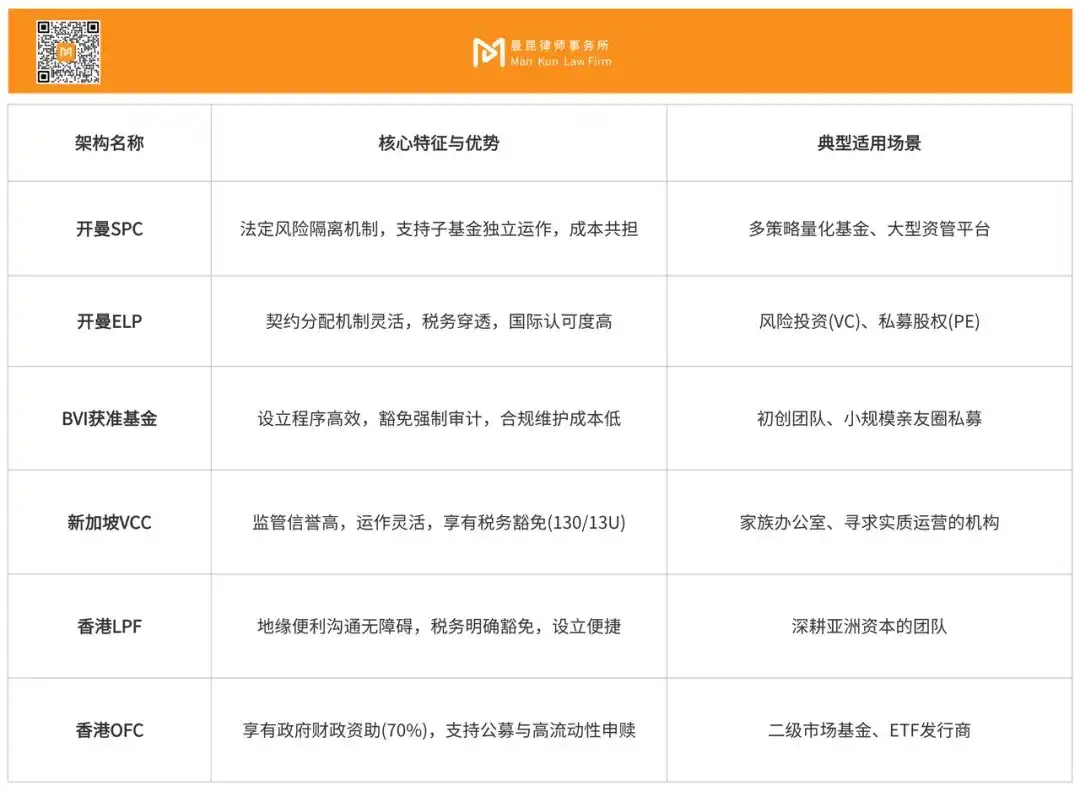
Conclusion

In the field of crypto assets, the question regarding fund structures is never "whether to establish one," but rather "when to establish it and in what form." Different legal structures correspond not only to how taxes are paid and how regulations are applied but also to how risks are borne, how investors participate, and how the future operational model will succeed.

The fund structures introduced in this article are neither good nor bad in themselves; the key is whether they match your business model, investment strategy, and target investors. For managers who are already operating or plan to operate crypto assets in a fund format, thinking through and finalizing the structure early is itself an important form of risk control.


Domande pertinenti

QWhat is the main advantage of using a Cayman Islands SPC structure for a crypto fund?

AThe main advantage is its ability to provide risk isolation through multiple segregated portfolios (SPs) within a single legal entity, ensuring that the assets and debts of one strategy do not affect others.

QWhich fund structure is most suitable for early-stage teams with smaller assets under management (AUM) and why?

AThe BVI Approved Fund is most suitable because it has a low compliance threshold, fast setup (approved in 2-3 days), reduced operational costs (no mandatory auditor or local custodian), and is designed for teams with AUM below $100 million and up to 20 investors.

QHow does the Singapore VCC structure benefit teams looking to establish a presence in Singapore?

AThe Singapore VCC offers regulatory backing from the Monetary Authority of Singapore (MAS), allows for multiple sub-funds with asset segregation, and provides tax exemptions (e.g., under 13O/13U schemes) on qualifying investment income, making it attractive for setting up offices, obtaining work visas, or establishing family offices.

QWhat makes the Hong LPF a convenient option for teams primarily based in Asia?

AThe Hong Kong LPF is convenient because all legal matters, banking communication, and daily maintenance are handled locally in Hong Kong, eliminating language and time zone barriers, and it benefits from tax exemptions under the Unified Fund Exemption (UFE) regime.

QWhich fund structure is ideal for issuing public offerings or virtual asset ETFs, and what support does it receive?

AThe Hong Kong OFC (Open-ended Fund Company) is ideal for public offerings or ETF issuance due to its flexible capital structure that allows for share redemptions and subscriptions. It also receives government support, including up to 70% subsidy on setup costs (capped at HKD 1 million per company).

Letture associate

UBS: The Crowdedness of A-Share Tech Stocks Is Far From Reaching Historical Peaks

UBS: A-share tech stocks still far from peak crowding levels A-shares' technology sector has seen a strong rebound, with trading activity hitting record highs, raising concerns about market crowding. However, UBS Securities argues that a key indicator of institutional positioning suggests the current crowding level remains well below historical peaks. While the large-cap tech sector's share of total A-share trading volume and market capitalization have reached historical highs, the overweight ratio of domestic mutual funds in this sector stood at 9.9% in Q1 2026. This is down from 11.6% in Q3 2025 and significantly lower than the historical peak of 14.1% in Q4 2015. It also pales in comparison to the historical peak overweight of 18.7% for the consumer sector. UBS notes that typical cycles from a low to a peak in fund overweighting last about three years, and the current outperformance of the tech/growth style has lasted less than two years since the policy pivot in September 2024. UBS expects A-share earnings recovery to accelerate, providing fundamental support. It forecasts 2026 A-share profit growth to rise to 11% from 3.9% in 2025. Non-financial A-share profits grew 11.8% YoY in Q1 2026, with gross and net profit margins at their highest since 2023. Persistent fund inflows, the expansion of thematic ETFs, and a recovery in private fund issuance are supporting market liquidity. In tactical allocation, UBS favors growth and cyclical styles under its "slow bull" base case, with overweight ratings on six sectors: Electronics (benefiting from semiconductor inventory recovery and AI innovation), Communications (driven by AI computing demand), Machinery (aided by domestic capex recovery), Non-ferrous Metals (due to rising copper/aluminum prices), Chemicals (supported by anti-involution policies), and Electrical Equipment (driven by policy support and AI data center power demand).

marsbit12 min fa

UBS: The Crowdedness of A-Share Tech Stocks Is Far From Reaching Historical Peaks

marsbit12 min fa

Should You Buy SpaceX Stock at $1.7 Trillion? Here's What the Market Is Worried About

SpaceX is preparing for a massive IPO aiming to raise around $75 billion at a valuation of approximately $1.75 trillion. While its achievements in reusable rockets and the profitable Starlink satellite internet service are clear, the market is concerned about the aggressive valuation. Key issues include: the current $1.75 trillion valuation, which is about 94 times 2025 revenue, seems to price in not just existing businesses but also unproven future ventures like AI infrastructure and orbital data centers. Financially, while Starlink is profitable, the AI division, bolstered by the acquisition of xAI, is incurring massive losses and consuming the majority of capital expenditures. This acquisition also introduced complex related-party financing arrangements and debt onto SpaceX's balance sheet. Furthermore, corporate governance poses a challenge. SpaceX's dual-class share structure ensures founder Elon Musk retains absolute control, limiting ordinary shareholders' influence over high-risk, long-term strategic decisions. The future success of ambitious projects like the Starship rocket—critical for lowering costs and enabling new services—remains a significant variable for the valuation. In summary, the market's apprehension (FUD) centers not on doubting SpaceX's past technological triumphs but on questioning how much premium public investors should pay for a future that combines proven profits with highly speculative and capital-intensive new ventures, all under a governance structure that offers limited shareholder oversight.

marsbit1 h fa

Should You Buy SpaceX Stock at $1.7 Trillion? Here's What the Market Is Worried About

marsbit1 h fa

Breaking the DeFi Cascading Liquidation Curse: Vitalik Proposes a New Solution

Vitalik Buterin has proposed a new DeFi design to eliminate the automatic liquidation mechanism that causes market instability during sharp downturns. The current system, used by protocols like Aave, triggers forced sales when collateral value falls below a threshold, often exacerbating price drops and creating systemic selling pressure. Buterin's alternative model is based on splitting an asset like ETH into two synthetic option-like tokens, P and N, pegged to a price index. Their combined value always equals one ETH. Instead of sudden liquidation, a position's value gradually drifts from its target peg if the market moves. Users must proactively rebalance their holdings to maintain their desired exposure, transferring the management burden from the protocol to the user or automated tools. A key advantage is the reduced reliance on real-time oracles. Pricing decisions are deferred until contract expiry, allowing for more robust, fault-tolerant oracle designs. This removes a clear liquidation threshold that speculators can target for manipulation or MEV extraction. However, significant challenges remain. Frequent rebalancing could incur high slippage and transaction costs, necessitating new liquidity provider models. The design is better suited for hedging instruments than for stablecoins requiring a rigid 1:1 peg. While not an immediate replacement for existing systems, the proposal challenges the foundational assumption that instantaneous forced liquidation is an unavoidable necessity in DeFi, opening the door for fundamentally different risk management architectures.

marsbit1 h fa

Breaking the DeFi Cascading Liquidation Curse: Vitalik Proposes a New Solution

marsbit1 h fa

Trading

Spot
Futures
活动图片




