Web3 and DApps in 2026: A utility-driven year ahead for crypto

cointelegraphPubblicato 2025-12-24Pubblicato ultima volta 2025-12-24

Introduzione

By 2026, the crypto industry is shifting from speculative hype toward a utility-driven focus. Decentralized applications (DApps) are increasingly built for real-world use, with developers prioritizing polished user experience, interoperability, and sustainable monetization rather than short-term gains. Key improvements include account abstraction, gas sponsorships, and faster blockchain performance, narrowing the gap with Web2 applications. Ecosystems like Ethereum, Solana, and TON are competing not just on scalability but also on distribution and practical relevance. The emergence of super-apps and AI agents may further simplify user interaction. The year will test whether DApps can retain users without speculative incentives—making actual utility the defining metric for success.

As the crypto space headed into the last month of 2025, the mood was different from previous cycles. The year didn’t bring another decentralized finance (DeFi) summer or non-fungible token (NFT) euphoria, but instead ushered in a slow and sober pivot toward utility.

Decentralized applications (DApps) are software programs that run on blockchain networks, rather than centralized servers. By using smart contracts, DApps allow users to interact directly with apps for payments, finance, gaming or social media while retaining greater control over identities and assets.

Active builders held steady in 2025 but shifted their priorities to a longer-term outlook. According to Electric Capital’s Developer Report, the number of full-time crypto developers — defined as contributors committing code at least 10 days per month — rose 5% year-on-year, even as total developer counts dipped slightly.

The divergence suggests that speculative “tourist” participation has waned, while more builders are pursuing crypto as a full-time profession. In practice, that points to a smaller but more committed developer base, with sustained development effort increasingly concentrated among long-term teams rather than short-term projects.
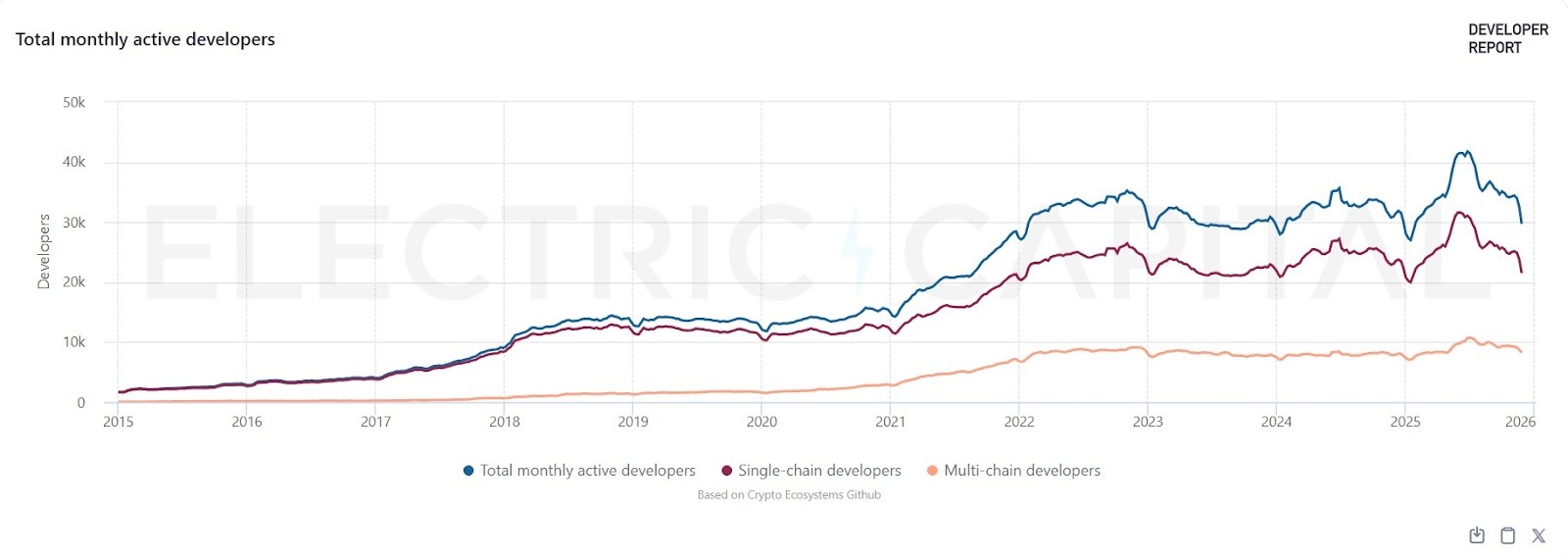
Total monthly active developers. Source: Electric Capital

Web3 gaming developers are also identifying different drivers of success for gaming DApps. According to a survey by the Blockchain Gaming Alliance (BGA), Web3 game developers are tying success to polished gameplay, sustainable monetization and infrastructure that supports spending.

This means that builders are depending less on external forces like traditional gaming giants coming into Web3 and instead focusing on controllable factors such as implementing interoperability, integrating artificial intelligence and creating player-driven economies.
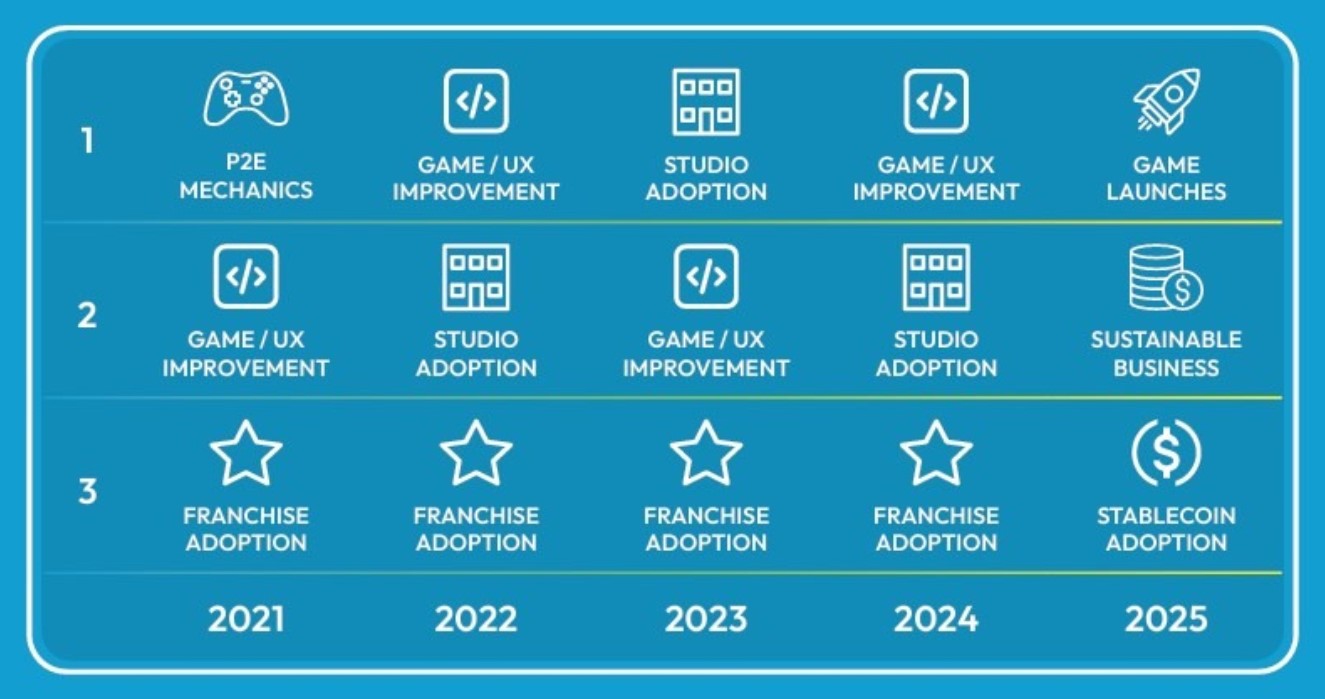
Key factors that are perceived to drive the growth of the blockchain gaming industry. Source: BGA Survey

If 2024 was defined by layer-2 scaling paths, 2025 became a year of preparation. Builders focused on making crypto usable, pushing account abstraction into production, tightening wallet UX and building mobile distribution channels through ecosystems like Solana’s Saga and The Open Network’s deep integration with Telegram.

At the same time, regulators across major jurisdictions like the United States, Europe and Asia have drawn clearer boundaries around stablecoins, custody and reporting, giving developers a framework to build within. The result was a year spent building the groundwork instead of chasing breakout apps.

The groundwork now sets up 2026 as a decisive test of relevance. With tooling largely in place and compliance streamlined, DApps will need to address the challenging question of whether they can attract and retain users without relying on speculative incentives.

The industry spent much of 2025 talking about a pivot to utility, but 2026 is where this claim would have to meet reality. If everyday users don’t stay once yields fade and rewards disappear, the problem will no longer be the technology, but the applications themselves.

How DApps can compete with Web2 in 2026

While DApps focused on competing with each other for user attention in previous years, 2026 may become the year when they must stand against Web2 applications and their scale.

For DApps to stand a chance, they must erase barriers that historically caused friction for mainstream users — and the shift is already underway. Account abstraction is moving closer to becoming the default experience across major ecosystems, enabling smart accounts that behave more like familiar log-in mechanisms than cryptographic tooling.

Gas sponsorships, where apps pay gas on behalf of users, reduced one of the biggest pain points, while social logins and MPC wallets removed the need for seed phrases. Moreover, sub-second finality on high-performance blockchains like Solana and modular rollups on Ethereum have narrowed the latency gap.

The emerging layer of AI agents capable of interacting with smart contracts could make DApp usage feel less like managing a wallet and more like a regular application.

Related: Tether deepens AI bet, backs Italian firm’s humanoid robots

This highlights the stark contrast between 2025 and 2026. This year showed fragmentation fatigue, where thousands of isolated DApps, each with separate accounts, assets and user journeys, created a high cognitive load for new users.

Because of this, the next leap for the sector may come from modular, interoperable super apps that bundle multiple needs in one interface, similar to how WeChat and Grab built dominance in the Web2 space.

Payments, savings and stablecoin rails could sit alongside NFT creator tools, gaming assets, loyalty tokens and social identity, allowing users to move across experiences inside a single ecosystem.

If 2025 was the year protocols built the foundation, 2026 may be the year to test whether these actually work in daily use.
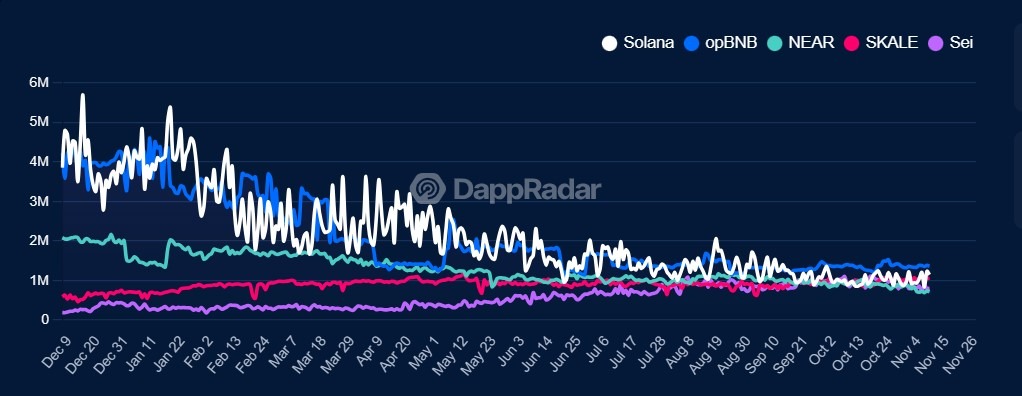
Solana and opBNB dominate in unique active wallets in 2025. Source: DappRadar

Related: Web3 gaming, DeFi lead sector activity in October despite market decline: Report

Which ecosystems are positioned to win in 2026?

Several ecosystems enter 2026 with distinct advantages, not only in throughput or developer tools, but also in distribution, user funnels and real-world relevance.

Ethereum remains the center of smart contract development, but its 2025 upgrades were incremental in nature. Improvements tied to the Fusaka upgrade focused on advancing Ethereum's data availability and zero-knowledge roadmap.

It includes early steps toward more efficient proof systems and shared sequencing concepts rather than immediate fee reductions on the mainnet. Together with the continued maturation of rollups, these changes position Ethereum to support cheaper and faster settlement over time, without compromising its security model.

Related: Vitalik Buterin pitches ZK-proofs to audit X algorithm and rankings

Solana continues to carve out the consumer lane, powering sub-second transactions for payments, in-app micro-purchases and mobile-native experiences that feel more Web2 than Web3.

On the other hand, TON stands out with arguably the strongest user funnel in the crypto space. Telegram's massive user base, Mini Apps and seamless wallet integrations created a distribution channel that would be difficult to replicate.
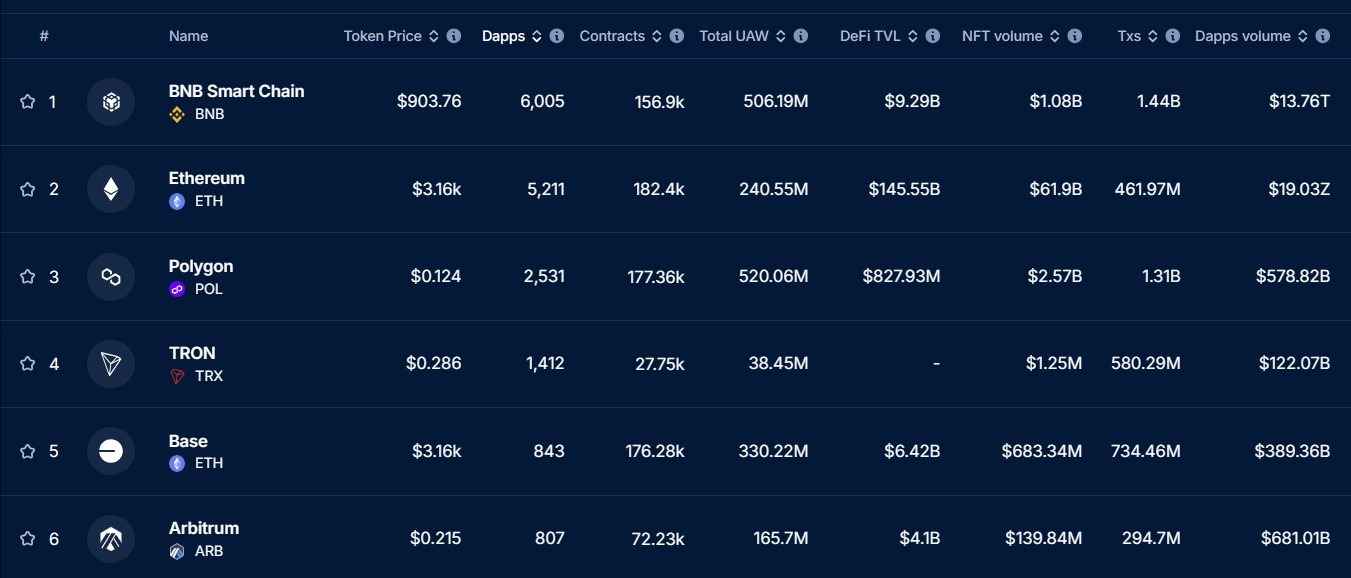
DappRadar integrated data showed that BNB Chain has over 6,000 DApps. Source: DappRadar

Beyond chains, thematic sectors could also define what could dominate the sector in 2026. Decentralized physical infrastructure networks (DePIN) gained traction in 2025 by anchoring crypto to real-world workflows like bandwidth, compute markets, mobility networks and energy credits.

These provided revenue paths that are not dependent on yield farming. In June, a World Economic Forum (WEF) report predicted that the sector could grow to $3.5 trillion by 2028, driven by the adoption of blockchain and artificial intelligence.

Meanwhile, creator-focused DApps are also maturing beyond NFTs and speculation toward micro-IP ownership, music royalties and fan-powered monetization models.

If these trends hold, the ecosystems best placed to succeed in 2026 will likely be the ones that combine distribution, scalability and clearer everyday use cases — not just the fastest network, but the one with the most active users.

2026 will be a turning point for utility

Crypto has already spent years building, scaling networks, tightening security, refining user experiences and building regulatory foundations to support its developments.

With infrastructure reaching consumer-grade readiness, the next phase may be less about which chain processes transactions faster and more about which products we are willing to return to without the usual token incentives.

If 2025 was a year spent in construction, 2026 is shaping up to be a year to evaluate — one where DApps must deliver practical value and not just promises. The winners will be those that feel similar to everyday applications, with simple onboarding, invisible gas and stable cost structures.

Magazine: Ethereum’s Fusaka fork explained for dummies: What the hell is PeerDAS?

Crypto di tendenza

Domande pertinenti

QWhat was the main shift in the crypto space during 2025 according to the article?

AThe main shift in 2025 was a slow and sober pivot toward utility, moving away from speculative trends like DeFi summers and NFT euphoria, with builders focusing on long-term development and making crypto usable.

QHow did the developer landscape change in 2025 based on Electric Capital's Developer Report?

AAccording to Electric Capital's Developer Report, the number of full-time crypto developers (those committing code at least 10 days per month) rose 5% year-on-year, while total developer counts dipped slightly, indicating a smaller but more committed developer base focused on long-term projects.

QWhat are the key factors that Web3 game developers believe drive success for gaming DApps, as per the Blockchain Gaming Alliance survey?

AWeb3 game developers tie success to polished gameplay, sustainable monetization, and infrastructure that supports spending, focusing on controllable factors like interoperability, AI integration, and player-driven economies rather than relying on external forces like traditional gaming giants.

QWhat technological and UX improvements are helping DApps compete with Web2 applications in 2026?

AImprovements include account abstraction becoming the default experience, gas sponsorships where apps pay gas fees for users, social logins, MPC wallets eliminating seed phrases, sub-second finality on high-performance blockchains, and AI agents that make DApp usage feel like regular applications, all reducing friction for mainstream users.

QWhich ecosystems are positioned to win in 2026, and what advantages do they have?

AEthereum remains the center of smart contract development with incremental upgrades focused on data availability and zero-knowledge proofs. Solana excels in consumer applications with sub-second transactions for payments and mobile-native experiences. TON has a strong user funnel through Telegram's massive user base and seamless wallet features. Additionally, ecosystems supporting DePIN and creator-focused DApps with real-world utility are well-positioned.

Letture associate

Annual Salary of Millions Competing for Electricians, Meta Rushes to Open Its Own Technical School

The AI boom is facing an unexpected bottleneck: a severe shortage of skilled construction workers and electricians. As tech giants like Meta, OpenAI, and Alphabet race to build massive data centers—such as OpenAI's $16 billion "Stargate" project—they are hitting a critical labor wall. The U.S. needs an estimated 130,000 more electricians, 240,000 construction workers, and 150,000 supervisors by 2030 for AI infrastructure alone, but tens of thousands of electrician jobs go unfilled each year. While AI companies offer high premiums, with electricians earning up to $280,000 annually, worker scarcity still causes massive losses—delays on a single project can cost $14.2 million per month. The complexity of building AI data centers, which require immense power (equivalent to powering hundreds of thousands of homes), sophisticated electrical systems, and advanced liquid cooling solutions, demands highly skilled technicians who are in short supply. To combat this, companies are investing heavily in training. Meta has committed $115 million to a free training school offering tuition, housing, and stipends, targeting 5,000 new workers. OpenAI is partnering with unions to secure skilled labor. These efforts are paying off, with a significant rise in Gen Z interest in trade schools over college. However, the power demands are staggering. AI data centers are driving a rapid surge in electricity consumption, projected to account for up to 12% of U.S. power use by 2028 and raising costs for consumers. Furthermore, the construction boom is project-based, leading to a potential future glut of trained workers once building peaks, which could depress wages industry-wide. The race for AI supremacy now depends as much on skilled hands as on advanced chips.

marsbit27 min fa

Annual Salary of Millions Competing for Electricians, Meta Rushes to Open Its Own Technical School

marsbit27 min fa

OpenAI No Longer Sells Its Most Expensive Model for Profit

OpenAI is shifting its business strategy away from promoting its most expensive, flagship models for every task. Recent price cuts—80% for GPT-5.6 Luna and 20% for Terra—signal a deeper change: the company now actively advises users that many tasks don't require the most powerful model. Instead, OpenAI recommends a tiered approach: use the high-end GPT-5.6 Sol for complex planning and analysis, then delegate execution to cheaper models like Luna. This mirrors moves by Anthropic, which recently launched Claude Opus 5 at half the price of its top model, Fable 5. Both companies are de-emphasizing flagship models as primary revenue drivers, using them instead for brand prestige and technological showcases. The industry is entering a "mass-market" phase, similar to automotive, where high-volume, cost-effective models handle daily operations and drive scale. OpenAI's price reductions are partly enabled by AI models themselves optimizing underlying code and infrastructure, creating a self-reinforcing cycle of efficiency gains and cost reduction. Competition is shifting from "who is smartest" to "who offers the best value." The goal is no longer selling individual models but fostering widespread API adoption and ecosystem lock-in. By making AI calls cheap and ubiquitous, companies like OpenAI aim to become the indispensable, utility-like infrastructure powering automated workflows—the "water and electricity" of software, quietly embedded everywhere.

marsbit27 min fa

OpenAI No Longer Sells Its Most Expensive Model for Profit

marsbit27 min fa

Will the Fed Definitely Raise Interest Rates in September? How Will Crypto and U.S. Stocks Withstand the Pressure?

The market's expectation for a September Fed rate hike surged dramatically in early August, jumping from under 50% to over 80% within a week. This shift followed a contentious July FOMC meeting, where a 9-3 vote to hold rates revealed growing dissent from hawkish members advocating for an immediate hike to combat persistent inflation. The primary catalyst for this repricing is rising oil prices, driven by renewed geopolitical tensions around the Strait of Hormuz, which threaten global supply. Energy costs directly influence inflation metrics, making the upcoming July CPI report (due August 12th) a critical data point. If it shows inflation reaccelerating, the probability of a September hike will solidify. For Bitcoin and crypto assets, this is typically bearish news. Bitcoin continues to behave as a high-beta, liquidity-sensitive risk asset. A rate hike raises the opportunity cost of holding non-yielding assets and could drive capital toward money markets, pressuring crypto prices in the short term. However, historical patterns suggest that if a hike is perceived as the end of a tightening cycle rather than the start, any negative price impact may be brief. U.S. stocks, particularly crypto-linked equities like Coinbase and growth-oriented tech stocks, are also vulnerable. Higher rates increase discount rates in valuation models, putting pressure on high-multiple companies. This coincides with a pivotal tech earnings season where investor focus has shifted from massive AI capital expenditure to tangible revenue and cash flow generation. Companies with negative cash flow and weak growth narratives could face heightened volatility if borrowing costs rise in September. In summary, a September Fed hike has evolved into a mainstream market scenario. Key factors to watch are oil prices, the July CPI report, and Fed communications, which will determine the final decision and its impact on volatile crypto and equity markets.

marsbit37 min fa

Will the Fed Definitely Raise Interest Rates in September? How Will Crypto and U.S. Stocks Withstand the Pressure?

marsbit37 min fa

Trading

Spot

Articoli Popolari

Come comprare O

Benvenuto in HTX.com! Abbiamo reso l'acquisto di O1 exchange (O) semplice e conveniente. Segui la nostra guida passo passo per intraprendere il tuo viaggio nel mondo delle criptovalute.Step 1: Crea il tuo Account HTXUsa la tua email o numero di telefono per registrarti il tuo account gratuito su HTX. Vivi un'esperienza facile e sblocca tutte le funzionalità,Crea il mio accountStep 2: Vai in Acquista crypto e seleziona il tuo metodo di pagamentoCarta di credito/debito: utilizza la tua Visa o Mastercard per acquistare immediatamente O1 exchangeO.Bilancio: Usa i fondi dal bilancio del tuo account HTX per fare trading senza problemi.Terze parti: abbiamo aggiunto metodi di pagamento molto utilizzati come Google Pay e Apple Pay per maggiore comodità.P2P: Fai trading direttamente con altri utenti HTX.Over-the-Counter (OTC): Offriamo servizi su misura e tassi di cambio competitivi per i trader.Step 3: Conserva O1 exchange (O)Dopo aver acquistato O1 exchange (O), conserva nel tuo account HTX. In alternativa, puoi inviare tramite trasferimento blockchain o scambiare per altre criptovalute.Step 4: Scambia O1 exchange (O)Scambia facilmente O1 exchange (O) nel mercato spot di HTX. Accedi al tuo account, seleziona la tua coppia di trading, esegui le tue operazioni e monitora in tempo reale. Offriamo un'esperienza user-friendly sia per chi ha appena iniziato che per i trader più esperti.

586 Totale visualizzazioniPubblicato il 2026.06.19Aggiornato il 2026.06.29

Come comprare O

Come comprare PROS

Benvenuto in HTX.com! Abbiamo reso l'acquisto di Pharos (PROS) semplice e conveniente. Segui la nostra guida passo passo per intraprendere il tuo viaggio nel mondo delle criptovalute.Step 1: Crea il tuo Account HTXUsa la tua email o numero di telefono per registrarti il tuo account gratuito su HTX. Vivi un'esperienza facile e sblocca tutte le funzionalità,Crea il mio accountStep 2: Vai in Acquista crypto e seleziona il tuo metodo di pagamentoCarta di credito/debito: utilizza la tua Visa o Mastercard per acquistare immediatamente PharosPROS.Bilancio: Usa i fondi dal bilancio del tuo account HTX per fare trading senza problemi.Terze parti: abbiamo aggiunto metodi di pagamento molto utilizzati come Google Pay e Apple Pay per maggiore comodità.P2P: Fai trading direttamente con altri utenti HTX.Over-the-Counter (OTC): Offriamo servizi su misura e tassi di cambio competitivi per i trader.Step 3: Conserva Pharos (PROS)Dopo aver acquistato Pharos (PROS), conserva nel tuo account HTX. In alternativa, puoi inviare tramite trasferimento blockchain o scambiare per altre criptovalute.Step 4: Scambia Pharos (PROS)Scambia facilmente Pharos (PROS) nel mercato spot di HTX. Accedi al tuo account, seleziona la tua coppia di trading, esegui le tue operazioni e monitora in tempo reale. Offriamo un'esperienza user-friendly sia per chi ha appena iniziato che per i trader più esperti.

550 Totale visualizzazioniPubblicato il 2026.06.22Aggiornato il 2026.06.29

Come comprare PROS

Cosa è VERONA

I. Introduzione al Progetto VERONA è una blockchain costruita per tutti, ovunque attraverso l'astrazione della catena. Utilizzando il suo livello di astrazione generalizzato, VERONA si distingue integrando funzionalità blockchain complesse, come conti, firme e interoperabilità, direttamente a livello di protocollo. Questo approccio consente di interagire con le applicazioni blockchain senza la necessità di comprendere le tecnologie sottostanti.1) Informazioni di Base Nome:VERONA(VERONA)III. Link Correlati Link al sito ufficiale:https://xion.burnt.com/ Whitepaper:https://xion.burnt.com/whitepaper.pdf Esploratori:https://explorer.burnt.com/ Social Media: https://x.com/burnt_xion Nota: L'introduzione al progetto proviene dai materiali pubblicati o forniti dal team ufficiale del progetto, che è solo a scopo di riferimento e non costituisce consulenza per investimenti. HTX non si assume responsabilità per eventuali perdite dirette o indirette risultanti.

534 Totale visualizzazioniPubblicato il 2026.06.22Aggiornato il 2026.06.22

Cosa è VERONA

Discussioni

Benvenuto nella Community HTX. Qui puoi rimanere informato sugli ultimi sviluppi della piattaforma e accedere ad approfondimenti esperti sul mercato. Le opinioni degli utenti sul prezzo di A A sono presentate come di seguito.

活动图片














