Source: The New York Times Chinese Website
Original Title: TikTok Trend and Western Youth's Fantasy of 'Chinese-Style Life'
If you are reading this article, then you are Chinese. Or at least, that's what one type of online content claims, offering various guides for newcomers:
You should wear slippers at home, practice Baduanjin; have a pillow towel on your pillow when sleeping; drink only hot water, preferably with apples, red dates, and goji berries soaked in it. Since this idea became popular last year, many Westerners have declared that they are entering a "very Chinese moment" in their lives and have enthusiastically shared their newfound Chinese enthusiasm on social media. They are not only curious but have also started delving into various details: for example, should apples be peeled? Or even switched to pears?
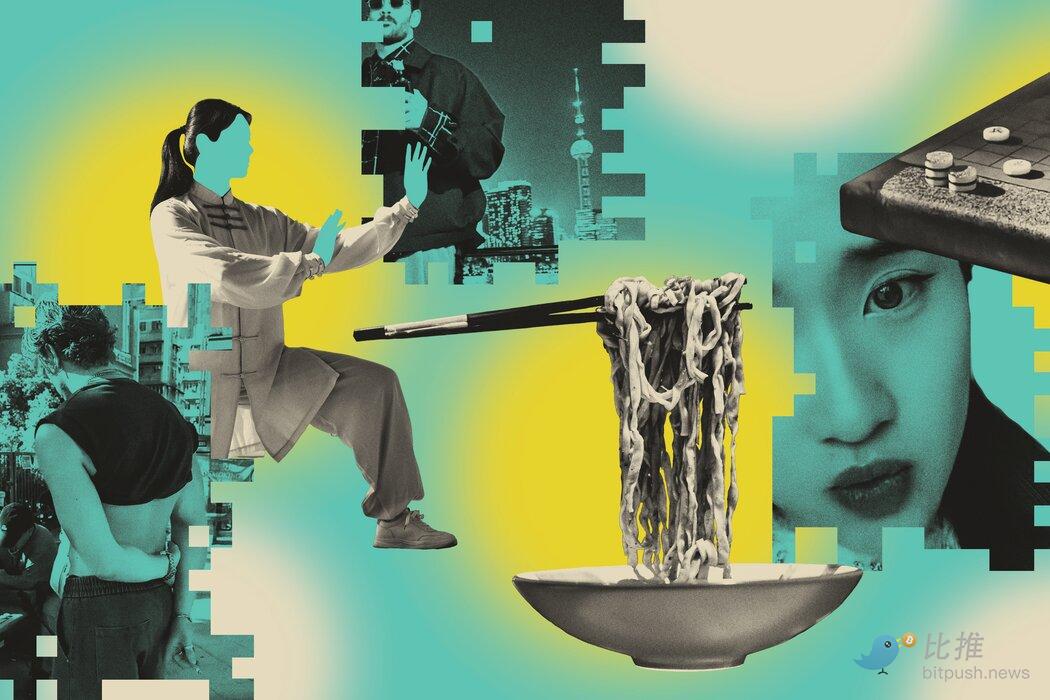
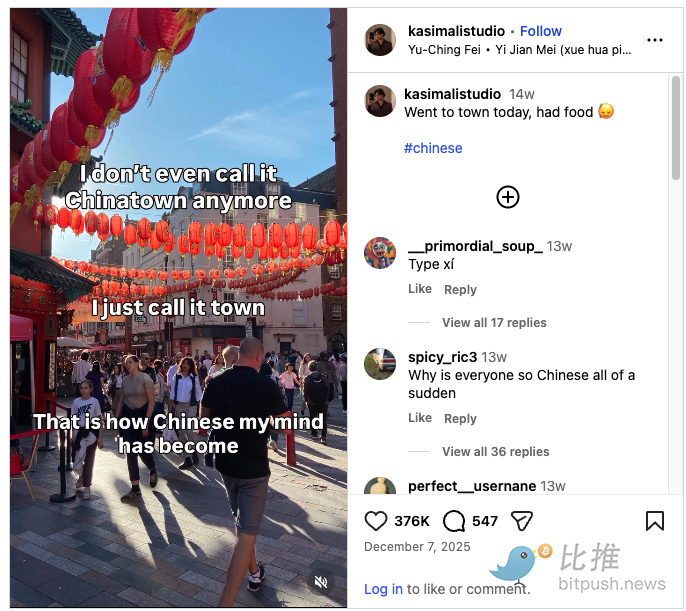
The idea of "becoming Chinese" started as a somewhat absurd joke but later evolved into an online trend with a touch of aspiration. Casual imitation gradually turned into creators "unlocking" their "Chinese uncle" persona (roughly: expressionless, somewhat aloof, occasionally exposing their belly), or discovering they were "almost" about to buy a floral-patterned cotton jacket—what one viewer called "Chinese auntie style." Now, many netizens "suddenly realize" that they are actually Chinese or claim to have completely transformed: "I don't even call it 'Chinatown' anymore, I just call it 'the street'," reads the caption of one video. "That's how Chinese my mindset is." This online trend has become so widespread that even the most mundane behaviors are called "ultimate Chinese life"—American influencer Hasan Paker filmed a video in front of the Shanghai skyline,特意 wearing socks with slippers.
Some Chinese-American influencers have gladly taken on the role of cultural arbiters. Among the more representative is Shirley Zhu, who often motivates her audience in an infectious mix of Chinese and English: for example, those staying home on Friday nights should go for hot pot or karaoke, because lying around all day "doesn't suit the vibe of a Chinese baddie." This "baddie" persona has expanded to various wellness content, much of which appropriates concepts from traditional Chinese medicine.
Recently, with the契机 of the Lunar New Year, such content surged, with one infographic showcasing a "Chinease Soothing Baddie Morning Routine" (Chinease is a deliberate misspelling of Chinese for a pun)—including "morning herbs," "meditation," "gua sha," and some illustrations: a set of abs (labeled "lymphatic detox abdominal massage") and a toilet (simply labeled "excretion").

Of course, many Chinese have opposed this, arguing that their culture is being oversimplified or even objectified by Western audiences—some compare this experience to the parasitic appropriation in Jordan Peele's horror film "Get Out." Particularly, the phrase "diagnosed as Chinese" has sparked strong dissatisfaction, as it evokes racial stereotypes reactivated at the beginning of the pandemic. "Where was this 'love' for Chinese culture when they were being attacked on the streets?" asked one social media user, recalling the surge in anti-Asian hate crimes in 2020, when President Trump also called COVID-19 the "China virus." His venomous remarks reignited a long-standing tradition of Sinophobia, portraying China as backward or even barbaric. In this "very Chinese moment," similar Orientalist impulses have taken on new variants: for example, a certain "British guy shows you the real China" blogger always emphasizes his integration into Chinese culture by holding a Chinese beer in one hand and a Chinese cigarette in the other.
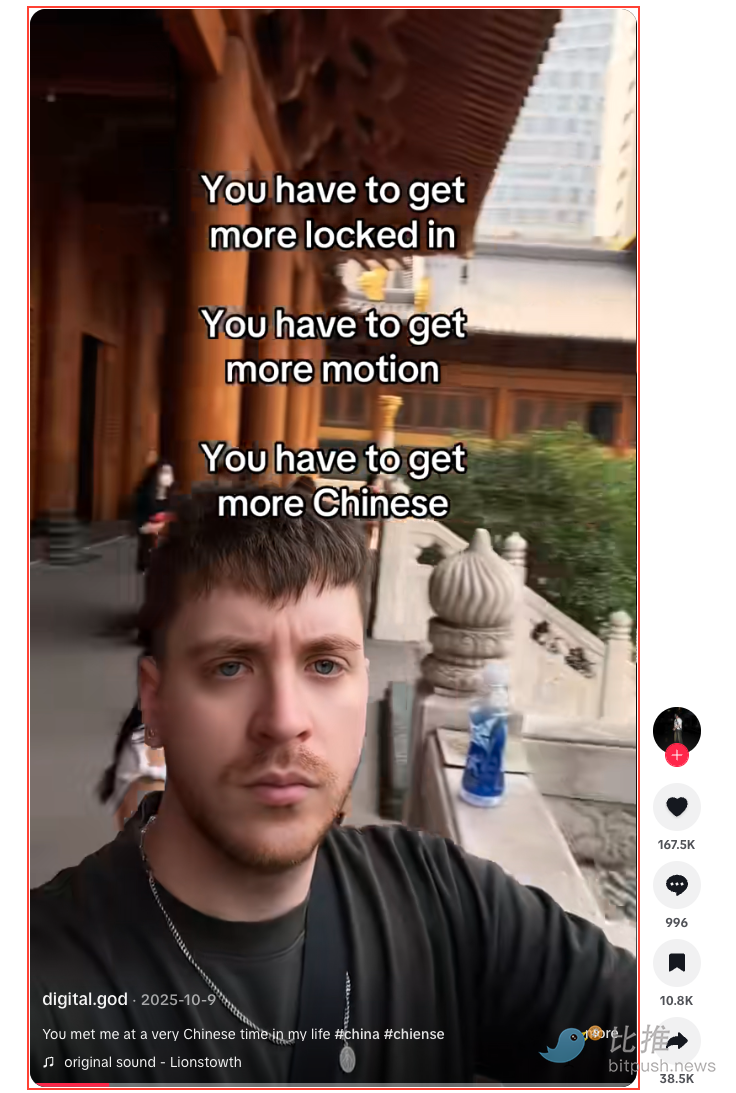
One surprising aspect of this trend—almost unthinkable six years ago, of course—is that these jokes now carry a tone of respect. For example, one video pairs footage of Chinese pagodas, markets, and city skylines with instructions that are both admiring and somewhat mystical: "You need to be more focused/You need to be more proactive/You need to be more Chinese." Or an account模仿 the "Analects" writes: "To naturalize the heart is not to await its arrival unexpectedly, but to welcome it joyfully, like the return of an old friend."
Social media has long sustained cultural exchange between China and the United States, and this relationship seems to strengthen反而 during escalating political tensions. In early 2025, as expectations grew that Trump would begin a second term—more specifically, that TikTok would be banned—American users prepared for the worst by finding another Chinese app, Xiaohongshu. By mid-January last year, it jumped to the top of the U.S. Apple App Store download charts. Many of these "TikTok refugees" were simply looking for a new digital home, but many others flocked to this Chinese app to "spite" the U.S. government. (Trump's inauguration gathered a group of tech giants whose combined net worth exceeded one trillion dollars.) One such "refugee" posted on Xiaohongshu: "In short, we're here to spite our government, and also to learn about China and have fun with you all."
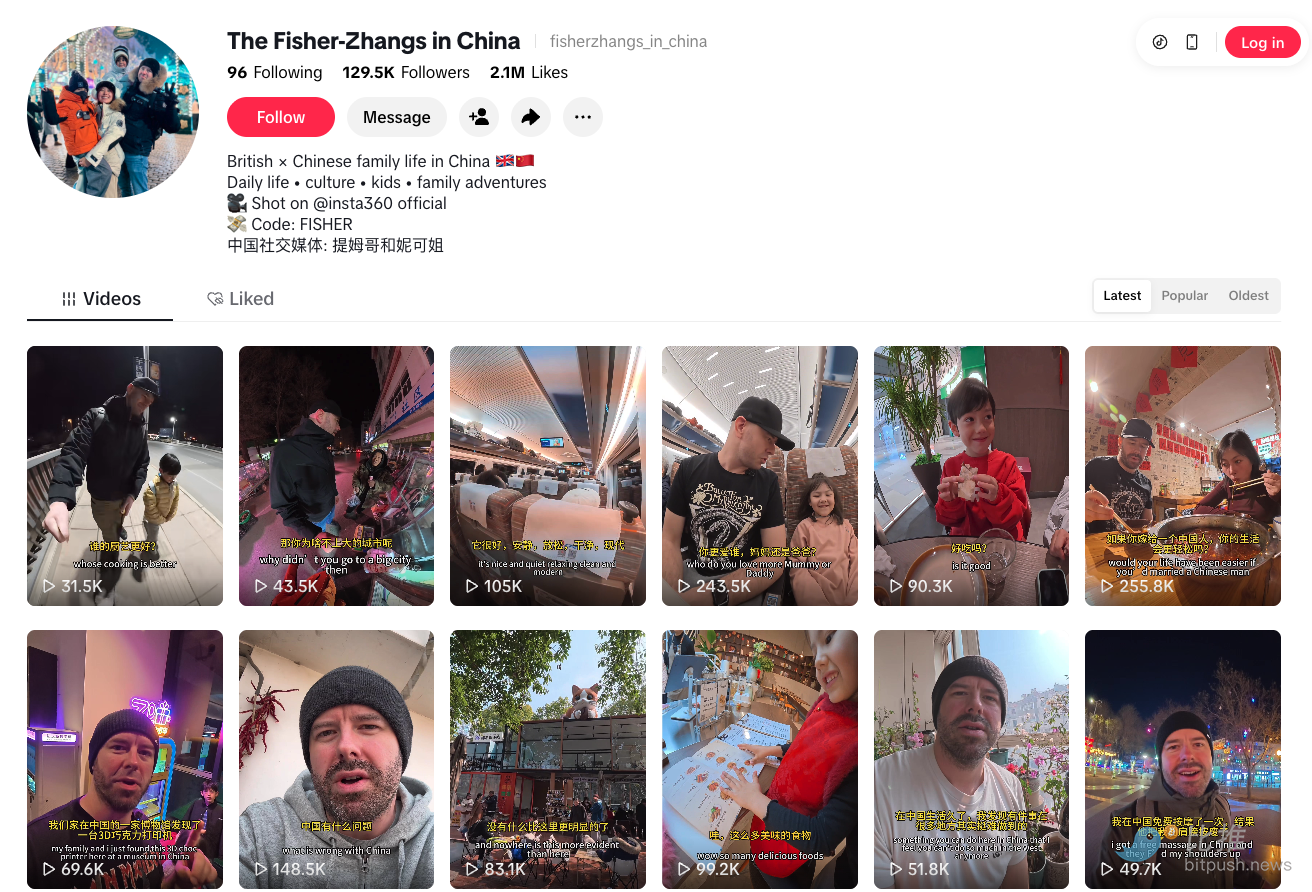
When TikTok was ultimately saved by Trump, the refugees returned to the platform, and business as usual resumed—though something had clearly changed during their brief exile. Users began to find themselves entering "very Chinese moments," sharing imaginations of another life: ubiquitous electric vehicles, socialized healthcare, high-speed rail. This content further corroborated impressions conveyed in recent years by tourists and professional vloggers—both continuously demystifying Chinese life and promoting the country as a new generation travel destination, a near-mythical place with surreal beauty and超现代 technology. Even Americans can see in these videos a vision of the future that their own country has yet to achieve.
While witnessing their own country's decline, American TikTok users continue to fantasize about "becoming Chinese": in their minds, high-quality, low-cost life—wearing slippers at home, nurturing the spleen and stomach—is not exclusive to a privileged few but available to all. If racist stereotypes once signified Western domination of the "Orient," then the "ultimate Chinese life" reveals that Americans now seem to some extent subjugated by Chinese influence. If you're not yet convinced, social media algorithms will牢牢 grab you, making you directly participate. When a China-born, UK-based user told his audience, "If you are watching this video, you are Chinese," he meant it materially. "Are you currently scrolling on this Chinese app? Probably your phone is made in China, the clothes you wear are made in China, the collectible dolls you have are from China, the bag you carry is made in China, the perfume you spray is made in China, right?"
But like other types of aspirational content, many scenes of Chinese life are also edited to maintain a fantasy; fan-shot high-speed rail videos highlight the ability to order McDonald's delivery on board but don't mention how the state uses surveillance to prevent "untrustworthy" individuals from boarding. Social media may have made Chinese life less mysterious, but by shaping it into an object of desire, influencers ensure that the "Orient" remains a container for Western desires—especially on platforms that favor binary oppositions (right and wrong, good and evil, East and West).
When viewed from the other side of the world, through a few seconds of polished short videos, the grass is always greener on the other side. But pledging allegiance to another country (or to your phone, or to a new wellness regimen) rarely solves problems fundamentally. However, who would stop at this moment? Especially when you feel that since "becoming Chinese"—that is, since accepting clear guidance on what to eat, wear, and do—life has felt smoother. "Thank you, Congress," a Western college student said smilingly in Mandarin, a Chinese national flag on the TV behind her. "Without you, none of this would be possible. I love the People's Republic of China!" The video was intended as a joke, but it also evoked some more sincere responses. "I can't lose this internet," wrote one popular comment that received thousands of likes, its allegiance not really to any country but to the state of being online itself.
Twitter:https://twitter.com/BitpushNewsCN
Bitpush TG Discussion Group:https://t.me/BitPushCommunity
Bitpush TG Subscription: https://t.me/bitpush