Was the Prediction Market the Biggest Winner of This Year's Super Bowl?

比推Pubblicato 2026-02-10Pubblicato ultima volta 2026-02-10

Introduzione

This year's Super Bowl marked a potential turning point, with prediction markets emerging as a serious competitor to traditional sports betting. Platforms Kalshi and Polymarket offered markets on the game, halftime show, and ads. While the American Gaming Association projected a record $1.76 billion in traditional sports bets, an analyst estimated prediction markets could capture 80% of the year-over-year growth, with a forecast of $630 million in volume for the event. However, available data suggests prediction markets fell short of this forecast. Kalshi's top Super Bowl-specific markets saw a combined volume of approximately $233 million. Its season-long "Who will win the Super Bowl" contract accumulated over $500 million in volume, but this was spread over the entire NFL season. Kalshi's significant growth is aided by its CFTC regulatory status, allowing a US mobile app, leading to 1.9 million downloads in January alone. Polymarket, lacking direct US app access for most users, saw about $76 million in volume across its top three Super Bowl markets. Its strength was demonstrated in information discovery, as its market accurately predicted Lady Gaga's surprise halftime show appearance days in advance. The activity occurs amidst an unresolved regulatory conflict, with Kalshi operating under federal CFTC oversight while state gaming regulators challenge it in court. Although prediction markets did not meet the $630 million hype for the Super Bowl weekend, their rapid user g...

Source: Bankless

Author: David Christopher

Original Title: Did Prediction Markets Win the Super Bowl?

Compiled and Edited by: BitpushNews


This year's Super Bowl—Seattle Seahawks vs. New England Patriots—though lacking the star power of last year's Chiefs vs. Eagles matchup with Taylor Swift's presence, marked a turning point: prediction markets were explicitly recognized as genuine competitors to traditional sports betting for the first time.

Two major prediction market platforms, Kalshi and Polymarket, both set up markets around the game, the halftime show, advertisements, and more. Preliminary data paints an interesting and complex picture.

A quick note before we begin: Sportsbooks have not yet aggregated and reported their total betting volume—this will take a few days. Therefore, this analysis is based on predicted data from the sports betting side versus the trading volume on prediction markets.

Sports Betting Predictions: Another Record High, But Growth Slows

The American Gaming Association estimates that U.S. sportsbooks will handle approximately $1.76 billion in bets on Super Bowl LX, setting a new record and representing a year-over-year increase of about 27%. Although specific figures vary slightly depending on the source, most predictions point in the same direction: another record high, continuing the eight-year growth trend since the Supreme Court allowed states to legalize sports betting in 2018.

But the growth rate is clearly slowing. Sports betting is now legal in 39 states and Washington D.C., with only Missouri joining this cycle as a new market—meaning the explosive growth driven by market expansion in previous years is giving way to incremental growth. Against this backdrop, prediction markets have become another factor curbing growth. Ed Birkin of H2 Gambling Capital told Fortune that he estimates prediction markets will account for 80% of the year-on-year increase in betting activity, predicting that trading volume on prediction markets during the entire event will reach $630 million.

Based on currently available data, the performance of prediction markets seems far below that figure.
Kalshi

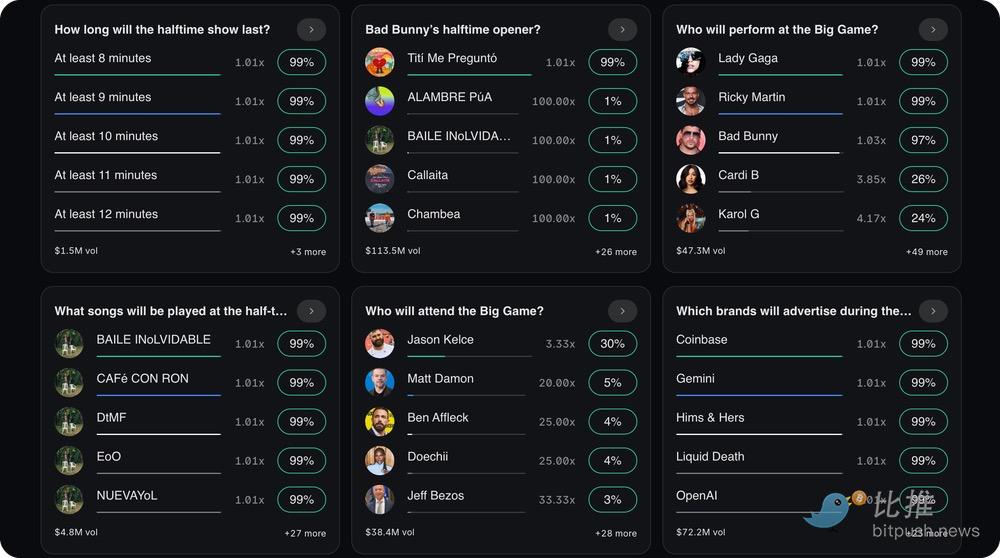
Kalshi's markets specifically created for the Super Bowl (i.e., contracts directly tied to the game, halftime show, and broadcast) generated significant, but not predicted, trading volume:

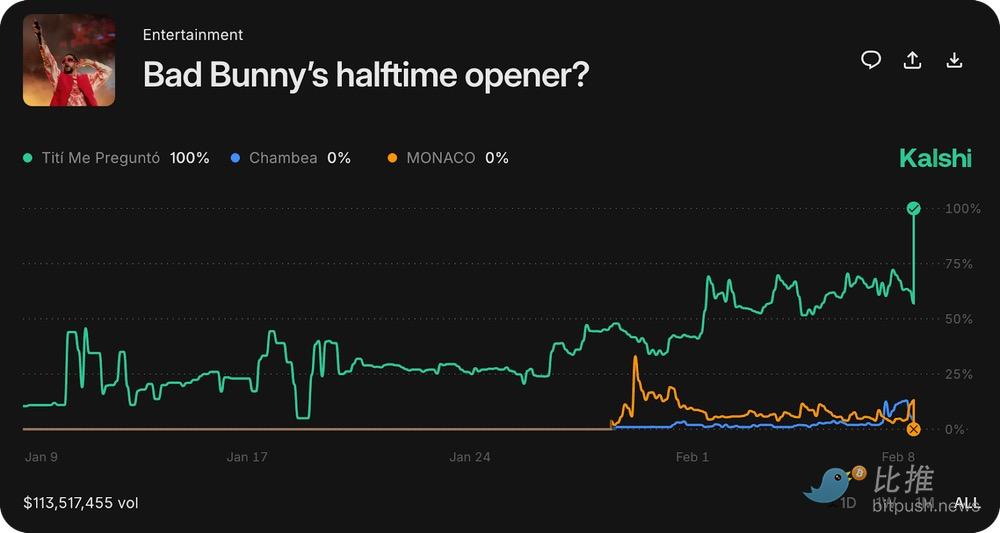
  • Bad Bunny Halftime Show Opening Song: $113.5 million

  • Which Company Will Air the First Commercial: $72.2 million

  • Who Will Perform at the Game: $47.3 million

Just these top few markets saw a combined trading volume of approximately $233 million, far below the $630 million prediction analysts had for the entire prediction market.

Furthermore, Kalshi's flagship NFL market—a "Who Will Win the Super Bowl" contract open for months throughout the season—saw total trading volume exceed $500 million. But this figure reflects the cumulative trading volume over the entire NFL season, not just Super Bowl weekend. Even so, this is less than a third of the amount sportsbooks are predicted to handle for the Super Bowl alone.

For months, sports betting has constituted the vast majority (over 90%) of Kalshi's total trading volume, thanks to its promotional channels which are on par with, if not better than, those of sportsbooks.

First, Kalshi's federal regulation through the CFTC means U.S. users can access it directly via its mobile app, just like a sports betting app. Coupled with a strong venture capital-backed advertising budget and a partnership with Robinhood, Kalshi stands out. This foundation is paying off: In January alone, Kalshi saw 1.9 million downloads, while DraftKings and FanDuel's new prediction market apps, launched in December, saw combined downloads of less than 100,000 (these apps were launched in states where their traditional sports betting apps are not permitted, but response has been tepid so far). Additionally, DraftKings partnered with Crypto.com last Friday to expand its event contract offerings, indicating that established giants are taking this threat seriously.
Polymarket

Polymarket's similar season-long NFL market saw trading volume of about $700 million—higher than Kalshi's—but the situation is different for its Super Bowl-specific markets. Polymarket's top three Super Bowl markets saw a combined trading volume of approximately $76 million:

  • Main Game Market: $55.26 million

  • Super Bowl MVP: $12 million

  • Who Will Perform the Halftime Show: $9 million

Polymarket lacks Kalshi's regulatory approval in the U.S., meaning American users cannot access it directly through a mobile app. Technically, Polymarket now has a U.S. app after acquiring a CFTC-registered exchange last year, but it is currently rolling out gradually through a waitlist, and its Super Bowl offerings were limited. As of the week before the game, the app didn't even list any sports markets; the full suite of Super Bowl features was only available on its global website.

Therefore, most U.S. users still need to access it via the website, using VPNs, etc. For casual sports bettors, this is not on the same playing field as downloading Kalshi from the App Store.

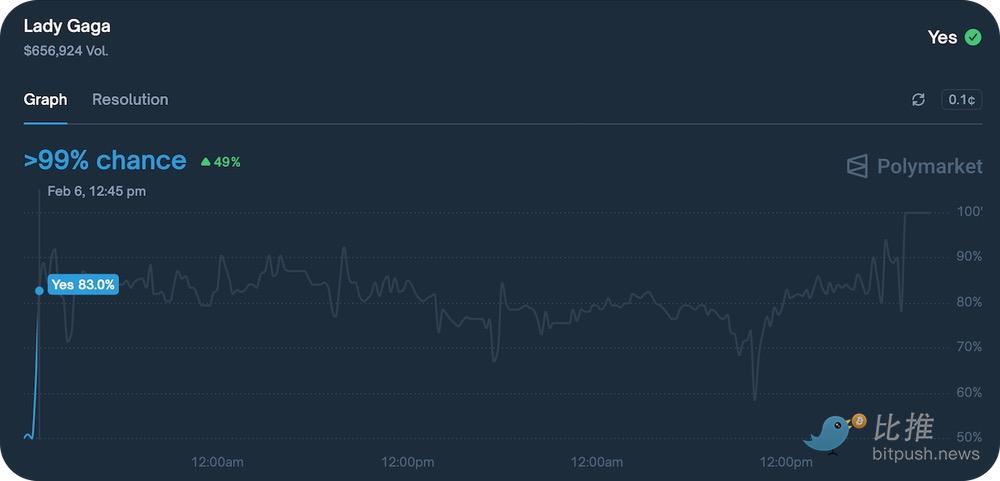
However, where Polymarket truly shines is its primary use case—information discovery. In its halftime show performer market, Lady Gaga's probability remained stable at around 80% in the days leading up to the game—well before her surprise appearance at the halftime show, which Billboard magazine had not reported on and genuinely surprised everyone I watched with.
Regulatory Progress

All of this is happening against the backdrop of unresolved regulatory conflicts.

Kalshi operates as a federally regulated exchange under the CFTC, which allows its sports contracts to proceed—especially after new CFTC Chairman Michael Selig stated he would not block or cede regulatory authority to the states. State gaming regulators, who oversee sportsbooks, continue to pursue legal challenges against Kalshi and its peers, and many analysts expect these cases to eventually reach the Supreme Court.

For now, prediction markets operate in a gray area, allowing them to cover the nation without needing state-by-state approval—a structural advantage that sportsbooks cannot easily replicate.

Summary

So, did prediction markets live up to the hype for Super Bowl LX? Relative to the $630 million prediction, not quite.

The combined trading volume on the visible top Super Bowl-specific markets across the two leading platforms was approximately $310 million—about half the predicted value. The season-long NFL markets on both platforms achieved huge trading volumes, but that was cumulative over months of football games, not a single-week explosion during Super Bowl weekend.

Context is also important. The 1.9 million downloads Kalshi garnered in January dwarf the combined total of DraftKings and FanDuel's prediction market apps. This pressure is already visibly reflected in stock prices—as observed by Fortune, shares of FanDuel parent Flutter Entertainment have fallen for eight consecutive weeks, their longest losing streak in twenty-three years; DraftKings' stock price is hovering near its lows since 2023, down more than 60% from its all-time high. Bloomberg data shows that over the past three months, market expectations for Flutter's Q4 earnings have been sharply cut by nearly 49%, and DraftKings' expectations have also fallen by 29%. Imagine if someone had bet on Polymarket that "DraftKings will underperform," they might have quietly profited by now.

Prediction markets may not have conquered the Super Bowl overnight, but they have certainly arrived—and for traditional sports betting platforms, the trajectory of this trend is alarming enough.


Twitter:https://twitter.com/BitpushNewsCN

Bitpush TG Discussion Group:https://t.me/BitPushCommunity

Bitpush TG Subscription: https://t.me/bitpush

Original link:https://www.bitpush.news/articles/7610501

Domande pertinenti

QWhat was the estimated total betting volume for Super Bowl LX by the American Gaming Association?

AThe American Gaming Association estimated that U.S. sportsbooks would handle approximately $1.76 billion in bets for Super Bowl LX.

QWhich two prediction market platforms were highlighted as major players for the Super Bowl markets?

AThe two major prediction market platforms highlighted were Kalshi and Polymarket.

QWhat was the combined trading volume of Kalshi's top three Super Bowl-specific markets?

AThe combined trading volume of Kalshi's top three Super Bowl-specific markets was approximately $233 million.

QWhat key regulatory advantage does Kalshi have over Polymarket in the United States?

AKalshi operates as a federally regulated exchange by the CFTC, which allows U.S. users direct access through its mobile app, unlike Polymarket which lacks this approval and requires most U.S. users to access via its global website, often using a VPN.

QAccording to the article, what was one significant way that Polymarket demonstrated its strength in 'information discovery'?

APolymarket's market on the halftime show performer correctly showed Lady Gaga's probability at around 80% days before the game, well ahead of her surprise appearance which was not reported by Billboard, showcasing its predictive information discovery capability.

Letture associate

Must-Watch Events Next Week|CLARITY Act Could Face Senate Vote; SpaceX, Circle to Report Earnings (8.3-8.9)

**Summary: Key Events and Developments to Watch (August 3-9)** The upcoming week is marked by significant financial disclosures, key legislative deadlines, and notable product updates. **Major Financial Events:** Several companies are scheduled to release their Q2 2026 earnings. American Bitcoin (ABTC) will report on August 3, followed by SpaceX and Hut 8 Mining Corp. on August 4, and Circle on August 5. Notably, a significant portion of SpaceX shares (up to 12% of total shares) will be unlocked on August 6 following their earnings release. **Key Legislative Deadline:** The U.S. Senate faces an August 7 deadline to secure 60 votes for the CLARITY Act, a bipartisan bill aiming to establish a federal regulatory framework for cryptocurrencies. The Senate may hold a full vote on the bill during the week. **Economic Data:** The U.S. July Non-Farm Payrolls report will be released on August 7, providing crucial labor market data. **Technology & Product Updates:** * **Shutdowns:** DeFi portfolio tracker Zapper and wallet app Ctrl Wallet will cease operations on August 3. * **Upgrades:** LayerZero will deprecate its v1 relayers on August 3. XRP Ledger's new version 3.3.0, featuring five new functions, is expected next week. * **AI:** Elon Musk announced that the advanced Grok 4.6 AI model is set for release around August 7. * **Bitcoin:** The BIP-110 forced signaling for a potential Bitcoin network change is scheduled to begin around August 8. **Other Notable Events:** Chinese robotics firm Unitree Tech has set its preliminary price inquiry for its IPO for August 5. South Korean exchange Upbit will delist AQT and AERGO tokens on August 3.

marsbit1 h fa

Must-Watch Events Next Week|CLARITY Act Could Face Senate Vote; SpaceX, Circle to Report Earnings (8.3-8.9)

marsbit1 h fa

Stocks Are Plummeting More Sharply Than Cryptocurrencies. Where Has the Money Gone?

Stock Markets Plunge Deeper Than Cryptocurrencies: Where Did the Money Go? In late July, Seoul's Kospi index triggered circuit breakers for two consecutive days, plummeting over 40% from its June high. The collapse was led by heavyweight stocks like SK Hynix, whose record profits still disappointed investors, and devastating leveraged ETFs, with one major product losing over 83% of its value. This signaled a global, forced deleveraging targeting the most crowded trades. Interestingly, while stocks exhibited extreme volatility akin to crypto markets, Bitcoin rose nearly 15% in July after a prior steep drop. Analysis shows the money fleeing equities did not flow into Bitcoin. Instead, Bitcoin had already absorbed its sell-off in May-June, when U.S. spot Bitcoin ETFs saw historic outflows. The true safe-haven beneficiary was gold, whose price rose over 20% year-on-year, highlighting a decoupling between Bitcoin and gold as "digital gold." The sell-off was a targeted unwinding of leveraged positions in tech and semiconductors, accelerated by broker-dealer risk management and shifts in the AI narrative, including new competition from Chinese memory chipmakers. The retreat path was clear: from high-valuation tech stocks to cash and U.S. Treasuries, then to gold. For Bitcoin to attract sustained institutional inflows, conditions like eased global liquidity pressure, a "soft-landing" Fed rate cut, and U.S. regulatory clarity via legislation like the stalled CLARITY Act are needed. Currently, Bitcoin is not a safe haven but an already-cleared asset. Its low correlation with tech stocks, however, makes it a potential diversification play for institutional portfolios once the storm passes. The money isn't here yet, but the positioning is underway.

marsbit1 h fa

Stocks Are Plummeting More Sharply Than Cryptocurrencies. Where Has the Money Gone?

marsbit1 h fa

In Conversation with Ray Dalio: We Are Currently in an AI Bubble, with 1% of My Portfolio in Bitcoin

Ray Dalio, founder of Bridgewater Associates, warns in an interview that the current AI boom shows classic bubble characteristics, which could lead to significant economic downturns as seen in past cycles like 1929 or 2000. He explains that speculative enthusiasm, fueled by debt and overvaluation, often precedes a crash when rising rates or taxation force asset sales, causing widespread losses and recession. Dalio also outlines his "Big Cycle" theory, describing an approximate 80-year pattern where widening wealth gaps, massive government deficits, and shifting geopolitical power (like China's rise) create internal conflict and global instability. He emphasizes that we are in a late-cycle, transitional phase where traditional powers like the US and UK face decline. For personal wealth protection, Dalio advises diversification beyond cash into assets like stocks, bonds, real estate, and particularly gold, which he prefers over Bitcoin. While he holds about 1% of his portfolio in Bitcoin as a non-printable hard asset, he views gold as more secure from technological or governmental threats. Regarding AI's impact, Dalio believes it will disproportionately benefit capital owners, worsening inequality by replacing both physical and cognitive labor. He suggests that human intuition and emotional intelligence, combined with AI, will be key for future workers. On taxation, Dalio argues that wealth taxes are impractical and risk triggering asset sell-offs, reducing productive investment. He points to the UK as a cautionary example of debt, low productivity, and political strife. Geopolitically, Dalio foresees a more regionalized world, with the US showing weakness in prolonged conflicts like with Iran, akin to past imperial declines. The ideal outcome, he suggests, is coexisting powerful blocs (e.g., Americas, China-Asia Pacific) without major war.

marsbit5 h fa

In Conversation with Ray Dalio: We Are Currently in an AI Bubble, with 1% of My Portfolio in Bitcoin

marsbit5 h fa

Trading

Spot
活动图片





