Wallet in Telegram Launches Cross Chain Deposits in Self Custodial TON Wallet

TheNewsCryptoPubblicato 2026-02-11Pubblicato ultima volta 2026-02-11

Introduzione

Wallet in Telegram has launched cross-chain deposits for its self-custodial TON Wallet, enabling over 100 million users to fund their wallets using cryptocurrencies from major blockchains without requiring bridges, swaps, or manual conversions. Powered by MoonPay, the integration allows users to deposit USDC or USDT from Ethereum, Solana, TRON, BSC, Polygon, Arbitrum, and Base, with automatic 1:1 conversion to USDT (TON). Soon, users will also be able to withdraw USDT (TON) to other chains and deposit BTC, ETH, and SOL—automatically converted to Toncoin. This simplifies onboarding into the TON ecosystem, reducing barriers to Web3 adoption by eliminating complex multi-step processes and minimizing conversion fees. The feature is natively integrated into Telegram, supporting DeFi, gaming, payments, and on-chain applications.

Ile Du Port, Seychelles, February 11th, 2026, Chainwire

Over 100 million users can now fund their TON Wallet using crypto from the most popular blockchains – no additional bridges, swaps or manual conversions required.

Wallet in Telegram today announced the launch of cross-chain deposits in its self-custodial TON Wallet, enabling users to fund their wallets with crypto from the most popular blockchains. Powered by MoonPay, the integration manages cross-chain transfers behind the scenes, ensuring a smooth deposit experience in TON Wallet.

With this launch, more than 100 million users can transfer their stablecoins from other chains to TON without friction or losing value. TON Wallet users can now deposit USDC or USDT from Ethereum, Solana, TRON, BSC, Polygon, Arbitrum, and Base – converted at a 1:1 rate to USDT (TON) – directly in Wallet in Telegram. This removes the need to already hold TON-native assets, opening the ecosystem to users across the broader crypto landscape. As part of the integration, users will soon be able to withdraw USDT on TON to USDT or USDC on popular blockchains with a fee and deposit BTC, ETH, and SOL, which are automatically converted into Toncoin.

This Launch Introduces the Following Functionality

  1. Stablecoin deposits from leading blockchains, allowing users to deposit USDC or USDT with automatic 1:1 conversion into USDT (TON)
  2. Stablecoin withdrawals from USDT (TON) to USDT or USDC on other major blockchains, processed at a 1:1 rate, subject to applicable network and service fees. Will be available soon.
  3. Crypto deposits from BTC, ETH, and SOL, which are automatically converted into Toncoin upon arrival in TON Wallet
Removing Barriers to Web3 Adoption on Telegram

Funding a self-custodial wallet has traditionally been a complex, multi-step process. Through its collaboration with MoonPay, Wallet in Telegram removes this friction by introducing a single, seamless deposit flow that works across blockchains and assets. As a result, cross-chain transfers are now as simple as custodial ones, significantly streamlining onboarding into TON Ecosystem – while preserving value by minimizing unnecessary conversion losses and fees.

“One of the biggest challenges in crypto adoption is the first step – getting users funded and ready to participate. Until now, using TON Wallet meant already having assets on TON, which created unnecessary friction and limited access to the broader ecosystem. Now, we’re removing that barrier entirely. Users can bring their funds directly into TON Wallet from other networks, without unnecessary conversions, exchanges or lock-ins,” said Andrew Rogozov, Founder and CEO of The Open Platform and Wallet in Telegram. “Our goal is simple: make entering, and exiting, TON ecosystem as seamless as using a custodial wallet, while preserving the freedom and control of self-custody.”

Powered by MoonPay Deposits and built on MoonPay’s infrastructure, the solution supports the end-to-end flow, from deposit detection to final asset delivery, and is integrated natively into partner environments

“Users shouldn’t have to buy new assets or navigate complex steps just to fund an account,” said Ivan Soto-Wright, CEO of MoonPay. “We simplify the process by letting people use the crypto they already have while we handle the technicalities behind the scenes, making it easier to move value across the ecosystem and access a broader range of applications.”

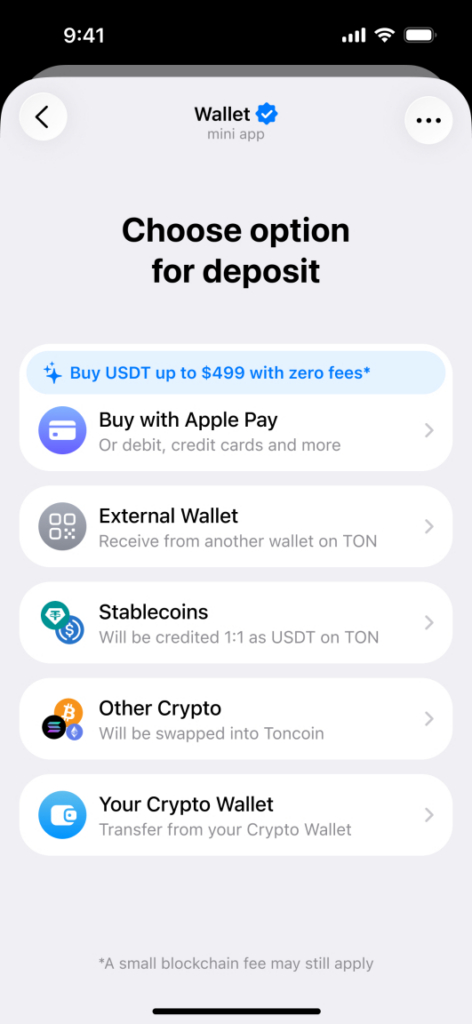
Funding a TON Wallet now takes just a few steps

  • The Deposit section includes two options: Stablecoins (for 1:1 stablecoin deposits) and Other Crypto (for converting BTC, ETH, or SOL to TON).
  • After selecting the token and the originating network, a deposit address is generated automatically.
  • The deposit address can be copied or accessed via QR code.
  • This address is entered on the withdrawal page of the external wallet or exchange.
  • The transfer amount must meet the minimum deposit requirement.
  • Once the details are verified, the transfer is confirmed on the sending platform.

Funds arrive in the user’s selected asset, fully compatible with TON ecosystem and Telegram’s growing network of decentralized applications.

Built for Scale, Native to Telegram

The new deposit experience is available exclusively in the self-custodial TON Wallet, part of Wallet in Telegram’s dual-wallet setup, and is fully integrated into the Telegram interface. By abstracting away cross-chain complexity, Wallet in Telegram makes it easier for users to participate in DeFi, gaming, payments, and on-chain apps – without needing deep crypto expertise.

This launch marks a major step toward making Telegram the most accessible Web3 gateway in the world, combining mass-market distribution with self-custody and open blockchain infrastructure.

About Wallet in Telegram

Wallet in Telegram is a digital asset solution natively embedded into Telegram’s interface. Backed by The Open Platform, Wallet in Telegram has gained 150M+ registered users to date and continues to grow. The company offers a dual-wallet experience with Crypto Wallet (a multi-chain wallet for trading and sending crypto to contacts) and TON Wallet (a self-custodial wallet with access to TON ecosystem of apps and TON-based digital assets).

About MoonPay

Founded in 2019, MoonPay is a global financial technology company that helps businesses and consumers move value across fiat and digital assets. MoonPay has more than 30 million customers across 180 countries and supports more than 500 enterprise customers spanning crypto and fintech.

Through a single integration, MoonPay powers on- and off-ramps, trading, crypto payments, and stablecoin infrastructure, connecting traditional payment rails with blockchains. MoonPay maintains a broad regulatory footprint, including a New York BitLicense, a New York Limited Purpose Trust Charter, and money transmitter licenses across the United States, as well as MiCA authorization in the EU.

MoonPay is how the world moves value.

Contact

Masha Balanovich
Wallet in Telegram
masha@wallet.tg

Domande pertinenti

QWhat is the main feature announced by Wallet in Telegram in this article?

AWallet in Telegram has launched cross-chain deposits in its self-custodial TON Wallet, allowing users to fund their wallets with crypto from popular blockchains without additional bridges, swaps, or manual conversions.

QWhich company powers the cross-chain transfer integration for Wallet in Telegram?

AThe cross-chain transfer integration is powered by MoonPay, which manages the transfers behind the scenes to ensure a smooth deposit experience.

QWhich stablecoins and blockchains are supported for deposits into the TON Wallet?

AUsers can deposit USDC or USDT from Ethereum, Solana, TRON, BSC, Polygon, Arbitrum, and Base, which are converted at a 1:1 rate to USDT (TON).

QWhat other cryptocurrencies can be deposited, and how are they handled?

AUsers can deposit BTC, ETH, and SOL, which are automatically converted into Toncoin upon arrival in the TON Wallet.

QWhat is the goal of this integration according to Andrew Rogozov, Founder and CEO of The Open Platform?

AThe goal is to make entering and exiting the TON ecosystem as seamless as using a custodial wallet while preserving the freedom and control of self-custody, by removing barriers like the need to already hold TON-native assets.

Letture associate

Can Japan Buy Growth with AI? Will the Bond Market Believe It?

Japan's cabinet has introduced the 2026 Basic Policy on Economic and Fiscal Management and Reform, shifting its primary fiscal target. The new framework moves away from the traditional annual primary balance goal and instead prioritizes a stable reduction of the debt-to-GDP ratio. This change is tied to a strategy of increased "responsible proactive fiscal" spending, aiming to boost long-term growth through investments in strategic sectors like AI, semiconductors, energy, and robotics. The government estimates total public and private investment in 62 key technologies could exceed 370 trillion yen by 2040. The market reaction has been mixed and cautious. While equity markets may respond to policy signals, bond markets are focused on fiscal credibility. Concerns center on whether the weakening of the clear primary balance anchor could lead to looser fiscal discipline. If investors doubt that these strategic investments will generate sufficient productivity gains, tax revenue, and nominal growth to outpace rising interest costs, they may demand higher yields on Japanese Government Bonds (JGBs). Recent volatility in the yen and JGB yields, with the 10-year yield briefly reaching 2.9%, reflects this skepticism. The success of this new framework hinges on two factors: whether Japan can achieve a nominal growth rate consistently higher than its long-term interest rates, and whether future budgets demonstrate disciplined control over bond issuance. The government's narrative is that strategic investment is essential to break Japan's cycle of low growth, aging, and labor shortages. However, the bond market will continuously assess the credibility of this plan, pricing the risk that it may represent fiscal expansion rather than a viable growth strategy.

marsbit25 min fa

Can Japan Buy Growth with AI? Will the Bond Market Believe It?

marsbit25 min fa

Misjudged A-Shares: Resilience, Expectations, and Confidence

China's A-share market recently faced selling pressure, especially in tech sectors, initially triggered by a global tech sell-off that began in South Korea. However, the article argues this is a case of "mistaken injury" and highlights the market's underlying resilience. This resilience stems from three main pillars: **1) Tech Sector Fundamentals:** Unlike Korea's market dominated by a few memory chip stocks, China's tech sector is diversified across computing, communications, electronics, and semiconductors, supported by dual narratives of global AI supply chains and domestic substitution. Core areas like optical modules and fiber optics continue to show strong earnings growth. **2) "National Team" Support:** State-backed institutions and large corporations have made significant market purchases and announced buybacks, providing liquidity and signaling confidence. This is seen as a stabilizing policy signal, often associated with market bottoms. **3) Broader Market Pillars:** Other major sectors are showing endogenous recovery momentum. Consumer stocks benefit from stabilizing CPI and signs of sector recovery (e.g., liquor price hikes). Cyclical sectors like aluminum have high earnings, potential price increases due to tight supply, and low valuations. The financial sector offers stable dividends and low valuations. The conclusion is that the sell-off was driven by external contagion, not a collapse in fundamentals. With strong policy support and recovering momentum across key sectors, the A-share market possesses the toughness to regain stability.

marsbit56 min fa

Misjudged A-Shares: Resilience, Expectations, and Confidence

marsbit56 min fa

Trading

Spot
活动图片





