Wall Street 'Withdraws' from Bitcoin Basis Arbitrage: CME Falls Out of Favor, the Golden Age of Arbitrage Comes to an End

marsbitPubblicato 2026-01-22Pubblicato ultima volta 2026-01-22

Introduzione

Wall Street is retreating from the once-lucrative Bitcoin basis trade, as narrowing spreads between spot and futures prices have made the strategy barely profitable. The cash-and-carry trade, which involved buying Bitcoin spot (often via ETFs) and selling futures to capture the premium, has seen annualized returns drop to around 5%, down from nearly 17% a year ago, barely covering funding and execution costs. This compression has led to a significant shift in market structure: CME's Bitcoin futures open interest has fallen below Binance's for the first time since 2023, indicating a withdrawal of hedge funds and large US accounts from this specific arbitrage strategy. While CME was the preferred venue for this institutional trade, Binance's dominance in perpetual futures has remained steady. The approval of spot Bitcoin ETFs initially fueled the trade's popularity but also accelerated its decline by attracting capital that quickly eroded the arbitrage opportunity. The market is now maturing, with participants shifting from simple leveraged directional bets to using options, hedges, and expressing views through diverse instruments like ETFs. This increased efficiency has naturally narrowed price disparities between venues. As the era of easy, high returns from basis trading ends, participants are expected to seek more complex strategies in decentralized markets and other crypto assets.

Original Title: Wall Street Pulls Back From Bitcoin』s Money-Spinning Basis Trade

Original Author: Sidhartha Shukla, Bloomberg

Original Compilation: Peggy, BlockBeats

Editor's Note: The once considered 'surefire' Bitcoin basis arbitrage is quietly losing its appeal: the open interest between CME and Binance is shifting, and the spread has narrowed to the point where it barely covers funding and execution costs.

On the surface, this is a squeeze in arbitrage opportunities; at a deeper level, the crypto derivatives market is maturing. Institutions no longer need to rely on 'arbitrage' for returns, and traders are shifting from leverage to options and hedging. The era of high returns through simple strategies is fading, and new competition will emerge in more complex and refined strategies.

Below is the original text:

The crypto derivatives market is undergoing a quiet yet significant change: one of the most stable and profitable trading strategies is showing signs of faltering.

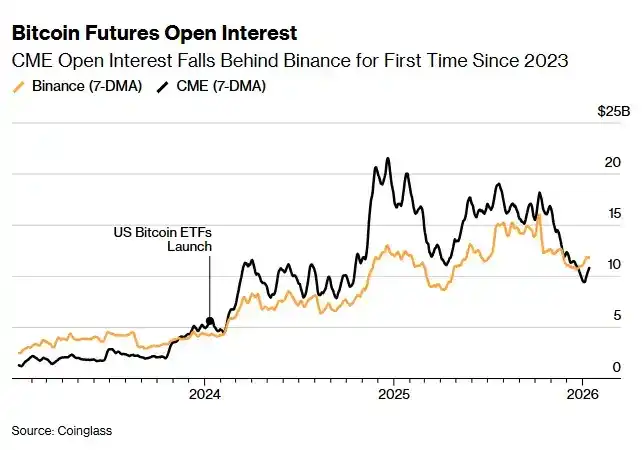
The 'cash-and-carry' trade, commonly used by institutions—buying Bitcoin spot while selling futures to profit from the spread—is collapsing. This not only signals a rapid compression of arbitrage opportunities but also releases a deeper message: the structure of the crypto market is changing. The open interest of Bitcoin futures on the Chicago Mercantile Exchange (CME) has fallen below that of Binance for the first time since 2023, further indicating that the highly profitable arbitrage opportunities of the past are being rapidly eroded as spreads narrow and market access becomes more efficient.

After the launch of spot Bitcoin ETFs in early 2024, CME once became the preferred venue for Wall Street trading desks to execute such strategies. This operation is highly similar to the 'basis trade' in traditional markets: buying Bitcoin spot through ETFs while selling futures contracts to profit from the spread between the two.

In the months following the ETF approval, the annualized return of this so-called 'delta-neutral strategy' often reached double digits, attracting billions of dollars in capital—capital that was indifferent to the direction of Bitcoin's price movement, focusing solely on capturing the returns. However, it was precisely the ETF that drove the rapid expansion of this trade that also sowed the seeds of its demise: as more trading desks rushed in, the arbitrage spread was quickly erased. Today, the returns from this trade are barely enough to cover funding costs.
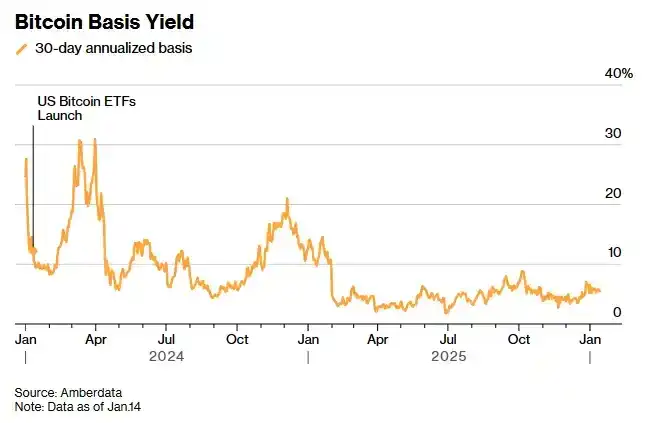
According to data compiled by Amberdata, the current annualized return for a one-month period is hovering around 5%, near its lowest level in recent years. Greg Magadini, Director of Derivatives at Amberdata, noted that around this time last year, the basis was close to 17%, but has now fallen to about 4.7%, barely enough to cover the threshold of funding and execution costs. Meanwhile, the one-year U.S. Treasury yield is around 3.5%, making the trade increasingly less attractive.

Against the backdrop of narrowing spreads, the open interest of CME Bitcoin futures has fallen from a peak of over $21 billion to below $10 billion, according to data compiled by Coinglass. In contrast, Binance's open interest has remained relatively stable, at around $11 billion. James Harris, CEO of digital asset management firm Tesseract, stated that this change reflects more of a pullback by hedge funds and large U.S. accounts, rather than a broad retreat from crypto assets after Bitcoin prices peaked in October.

Exchanges like Binance are the primary venues for perpetual contracts. These contracts are settled, priced, and margin-calculated continuously, often updated multiple times a day. Perpetual contracts, commonly referred to as 'perps,' account for the largest share of crypto trading volume. Last year, CME also launched smaller-sized, longer-term futures contracts covering crypto assets and equity indices, offering futures positions close to the spot market, allowing investors to hold contracts for up to five years without frequent rollovers.

Harris of Tesseract noted that historically, CME has been the preferred venue for institutional capital and 'cash-and-carry' trades. He added that CME's open interest being overtaken by Binance is 'a significant signal that the market participation structure is shifting.' He described the current situation as a 'tactical reset,' driven by lower returns and thinning liquidity, rather than a loss of market confidence.

According to a statement from CME Group, 2025 is a key inflection point for the market: as regulatory frameworks become clearer and investor expectations for the sector improve, institutional capital is expanding from single bets on Bitcoin to tokens like Ethereum, Ripple's XRP, and Solana.

CME Group stated: 'Our average daily nominal open interest for Ethereum futures in 2024 was about $1 billion, and by 2025, this number has grown to nearly $5 billion.'
Although the Federal Reserve's interest rate cuts have reduced funding costs, this has not driven a sustained rebound in the crypto market since the collective crash of various tokens on October 10. Current borrowing demand is weak, decentralized finance (DeFi) yields are low, and traders are more inclined to use options and hedging tools rather than directly leveraging directional bets.

Le Shi, Managing Director of market maker Auros in Hong Kong, stated that as the market matures, traditional participants now have more channels to express directional views, from ETFs to direct access to exchanges. This increase in choice has narrowed the price differences between trading venues, naturally compressing the arbitrage opportunities that once drove the growth of CME's open interest.

Le said: 'There is a self-balancing effect here.' He believes that as market participants continue to flock to the lowest-cost trading venues, the basis narrows, and the motivation to engage in cash-and-carry trades diminishes accordingly.

On Wednesday, Bitcoin fell by 2.4% at one point to $87,188 before paring losses. This decline briefly erased all gains for the year.

Bohumil Vosalik, Chief Investment Officer of 319 Capital, stated that the era of nearly risk-free high returns may be over, forcing traders to turn to more complex strategies in decentralized markets. For high-frequency and arbitrage-focused institutions, this means they need to look elsewhere for opportunities.

Original Link

Domande pertinenti

QWhat is the main reason for the decline in the profitability of Bitcoin basis trades according to the article?

AThe main reason is the rapid compression of arbitrage spreads due to increased market efficiency and massive inflows from Wall Street trading desks after the launch of spot Bitcoin ETFs, which has pushed returns down to levels that barely cover funding and execution costs.

QHow has the open interest in Bitcoin futures on CME changed compared to Binance, and what does this shift indicate?

AThe open interest in Bitcoin futures on CME has fallen below that of Binance for the first time since 2023, dropping from a peak of over $21 billion to under $10 billion. This shift indicates a tactical reset where hedge funds and large US accounts are pulling back from basis trades due to lower yields, rather than a broad retreat from crypto assets.

QWhat specific trading strategy used by institutions is discussed in the article, and how does it work?

AThe strategy discussed is the 'cash-and-carry' trade, also known as basis trade. It involves buying Bitcoin spot (often through ETFs) and simultaneously selling Bitcoin futures contracts to profit from the price difference (basis) between the spot and futures markets.

QWhat does the article suggest about the future of trading opportunities in the crypto derivatives market?

AThe article suggests that the era of easy, high returns from simple arbitrage strategies is ending. Future opportunities will require more complex and sophisticated strategies, as traders move towards options, hedging, and seeking alpha in decentralized markets.

QAccording to the article, what broader market development is contributing to the maturation of the crypto derivatives landscape?

AThe broader market development is the increasing clarity and improved regulatory framework, which has encouraged institutional capital to expand beyond Bitcoin into other tokens like Ethereum, XRP, and Solana, as evidenced by the growth in CME's Ethereum futures open interest.

Letture associate

human.tech Launches Clean SDK for Privacy-First Web3 Apps

human.tech has launched the Clean SDK, a toolkit enabling developers to build privacy-first Web3 applications with transparent accountability. Released alongside Aztec's version 5, the SDK provides components for integrating zero-knowledge identity verification, sanctions screening, and private transactions, without developers handling sensitive user data or building compliance infrastructure from scratch. It uses zero-knowledge proofs and programmable verification to allow apps to confirm user legitimacy and sanctions compliance while keeping identities confidential. The first application built on the SDK, Shield, a privacy bridge to Aztec, also launched. It allows users to transfer assets privately while proving a unique human is behind each transfer and that funds have passed sanctions checks, as verified by a May 2026 audit. The SDK offers three core verification techniques: Proof of Innocence (sanctions screening against 23 sources), Proof of Personhood (simpler verification via Human Passport), and Proof of Clean Hands (higher-assurance zero-knowledge government ID checks). This allows apps to authenticate users and transactions without exposing personal data. Designed for Aztec builders, the SDK lets developers add programmable privacy to decentralized apps, eliminating the need to create their own verification and ZK infrastructure. Shield demonstrates its practical use for private bridges, but the SDK aims to enable a wider ecosystem of private, accountable financial apps and services. The launch addresses growing demand for infrastructure that balances privacy and accountability. The SDK avoids traditional identity databases, storing encrypted data off-chain, screening at both entry and exit points, and including a gated disclosure mechanism for legal requests. human.tech's products, including the Clean SDK, focus on using zero-knowledge technology to enable verifiable personhood and privacy in digital systems.

TheNewsCrypto30 min fa

human.tech Launches Clean SDK for Privacy-First Web3 Apps

TheNewsCrypto30 min fa

Unlocking $100 Million in Liquidity? Pump.fun's New Policy Tests the 5-Minute Pump Technique

Pump.fun, a popular meme coin launchpad, has introduced a new standard mechanism called BOOST. It aims to address a significant capital efficiency issue: when a newly launched token graduates from its initial bonding curve to a liquidity pool (LP), roughly 20% of its liquidity becomes permanently locked as "dead liquidity," estimated to waste over $100 million annually. Instead of locking these funds permanently, BOOST repurposes them. Upon a token's migration, approximately 20% of the settlement funds (e.g., 17.6 SOL or ~$2516 USDC) are used to buy back the token on the open market over a 5-minute period via a Time-Weighted Average Price (TWAP) mechanism. All purchased tokens are immediately burned. This creates a brief, systematic buy pressure immediately after migration, potentially generating a short-term price surge ("pump") while permanently reducing the token's circulating supply. The goal is to enhance the immediate post-launch trading experience, potentially increasing trader retention and sustainable protocol revenue, which funds ongoing token buybacks. However, concerns exist that this artificial 5-minute boost could lower the barrier for launching low-quality tokens and lead to steeper price crashes once the buy pressure stops, if followed by large sell-offs. The feature automatically applies to tokens migrating after July 21, 2024, but not to previously migrated tokens or those launched via the Mayhem AI Agent lab.

marsbit37 min fa

Unlocking $100 Million in Liquidity? Pump.fun's New Policy Tests the 5-Minute Pump Technique

marsbit37 min fa

Podcast Notes | Conversation with GSR Asset Management Head: To Determine if This Crypto Rally is Real, Just Watch the Lending Rates on Aave

Podcast Summary: Dialogue with GSR's Head of Asset Management: To Determine if This Crypto Rally is Real, Just Check Lending Rates on Aave Andy Baehr, Managing Director of Asset Management at GSR, discusses the current crypto market, characterizing it as stuck in a state of "ambivalence" with short-lived, unsustainable rallies. He outlines a simple framework: the market moves between "ambivalence" and "conviction" (sustained upward momentum). Currently, every rally resembles a single-stage rocket booster that quickly fizzles out. Baehr identifies three key signals to watch: 1) DeFi lending rates, 2) the potential passage of the CLARITY Act, and 3) the market forming a consensus on the "Fed hawkish peak." He emphasizes that the most immediate indicator for the sustainability of the recent CPI-triggered rally is the USDC borrowing rate on Aave, currently around 3.75%—close to U.S. Treasury yields. The absence of a credit spread indicates low leverage demand and a lack of market energy. He explains that a healthy, sustained rally requires layered buying pressure. Last year's rally progressed from an ETH short squeeze to crypto-native trader influx and finally to ETF inflows. Currently, this structure is missing. Other potential structural buyers like Digital Asset Treasury (DAT) companies are absent, and ETF flows have proven transient. Baehr notes that while small-cap crypto tokens outperformed large caps in Q2—a potential sign of capitation in major assets—capital is also flowing to more exciting opportunities like AI stocks and tech IPOs, leaving crypto sidelined. Regarding DeFi, he highlights that platforms like Aave provide a clear, real-time signal of leverage demand through their supply/demand-driven interest rates. A significant, sustained rate increase would signal genuine market conviction. He also observes the quiet emergence of fixed-income-like products and vaults in DeFi. On regulation, the probability of the CLARITY Act passing before the August 7th deadline has dropped linearly from 75% to below 40% on Polymarket. Baehr suggests its passage would be treated as a bullish surprise, a potent driver for price movement. However, political hurdles, including ethical clause debates and disclosures about the First Family's crypto profits, remain significant obstacles. Ultimately, the market awaits clarity on the Fed's terminal rate under Chair Warsh. Until the "Fed Solstice"—the point where the market collectively understands the peak of hawkish policy—sustained conviction will be difficult to achieve.

marsbit1 h fa

Podcast Notes | Conversation with GSR Asset Management Head: To Determine if This Crypto Rally is Real, Just Watch the Lending Rates on Aave

marsbit1 h fa

Trading

Spot
活动图片





