Wall Street Morning Report: U.S. Stocks Suffer Collective Setback, Apple Hits New High Against the Trend, Tonight's CPI and Waller's Hearing to Determine Interest Rate Path

marsbitPubblicato 2026-07-14Pubblicato ultima volta 2026-07-14

Introduzione

Wall Street Morning Report: U.S. stocks fell collectively, while Apple hit a new record high. Key events including tonight's CPI data and Fed Chair Walsh's testimony will set the direction for interest rates. Markets experienced a sharp "risk-off" move due to escalating Middle East tensions and unexpected hawkish signals from the Federal Reserve. Major indices declined, with the Nasdaq Composite leading losses, down 1.55%. The VIX fear index surged over 14%. Geopolitical tensions spiked as the U.S. conducted consecutive airstrikes on Iran and announced a maritime blockade of Iranian ports, set to begin on July 15. This triggered a panic-driven rally in oil, with WTI crude soaring over 9% to breach $80 per barrel. Safe-haven flows bolstered the U.S. dollar and Treasury yields, while gold plunged nearly 3%, losing its $4,000 level. Rate markets now price a nearly 50% chance of a Fed rate hike in July, up significantly from prior expectations, following hawkish commentary from Fed Governor Waller. The tech sector, particularly AI-related stocks, faced intense selling pressure. The Philadelphia Semiconductor Index plunged 4%. Notable decliners included SK Hynix (down 9% on its second trading day as an ADR), Nvidia, AMD, and Intel. In contrast, Apple shares rose 0.63% to a record high, viewed as a stable haven away from the costly AI data center arms race. Key events to watch include the U.S. June CPI inflation data and Fed Chair Walsh's Congressional testimony tonight, which...

Every Monday to Friday morning, focusing on macro trends, U.S. stocks, AI, precious metals, and crude oil, using data to review the market and trends to seize opportunities, presented by PANews.
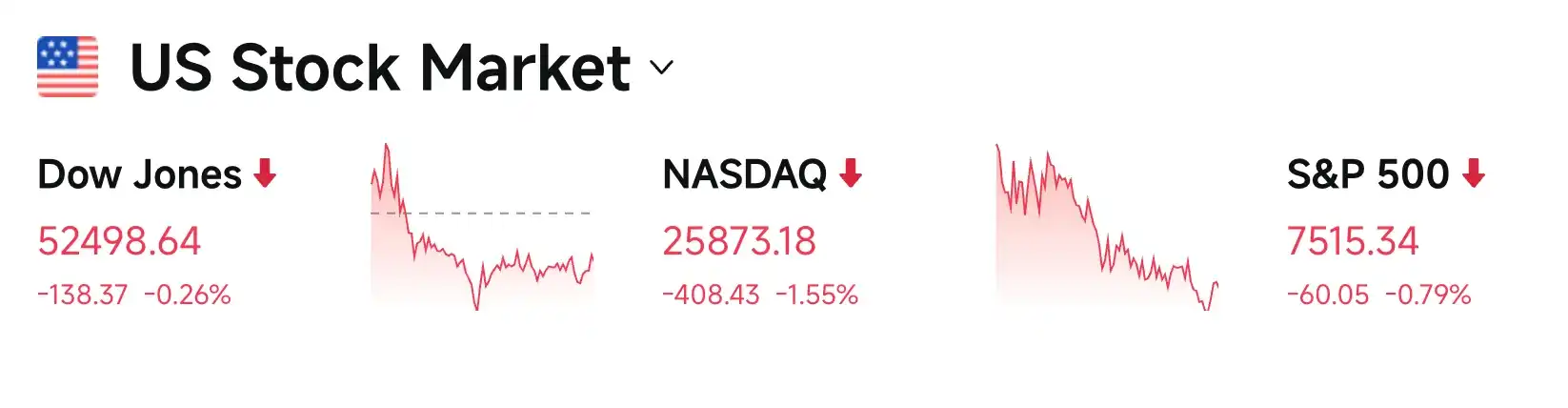
Last night and this morning, the sharp escalation of geopolitical conflicts and the Federal Reserve's unexpectedly hawkish stance led to a brutal 'stocks and bonds sell-off' in the market. Tech stocks were the hardest hit, dragging the Nasdaq Composite Index down sharply by 1.55% to 25,873.18 points, directly falling below its 50-day moving average. The S&P 500 and Dow Jones Industrial Average were not spared either, falling 0.79% and 0.26% respectively. Deeply intertwined anxiety over AI capital expenditure and macro safe-haven demand drove the VIX fear index up over 14%.

U.S. Conducts Fresh Airstrikes on Iran and Plans to Enforce Maritime Blockade, Crude Oil Soars 9%

The Middle East situation continues to dominate market sentiment, with the U.S. conducting airstrikes on Iran for three consecutive nights and planning to destroy a fortified underground nuclear facility named 'Gao Shan.' Furthermore, starting from 4 a.m. on July 15, the U.S. will implement a maritime blockade on all Iranian ports and coastal areas, and plans to impose a 20% transit fee on all cargo passing through the Strait of Hormuz. These remarks, coupled with rumors of a downed drone, instantly ignited the crude oil market.

Wall Street traders frantically restarted the 'NACHO (Never Again Channel Opening of Hormuz) trade,' betting that this global artery would not return to calm anytime soon. Amid panic, WTI crude oil surged over 9% in a single day, breaking through the $80 per barrel mark; Brent crude oil also strongly stood above $85, marking its biggest single-day gain since 2020. Despite the intensified conflict, Trump stated that there is still a possibility for both sides to reach an agreement.

Goldman Sachs warned that the core market contradiction has shifted from 'whether the channel opens' to 'who gets to decide.' Their base case scenario remains that oil prices will stay within the $75-$85 range. However, if energy infrastructure like offshore drilling platforms also comes under attack, oil prices breaking through $100 is not a fantasy. Although the UAE's daily crude production surged by 80% in June (reaching 3.8 million barrels) and OPEC lowered its future demand forecasts, these bearish factors appear insignificant in the face of the current supply disruption panic.

Gold Plunges, Dollar and U.S. Treasuries Surge, Probability of July Rate Hike Nears 50%

Influenced by simultaneous increases in real interest rates and the dollar, gold plummeted nearly 3%, losing the psychological $4,000 per ounce level, with its safe-haven attributes temporarily yielding to dollar-denominated assets. The U.S. dollar index continued to strengthen, and U.S. Treasuries faced selling pressure. The 2-year Treasury yield soared 1.7%, breaking above 4.29%, a multi-year high; the 10-year Treasury yield also rose 1.4% to climb to 4.62%. Bloomberg analysts noted that inflation expectations fueled by the oil price surge have completely overshadowed gold's safe-haven appeal.
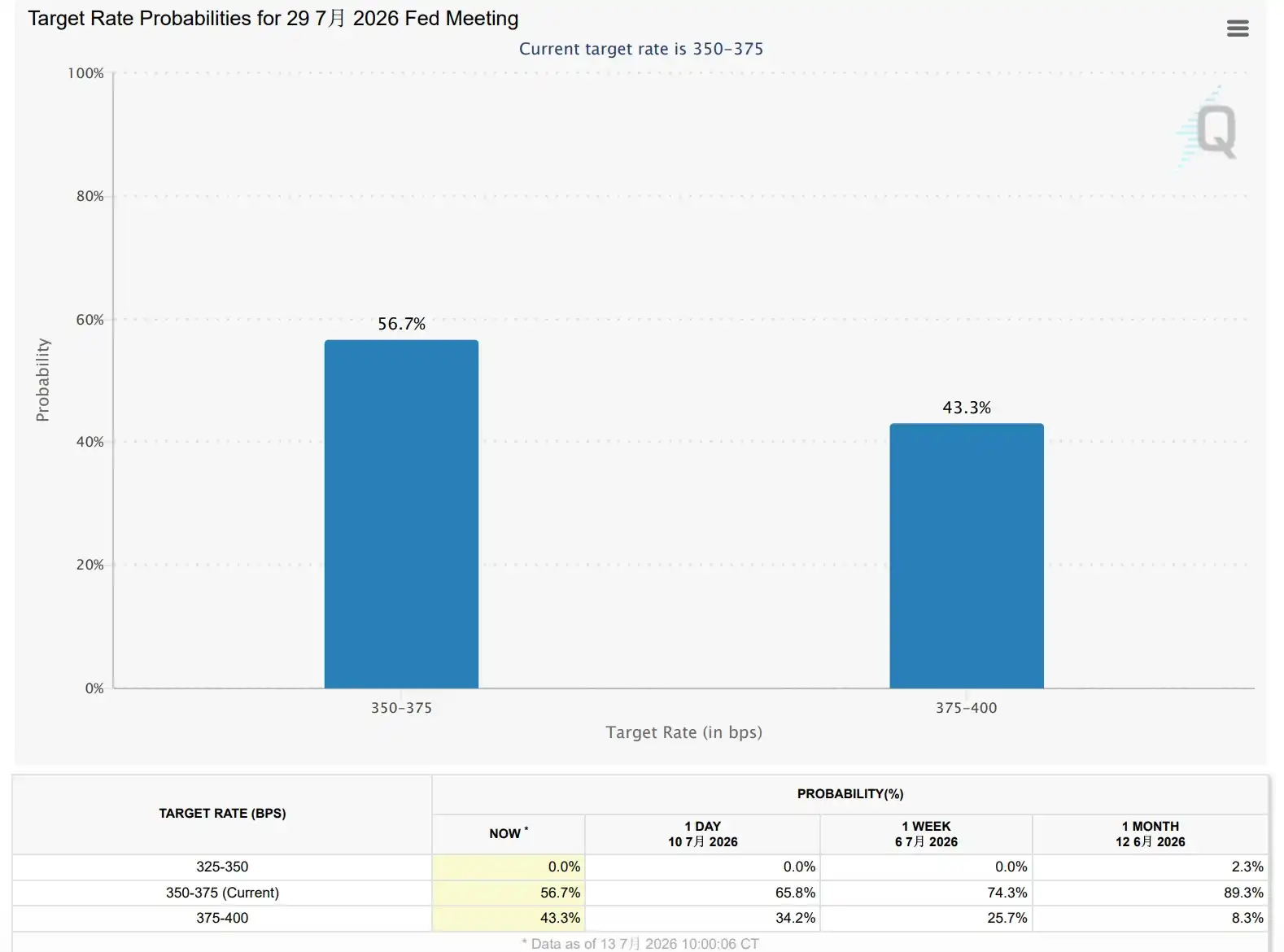
Interest rate swap markets indicate that the probability of a 25 basis point rate hike by the Federal Reserve in July is now close to 50%, up significantly from less than 40% previously; the probability of at least two rate hikes before year-end has also risen to 56%.

Federal Reserve Governor Waller stated that if future inflation data shows price pressures expanding again, the Fed might need to raise rates again in the near term. BMO Capital Markets believes the market now views the late-July FOMC meeting as a genuine policy inflection point.

Goldman Sachs noted that if the Fed resumes rate hikes, it would simultaneously suppress economic growth, increase financing costs for AI capital expenditures, and elevate market volatility, putting pressure on U.S. stock valuations for a repricing.

AI Trade Continues Cooling, U.S. Tech Sector Sees Sharp Volatility, Apple Hits New High Against the Trend

Under the triple pressure of U.S.-Iran geopolitical conflict, renewed hawkish Fed rate hike expectations, and concerns over the sustainability of AI capital expenditure, U.S. stock market internal structure experienced severe turbulence last night. Funds panic-sold from high-valuation chip and cloud service sectors, causing the Philadelphia Semiconductor Index to plunge 4% and the Nasdaq to lead the decline among major indices.

The semiconductor industry suffered heavy losses, with SK Hynix and Micron Technology leading the decline due to profit-taking and earnings forecast revisions. Nvidia and AMD fell between 3% and 5%. Market analysis suggests the AI 'computing power arms race' logic is facing a severe test, with investors beginning to reassess the profit realization capabilities of high-valuation tech stocks.

Specific Company Actions and Stock Price Movements:
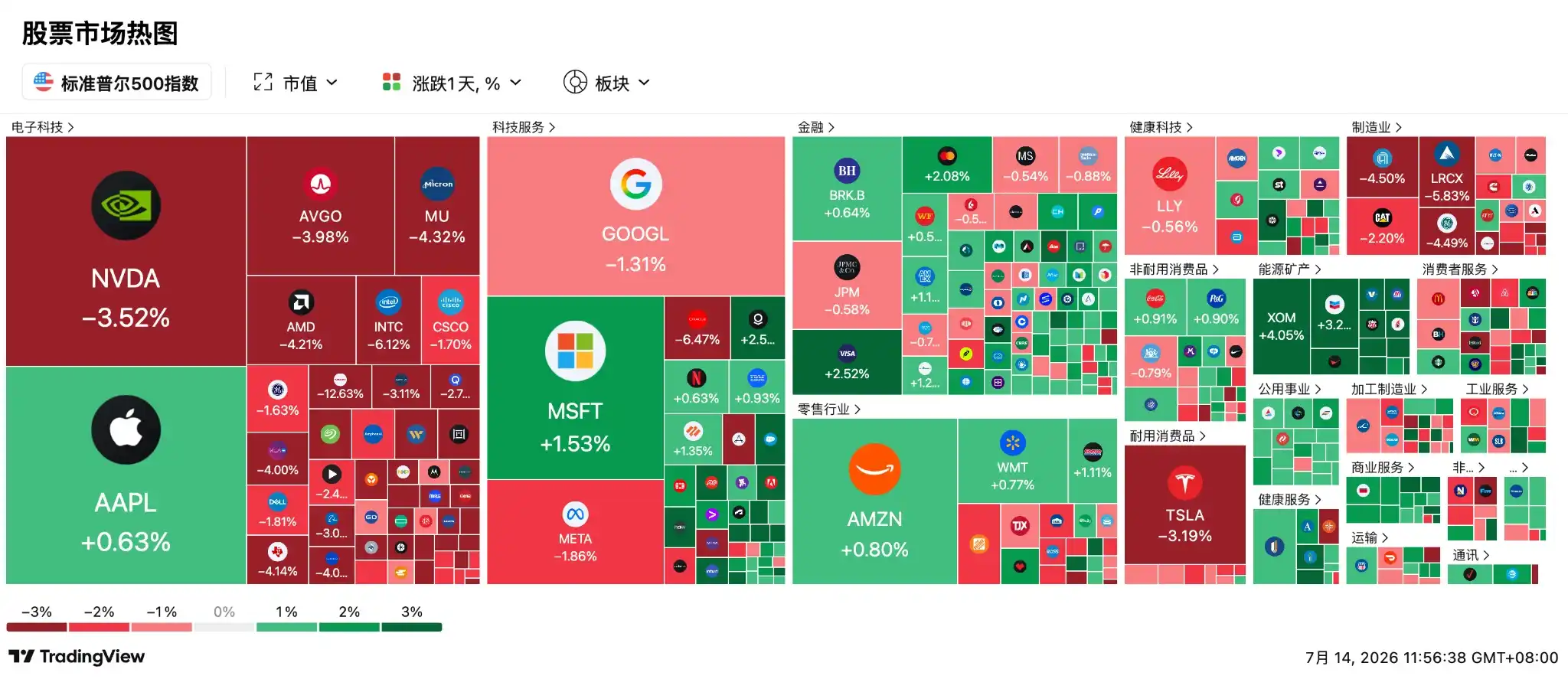
  • SK Hynix ADR plunged 9% on its second trading day, with its domestic Korean stock price plummeting 15% in a single session, dragging down the global AI memory sector. The trigger for the crash was a bearish research report: Korea Investment & Securities pointed out that SK Hynix's high-bandwidth memory (HBM) contracts are long-term agreements with locked-in prices, meaning even if chip prices skyrocket now, they can only sell at the previously agreed lower prices. This has led to their Q2 profit expectations being far below market consensus. This 'fame without fortune' situation triggered a frantic sell-off by profit-takers.

  • The AI memory chain adjusted across the board, with SanDisk plunging over 12%, Western Digital down about 8%, Seagate down nearly 7%, and Micron down over 4%. As part of plans to expand U.S. domestic chip manufacturing investment, Micron took a stake in silicon wafer manufacturer GlobalWafers. Wall Street firm Wedbush believes the future AI bottleneck will shift from 'chip shortage' to 'silicon wafer shortage,' and Micron is preemptively securing core raw materials, building a deep moat.

  • GPU and AI chips also pulled back, with Nvidia falling 3.52%. The market is beginning to worry that cloud computing giants might not be able to afford so many expensive AI chips. However, Morgan Stanley maintains its $300 price target, insisting competitors' custom chips cannot yet challenge Nvidia's dominance. AMD also tumbled 4.21%, but institutions like Bank of America remain bullish against the trend, raising their price target to $620, citing AMD's server processors gaining significant market share, with promising Q3 shipment volumes. TSMC fell nearly 3%, announcing continuous expansion of advanced packaging bases, with the Chiayi park potentially becoming the world's largest advanced packaging production base. Additionally, Broadcom fell about 3%, Marvell down nearly 7%, Arm down about 8%, ASML down nearly 3%, with Applied Materials, KLA, and Lam Research all down about 4%.

  • Intel slumped 6.12%, failing to recover even after announcing a €5 billion investment to expand AI capacity in Ireland.

  • Apple rose against the trend by 0.63% to $316.91, hitting a new all-time high. Top Goldman Sachs analysts noted that Apple, not deeply entrenched in the AI data center 'money-burning war,' has instead become the safest haven. Coupled with the upcoming foldable iPhone launch and recent price increases across its product line, Apple's valuation premium relative to the S&P 500 has reached its highest point in 15 years.

  • SpaceX fell for a second consecutive day, with cumulative losses nearing 9%, approaching its $135 IPO price. High valuation and massive losses led some investors to cash out. However, the good news is the U.S. Federal Aviation Administration (FAA) has given the green light, with the 13th Starship test flight scheduled for this Thursday.

  • U.S. solar giant Sunrun enters the 'selling computing power' arena. Amid the high demand and shortage of AI computing power, the company's CEO announced plans to transform millions of U.S. households with rooftop solar installations into 'distributed AI data centers.' Users can earn hundreds of dollars per month simply by contributing their home's micro computing nodes.

Key Events to Watch Next:

  • July 14, 20:30: U.S. June CPI Inflation Data. This is the undisputed most crucial data of the week. The market expects the year-on-year growth rate to drop from 4.2% to 3.8%. If the data comes in hotter than expected, the 'rate hike' mentioned by Fed governors could become a reality, sending U.S. Treasury yields soaring again and likely triggering another round of tech stock sell-offs.

  • July 14, 22:00: Fed Chair Waller's Congressional Hearing. As the grand finale of 'Super Tuesday,' after reviewing the latest CPI data, Waller will provide his first insights to Congress. Whether his testimony leans towards maintaining the status quo or strongly advocating for rate hikes will directly set the tone for the final direction of the FOMC meeting two weeks later.

  • July 14: Key Bank Earnings Season Kicks Off. JPMorgan Chase, Bank of America, Citigroup, Wells Fargo, and Goldman Sachs Group will release results. Amid current concerns over high interest rates and economic slowdown, whether these Wall Street giants can maintain their net interest income will be a benchmark for testing the resilience of the U.S. financial system.

  • July 15, 4:00 a.m.: U.S. Military Officially Reinstates Maritime Blockade on Iran. Trump's sanction hammer officially falls. The actual intensity of the blockade in these hours and Iran's response will directly determine the fate of navigation through the Strait of Hormuz.

  • July 16: TSMC Q2 Earnings Report and SpaceX's 13th Starship Test Flight. TSMC's earnings are more than just a financial report; they reveal the state of global AI advanced packaging capacity, directly verifying whether the AI boom is a bubble or real gold. Meanwhile, the outcome of SpaceX's launch will determine if this aerospace unicorn can achieve a new round of valuation re-rating.

Crypto di tendenza

Domande pertinenti

QAccording to the article, which tech company bucked the market trend and reached a new all-time high, and why?

AApple bucked the market trend and reached a new all-time high. According to a Goldman Sachs analyst, this is because Apple is not deeply involved in the expensive 'cash-burning war' for AI data centers, making it a stable safe haven. Additionally, anticipation for the upcoming foldable iPhone and recent price increases across its product line contributed to the positive sentiment.

QWhat three main factors are causing volatility in the US tech stock sector as described in the article?

AThe three main factors causing volatility in the US tech stock sector are: 1) The US-Iran geopolitical conflict escalating, 2) A resurgence of hawkish interest rate hike expectations from the Federal Reserve, and 3) Concerns about the sustainability of AI-related capital expenditures.

QWhat is the market's implied probability of a Federal Reserve interest rate hike in July, and what key event on July 14th will significantly influence this path?

AAccording to interest rate swap markets, the probability of a Federal Reserve 25-basis-point rate hike in July is close to 50%. The key event on July 14th that will significantly influence this path is the Congressional testimony by Federal Reserve Chairman Walsh, which will follow the release of the June CPI data.

QWhat action is the US reportedly planning against Iran starting July 15th, and what was the immediate market impact of this news on oil prices?

AThe US reportedly plans to implement a naval blockade against all Iranian ports and coastal areas starting at 4 AM on July 15th. The immediate market impact of this news was a surge in oil prices, with WTI crude oil rising over 9% to break above $80 per barrel, and Brent crude oil rising to above $85.

QWhich AI chip and memory-related companies saw significant stock price declines, and what specific reason was cited for SK Hynix's sharp drop?

ASignificant declines were seen in SK Hynix (ADR down 9%, Korean shares down 15%), SanDisk (down over 12%), Western Digital (down ~8%), Seagate (down nearly 7%), Micron (down over 4%), NVIDIA (down 3.52%), and AMD (down 4.21%). The specific reason cited for SK Hynix's sharp drop was a bearish research report indicating its High Bandwidth Memory (HBM) contracts have locked-in low prices, meaning it cannot benefit from current high market chip prices, leading to Q2 profit expectations well below market consensus.

Letture associate

Three Rounds in a Row, Shanghai Gives Birth to a $10 Billion Satellite Internet Unicorn

Shanghai-based semiconductor company Sixic has raised a new strategic investment round, securing backing from investors including Xinhuanet Venture Capital and Tongding Group, with continued support from existing investors. This marks the company's third disclosed financing this year, following a 1.5 billion RMB raise in February, officially cementing its status as a new Shanghai unicorn with a valuation exceeding 10 billion USD. The financing comes amid a dynamic period for China's commercial aerospace sector. Recent milestones include a successful controlled landing of a rocket first stage, signaling a path toward lower launch costs, and the establishment of a national Commercial Aerospace Innovation Consortium comprising 271 entities. Sixic stands out as the only 6G satellite internet baseband chip company within this consortium. The article highlights a market shift from a focus on rockets and satellites towards recognizing the value of the terminal and connectivity layer, essential for completing the commercial loop. Satellite internet, integral to 6G and commercial aerospace, is entering an industrial phase with clear policy support, including China's pioneering allocation of 6GHz spectrum for 6G R&D. Sixic specializes in 5G/6G satellite communication baseband chips, a highly complex segment. Unlike terrestrial communication, satellite chips must address challenges like high Doppler shift and signal loss. The company's technological validation is a key driver for investment. It has secured product certifications from leading global smartphone manufacturers, new energy vehicle makers, and communication module companies. A strategic partnership with ZTE was announced in March to collaborate on 6G NTN satellite internet. The company has achieved a full technical verification loop, from lab tests to in-orbit validation, including successfully demonstrating 5G NTN standard-based HD video calls via satellite in 2025. It maintains a 100% first-pass success rate for chip tape-outs and possesses full-stack in-house R&D capabilities. Sixic's strategy focuses on ASIC development for future commercial-scale, power-efficient consumer devices like smartphones. Its early and deep involvement in industry standards and constellation planning creates a significant competitive barrier. Looking ahead, Sixic's opportunity extends beyond chips into modules and terminal ecosystems. It has developed a full range of baseband SoC solutions and provides reference designs to help partners launch products quickly. The recent release of the CM7620 broadband satellite communication module at MWC Shanghai completes its "chip-module-terminal" portfolio. This latest funding round represents a strategic bet on the foundational communication capabilities that will underpin the next generation of 6G and satellite internet value chains.

marsbit21 min fa

Three Rounds in a Row, Shanghai Gives Birth to a $10 Billion Satellite Internet Unicorn

marsbit21 min fa

Is the iPhone Moment for Embodied AI Coming Soon?

Is the "iPhone moment" for embodied AI approaching? This article, based on a roundtable discussion, presents expert insights on the current state and future of embodied AI. The consensus is that the pivotal "iPhone moment" is still distant. The field is likened to the "brick phone" era, with technology paths—such as VLA and world models—not yet converging. While robotic "motor skills" (e.g., walking) have matured, the "brain" (decision-making, generalization) remains far from commercial readiness. A major bottleneck is data: an estimated tens of millions of data points are needed for a breakthrough, but only around 500,000 currently exist globally. Currently, cost remains prohibitive for widespread labor replacement, making the economic case challenging. However, experts see a three-tiered market potential: a billion-level market for emotional companionship (e.g., entertainment, basic care), a trillion-level market for commercial services (e.g., guides, receptionists), and a massive, long-term opportunity for physical labor in factories and homes. The discussion suggests that while humanoid robots face hurdles, non-humanoid embodied AI applications (like existing service robots) can be deployed sooner. The ultimate vision is for AI to operate seamlessly in the physical world, not just behind screens. Regarding AI tools, participants noted their widespread use for boosting efficiency in coding, research, and teaching. However, they warned against over-reliance due to risks of AI "deception" and the erosion of critical thinking, emphasizing that core judgment must remain with humans. In summary, embodied AI holds immense promise but requires significant progress in brain models, data collection, and cost reduction before achieving its transformative potential. Its development is expected to be gradual, advancing through specific use cases rather than a single explosive moment.

marsbit38 min fa

Is the iPhone Moment for Embodied AI Coming Soon?

marsbit38 min fa

Crude Oil Surges 10% in Intraday Trading! US Military Restores Blockade on Iran, Trump Warns of 'Heavy Blows' Tonight and Tomorrow, Imposes 20% Fee on Strait Shipping

Crude oil prices surged up to 10% intraday as tensions between the US and Iran escalated sharply. President Trump announced the reinstatement of a maritime blockade against Iran, targeting its ships and their customers, while stating the Strait of Hormuz would remain open to all other nations. He further declared that the US, as the "guardian" of the strait, would impose a 20% fee on all cargo transiting the strategic waterway to compensate for security costs. The US Central Command confirmed the naval blockade would commence on July 14 (GMT). Following Trump's statements, reports emerged of explosions near Iran's Larak Island and the port of Bandar Abbas, though Iranian authorities did not confirm their nature. Iran's Foreign Minister criticized the proposed 20% fee as excessive, asserting Iran's role as the guardian of the strait. An Iranian military spokesperson warned of a strong response to any unauthorized US interference in the waterway. The United Nations' International Maritime Organization (IMO) expressed opposition to charging tolls for passage through international straits, stating such measures lack legal foundation. Market reactions were pronounced, with Brent crude briefly surpassing $83 and WTI above $78. The situation intensified as Trump notified Congress of renewed hostilities with Iran, following US airstrikes on Iranian targets.

marsbit1 h fa

Crude Oil Surges 10% in Intraday Trading! US Military Restores Blockade on Iran, Trump Warns of 'Heavy Blows' Tonight and Tomorrow, Imposes 20% Fee on Strait Shipping

marsbit1 h fa

How to Regulate Single-Stock Leveraged ETFs? On Thursday, the Entire Market Is Watching This Korean Government Meeting

The highest-level economic coordination body in South Korea, the "F4" comprising the Ministry of Economy and Finance, the Financial Services Commission, the Bank of Korea, and the Financial Supervisory Service, will hold an emergency meeting on Thursday to discuss regulatory measures for single-stock leveraged ETFs. These products, launched just six weeks ago, have been widely blamed for exacerbating market volatility. The KOSPI's 8% plunge on Monday triggered the year's seventh trading halt, intensifying scrutiny. Regulators have expressed rare public regret over approving the products. FSS Governor Lee Bok-hyun stated he "regretted not doing everything possible to prevent" their introduction and acknowledged structural problems, citing massive retail investments and legal complications from a rushed rollout. Possible countermeasures under discussion include raising margin requirements, imposing daily price limits, and adjusting leverage caps. However, officials admit these may be temporary fixes. Data confirms the amplified volatility. Since the ETFs' launch, days with KOSPI moves exceeding 3% have nearly doubled. Trading halts have reached record levels, surpassing the 2008 financial crisis peak. The products allow 2x leveraged bets on giants like Samsung Electronics and SK Hynix. Their daily rebalancing to match returns is seen as mechanically fueling market swings. The outcome of Thursday's F4 meeting is highly anticipated, with expectations leaning towards stricter controls on leverage, investor access, or other structural constraints to curb the products' market impact.

marsbit1 h fa

How to Regulate Single-Stock Leveraged ETFs? On Thursday, the Entire Market Is Watching This Korean Government Meeting

marsbit1 h fa

Trading

Spot

Articoli Popolari

Cosa è $S$

Comprendere SPERO: Una Panoramica Completa Introduzione a SPERO Mentre il panorama dell'innovazione continua a evolversi, l'emergere delle tecnologie web3 e dei progetti di criptovaluta gioca un ruolo fondamentale nel plasmare il futuro digitale. Un progetto che ha attirato l'attenzione in questo campo dinamico è SPERO, denotato come SPERO,$$s$. Questo articolo mira a raccogliere e presentare informazioni dettagliate su SPERO, per aiutare gli appassionati e gli investitori a comprendere le sue basi, obiettivi e innovazioni nei domini web3 e crypto. Che cos'è SPERO,$$s$? SPERO,$$s$ è un progetto unico all'interno dello spazio crypto che cerca di sfruttare i principi della decentralizzazione e della tecnologia blockchain per creare un ecosistema che promuove l'impegno, l'utilità e l'inclusione finanziaria. Il progetto è progettato per facilitare interazioni peer-to-peer in modi nuovi, fornendo agli utenti soluzioni e servizi finanziari innovativi. Al suo interno, SPERO,$$s$ mira a responsabilizzare gli individui fornendo strumenti e piattaforme che migliorano l'esperienza dell'utente nello spazio delle criptovalute. Questo include la possibilità di metodi di transazione più flessibili, la promozione di iniziative guidate dalla comunità e la creazione di percorsi per opportunità finanziarie attraverso applicazioni decentralizzate (dApps). La visione sottostante di SPERO,$$s$ ruota attorno all'inclusività, cercando di colmare le lacune all'interno della finanza tradizionale mentre sfrutta i vantaggi della tecnologia blockchain. Chi è il Creatore di SPERO,$$s$? L'identità del creatore di SPERO,$$s$ rimane piuttosto oscura, poiché ci sono risorse pubblicamente disponibili limitate che forniscono informazioni dettagliate sul suo fondatore o fondatori. Questa mancanza di trasparenza può derivare dall'impegno del progetto per la decentralizzazione—un ethos che molti progetti web3 condividono, dando priorità ai contributi collettivi rispetto al riconoscimento individuale. Centrando le discussioni attorno alla comunità e ai suoi obiettivi collettivi, SPERO,$$s$ incarna l'essenza dell'empowerment senza mettere in evidenza individui specifici. Pertanto, comprendere l'etica e la missione di SPERO rimane più importante che identificare un creatore singolo. Chi sono gli Investitori di SPERO,$$s$? SPERO,$$s$ è supportato da una varietà di investitori che vanno dai capitalisti di rischio agli investitori angelici dedicati a promuovere l'innovazione nel settore crypto. Il focus di questi investitori generalmente si allinea con la missione di SPERO—dando priorità a progetti che promettono avanzamenti tecnologici sociali, inclusività finanziaria e governance decentralizzata. Queste fondazioni di investitori sono tipicamente interessate a progetti che non solo offrono prodotti innovativi, ma contribuiscono anche positivamente alla comunità blockchain e ai suoi ecosistemi. Il supporto di questi investitori rafforza SPERO,$$s$ come un concorrente degno di nota nel dominio in rapida evoluzione dei progetti crypto. Come Funziona SPERO,$$s$? SPERO,$$s$ impiega un framework multifunzionale che lo distingue dai progetti di criptovaluta convenzionali. Ecco alcune delle caratteristiche chiave che sottolineano la sua unicità e innovazione: Governance Decentralizzata: SPERO,$$s$ integra modelli di governance decentralizzati, responsabilizzando gli utenti a partecipare attivamente ai processi decisionali riguardanti il futuro del progetto. Questo approccio favorisce un senso di proprietà e responsabilità tra i membri della comunità. Utilità del Token: SPERO,$$s$ utilizza il proprio token di criptovaluta, progettato per servire varie funzioni all'interno dell'ecosistema. Questi token abilitano transazioni, premi e la facilitazione dei servizi offerti sulla piattaforma, migliorando l'impegno e l'utilità complessivi. Architettura Stratificata: L'architettura tecnica di SPERO,$$s$ supporta la modularità e la scalabilità, consentendo un'integrazione fluida di funzionalità e applicazioni aggiuntive man mano che il progetto evolve. Questa adattabilità è fondamentale per mantenere la rilevanza nel panorama crypto in continua evoluzione. Coinvolgimento della Comunità: Il progetto enfatizza iniziative guidate dalla comunità, impiegando meccanismi che incentivano la collaborazione e il feedback. Nutrendo una comunità forte, SPERO,$$s$ può affrontare meglio le esigenze degli utenti e adattarsi alle tendenze di mercato. Focus sull'Inclusione: Offrendo basse commissioni di transazione e interfacce user-friendly, SPERO,$$s$ mira ad attrarre una base utenti diversificata, inclusi individui che potrebbero non aver precedentemente interagito nello spazio crypto. Questo impegno per l'inclusione si allinea con la sua missione generale di empowerment attraverso l'accessibilità. Cronologia di SPERO,$$s$ Comprendere la storia di un progetto fornisce preziose intuizioni sulla sua traiettoria di sviluppo e sui traguardi. Di seguito è riportata una cronologia suggerita che mappa eventi significativi nell'evoluzione di SPERO,$$s$: Fase di Concettualizzazione e Ideazione: Le idee iniziali che formano la base di SPERO,$$s$ sono state concepite, allineandosi strettamente con i principi di decentralizzazione e focus sulla comunità all'interno dell'industria blockchain. Lancio del Whitepaper del Progetto: Dopo la fase concettuale, è stato rilasciato un whitepaper completo che dettaglia la visione, gli obiettivi e l'infrastruttura tecnologica di SPERO,$$s$ per suscitare interesse e feedback dalla comunità. Costruzione della Comunità e Prime Interazioni: Sono stati effettuati sforzi attivi di outreach per costruire una comunità di early adopters e potenziali investitori, facilitando discussioni attorno agli obiettivi del progetto e ottenendo supporto. Evento di Generazione del Token: SPERO,$$s$ ha condotto un evento di generazione del token (TGE) per distribuire i propri token nativi ai primi sostenitori e stabilire una liquidità iniziale all'interno dell'ecosistema. Lancio della Prima dApp: La prima applicazione decentralizzata (dApp) associata a SPERO,$$s$ è stata attivata, consentendo agli utenti di interagire con le funzionalità principali della piattaforma. Sviluppo Continuo e Partnership: Aggiornamenti e miglioramenti continui alle offerte del progetto, inclusi partnership strategiche con altri attori nello spazio blockchain, hanno plasmato SPERO,$$s$ in un concorrente competitivo e in evoluzione nel mercato crypto. Conclusione SPERO,$$s$ rappresenta una testimonianza del potenziale del web3 e delle criptovalute di rivoluzionare i sistemi finanziari e responsabilizzare gli individui. Con un impegno per la governance decentralizzata, il coinvolgimento della comunità e funzionalità progettate in modo innovativo, apre la strada verso un panorama finanziario più inclusivo. Come per qualsiasi investimento nello spazio crypto in rapida evoluzione, si incoraggiano potenziali investitori e utenti a ricercare approfonditamente e a impegnarsi in modo riflessivo con gli sviluppi in corso all'interno di SPERO,$$s$. Il progetto mostra lo spirito innovativo dell'industria crypto, invitando a ulteriori esplorazioni delle sue innumerevoli possibilità. Mentre il percorso di SPERO,$$s$ è ancora in fase di sviluppo, i suoi principi fondamentali potrebbero effettivamente influenzare il futuro di come interagiamo con la tecnologia, la finanza e tra di noi in ecosistemi digitali interconnessi.

118 Totale visualizzazioniPubblicato il 2024.12.17Aggiornato il 2024.12.17

Cosa è $S$

Cosa è AGENT S

Agent S: Il Futuro dell'Interazione Autonoma in Web3 Introduzione Nel panorama in continua evoluzione di Web3 e criptovalute, le innovazioni stanno costantemente ridefinendo il modo in cui gli individui interagiscono con le piattaforme digitali. Uno di questi progetti pionieristici, Agent S, promette di rivoluzionare l'interazione uomo-computer attraverso il suo framework agentico aperto. Aprendo la strada a interazioni autonome, Agent S mira a semplificare compiti complessi, offrendo applicazioni trasformative nell'intelligenza artificiale (AI). Questa esplorazione dettagliata approfondirà le complessità del progetto, le sue caratteristiche uniche e le implicazioni per il dominio delle criptovalute. Cos'è Agent S? Agent S si presenta come un innovativo framework agentico aperto, progettato specificamente per affrontare tre sfide fondamentali nell'automazione dei compiti informatici: Acquisizione di Conoscenze Specifiche del Dominio: Il framework apprende in modo intelligente da varie fonti di conoscenza esterne ed esperienze interne. Questo approccio duale gli consente di costruire un ricco repository di conoscenze specifiche del dominio, migliorando le sue prestazioni nell'esecuzione dei compiti. Pianificazione su Lungo Orizzonte di Compiti: Agent S impiega una pianificazione gerarchica potenziata dall'esperienza, un approccio strategico che facilita la suddivisione e l'esecuzione efficiente di compiti complessi. Questa caratteristica migliora significativamente la sua capacità di gestire più sottocompiti in modo efficiente ed efficace. Gestione di Interfacce Dinamiche e Non Uniformi: Il progetto introduce l'Interfaccia Agente-Computer (ACI), una soluzione innovativa che migliora l'interazione tra agenti e utenti. Utilizzando Modelli Linguistici Multimodali di Grandi Dimensioni (MLLM), Agent S può navigare e manipolare senza sforzo diverse interfacce grafiche utente. Attraverso queste caratteristiche pionieristiche, Agent S fornisce un framework robusto che affronta le complessità coinvolte nell'automazione dell'interazione umana con le macchine, preparando il terreno per innumerevoli applicazioni nell'AI e oltre. Chi è il Creatore di Agent S? Sebbene il concetto di Agent S sia fondamentalmente innovativo, informazioni specifiche sul suo creatore rimangono elusive. Il creatore è attualmente sconosciuto, il che evidenzia sia la fase embrionale del progetto sia la scelta strategica di mantenere i membri fondatori sotto anonimato. Indipendentemente dall'anonimato, l'attenzione rimane sulle capacità e sul potenziale del framework. Chi sono gli Investitori di Agent S? Poiché Agent S è relativamente nuovo nell'ecosistema crittografico, informazioni dettagliate riguardanti i suoi investitori e sostenitori finanziari non sono documentate esplicitamente. La mancanza di approfondimenti pubblicamente disponibili sulle fondazioni di investimento o sulle organizzazioni che supportano il progetto solleva interrogativi sulla sua struttura di finanziamento e sulla roadmap di sviluppo. Comprendere il supporto è cruciale per valutare la sostenibilità del progetto e il suo potenziale impatto sul mercato. Come Funziona Agent S? Al centro di Agent S si trova una tecnologia all'avanguardia che gli consente di funzionare efficacemente in contesti diversi. Il suo modello operativo è costruito attorno a diverse caratteristiche chiave: Interazione Uomo-Computer Simile a Quella Umana: Il framework offre una pianificazione AI avanzata, cercando di rendere le interazioni con i computer più intuitive. Mimando il comportamento umano nell'esecuzione dei compiti, promette di elevare le esperienze degli utenti. Memoria Narrativa: Utilizzata per sfruttare esperienze di alto livello, Agent S utilizza la memoria narrativa per tenere traccia delle storie dei compiti, migliorando così i suoi processi decisionali. Memoria Episodica: Questa caratteristica fornisce agli utenti una guida passo-passo, consentendo al framework di offrire supporto contestuale mentre i compiti si sviluppano. Supporto per OpenACI: Con la capacità di funzionare localmente, Agent S consente agli utenti di mantenere il controllo sulle proprie interazioni e flussi di lavoro, allineandosi con l'etica decentralizzata di Web3. Facile Integrazione con API Esterne: La sua versatilità e compatibilità con varie piattaforme AI garantiscono che Agent S possa adattarsi senza problemi agli ecosistemi tecnologici esistenti, rendendolo una scelta attraente per sviluppatori e organizzazioni. Queste funzionalità contribuiscono collettivamente alla posizione unica di Agent S all'interno dello spazio crittografico, poiché automatizza compiti complessi e multi-fase con un intervento umano minimo. Man mano che il progetto evolve, le sue potenziali applicazioni in Web3 potrebbero ridefinire il modo in cui si svolgono le interazioni digitali. Cronologia di Agent S Lo sviluppo e le tappe di Agent S possono essere riassunti in una cronologia che evidenzia i suoi eventi significativi: 27 Settembre 2024: Il concetto di Agent S è stato lanciato in un documento di ricerca completo intitolato “Un Framework Agentico Aperto che Usa i Computer Come un Umano”, mostrando le basi per il progetto. 10 Ottobre 2024: Il documento di ricerca è stato reso pubblicamente disponibile su arXiv, offrendo un'esplorazione approfondita del framework e della sua valutazione delle prestazioni basata sul benchmark OSWorld. 12 Ottobre 2024: È stata rilasciata una presentazione video, fornendo un'idea visiva delle capacità e delle caratteristiche di Agent S, coinvolgendo ulteriormente potenziali utenti e investitori. Questi indicatori nella cronologia non solo illustrano i progressi di Agent S, ma indicano anche il suo impegno per la trasparenza e il coinvolgimento della comunità. Punti Chiave su Agent S Man mano che il framework Agent S continua a evolversi, diversi attributi chiave si distinguono, sottolineando la sua natura innovativa e il potenziale: Framework Innovativo: Progettato per fornire un uso intuitivo dei computer simile all'interazione umana, Agent S porta un approccio nuovo all'automazione dei compiti. Interazione Autonoma: La capacità di interagire autonomamente con i computer attraverso GUI segna un passo avanti verso soluzioni informatiche più intelligenti ed efficienti. Automazione di Compiti Complessi: Con la sua metodologia robusta, può automatizzare compiti complessi e multi-fase, rendendo i processi più veloci e meno soggetti a errori. Miglioramento Continuo: I meccanismi di apprendimento consentono ad Agent S di migliorare dalle esperienze passate, migliorando continuamente le sue prestazioni e la sua efficacia. Versatilità: La sua adattabilità attraverso diversi ambienti operativi come OSWorld e WindowsAgentArena garantisce che possa servire un'ampia gamma di applicazioni. Man mano che Agent S si posiziona nel panorama di Web3 e delle criptovalute, il suo potenziale per migliorare le capacità di interazione e automatizzare i processi segna un significativo avanzamento nelle tecnologie AI. Attraverso il suo framework innovativo, Agent S esemplifica il futuro delle interazioni digitali, promettendo un'esperienza più fluida ed efficiente per gli utenti in vari settori. Conclusione Agent S rappresenta un audace passo avanti nell'unione tra AI e Web3, con la capacità di ridefinire il modo in cui interagiamo con la tecnologia. Sebbene sia ancora nelle sue fasi iniziali, le possibilità per la sua applicazione sono vaste e coinvolgenti. Attraverso il suo framework completo che affronta sfide critiche, Agent S mira a portare le interazioni autonome al centro dell'esperienza digitale. Man mano che ci addentriamo nei regni delle criptovalute e della decentralizzazione, progetti come Agent S giocheranno senza dubbio un ruolo cruciale nel plasmare il futuro della tecnologia e della collaborazione uomo-computer.

573 Totale visualizzazioniPubblicato il 2025.01.14Aggiornato il 2025.01.14

Cosa è AGENT S

Come comprare S

Benvenuto in HTX.com! Abbiamo reso l'acquisto di Sonic (S) semplice e conveniente. Segui la nostra guida passo passo per intraprendere il tuo viaggio nel mondo delle criptovalute.Step 1: Crea il tuo Account HTXUsa la tua email o numero di telefono per registrarti il tuo account gratuito su HTX. Vivi un'esperienza facile e sblocca tutte le funzionalità,Crea il mio accountStep 2: Vai in Acquista crypto e seleziona il tuo metodo di pagamentoCarta di credito/debito: utilizza la tua Visa o Mastercard per acquistare immediatamente SonicS.Bilancio: Usa i fondi dal bilancio del tuo account HTX per fare trading senza problemi.Terze parti: abbiamo aggiunto metodi di pagamento molto utilizzati come Google Pay e Apple Pay per maggiore comodità.P2P: Fai trading direttamente con altri utenti HTX.Over-the-Counter (OTC): Offriamo servizi su misura e tassi di cambio competitivi per i trader.Step 3: Conserva Sonic (S)Dopo aver acquistato Sonic (S), conserva nel tuo account HTX. In alternativa, puoi inviare tramite trasferimento blockchain o scambiare per altre criptovalute.Step 4: Scambia Sonic (S)Scambia facilmente Sonic (S) nel mercato spot di HTX. Accedi al tuo account, seleziona la tua coppia di trading, esegui le tue operazioni e monitora in tempo reale. Offriamo un'esperienza user-friendly sia per chi ha appena iniziato che per i trader più esperti.

1.1k Totale visualizzazioniPubblicato il 2025.01.15Aggiornato il 2026.06.02

Come comprare S

Discussioni

Benvenuto nella Community HTX. Qui puoi rimanere informato sugli ultimi sviluppi della piattaforma e accedere ad approfondimenti esperti sul mercato. Le opinioni degli utenti sul prezzo di S S sono presentate come di seguito.

活动图片