Wall Street goes on-chain: DTCC gets SEC nod to tokenize $99T market

ambcryptoPubblicato 2025-12-12Pubblicato ultima volta 2025-12-12

Introduzione

The Depository Trust & Clearing Corporation (DTCC) has received a critical No-Action Letter from the SEC, allowing its subsidiary DTC to begin tokenizing traditional securities. This regulatory milestone permits the use of blockchain technology to introduce features like 24/7 trading and programmable assets into the $99 trillion market. The initial phase will focus on highly liquid assets like Russell 1000 stocks and U.S. Treasuries. DTCC will leverage its proprietary ComposerX platform to ensure these digital tokens maintain the same legal rights, investor protections, and operational resiliency as their counterparts. This move is a major step in bridging traditional finance and DeFi, accelerating the global shift toward real-world asset (RWA) tokenization.

The foundation of U.S. securities trading is officially preparing to go digital.

On the 11th of December, the Depository Trust & Clearing Corporation (DTCC) made an important announcement.

DTCC, which processes the majority of U.S. securities transactions, revealed that its subsidiary, the Depository Trust Company (DTC), had secured a critical No‐Action Letter (NAL) from the SEC.

This development marks a significant regulatory milestone for the organization and its operations.

Why was it important?

That said, the SEC’s approval allows DTCC to bring blockchain features, such as 24/7 trading and programmable assets, into its $99 trillion market.

This ensures digital assets maintain established legal rights and investor protections.

All in all, it is the strongest step so far toward Wall Street adopting distributed ledger technology.

Additionally, the NAL lets DTC offer this tokenization service on pre-approved blockchains for three years, but with clear limits to keep the rollout cautious.

Investors are guaranteed that the digital asset will carry the same rights, protections, and ownership claims as the traditional version.

In this process, DTC will also maintain the same high standards of safety and resiliency.

Notably, the first phase focuses only on highly liquid, blue-chip assets like Russell 1000 stocks, major-index ETFs, and U.S. Treasury bills, bonds, and notes.

This ensures the earliest tokenized assets come from the most trusted and stable markets.

Execs weigh in...

Expressing the same, Frank La Salla, President & CEO, DTCC, noted,

“We welcome this opportunity to further enable and innovate for the industry, our participants and their clients.”

Echoing similar sentiments, Brian Steele, Managing Director, President of Clearing & Securities Services at DTCC, added,

“In partnership with our clients and the broader market, we will tokenize securities with uncompromising security, sound legal footing and seamless interoperability, all backed by the resilience that has anchored traditional markets for decades.”

DTCC leverages ComposerX

In support of this strategic move, DTCC will use its proprietary ComposerX platform to power the new tokenization service.

This technology will support their goal of giving DTC participants a more resilient, inclusive, cost-effective, and efficient financial system.

Importantly, DTCC aims to create a single pool of liquidity that connects traditional finance and DeFi. This unified structure is intended to reduce the fragmentation and inefficiencies that currently exist between the two systems.

For those unaware, this momentous step by DTCC is the culmination of nearly a decade of institutional exploration into DLT.

The goal has been to harness blockchain’s core benefits while preserving the bedrock protections and accountability of the DTC.

By authorizing a limited production environment across L1 and L2 providers for three years, the SEC is enabling a controlled integration.

What’s more?

Finally, the DTCC’s entry is not an isolated event but accelerates a massive paradigm shift.

The global financial system is now definitively moving toward real-world asset (RWA) tokenization, a sector projected to swell into a $13–$30 trillion opportunity by 2030.

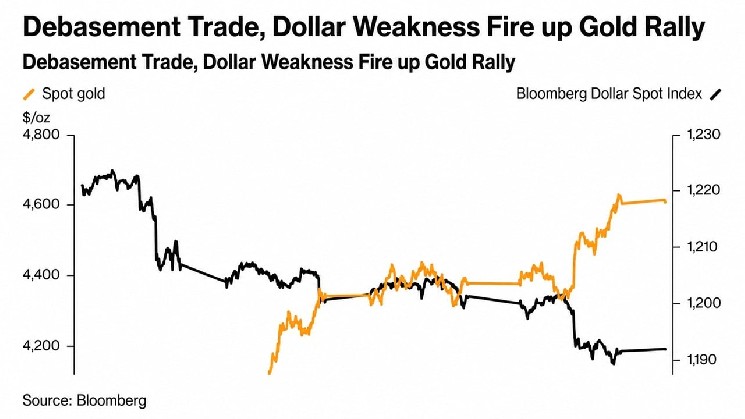
This acceleration is perhaps best exemplified by the explosion of tokenized gold.

Fuelled by a 50% price surge in 2025 and growing geopolitical instability, gold’s $29 trillion market value has intensified institutional interest.


Final Thoughts

  • The No-Action Letter finally provides regulatory clarity, allowing trillions in traditional assets to move on-chain without risking legal rights or investor protections.
  • It also aligns U.S. finance with the global shift toward real-world asset tokenization, a market expected to reach $30 trillion by 2030.


Crypto di tendenza

Letture associate

WEEX TradFi Trading Competition Kicks Off, 50,000 USDT Prize Pool First-Come, First-Served, Open a Position and Get 5 U

WEEX Exchange Launches "TradFi Trading Competition" with a 50,000 USDT Prize Pool Amidst a crypto market downturn, WEEX Exchange highlights the growth of tokenized traditional finance (TradFi) assets as a key trend, allowing users to trade stocks, ETFs, and commodities using crypto. The platform has launched a "TradFi Trading Competition" from July 9th to 23rd, featuring a 50,000 USDT prize pool. The campaign offers three reward tiers: 1. **New User Bonus (25,000 USDT pool):** New users depositing ≥100 USDT, completing a specified spot trade, and one TradFi contract trade (margin ≥10 USDT) receive 200 USDT. 2. **Volume-Based Rewards (20,000 USDT pool):** All users can earn tiered bonuses for achieving TradFi contract trading volumes of 5,000 USDT (3 USDT), 20,000 USDT (10 USDT), and 100,000 USDT (50 USDT). Rewards are stackable. 3. **Participation Reward:** Any user opening a TradFi contract trade during the event receives 5 USDT instantly. The article promotes WEEX's TradFi features, which include trading tokenized shares of companies like NVIDIA and Tesla using USDT, 24/7 trading, fractional share investing starting from $5, and high leverage up to 100x for hedging. It positions these features as solutions to traditional investing barriers like high fees, strict trading hours, and high share prices. The summary concludes by encouraging users to join the competition and leverage WEEX's platform to access global TradFi markets.

marsbit5 min fa

WEEX TradFi Trading Competition Kicks Off, 50,000 USDT Prize Pool First-Come, First-Served, Open a Position and Get 5 U

marsbit5 min fa

Switching Chains for Another Shot at Success: Can It Really 'Change One's Destiny'?

Recent months have witnessed a wave of established blockchain projects migrating to new public chains, notably Base and Arbitrum, coupled with strategic pivots in their business models—essentially "re-starting" elsewhere. Examples include Sophon (moving from ZKsync to Base to cut $3M+ annual costs and focus on consumer apps), Moonbeam (shifting from Polkadot to Base to pursue decentralized AI), and Secret Network (planning a move from Cosmos to Arbitrum to explore privacy-AI integrations, though its token price plunged 30% post-announcement). A common thread is that these migrating projects are primarily layer-1 or layer-2 chains now seeking relevance in AI and real-world consumer applications. This trend highlights the relative stagnation of ecosystems like Polkadot and Cosmos, which are seeing significant outflows. However, the community remains skeptical about whether such chain-hopping truly enables a turnaround. Historical cases like y00ts NFTs (which moved from Solana to Polygon and back to Ethereum) and Synthetix (which retreated from a multi-chain strategy) show that migration often fails to deliver expected benefits and can add complexity. In today's more rational market, devoid of easy narrative or airdrop红利, simply changing chains is unlikely to be a silver bullet. For both migrating projects and destination chains, the real challenge lies not in attracting projects but in developing actual use cases that retain users.

marsbit8 min fa

Switching Chains for Another Shot at Success: Can It Really 'Change One's Destiny'?

marsbit8 min fa

Does Switching Chains to Re-entrepreneur Really "Change One's Destiny"?

Amid a recent wave of blockchain migrations, several established projects, including Sophon, Moonbeam, and Secret Network, are moving to new ecosystems like Base and Arbitrum. Unlike past migrations driven by hype or security, these moves are often accompanied by strategic pivots, such as shifting focus to consumer applications, AI, or privacy-AI integration, effectively representing a "re-startup" attempt. However, the crypto community has reacted cautiously. Following Secret Network's announcement of its planned migration to Arbitrum, its token price plummeted over 30% in 24 hours. While migrating to more cost-efficient, higher-traffic, or technologically suitable chains can be a pragmatic choice, history shows that such moves rarely guarantee success. Examples like the y00ts NFT project, which moved from Solana to Polygon and then to Ethereum, or Synthetix’s retreat from a multi-chain strategy, illustrate the challenges and often underwhelming results. The current market environment, characterized by greater user rationality and the partial validation of past narratives, makes a successful "pivot via migration" even more difficult. Simultaneously, destination chains themselves face challenges in demonstrating sustainable user adoption beyond merely attracting migrating projects. Ultimately, the competition is shifting from which chain can onboard the most projects to which can genuinely foster real-world application and retain users.

链捕手13 min fa

Does Switching Chains to Re-entrepreneur Really "Change One's Destiny"?

链捕手13 min fa

June Transaction Volume Doubles: x402 Ecosystem Continues to Expand, Content Monetization Narrative Faces Crucial Test

X402, a protocol for AI and data services, experienced significant growth in June. Its transaction volume doubled compared to May, primarily driven by the AI inference routing service BlockRun. The ecosystem expanded with new integrations: Apify enabled data scraping services, Exa extended its AI search to Solana, and Seal launched 'Hacks', a marketplace for automated AI agents. The protocol itself received crucial upgrades, including 'Builder Codes' for tracking and affiliate systems and 'Batch Settlement' to enable practical micropayments for high-frequency AI tasks. Major external validation came from tech giants. Amazon Web Services (AWS) launched a solution for AI traffic metering at its edge nodes. More significantly, Cloudflare opened its waitlist for a Content Monetization Gateway. This gateway allows websites to charge AI bots and other automated agents for accessing content, using x402 for stablecoin payments. This addresses a core internet monetization problem and represents x402's most promising path to mass adoption, though Cloudflare's CEO noted current blockchain scalability remains a critical hurdle. Current leading use cases are AI inference routing and paid data feeds. However, the large-scale real-world test with Cloudflare's gateway will be decisive in determining if x402 can transition from a useful tool to a fundamental infrastructure component for a new web economy where AI agents pay for the content they consume.

Foresight News39 min fa

June Transaction Volume Doubles: x402 Ecosystem Continues to Expand, Content Monetization Narrative Faces Crucial Test

Foresight News39 min fa

Trading

Spot

Articoli Popolari

Come comprare T

Benvenuto in HTX.com! Abbiamo reso l'acquisto di Threshold Network Token (T) semplice e conveniente. Segui la nostra guida passo passo per intraprendere il tuo viaggio nel mondo delle criptovalute.Step 1: Crea il tuo Account HTXUsa la tua email o numero di telefono per registrarti il tuo account gratuito su HTX. Vivi un'esperienza facile e sblocca tutte le funzionalità,Crea il mio accountStep 2: Vai in Acquista crypto e seleziona il tuo metodo di pagamentoCarta di credito/debito: utilizza la tua Visa o Mastercard per acquistare immediatamente Threshold Network TokenT.Bilancio: Usa i fondi dal bilancio del tuo account HTX per fare trading senza problemi.Terze parti: abbiamo aggiunto metodi di pagamento molto utilizzati come Google Pay e Apple Pay per maggiore comodità.P2P: Fai trading direttamente con altri utenti HTX.Over-the-Counter (OTC): Offriamo servizi su misura e tassi di cambio competitivi per i trader.Step 3: Conserva Threshold Network Token (T)Dopo aver acquistato Threshold Network Token (T), conserva nel tuo account HTX. In alternativa, puoi inviare tramite trasferimento blockchain o scambiare per altre criptovalute.Step 4: Scambia Threshold Network Token (T)Scambia facilmente Threshold Network Token (T) nel mercato spot di HTX. Accedi al tuo account, seleziona la tua coppia di trading, esegui le tue operazioni e monitora in tempo reale. Offriamo un'esperienza user-friendly sia per chi ha appena iniziato che per i trader più esperti.

441 Totale visualizzazioniPubblicato il 2024.12.10Aggiornato il 2026.06.02

Come comprare T

Discussioni

Benvenuto nella Community HTX. Qui puoi rimanere informato sugli ultimi sviluppi della piattaforma e accedere ad approfondimenti esperti sul mercato. Le opinioni degli utenti sul prezzo di T T sono presentate come di seguito.

活动图片