During the week of March 25, four institutions—Moody's Analytics, Goldman Sachs, J.P. Morgan, and EY-Parthenon—using different methodologies, simultaneously raised their probabilities of a U.S. recession within the next 12 months to over 30%. Moody's gave 48.6%, EY-Parthenon 40%, J.P. Morgan 35%, and Goldman Sachs 30%.
This fact itself is more significant than any specific number.
Four Lines Rising Simultaneously
Moody's Analytics' machine learning model provided the highest reading. According to a Fortune report on March 25, Mark Zandi, Chief Economist at Moody's, stated that this figure was only 15% in December 2024, rose to 42% by the end of 2025, jumped to 49% in February this year, and the latest calculation result is 48.6%. Zandi expects that the next round of data will likely push this number above 50%. The baseline recession probability is usually between 15% and 20%; the current reading is nearly three times the normal level.
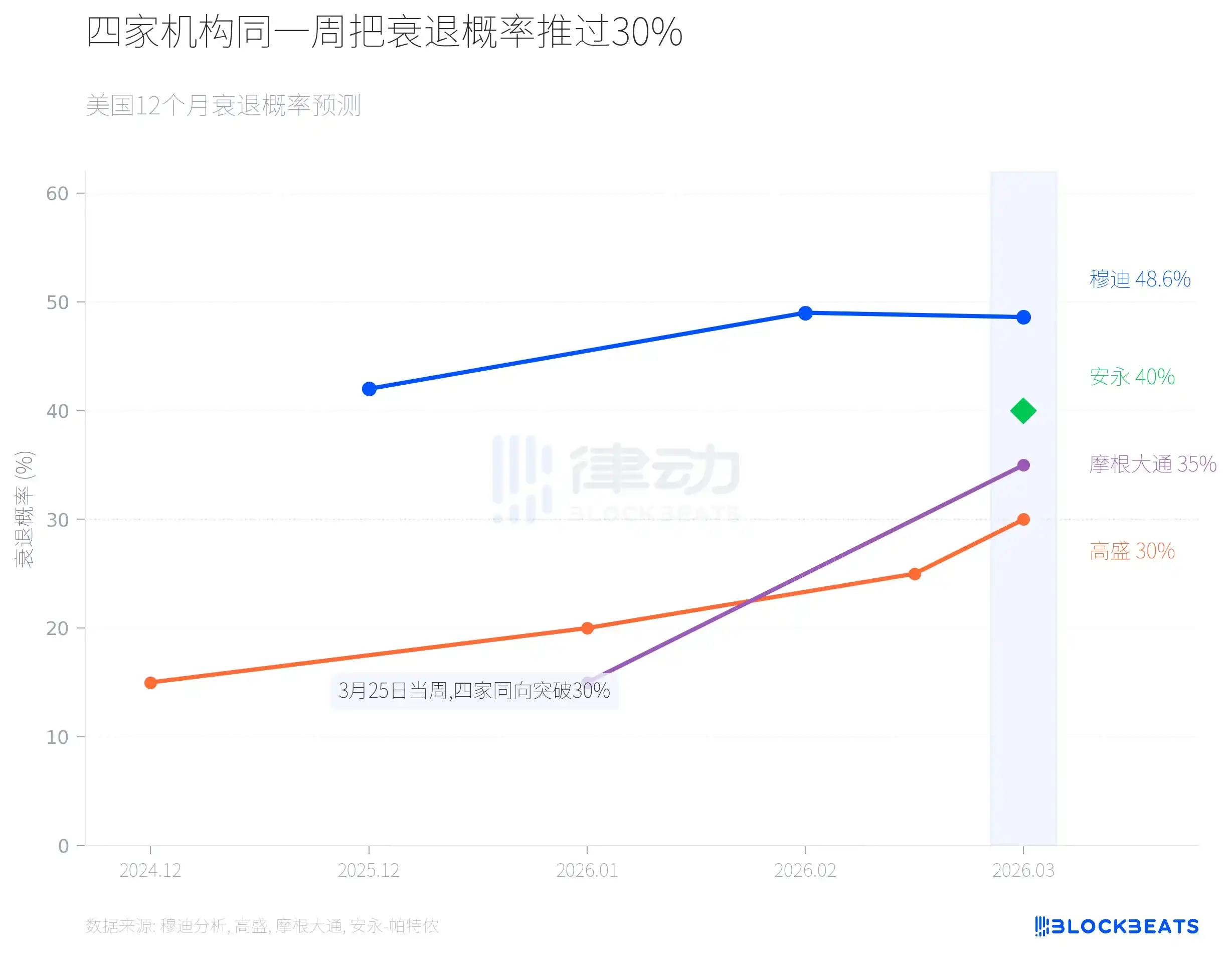
Goldman Sachs' trajectory is equally steep. According to the Fortune report, Goldman Sachs' prediction in December 2024 was 15%, slightly adjusted to 20% in January this year, raised to 25% on March 12, and reached 30% by March 25. A pace of doubling every two weeks is rare in Goldman Sachs' historical forecasts. Goldman Sachs also raised its PCE inflation forecast by 0.2 percentage points to 3.1%, lowered its full-year GDP growth forecast to 2.1%, and postponed its expectation for the first interest rate cut from June to September.
J.P. Morgan Global Research gave 35%. According to a CNBC report on March 19, J.P. Morgan economists simultaneously lowered their year-end target for the S&P 500 from 7500 points to 7200 points, with an extreme scenario possibly dropping to 6000 points.
EY-Parthenon was the last of the four to speak, but its 40% probability came with an interesting qualifier. According to a World Oil report on March 24, Gregory Daco, Chief Economist at EY-Parthenon, defined the current situation as a "multi-dimensional disturbance," reasoning that the impact is not limited to crude oil supply but also affects the refining system, LNG infrastructure, and fertilizer supply chains. This means that even if oil prices fall, inflationary pressures will not subside simultaneously.
Historical Win Rate of Oil Price Shocks
The core assumptions of the four institutions share a common variable: oil prices. Since the U.S.-Israel strike on Iran on February 28, Brent crude has climbed from about $70 per barrel, breaking through $100 on March 8 (the first time in four years), and touching $115 last week. As of March 25, it closed at $102.22.
According to the IEA's March report, the Strait of Hormuz previously saw about 20 million barrels of crude oil passing through daily, accounting for approximately 20% of global seaborne oil trade. After the conflict erupted, Gulf countries' crude oil production was cut by at least 10 million barrels per day. Zandi estimated in an interview with Fortune that about one-third of the global fertilizer supply also passes through this route.
Energy shocks of this magnitude have occurred four times in history.
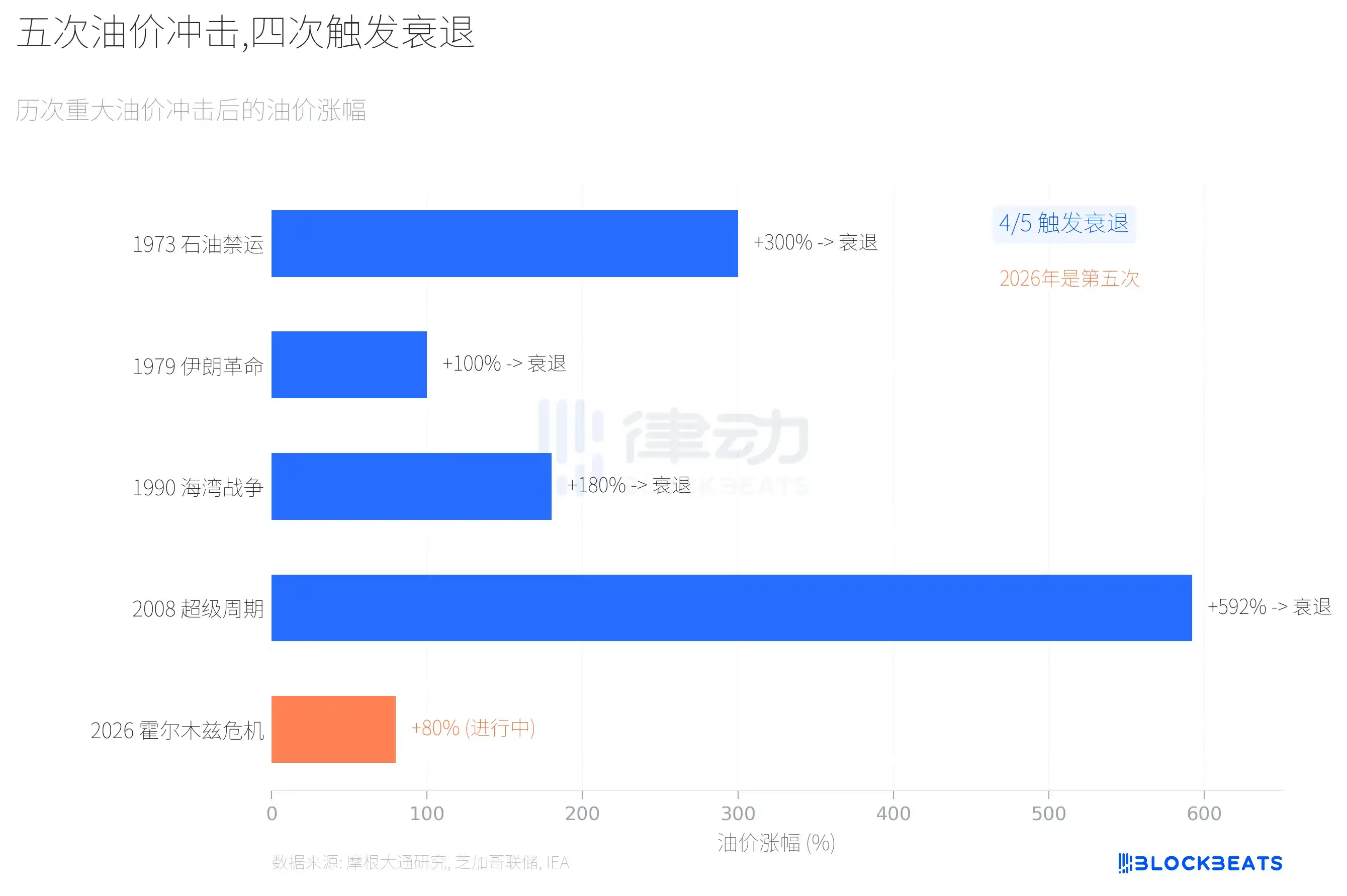
According to J.P. Morgan research, among the five major oil price shocks since the 1970s, four triggered recessions afterward. The 1973 Yom Kippur War caused oil prices to surge by 300%, and the U.S. entered a recession in November that year. The 1979 Iranian Revolution doubled oil prices, and a recession began in January 1980. The 1990 Gulf War pushed oil prices up by 180%, and the recession started almost simultaneously. The supercycle from 2002 to 2008 saw a cumulative oil price increase of 592%, ultimately ending with the global financial crisis.
The current increase from the 2026 Strait of Hormuz crisis is about 80%, the smallest among the five. But there is a key difference: the scale of this supply disruption is larger than any previous one. The IEA describes it as "the largest disturbance to energy supply since the 1970s energy crisis."
J.P. Morgan economists provided a quantitative estimate: every sustained 10% increase in oil prices drags U.S. GDP down by about 15 to 20 basis points.
Fink's Dichotomy
On March 25, Larry Fink, CEO of BlackRock, which manages over $10 trillion in assets, provided a more direct framework than numbers in an interview with the BBC.
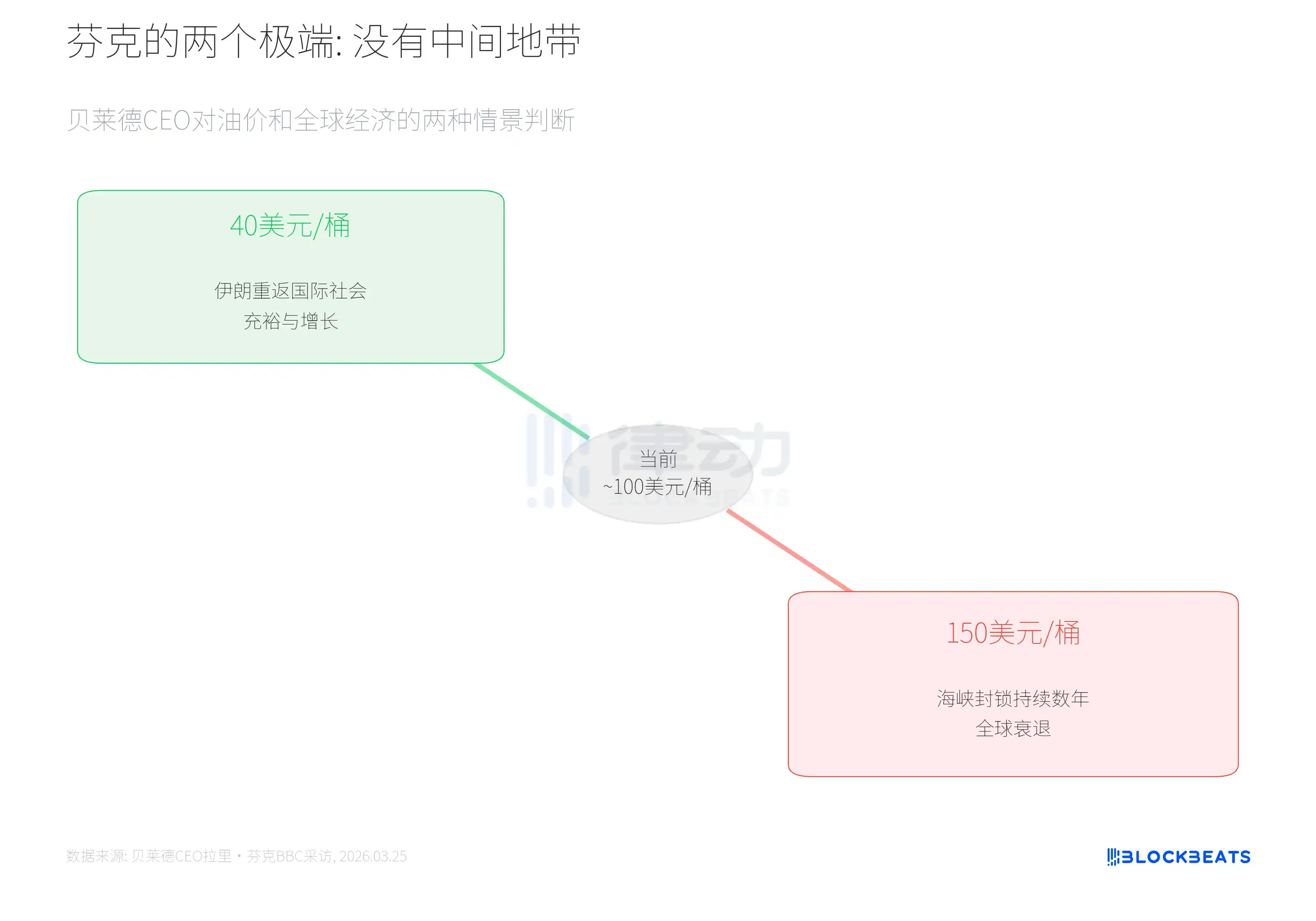
According to the Fortune report, Fink said: "There will be no middle ground; the outcome will definitely be one of two extremes."
The first scenario: Iran is accepted by the international community, re-engages in global trade, oil supply recovers, oil prices fall to $40 per barrel, and the world welcomes growth. The second scenario: the conflict continues, the strait remains blocked for years, oil prices stay above $100 or even approach $150, and the world enters a recession. Fink specifically pointed out that the ripple effects of high oil prices would extend to agricultural products and fertilizers, as these are byproducts of natural gas.
However, Fink also ruled out one possibility, clearly stating that there would not be a systemic financial crisis like 2008, as financial institutions' capital adequacy ratios are much higher now than back then.
Consensus Itself Is a Variable
Returning to the initial question. Moody's uses a machine learning model, Goldman Sachs uses a macroeconomic forecasting framework, J.P. Morgan tracks a five-factor indicator, and EY-Parthenon approaches from the supply chain dimension. Four different methodologies converged in the same direction in the same week.
According to the University of Michigan's March survey, the Consumer Confidence Index fell to 55.5, at the 2nd historical percentile. According to BLS data, U.S. nonfarm payrolls decreased by 92,000 in February, the opposite of the market expectation of an increase of 60,000. Leisure and hospitality lost 27,000, healthcare lost 28,000, manufacturing lost 12,000, and the federal government lost 10,000. According to BLS statistics, since the peak in October 2024, federal government employment has cumulatively shrunk by 330,000, a drop of 11%.
Zandi said in the interview that if oil prices average around $125 per barrel in the second quarter, "that would push us into a recession." At Brent's current level of about $102, it is $23 away from that line.
These four institutions' predictions may not be accurate. But when four institutions arrive at similar conclusions using different methods in the same week, its impact is more than just a probability number. Businesses may delay investment plans because of it, consumers may tighten their spending, and these behaviors themselves will, in turn, depress economic data, causing the numbers in the next round of predictions to continue rising.