Waiting for Conviction

insights.glassnodePubblicato 2026-02-25Pubblicato ultima volta 2026-02-25

Introduzione

Bitcoin remains in a fragile consolidation between $60k–$70k, showing signs of structural weakness despite finding temporary support. Nearly half of the circulating supply is held at a loss, indicating deep bear market conditions, though this often occurs in later stages of downturns. Large holders are not accumulating aggressively, and ETF flows have turned negative, reducing institutional support. Spot market selling is dominant, while derivatives have reset to neutral, shifting focus to spot demand. Options markets show defensive positioning with high demand for downside protection. A sustained recovery requires renewed institutional inflows, strong spot buying, and large-holder accumulation. Until then, the market remains vulnerable to further downside.

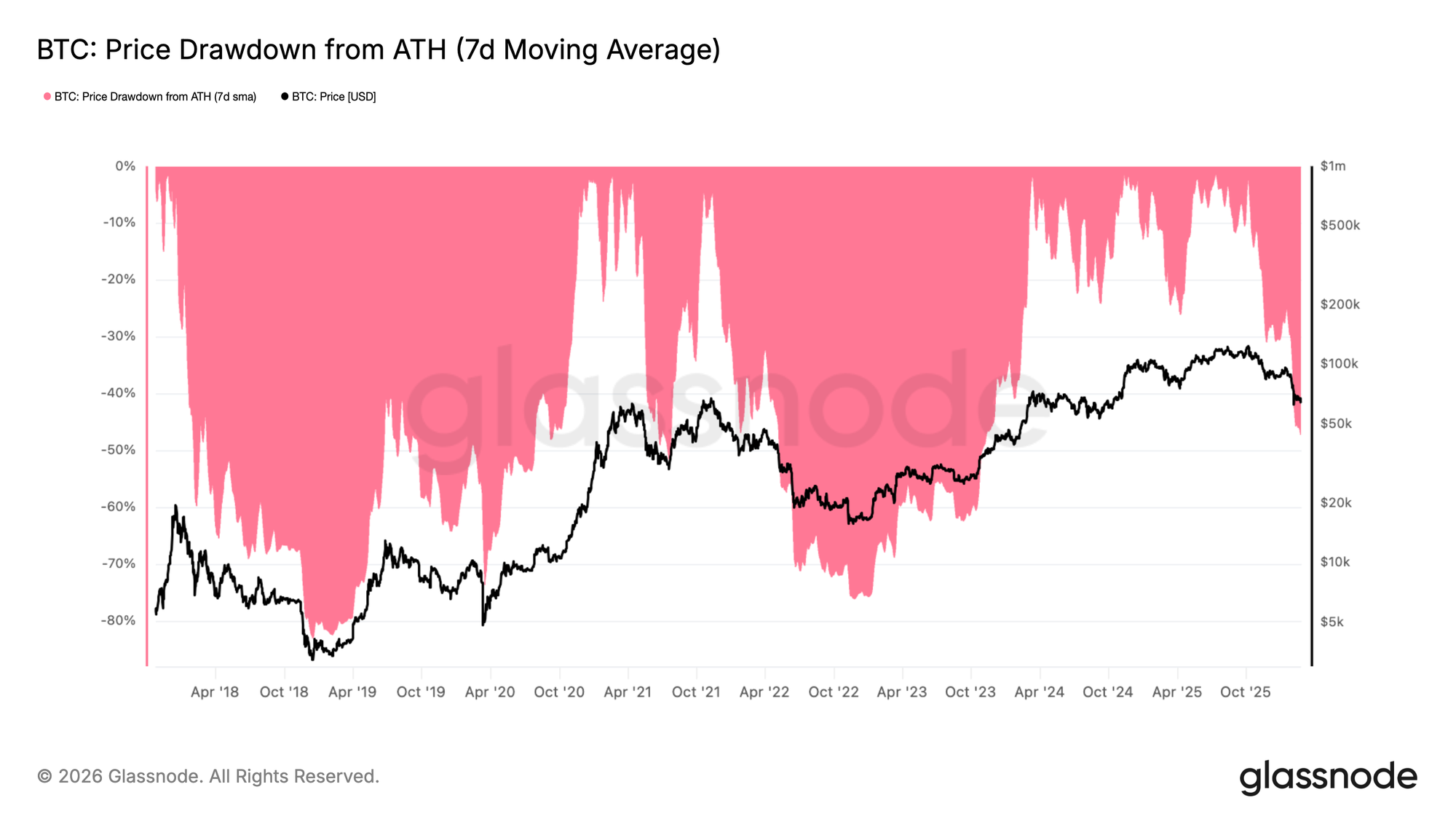
Since rebounding from the $60k region in early February, Bitcoin has entered a sideways consolidation phase. As outlined in Week 06 – Structural Weakness, this fragile range reflects a temporary equilibrium between seller exhaustion and localized support from long-term holders who accumulated within the same price band during H1 2024.

From a broader cyclical perspective, the 7-day moving average drawdown from the ATH currently sits at 47.3%, comparable to the early May 2022 range-bound phase that preceded further downside expansion. Historical analogues suggest that, at similar drawdown depths, time typically acts as a headwind rather than a tailwind for bullish continuation. Prolonged compression at these levels increases the probability that leveraged or structurally weak entities face mounting balance sheet stress.

Absent a decisive reclaim of higher price levels (>$70k) in the coming weeks, the risk of renewed contraction remains elevated.
Live Chart

Deep into Bear Market Territory

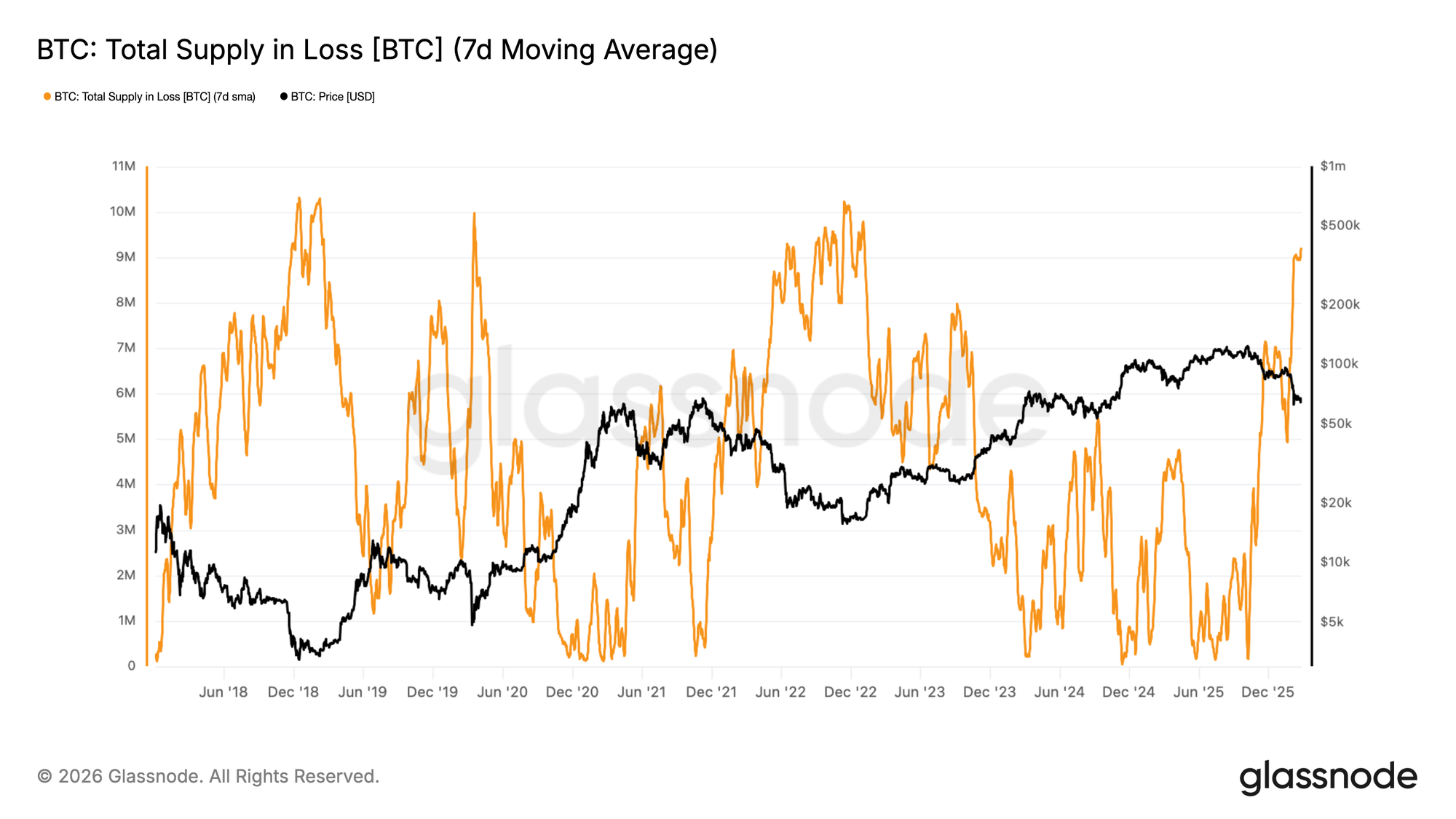
Extending this assessment of structural pressure, supply-side pain provides an additional lens into bear market depth. Total Supply in Loss measures the volume of coins whose acquisition price exceeds the current spot price, serving as a proxy for how widespread unrealized losses have become.

The 7-day moving average of this metric has risen to approximately 9.2M BTC underwater, indicating that nearly half of the circulating supply is now held at a loss. This aligns with prior bear market environments where drawdowns approached the 50% threshold and broad investor cohorts were under pressure.

While downside risk has not fully dissipated, such elevated levels of supply in loss historically characterize the latter stages of bear cycles rather than their early phase. In structural terms, the market appears closer to a potential bottoming range than to the initial onset of contraction, even as volatility and fragility persist.
Live Chart

Large Holders Remain Passive

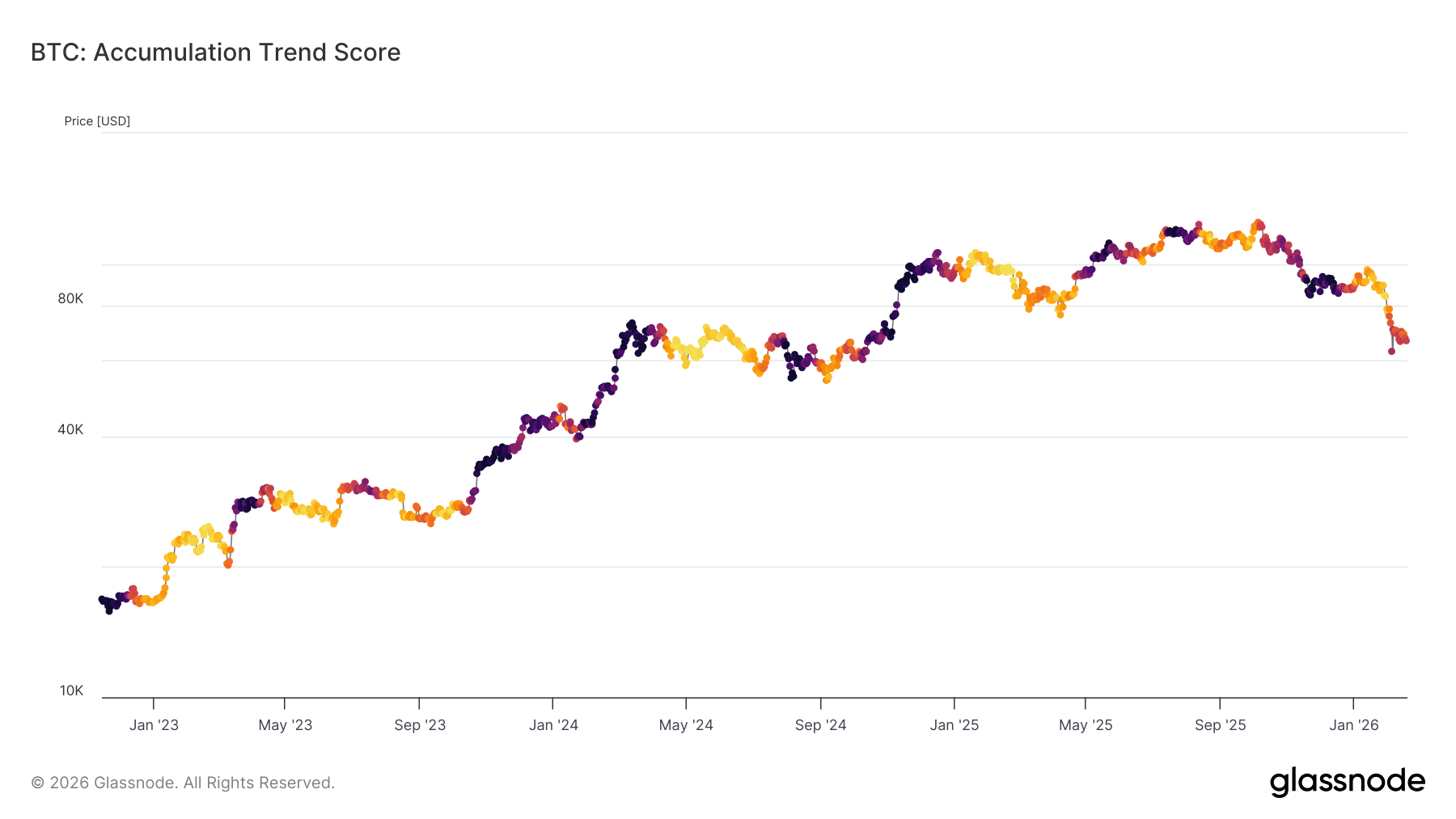
Against this backdrop of widespread unrealized losses, the sustainability of the current range hinges on renewed accumulation. Having traded largely between $60k and $70k throughout February, the direction of the eventual breakout will depend on the intensity of demand from new buyers.

The Accumulation Trend Score offers a useful gauge of this behavior, measuring relative balance changes across wallet cohorts while assigning greater weight to larger entities. Since February 5th, Accumulation Trend Score has remained capped below 0.5, signaling a lack of aggressive accumulation, particularly among large holders.

This subdued participation suggests that, despite elevated supply in loss, conviction-driven buying has yet to materialize. Until larger wallets shift toward sustained accumulation, the probability of further downside contraction remains elevated before a more durable bottoming structure can form.
Live Chart

Transition to Excess Loss

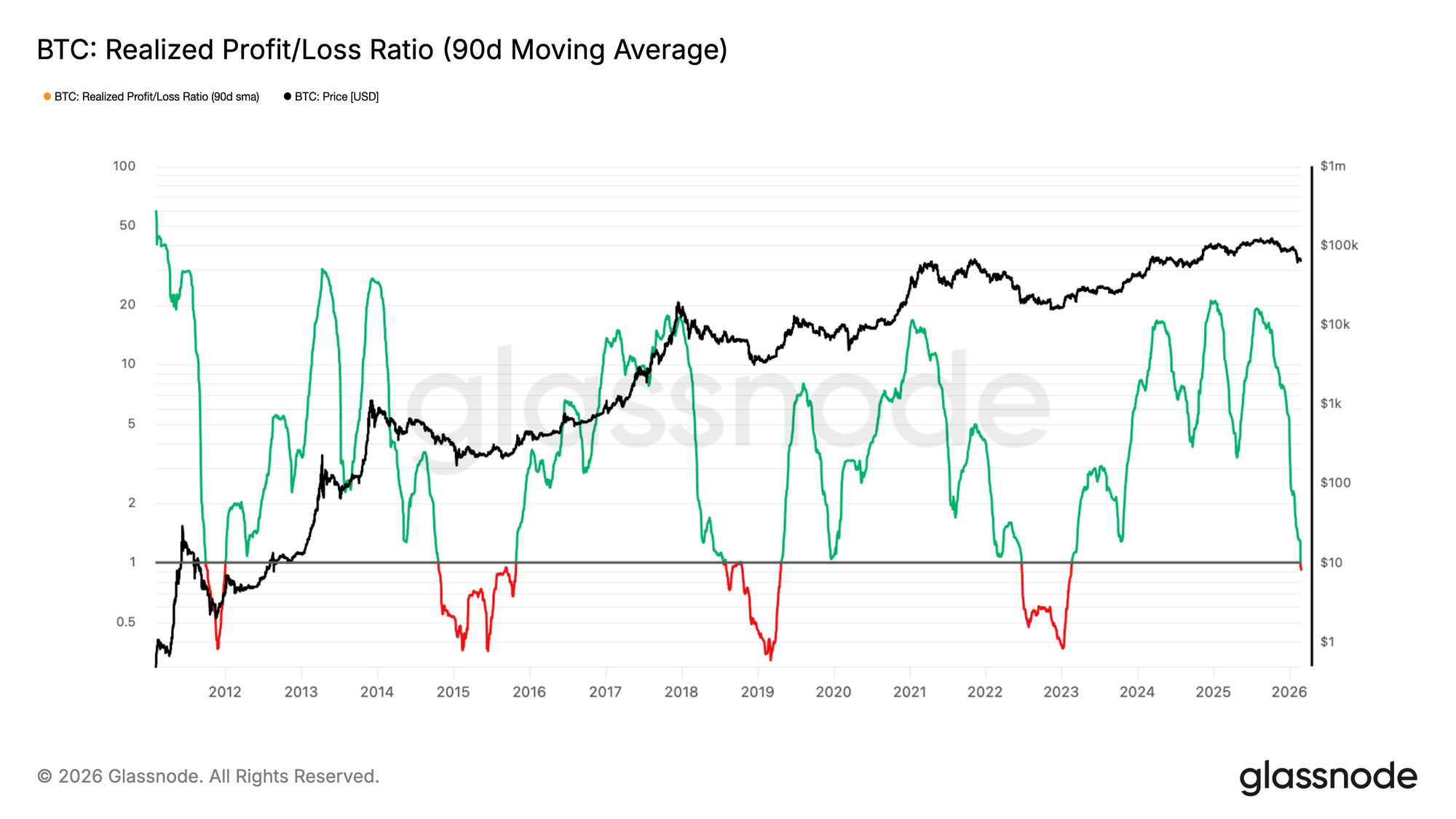
Reinforcing this muted accumulation backdrop, liquidity conditions have deteriorated further. The 90-day moving average of the Realized Profit/Loss Ratio, which compares the USD value of realized profits to realized losses, has now fallen below 1.0. This threshold is critical, as it marks the point where loss realization begins to dominate profit-taking, signaling a transition into an excess loss regime.

Historically, sustained breaks below 1.0 have persisted for six months or longer, reflecting prolonged periods of weak buy-side liquidity and constrained capital rotation. Only after a decisive reclaim of this level has the market typically entered a more constructive phase, characterized by renewed profitability and improving demand conditions.

Until the ratio stabilizes and trends back above 1, liquidity remains structurally impaired, limiting the probability of a durable recovery in the near term.
Live Chart

Off-Chain Insights

Spot CVD Bias Turns Sharply Negative

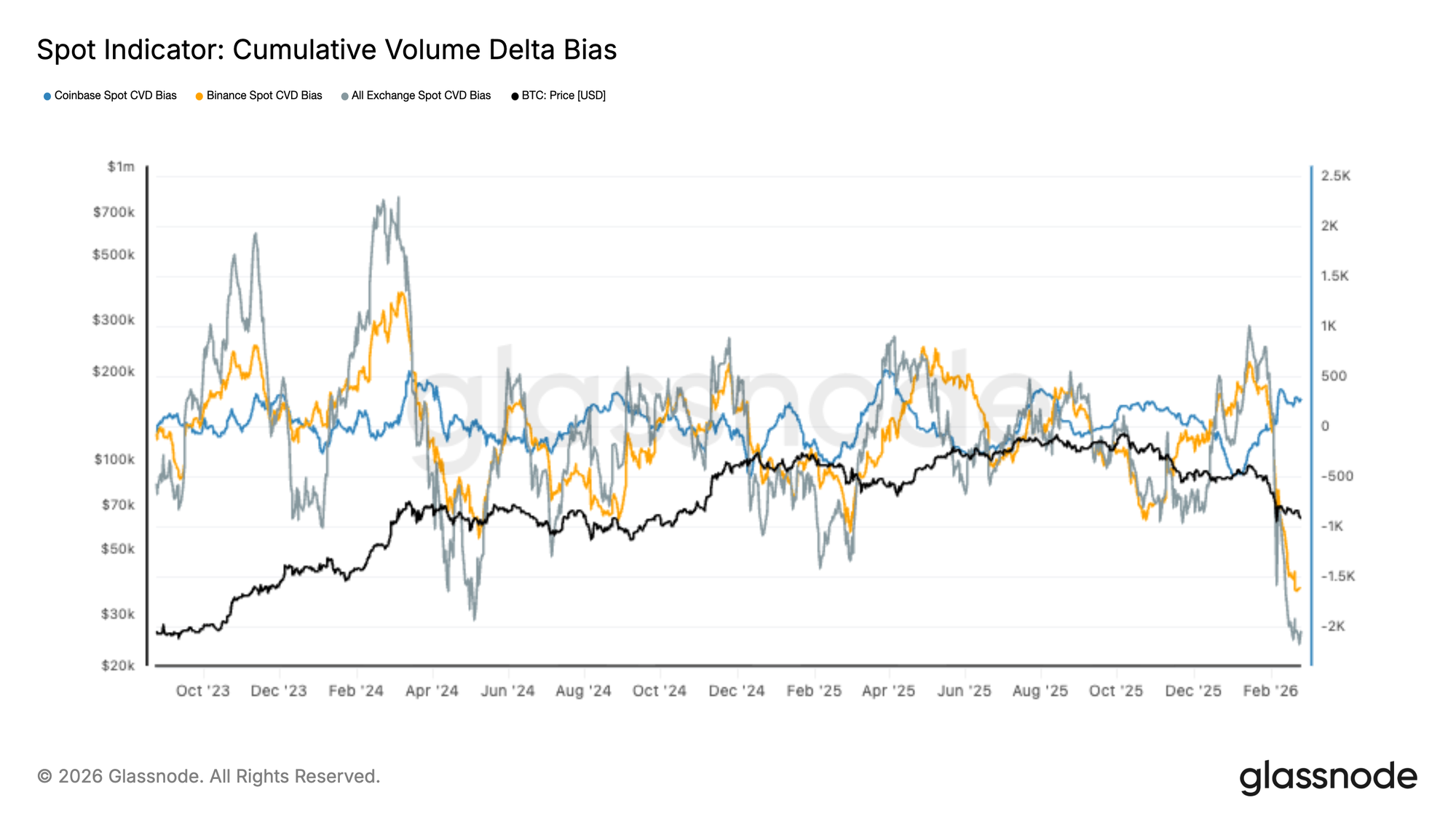
Spot markets have flipped decisively into sell-side dominance, with Cumulative Volume Delta (CVD) across all exchanges plunging to fresh cycle lows. Both Binance and aggregate spot flows show an aggressive wave of market sell orders, while Coinbase activity remains comparatively muted but unable to offset broader weakness.

The recent drawdown in price has coincided with one of the steepest negative CVD impulses of the past two years, suggesting the move lower is being driven by active distribution rather than passive liquidity gaps. Similar extremes in late 2023 and mid 2024 marked local exhaustion events, though follow-through depended on derivatives positioning and broader liquidity conditions.

With spot flows now deeply skewed to the sell side, the market appears reactive and fragile. Sustained recovery will likely require a clear shift back toward spot bid absorption, particularly across Binance and aggregate exchange flows, before constructive accumulation can be confirmed.
Live Chart

US Spot ETF Flows Extend Distribution Phase

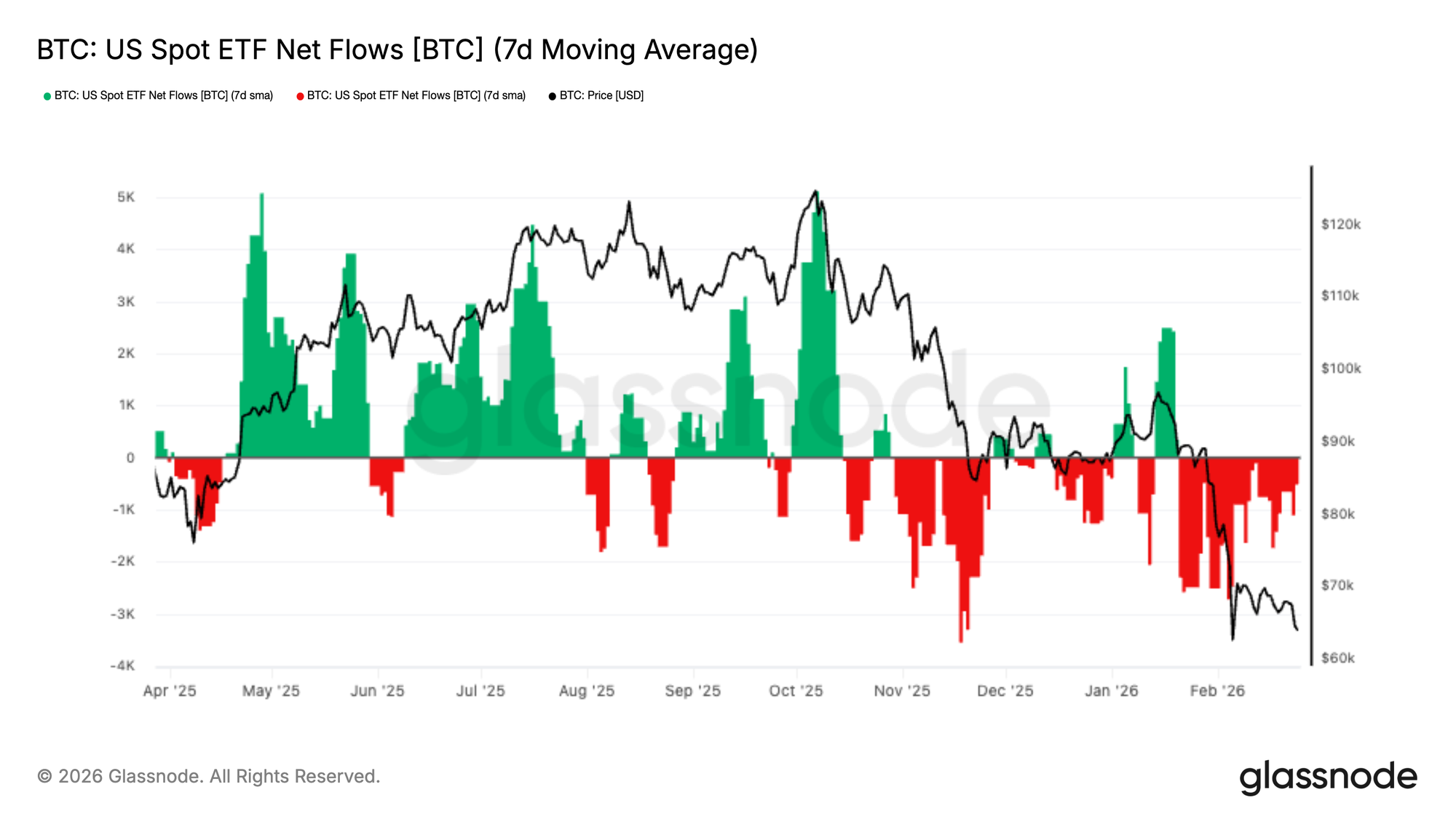
US Spot ETF flows have remained firmly in net outflow territory, with the 7-day moving average printing a persistent series of red bars since late November. Recent weeks have seen renewed acceleration in outflows, coinciding with BTC’s breakdown toward the $60k–$70k range.

Earlier in the cycle, strong inflow impulses consistently aligned with price expansions, particularly through May and October. In contrast, the current regime is characterized by sustained redemption pressure and a lack of meaningful bid support from ETF allocators.

This shift suggests institutional demand has cooled materially, removing a key structural tailwind that supported prior rallies. Until flows stabilize or return to sustained net inflows, price action is likely to remain reactive and vulnerable to further downside pressure.
Live Chart

Funding Rates Remain Neutral

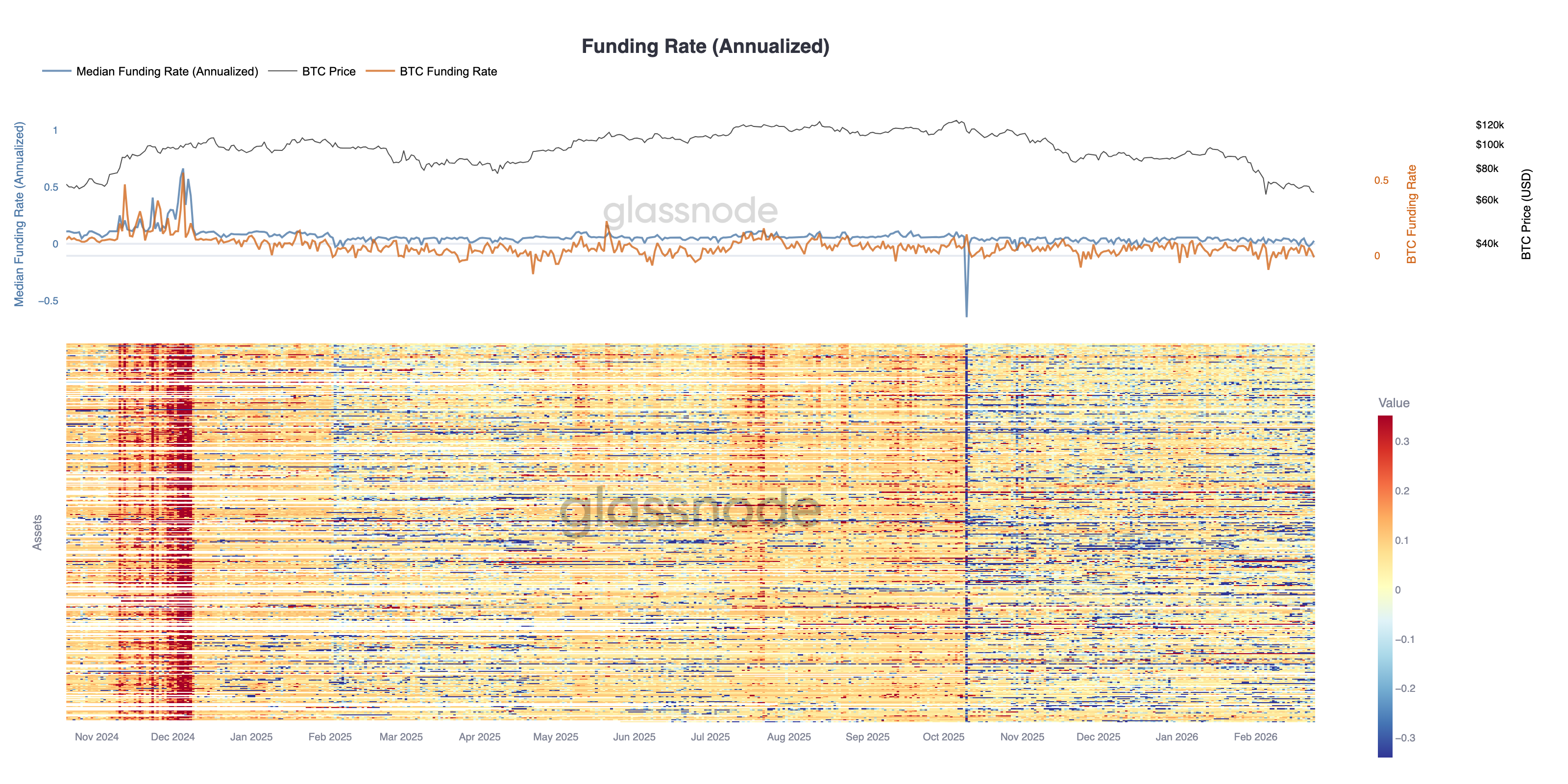
Perpetual futures funding has normalized materially, with the median annualized rate compressing back toward neutral after sustained positive readings through much of the prior rally. The recent price drawdown has coincided with a cooling in speculative positioning, as leveraged long exposure is gradually unwound.

The cross-asset heatmap highlights broad-based funding softness, with many instruments shifting from persistent positive prints to mixed or slightly negative territory. This stands in sharp contrast to late 2024, when elevated funding reflected crowded long positioning and aggressive directional conviction.

While the absence of extreme negative funding suggests limited panic-driven shorting, the lack of sustained positive prints also indicates muted risk appetite. Derivatives markets now appear more balanced, with leverage reduced and positioning less extended, leaving spot flows and structural demand as the key drivers for the next directional move.
Live Chart

Implied Volatility Reacts but Fails to Expand

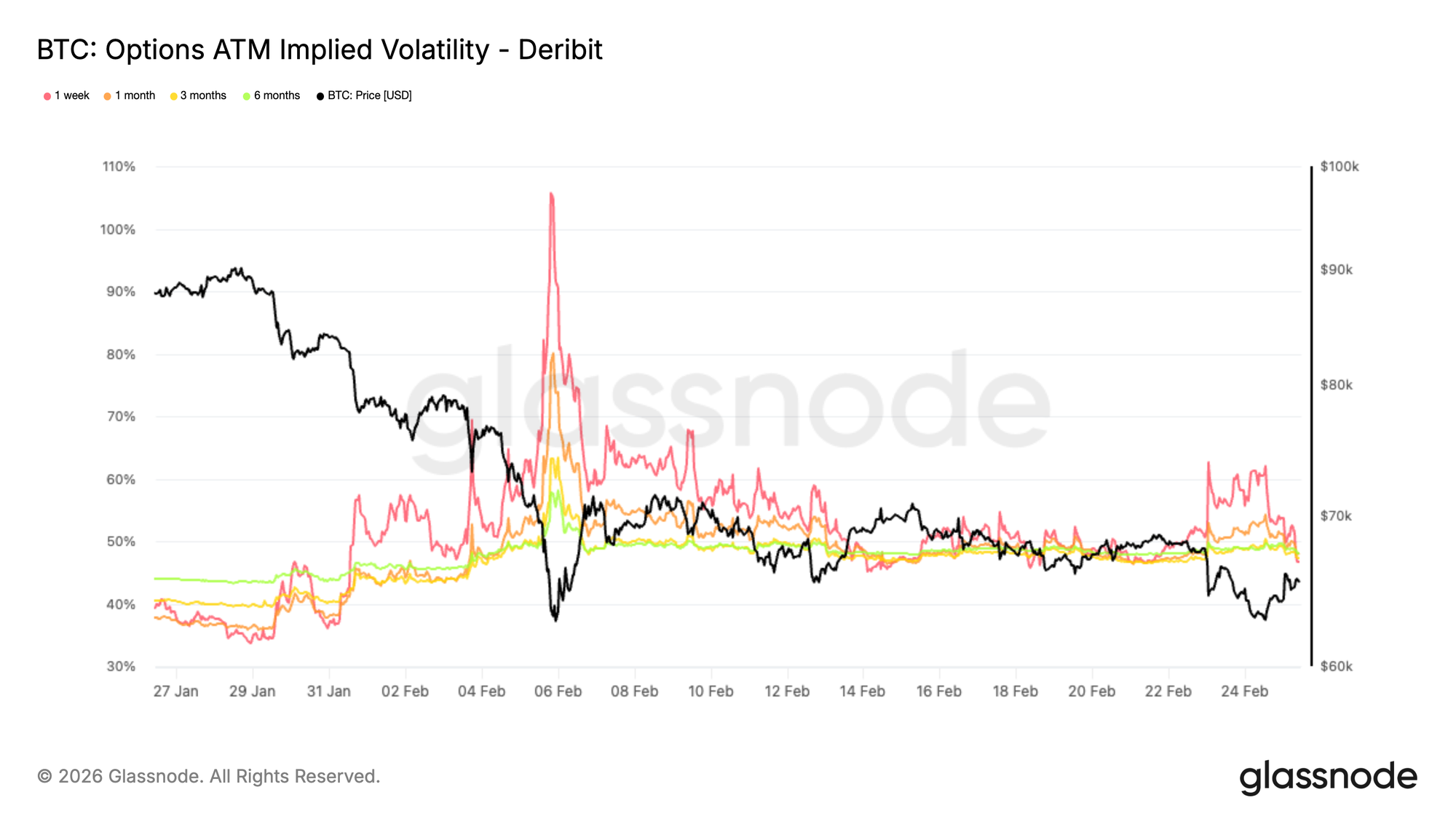
At the money implied volatility is elevated versus a month ago but not extreme, sitting around 47 percent across maturities.

In recent sessions, volatility briefly spiked as $BTC approached the 62K level, a zone that could have opened a move toward the high 50s if broken. One week ATM volatility jumped from 47 percent to 62 percent as traders rushed to hedge, recalling the sharp selloff earlier this month.

That repricing proved short lived. As price reclaimed 65K, one week volatility compressed back to 47 percent.

This rapid expansion and equally rapid compression highlights a highly reactive options market. Participants are quick to pay for short term protection near key levels, but just as quick to unwind it when the immediate threat fades.

The result is a mean reverting volatility backdrop, where fear spikes are not yet translating into sustained volatility expansion.
Live Chart

25 Delta Skew Signals Renewed Downside Fear

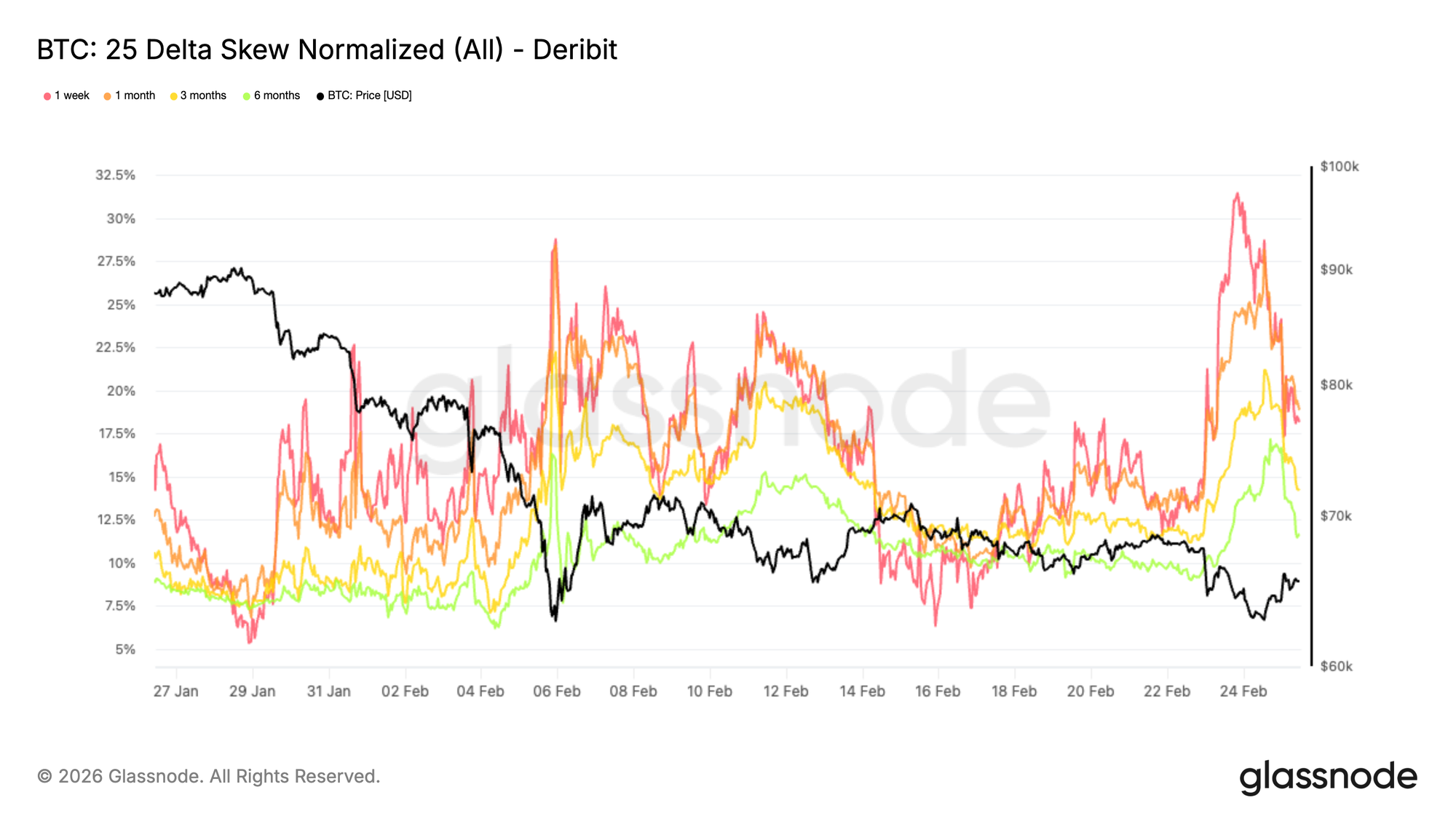
While implied volatility has remained contained overall, 25 delta skew tells a more defensive story. This metric measures the price difference between downside puts and upside calls, highlighting whether protection or upside exposure is in greater demand.

Skew has once again reached extreme asymmetry, approaching levels last seen on February 5 during the sharp drop toward 60K. At that time, the speed and amplitude of the move caught traders off guard, triggering late stage hedging and pushing puts to trade at a 28 percent premium over calls.

In recent sessions, put skew has climbed toward 30 percent. Each test of the lower end of the range has revived demand for protection, with participants using rebounds to rebuild downside hedges.

This persistent richness in puts reflects a market willing to pay up for insurance, reinforcing a clearly defensive positioning bias.
Live Chart

Options Gamma Exposure Remains Net Short

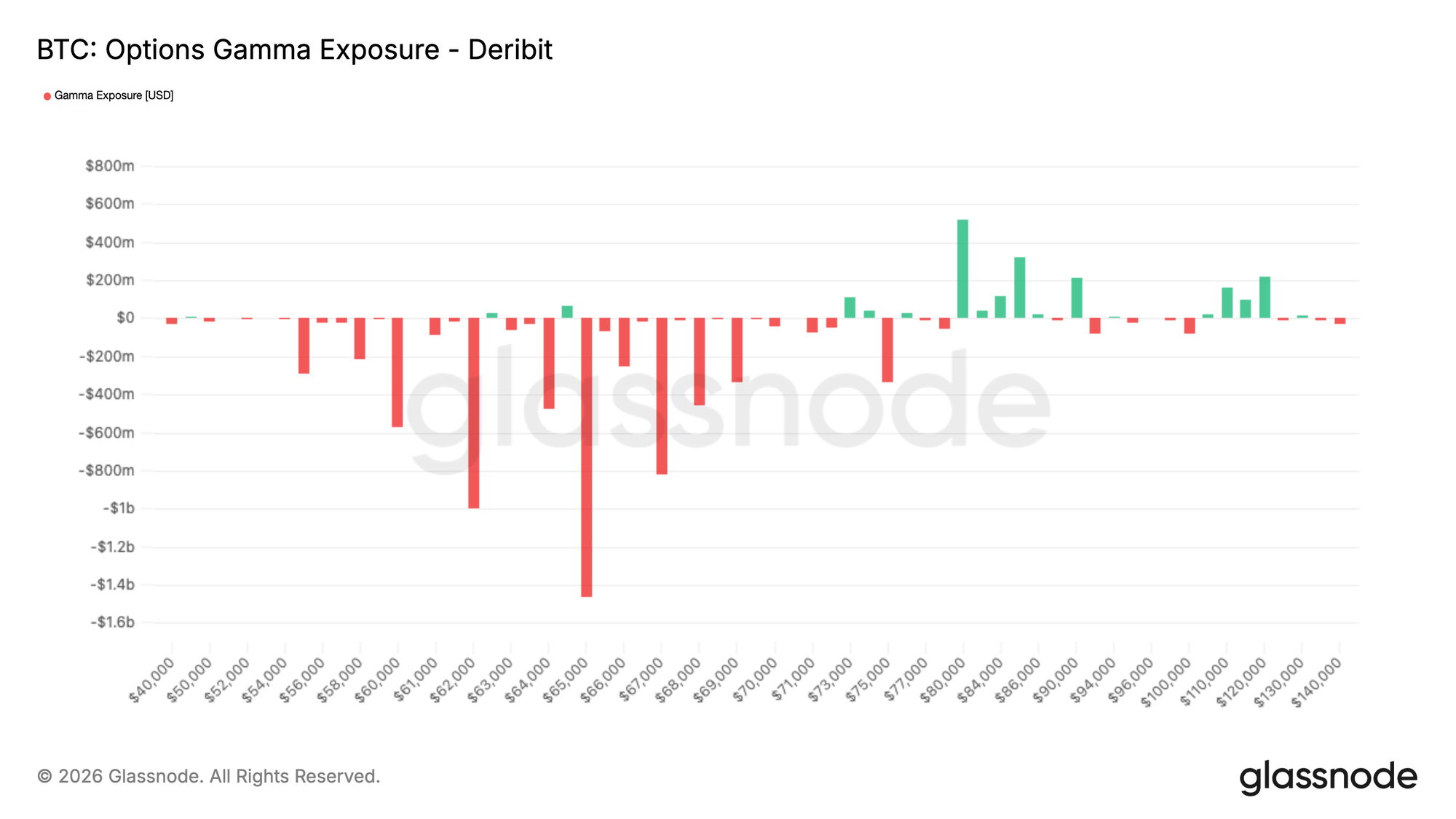
That persistent demand for protection is mirrored in current gamma positioning. Across expiries, the market sits inside a broad short gamma corridor between 70K and 55K, leaving the structure inherently fragile within this range.

The 65K strike stands out, with roughly 1.5 billion dollars of negative dealer gamma concentrated there. This pocket expires entirely this Friday, making it especially relevant in the short term. A move lower into expiry could trigger accelerated hedging flows as dealers sell futures to remain delta neutral. At the same time, once expiry passes, those hedges are unwound. Dealers would buy back futures, which can mechanically ease pressure and create temporary relief.

Further out, end of March expiries carry roughly 650 million dollars of negative gamma at 62K and 830 million dollars at 60K, extending structural sensitivity over the coming weeks.

Short gamma does not determine direction, but it increases the likelihood that moves, once underway, become sharper and more self reinforcing.
Live Chart

GEX Heatmap Highlights Structural Regime Shifts

While current positioning shows a net short gamma environment, the GEX Heatmap helps place this in a broader structural context.

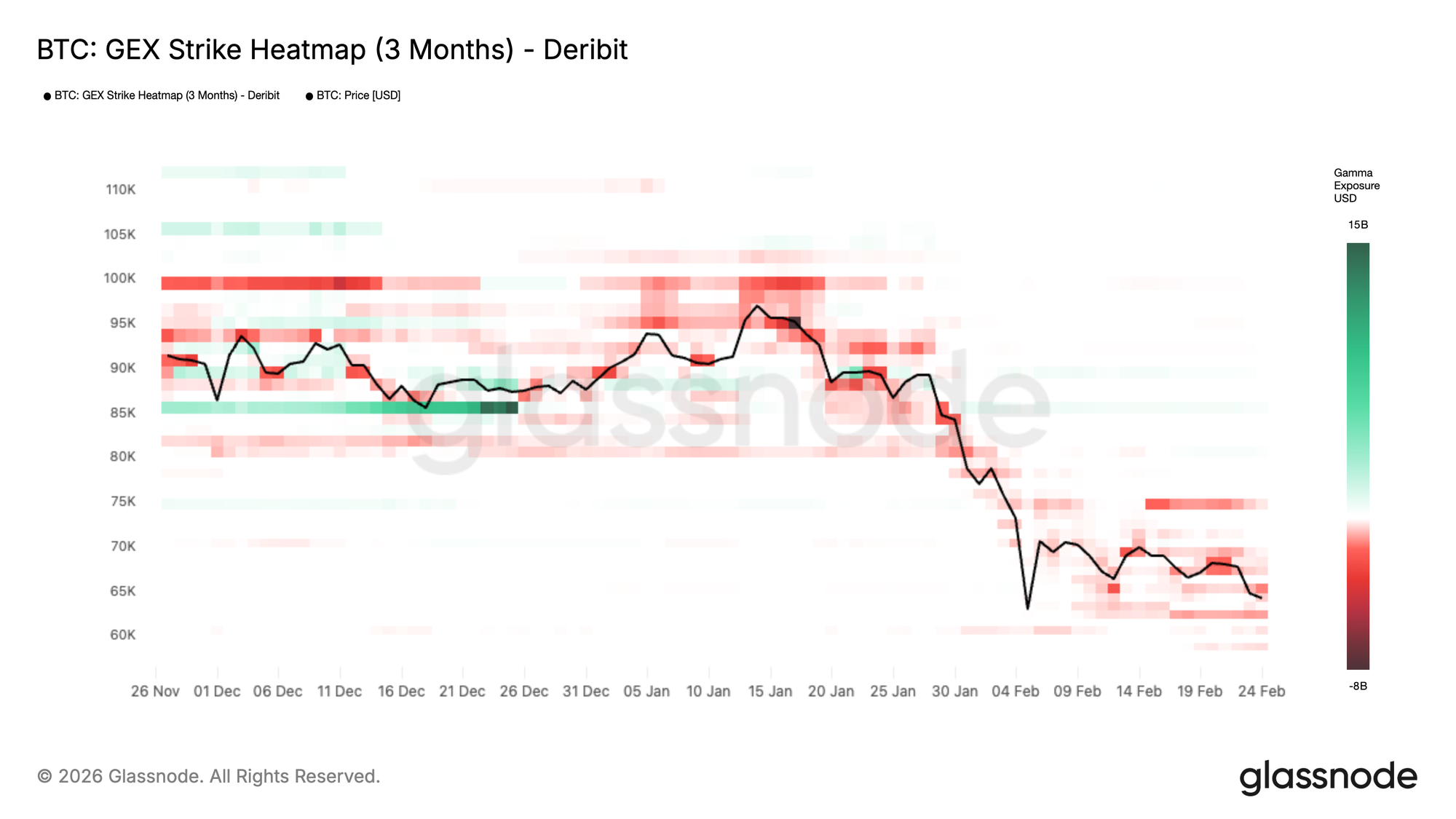
This chart tracks how dealer gamma exposure has evolved over the past three months, highlighting zones where volatility is mechanically suppressed or amplified.

In December, clear positive gamma bands appeared around 85K, shown in green. These acted as classic gamma walls. Dealers were structurally long gamma, incentivized to sell strength and buy weakness. That flow dampened volatility and helped anchor price within a tight range. The wall did not break. It simply rolled off as year end options expired, removing the stabilizing effect and allowing the structure to reset.

More recently, the heatmap shifted toward deeper red bands during the January to February decline. Expanding negative gamma around and below spot signaled a regime where dealer hedging reinforced the move, allowing volatility to expand and momentum to accelerate.
Live Chart

Conclusion

Bitcoin remains in a structurally defensive consolidation phase. While price continues to find support within the $60k–$69k demand zone, on-chain profit compression, weak breadth, and moderated large-holder accumulation highlight fragile conviction beneath the surface.

Spot sell pressure and sustained ETF outflows confirm that structural demand remains constrained, even as derivatives positioning has reset and panic hedging has faded. The market is stabilizing, but not yet strengthening.

For a durable upside recovery to emerge, renewed spot absorption, sustained large-entity accumulation, and a clear shift in institutional flows will be required. Until then, range-bound price action between key valuation anchors remains the dominant structural theme.


Disclaimer: This report does not provide any investment advice. All data is provided for informational and educational purposes only. No investment decision shall be based on the information provided here, and you are solely responsible for your own investment decisions.

Exchange balances presented are derived from Glassnode’s comprehensive database of address labels, which are amassed through both officially published exchange information and proprietary clustering algorithms. While we strive to ensure the utmost accuracy in representing exchange balances, it is important to note that these figures might not always encapsulate the entirety of an exchange’s reserves, particularly when exchanges refrain from disclosing their official addresses. We urge users to exercise caution and discretion when utilizing these metrics. Glassnode shall not be held responsible for any discrepancies or potential inaccuracies.

Please read our Transparency Notice when using exchange data.

Domande pertinenti

QWhat is the current state of Bitcoin's price action and what does the consolidation phase indicate?

ABitcoin is in a sideways consolidation phase between $60k and $70k, reflecting a fragile equilibrium between seller exhaustion and support from long-term holders. This prolonged compression increases the risk of balance sheet stress for leveraged entities and suggests a high risk of renewed contraction if higher price levels (>$70k) are not reclaimed.

QHow does the 'Total Supply in Loss' metric characterize the current bear market, and what stage does it suggest the market is in?

AThe 'Total Supply in Loss' metric shows approximately 9.2M BTC (nearly half the circulating supply) is held at a loss. Historically, such elevated levels are characteristic of the latter stages of a bear cycle, suggesting the market is closer to a potential bottoming range rather than the early phase of contraction.

QWhat does the Accumulation Trend Score reveal about the behavior of large holders, and why is it significant?

AThe Accumulation Trend Score has remained below 0.5 since February 5th, indicating a lack of aggressive accumulation, particularly among large holders. This subdued participation shows conviction-driven buying has not materialized, elevating the probability of further downside before a durable bottom can form.

QWhat is the significance of the Realized Profit/Loss Ratio falling below 1.0, and what does it imply for market liquidity?

AThe Realized Profit/Loss Ratio falling below 1.0 marks a transition into an excess loss regime, where loss realization dominates profit-taking. This signals structurally impaired liquidity, typically persisting for six months or longer, and limits the probability of a durable near-term recovery until the ratio stabilizes above 1.0.

QHow have US Spot ETF flows and spot market dynamics (CVD) contributed to the current market weakness?

AUS Spot ETF flows have seen sustained net outflows since late November, removing a key institutional demand tailwind. Spot Cumulative Volume Delta (CVD) has plunged to cycle lows, showing aggressive sell-side dominance. This indicates the downturn is driven by active distribution, and recovery requires a shift back to spot bid absorption and sustained ETF inflows.

Letture associate

The Second Half of Macro Influencer Fu Peng's Career

Fu Peng, a prominent Chinese macroeconomist and former chief economist of Northeast Securities, has joined Hong Kong-based digital asset management firm Bitfire Group (formerly New Huo Group) as its chief economist. This move, announced in April 2026, triggered an 11% surge in Bitfire's stock price. Fu, known for his accessible macroeconomic commentary and large social media following, will focus on integrating digital assets into global asset allocation frameworks, particularly combining FICC (fixed income, currencies, and commodities) with cryptocurrencies for institutional clients. His career includes roles at Lehman Brothers and Solomon International, with significant influence gained through public communication. However, in late 2024, Fu faced temporary social media bans after a controversial private speech at HSBC on China's economic challenges, though he denied regulatory sanctions. He later left Northeast Securities citing health reasons. Bitfire, a licensed virtual asset manager serving high-net-worth clients, seeks to build trust and attract traditional capital through Fu’s expertise and credibility. The partnership represents a strategic shift for both: Fu enters the crypto sector after a traditional finance peak, while Bitfire aims to leverage his macro framework for institutional adoption. Outcomes remain uncertain regarding capital inflows and compatibility within corporate structure.

marsbit49 min fa

The Second Half of Macro Influencer Fu Peng's Career

marsbit49 min fa

Trading

Spot
Futures

Articoli Popolari

Cosa è $S$

Comprendere SPERO: Una Panoramica Completa Introduzione a SPERO Mentre il panorama dell'innovazione continua a evolversi, l'emergere delle tecnologie web3 e dei progetti di criptovaluta gioca un ruolo fondamentale nel plasmare il futuro digitale. Un progetto che ha attirato l'attenzione in questo campo dinamico è SPERO, denotato come SPERO,$$s$. Questo articolo mira a raccogliere e presentare informazioni dettagliate su SPERO, per aiutare gli appassionati e gli investitori a comprendere le sue basi, obiettivi e innovazioni nei domini web3 e crypto. Che cos'è SPERO,$$s$? SPERO,$$s$ è un progetto unico all'interno dello spazio crypto che cerca di sfruttare i principi della decentralizzazione e della tecnologia blockchain per creare un ecosistema che promuove l'impegno, l'utilità e l'inclusione finanziaria. Il progetto è progettato per facilitare interazioni peer-to-peer in modi nuovi, fornendo agli utenti soluzioni e servizi finanziari innovativi. Al suo interno, SPERO,$$s$ mira a responsabilizzare gli individui fornendo strumenti e piattaforme che migliorano l'esperienza dell'utente nello spazio delle criptovalute. Questo include la possibilità di metodi di transazione più flessibili, la promozione di iniziative guidate dalla comunità e la creazione di percorsi per opportunità finanziarie attraverso applicazioni decentralizzate (dApps). La visione sottostante di SPERO,$$s$ ruota attorno all'inclusività, cercando di colmare le lacune all'interno della finanza tradizionale mentre sfrutta i vantaggi della tecnologia blockchain. Chi è il Creatore di SPERO,$$s$? L'identità del creatore di SPERO,$$s$ rimane piuttosto oscura, poiché ci sono risorse pubblicamente disponibili limitate che forniscono informazioni dettagliate sul suo fondatore o fondatori. Questa mancanza di trasparenza può derivare dall'impegno del progetto per la decentralizzazione—un ethos che molti progetti web3 condividono, dando priorità ai contributi collettivi rispetto al riconoscimento individuale. Centrando le discussioni attorno alla comunità e ai suoi obiettivi collettivi, SPERO,$$s$ incarna l'essenza dell'empowerment senza mettere in evidenza individui specifici. Pertanto, comprendere l'etica e la missione di SPERO rimane più importante che identificare un creatore singolo. Chi sono gli Investitori di SPERO,$$s$? SPERO,$$s$ è supportato da una varietà di investitori che vanno dai capitalisti di rischio agli investitori angelici dedicati a promuovere l'innovazione nel settore crypto. Il focus di questi investitori generalmente si allinea con la missione di SPERO—dando priorità a progetti che promettono avanzamenti tecnologici sociali, inclusività finanziaria e governance decentralizzata. Queste fondazioni di investitori sono tipicamente interessate a progetti che non solo offrono prodotti innovativi, ma contribuiscono anche positivamente alla comunità blockchain e ai suoi ecosistemi. Il supporto di questi investitori rafforza SPERO,$$s$ come un concorrente degno di nota nel dominio in rapida evoluzione dei progetti crypto. Come Funziona SPERO,$$s$? SPERO,$$s$ impiega un framework multifunzionale che lo distingue dai progetti di criptovaluta convenzionali. Ecco alcune delle caratteristiche chiave che sottolineano la sua unicità e innovazione: Governance Decentralizzata: SPERO,$$s$ integra modelli di governance decentralizzati, responsabilizzando gli utenti a partecipare attivamente ai processi decisionali riguardanti il futuro del progetto. Questo approccio favorisce un senso di proprietà e responsabilità tra i membri della comunità. Utilità del Token: SPERO,$$s$ utilizza il proprio token di criptovaluta, progettato per servire varie funzioni all'interno dell'ecosistema. Questi token abilitano transazioni, premi e la facilitazione dei servizi offerti sulla piattaforma, migliorando l'impegno e l'utilità complessivi. Architettura Stratificata: L'architettura tecnica di SPERO,$$s$ supporta la modularità e la scalabilità, consentendo un'integrazione fluida di funzionalità e applicazioni aggiuntive man mano che il progetto evolve. Questa adattabilità è fondamentale per mantenere la rilevanza nel panorama crypto in continua evoluzione. Coinvolgimento della Comunità: Il progetto enfatizza iniziative guidate dalla comunità, impiegando meccanismi che incentivano la collaborazione e il feedback. Nutrendo una comunità forte, SPERO,$$s$ può affrontare meglio le esigenze degli utenti e adattarsi alle tendenze di mercato. Focus sull'Inclusione: Offrendo basse commissioni di transazione e interfacce user-friendly, SPERO,$$s$ mira ad attrarre una base utenti diversificata, inclusi individui che potrebbero non aver precedentemente interagito nello spazio crypto. Questo impegno per l'inclusione si allinea con la sua missione generale di empowerment attraverso l'accessibilità. Cronologia di SPERO,$$s$ Comprendere la storia di un progetto fornisce preziose intuizioni sulla sua traiettoria di sviluppo e sui traguardi. Di seguito è riportata una cronologia suggerita che mappa eventi significativi nell'evoluzione di SPERO,$$s$: Fase di Concettualizzazione e Ideazione: Le idee iniziali che formano la base di SPERO,$$s$ sono state concepite, allineandosi strettamente con i principi di decentralizzazione e focus sulla comunità all'interno dell'industria blockchain. Lancio del Whitepaper del Progetto: Dopo la fase concettuale, è stato rilasciato un whitepaper completo che dettaglia la visione, gli obiettivi e l'infrastruttura tecnologica di SPERO,$$s$ per suscitare interesse e feedback dalla comunità. Costruzione della Comunità e Prime Interazioni: Sono stati effettuati sforzi attivi di outreach per costruire una comunità di early adopters e potenziali investitori, facilitando discussioni attorno agli obiettivi del progetto e ottenendo supporto. Evento di Generazione del Token: SPERO,$$s$ ha condotto un evento di generazione del token (TGE) per distribuire i propri token nativi ai primi sostenitori e stabilire una liquidità iniziale all'interno dell'ecosistema. Lancio della Prima dApp: La prima applicazione decentralizzata (dApp) associata a SPERO,$$s$ è stata attivata, consentendo agli utenti di interagire con le funzionalità principali della piattaforma. Sviluppo Continuo e Partnership: Aggiornamenti e miglioramenti continui alle offerte del progetto, inclusi partnership strategiche con altri attori nello spazio blockchain, hanno plasmato SPERO,$$s$ in un concorrente competitivo e in evoluzione nel mercato crypto. Conclusione SPERO,$$s$ rappresenta una testimonianza del potenziale del web3 e delle criptovalute di rivoluzionare i sistemi finanziari e responsabilizzare gli individui. Con un impegno per la governance decentralizzata, il coinvolgimento della comunità e funzionalità progettate in modo innovativo, apre la strada verso un panorama finanziario più inclusivo. Come per qualsiasi investimento nello spazio crypto in rapida evoluzione, si incoraggiano potenziali investitori e utenti a ricercare approfonditamente e a impegnarsi in modo riflessivo con gli sviluppi in corso all'interno di SPERO,$$s$. Il progetto mostra lo spirito innovativo dell'industria crypto, invitando a ulteriori esplorazioni delle sue innumerevoli possibilità. Mentre il percorso di SPERO,$$s$ è ancora in fase di sviluppo, i suoi principi fondamentali potrebbero effettivamente influenzare il futuro di come interagiamo con la tecnologia, la finanza e tra di noi in ecosistemi digitali interconnessi.

75 Totale visualizzazioniPubblicato il 2024.12.17Aggiornato il 2024.12.17

Cosa è $S$

Cosa è AGENT S

Agent S: Il Futuro dell'Interazione Autonoma in Web3 Introduzione Nel panorama in continua evoluzione di Web3 e criptovalute, le innovazioni stanno costantemente ridefinendo il modo in cui gli individui interagiscono con le piattaforme digitali. Uno di questi progetti pionieristici, Agent S, promette di rivoluzionare l'interazione uomo-computer attraverso il suo framework agentico aperto. Aprendo la strada a interazioni autonome, Agent S mira a semplificare compiti complessi, offrendo applicazioni trasformative nell'intelligenza artificiale (AI). Questa esplorazione dettagliata approfondirà le complessità del progetto, le sue caratteristiche uniche e le implicazioni per il dominio delle criptovalute. Cos'è Agent S? Agent S si presenta come un innovativo framework agentico aperto, progettato specificamente per affrontare tre sfide fondamentali nell'automazione dei compiti informatici: Acquisizione di Conoscenze Specifiche del Dominio: Il framework apprende in modo intelligente da varie fonti di conoscenza esterne ed esperienze interne. Questo approccio duale gli consente di costruire un ricco repository di conoscenze specifiche del dominio, migliorando le sue prestazioni nell'esecuzione dei compiti. Pianificazione su Lungo Orizzonte di Compiti: Agent S impiega una pianificazione gerarchica potenziata dall'esperienza, un approccio strategico che facilita la suddivisione e l'esecuzione efficiente di compiti complessi. Questa caratteristica migliora significativamente la sua capacità di gestire più sottocompiti in modo efficiente ed efficace. Gestione di Interfacce Dinamiche e Non Uniformi: Il progetto introduce l'Interfaccia Agente-Computer (ACI), una soluzione innovativa che migliora l'interazione tra agenti e utenti. Utilizzando Modelli Linguistici Multimodali di Grandi Dimensioni (MLLM), Agent S può navigare e manipolare senza sforzo diverse interfacce grafiche utente. Attraverso queste caratteristiche pionieristiche, Agent S fornisce un framework robusto che affronta le complessità coinvolte nell'automazione dell'interazione umana con le macchine, preparando il terreno per innumerevoli applicazioni nell'AI e oltre. Chi è il Creatore di Agent S? Sebbene il concetto di Agent S sia fondamentalmente innovativo, informazioni specifiche sul suo creatore rimangono elusive. Il creatore è attualmente sconosciuto, il che evidenzia sia la fase embrionale del progetto sia la scelta strategica di mantenere i membri fondatori sotto anonimato. Indipendentemente dall'anonimato, l'attenzione rimane sulle capacità e sul potenziale del framework. Chi sono gli Investitori di Agent S? Poiché Agent S è relativamente nuovo nell'ecosistema crittografico, informazioni dettagliate riguardanti i suoi investitori e sostenitori finanziari non sono documentate esplicitamente. La mancanza di approfondimenti pubblicamente disponibili sulle fondazioni di investimento o sulle organizzazioni che supportano il progetto solleva interrogativi sulla sua struttura di finanziamento e sulla roadmap di sviluppo. Comprendere il supporto è cruciale per valutare la sostenibilità del progetto e il suo potenziale impatto sul mercato. Come Funziona Agent S? Al centro di Agent S si trova una tecnologia all'avanguardia che gli consente di funzionare efficacemente in contesti diversi. Il suo modello operativo è costruito attorno a diverse caratteristiche chiave: Interazione Uomo-Computer Simile a Quella Umana: Il framework offre una pianificazione AI avanzata, cercando di rendere le interazioni con i computer più intuitive. Mimando il comportamento umano nell'esecuzione dei compiti, promette di elevare le esperienze degli utenti. Memoria Narrativa: Utilizzata per sfruttare esperienze di alto livello, Agent S utilizza la memoria narrativa per tenere traccia delle storie dei compiti, migliorando così i suoi processi decisionali. Memoria Episodica: Questa caratteristica fornisce agli utenti una guida passo-passo, consentendo al framework di offrire supporto contestuale mentre i compiti si sviluppano. Supporto per OpenACI: Con la capacità di funzionare localmente, Agent S consente agli utenti di mantenere il controllo sulle proprie interazioni e flussi di lavoro, allineandosi con l'etica decentralizzata di Web3. Facile Integrazione con API Esterne: La sua versatilità e compatibilità con varie piattaforme AI garantiscono che Agent S possa adattarsi senza problemi agli ecosistemi tecnologici esistenti, rendendolo una scelta attraente per sviluppatori e organizzazioni. Queste funzionalità contribuiscono collettivamente alla posizione unica di Agent S all'interno dello spazio crittografico, poiché automatizza compiti complessi e multi-fase con un intervento umano minimo. Man mano che il progetto evolve, le sue potenziali applicazioni in Web3 potrebbero ridefinire il modo in cui si svolgono le interazioni digitali. Cronologia di Agent S Lo sviluppo e le tappe di Agent S possono essere riassunti in una cronologia che evidenzia i suoi eventi significativi: 27 Settembre 2024: Il concetto di Agent S è stato lanciato in un documento di ricerca completo intitolato “Un Framework Agentico Aperto che Usa i Computer Come un Umano”, mostrando le basi per il progetto. 10 Ottobre 2024: Il documento di ricerca è stato reso pubblicamente disponibile su arXiv, offrendo un'esplorazione approfondita del framework e della sua valutazione delle prestazioni basata sul benchmark OSWorld. 12 Ottobre 2024: È stata rilasciata una presentazione video, fornendo un'idea visiva delle capacità e delle caratteristiche di Agent S, coinvolgendo ulteriormente potenziali utenti e investitori. Questi indicatori nella cronologia non solo illustrano i progressi di Agent S, ma indicano anche il suo impegno per la trasparenza e il coinvolgimento della comunità. Punti Chiave su Agent S Man mano che il framework Agent S continua a evolversi, diversi attributi chiave si distinguono, sottolineando la sua natura innovativa e il potenziale: Framework Innovativo: Progettato per fornire un uso intuitivo dei computer simile all'interazione umana, Agent S porta un approccio nuovo all'automazione dei compiti. Interazione Autonoma: La capacità di interagire autonomamente con i computer attraverso GUI segna un passo avanti verso soluzioni informatiche più intelligenti ed efficienti. Automazione di Compiti Complessi: Con la sua metodologia robusta, può automatizzare compiti complessi e multi-fase, rendendo i processi più veloci e meno soggetti a errori. Miglioramento Continuo: I meccanismi di apprendimento consentono ad Agent S di migliorare dalle esperienze passate, migliorando continuamente le sue prestazioni e la sua efficacia. Versatilità: La sua adattabilità attraverso diversi ambienti operativi come OSWorld e WindowsAgentArena garantisce che possa servire un'ampia gamma di applicazioni. Man mano che Agent S si posiziona nel panorama di Web3 e delle criptovalute, il suo potenziale per migliorare le capacità di interazione e automatizzare i processi segna un significativo avanzamento nelle tecnologie AI. Attraverso il suo framework innovativo, Agent S esemplifica il futuro delle interazioni digitali, promettendo un'esperienza più fluida ed efficiente per gli utenti in vari settori. Conclusione Agent S rappresenta un audace passo avanti nell'unione tra AI e Web3, con la capacità di ridefinire il modo in cui interagiamo con la tecnologia. Sebbene sia ancora nelle sue fasi iniziali, le possibilità per la sua applicazione sono vaste e coinvolgenti. Attraverso il suo framework completo che affronta sfide critiche, Agent S mira a portare le interazioni autonome al centro dell'esperienza digitale. Man mano che ci addentriamo nei regni delle criptovalute e della decentralizzazione, progetti come Agent S giocheranno senza dubbio un ruolo cruciale nel plasmare il futuro della tecnologia e della collaborazione uomo-computer.

397 Totale visualizzazioniPubblicato il 2025.01.14Aggiornato il 2025.01.14

Cosa è AGENT S

Come comprare S

Benvenuto in HTX.com! Abbiamo reso l'acquisto di Sonic (S) semplice e conveniente. Segui la nostra guida passo passo per intraprendere il tuo viaggio nel mondo delle criptovalute.Step 1: Crea il tuo Account HTXUsa la tua email o numero di telefono per registrarti il tuo account gratuito su HTX. Vivi un'esperienza facile e sblocca tutte le funzionalità,Crea il mio accountStep 2: Vai in Acquista crypto e seleziona il tuo metodo di pagamentoCarta di credito/debito: utilizza la tua Visa o Mastercard per acquistare immediatamente SonicS.Bilancio: Usa i fondi dal bilancio del tuo account HTX per fare trading senza problemi.Terze parti: abbiamo aggiunto metodi di pagamento molto utilizzati come Google Pay e Apple Pay per maggiore comodità.P2P: Fai trading direttamente con altri utenti HTX.Over-the-Counter (OTC): Offriamo servizi su misura e tassi di cambio competitivi per i trader.Step 3: Conserva Sonic (S)Dopo aver acquistato Sonic (S), conserva nel tuo account HTX. In alternativa, puoi inviare tramite trasferimento blockchain o scambiare per altre criptovalute.Step 4: Scambia Sonic (S)Scambia facilmente Sonic (S) nel mercato spot di HTX. Accedi al tuo account, seleziona la tua coppia di trading, esegui le tue operazioni e monitora in tempo reale. Offriamo un'esperienza user-friendly sia per chi ha appena iniziato che per i trader più esperti.

785 Totale visualizzazioniPubblicato il 2025.01.15Aggiornato il 2025.03.21

Come comprare S

Discussioni

Benvenuto nella Community HTX. Qui puoi rimanere informato sugli ultimi sviluppi della piattaforma e accedere ad approfondimenti esperti sul mercato. Le opinioni degli utenti sul prezzo di S S sono presentate come di seguito.

活动图片














