Vitalik's Vision for the Next Evolution of On-Chain Finance: How to Reconstruct DeFi with an 'Options Mindset'?

marsbitPubblicato 2026-06-09Pubblicato ultima volta 2026-06-09

Introduzione

Vitalik Buterin recently proposed a conceptual shift for DeFi: replacing traditional Collateralized Debt Positions (CDPs) and forced liquidations with an options-based mechanism. This aims to address key vulnerabilities in current DeFi lending. The traditional CDP model, foundational to protocols like MakerDAO and Aave, allows users to borrow against collateral but relies on real-time oracles and triggers sudden, mandatory liquidations during price volatility. This can cause cascading sell-offs, oracle manipulation risks, and significant MEV extraction, exacerbating market stress. Vitalik's alternative envisions splitting an asset like 1 ETH into two complementary components: one offering stable/index-like exposure and the other absorbing the opposite risk/reward. Instead of a hard liquidation threshold, a user's exposure to the target asset would gradually and smoothly deviate (following a near-quadratic curve) as the collateral price moves. The system would primarily depend on "slow oracles" for periodic settlement rather than instant price feeds. Key potential benefits include: the elimination of abrupt, forced liquidations; drastically reduced reliance on vulnerable real-time oracles; and inherent resistance to certain MEV exploits centered on liquidation auctions. The article posits that for Ethereum DeFi to maintain its relevance amid competition from faster, cheaper chains, it must compete on sophisticated financial engineering and robustness—not just transaction s...

If you've been in the industry for more than one cycle, you've undoubtedly witnessed this recurring scene:

During extreme market conditions, prices flash crash, oracles deliver distorted prices, liquidation bots swarm in, and a batch of positions gets liquidated in a chain reaction within minutes. The selling pressure continues to cascade downward, eventually evolving into a liquidity run on the entire ecosystem. Starting from the "312" event in 2020, through subsequent crashes like "519" and "1011", forced liquidations have consistently been the most criticized trigger.

Facing this dilemma, Vitalik Buterin published a research concept earlier this month titled Building index-tracking assets on top of options instead of debt, posing a rather disruptive question: Can DeFi replace the traditional CDP (Collateralized Debt Position) and forced liquidation model with an option-based mechanism?

According to Vitalik's conception, the core advantage of this design is the potential use of "slow oracles" to replace real-time oracles, thereby significantly reducing the risk of oracle manipulation. A user's exposure to the index would deviate from the target in a smooth (approximately quadratic) manner, rather than experiencing instantaneous forced liquidation.
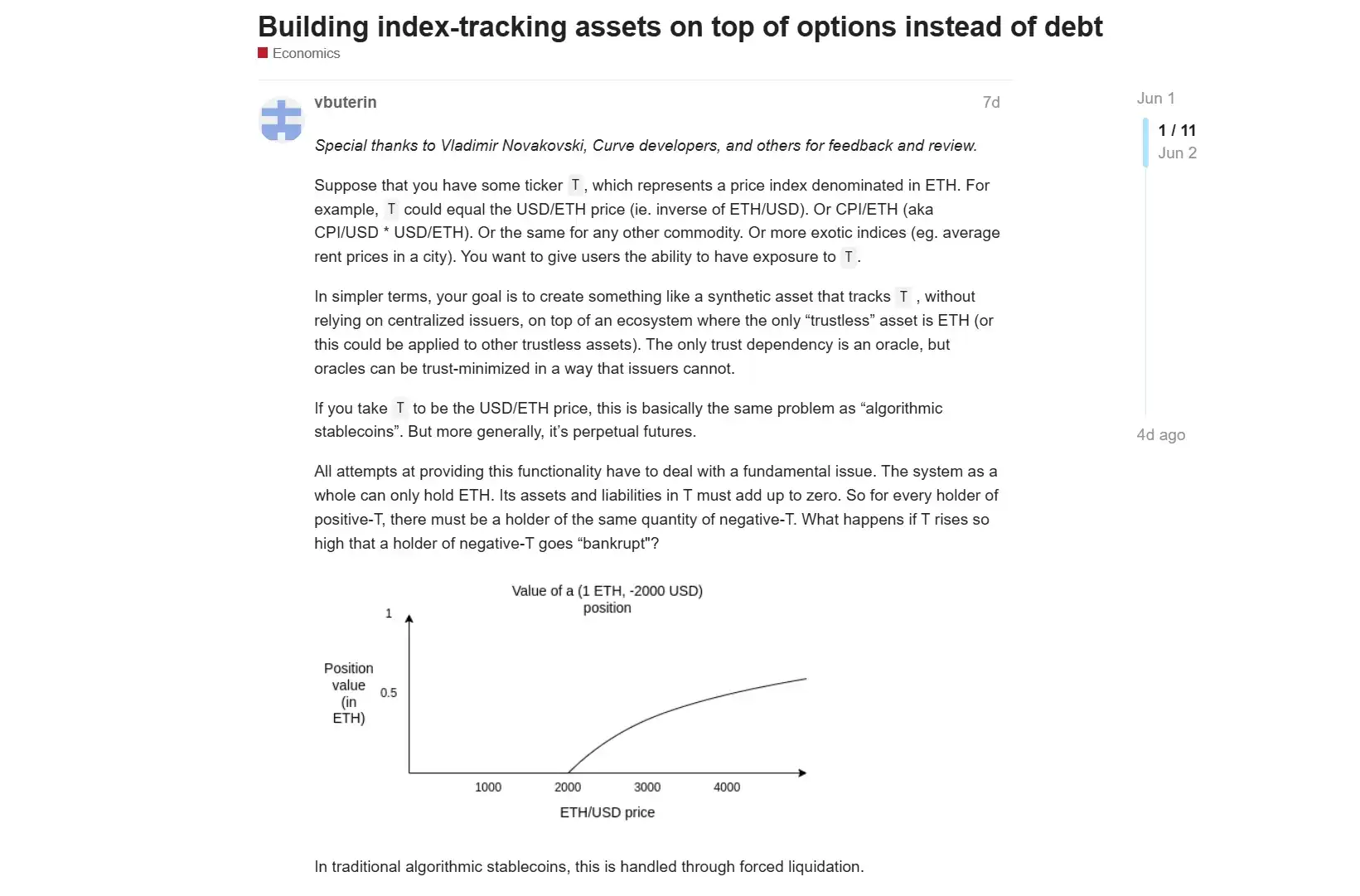
I. The Achilles' Heel of Traditional DeFi

Before discussing Vitalik's new line of thinking, it's necessary to revisit why "CDP + forced liquidation" became the core model of DeFi, and why it also became its weakness.

As is well known, represented by classic lending protocols like MakerDAO/Sky, Aave, and Compound, one of the most important early financial innovations in DeFi was allowing users to collateralize on-chain assets to borrow another asset.

This mechanism can be simply understood as users depositing assets like ETH into a protocol, obtaining a borrowing limit. As long as the collateral value remains sufficiently high, the position is safe; however, once the collateral price falls below a certain threshold, the protocol triggers a liquidation, selling the collateral to repay the debt and protect the system's solvency.

It may seem mundane today, but this mechanism was crucial for early DeFi. It transformed assets like ETH from "passively held" into "reusable" financial base assets for the first time, enabling them to enter more complex systems like lending, leverage, stablecoins, and yield strategies.

It can be said that CDPs and lending protocols laid the earliest and most critical foundation for DeFi's composability.

However, its problems are also evident:

  • Forced liquidation relies on real-time and highly reliable oracles: Protocols must rely on external oracles for second-by-second price feeds. If an oracle experiences delays, manipulation, extreme network congestion, or if certain assets themselves have insufficient liquidity, the protocol may execute liquidations based on temporarily distorted prices.
  • Forced liquidation amplifies pressure during extreme market conditions: When collateral prices fall rapidly, liquidators and MEV bots compete intensely for liquidation opportunities. The concentrated selling of collateral further exacerbates market pressure, potentially triggering a liquidity run across the entire ecosystem.
  • Illusion of liquidity: Traditional lending protocols assume "the market will always have sufficient liquidity to absorb liquidation selling pressure." However, in truly extreme market environments, liquidity can evaporate instantly. This leads to a situation where the price falls further, fewer people are willing to take on the risk, making liquidations harder to complete smoothly. If a protocol cannot promptly handle bad positions, it may be left with bad debt.

So, objectively speaking, CDP + forced liquidation is not a flawed design. It was an extremely important and effective foundational module in early DeFi. However, as DeFi has entered a stage of larger capital scale and more complex structures, the costs of this model have become increasingly prominent:

It concentrates risk highly on a single liquidation threshold—before the threshold is triggered, everything seems normal; once it's touched, users often have no choice but to passively endure the outcome.

II. Vitalik's New Approach: Reconstructing Lending with an 'Options Mindset'

Vitalik's new approach essentially seeks to change the underlying way DeFi handles risk.

We can summarize his thinking in one sentence: Could DeFi stop using "debt" as its foundational component and instead use "options" as its foundational component?

Because the foundation of the traditional CDP model is debt. Users borrow assets, and there must be a mechanism to ensure the debt is always sufficiently collateralized. Once collateral becomes insufficient, the protocol can only resort to forced liquidation to prevent system bad debt.

The design based on options takes a completely different approach. It doesn't have users create a debt that must be protected in real-time. Instead, it breaks down the underlying asset into a set of complementary contracts. Simply put, 1 ETH can be split into two types of assets: one closer to a stable or index-tracking exposure, and the other bearing the opposite risk and return. Regardless of price movements, the combined returns of these two assets always correspond to the underlying 1 ETH.
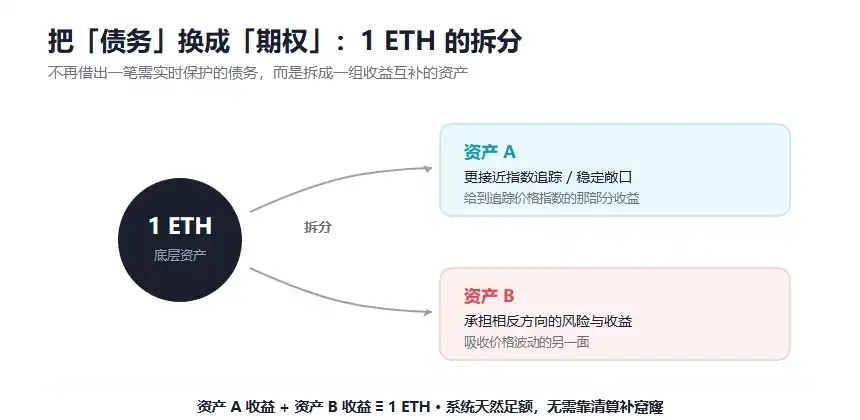
This means the system no longer needs to suddenly force-liquidate a user at a specific price point. In the traditional liquidation model, a user might be abruptly liquidated when the price hits the line. In the option-based model, users face a gradual deviation of their exposure from the target, requiring rebalancing at an appropriate time. Here's a more accessible analogy to understand this:

  • The traditional model (CDP) is like you pledging $10,000 worth of ETH to a lending protocol, borrowing $5,000. The protocol monitors the price via an oracle; once ETH falls to a critical point, it directly sells your ETH without a second thought, charging you a hefty fee. You have no right to appeal.
  • In the new option-based model, you pledge ETH and still receive $5,000, but this isn't called a loan. Its form is more like a time-bound "right": before the agreed-upon time, no matter how much ETH falls, your position won't be liquidated mid-way—the initiative always remains in your hands. At expiration, if the price recovers, you can redeem your collateral; if the price falls, you can simply choose not to exercise the option, letting the protocol take the collateral. You've already secured the $5,000 in hand, rather than being "cleaned out" by a wick in your sleep.

Of course, this is a simplified analogy to aid understanding. Vitalik's original design is closer to a combination of "holding deep in-the-money options and gradually rolling them to lower strike prices as the price approaches."
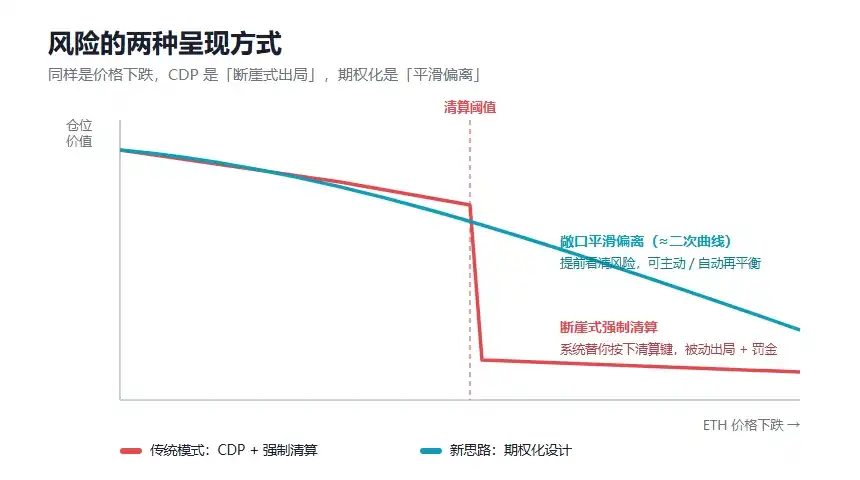
Overall, the former is more like "the system presses the liquidation button for the user," while the latter is more like "the user sees the risk curve in advance and decides when to adjust the position themselves." This shift in mechanism will undoubtedly bring profound changes to DeFi on several levels:

  • No more 'hard liquidation': Since borrowing positions are transformed into options with a time cycle, the protocol no longer needs to set a "liquidation line that explodes immediately upon touch." Users no longer need to anxiously watch the charts daily and won't be force-liquidated in their sleep due to a single malicious wick.
  • Significantly reduced reliance on oracles: The new mechanism drastically reduces dependence on high-frequency, real-time oracle price feeds. The protocol only needs to settle at expiration or specific time nodes. This directly reduces the space for hackers to launch attacks using "flash loans + oracle manipulation."
  • Inherently anti-MEV properties: Without instantaneous forced liquidation, on-chain gas wars triggered by "cascading liquidations" will no longer occur. MEV bots lose their most lucrative liquidation arbitrage scenario. Value created by the protocol is more likely to flow back to users and LPs, rather than being extracted by arbitrageurs and sequencers.

The significance of this change goes far beyond "more safety."

Because the future users DeFi aims to serve include not just high-risk traders, but also more ordinary users and real payment scenarios. For these groups, what truly matters often isn't pushing capital efficiency to the extreme, but rather whether they retain choice during extreme market conditions and can avoid being forcibly kicked out of the system by a short-term fluctuation.

III. Do Users Still Need Ethereum DeFi?

This question has become more pertinent today.

With the rise of emerging ecosystems like Hyperliquid, users are seeing another form of DeFi product. They can offer faster matching experiences, interactions closer to centralized exchanges, more concentrated liquidity, and more direct fulfillment of trading needs.

This represents real competitive pressure for Ethereum.

If we only compare transaction speed, fees, and front-end experience, Ethereum mainnet and some traditional DeFi protocols may not always hold the advantage. Users won't automatically believe a protocol is better just because it's deployed on Ethereum, nor will they ignore cheaper and more convenient alternatives just because a product is more "orthodox."

Therefore, Ethereum DeFi needs to re-answer the question: Why do users still need Ethereum DeFi?

The answer certainly can't just be "because Ethereum is the most secure" or "because Ethereum has the largest TVL." The truly compelling answer should stem from more fundamental financial design capabilities.
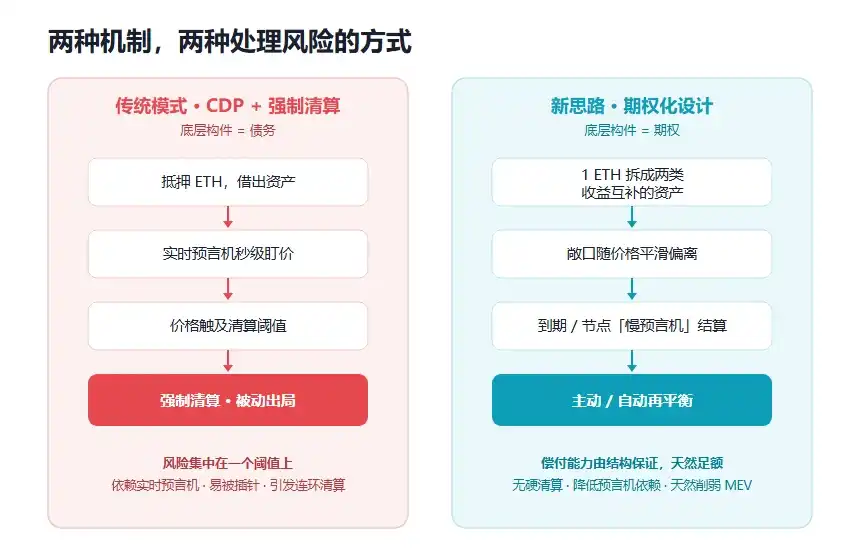
In the author's opinion, if Ethereum DeFi is to remain the core arena of on-chain finance, it cannot merely stay at replicating traditional financial products to simply increase leverage efficiency. It must build advantages in more challenging areas, such as more transparent risk boundaries, more robust oracle mechanisms, fewer forced system actions, stronger user autonomy, and protocol structures that can better withstand extreme scenario testing.

In other words, the competitive focus for the next generation of Ethereum DeFi might no longer be about who can make users earn more, but about who can help users avoid being passively forced out in complex financial environments and truly understand the risks they are taking.

For ordinary users, the option-based DeFi design proposed by Vitalik might still seem distant and may not quickly mature into products. However, the direction it signals is clear: DeFi shouldn't only pursue higher yields; it should also pursue clearer, more explainable, and more manageable risk structures.

In Conclusion

To be realistic, after frequent security incidents, a common voice asks: Since DeFi has so many risks, does it mean on-chain finance itself is not viable?

This judgment might be overly simplistic.

The problem with DeFi doesn't lie in the direction of "decentralization" itself, but in the fact that many products haven't truly completed the evolution from high-risk experiments to robust financial infrastructure. The industry has been too accustomed to proving value with growth and TVL, while relatively underestimating risk design and resilience in extreme scenarios.

The new approach proposed by Vitalik precisely serves as a reminder to the industry: The evolution of DeFi isn't just about porting old finance onto the chain. It's about leveraging the programmable and composable characteristics of the chain to design new risk structures that traditional finance might not easily achieve.

If we only compete on speed and speculative efficiency, Ethereum can hardly win. Ethereum must return to its foundational narrative: security, decentralization, and bottom-up innovation in financial paradigms.

This, perhaps, is the real opportunity for Ethereum DeFi.

Domande pertinenti

QWhat is the core problem with the traditional CDP and forced liquidation model in DeFi, as highlighted in the article?

AThe core problem is its reliance on real-time, reliable oracles. If the oracle price is manipulated, delayed, or inaccurate, it can trigger forced liquidations based on distorted data. This creates a highly concentrated risk point where users can be instantly liquidated during market volatility, exacerbating selling pressure and potentially leading to cascading liquidations and liquidity crises within the ecosystem.

QAccording to Vitalik Buterin's proposal, how does an 'option-based' mechanism differ fundamentally from the traditional CDP model?

AThe fundamental difference is in the underlying financial primitive. The CDP model is based on *debt*, requiring constant over-collateralization and forced liquidation if the collateral value falls below a threshold. The option-based model decomposes the underlying asset (e.g., 1 ETH) into complementary financial contracts (like options), creating one asset with stable/index-tracking exposure and another bearing the opposing risk/reward. It eliminates the hard liquidation threshold, gradually shifting the user's exposure in a smoother, non-instantaneous way.

QWhat are the key potential benefits of adopting an option-based design for DeFi protocols, as mentioned in the text?

AKey benefits include: 1) The elimination of instantaneous 'hard liquidations,' giving users more control and time to manage their positions. 2) A significantly reduced dependency on high-frequency, real-time oracles, minimizing risks of oracle manipulation and attacks. 3) Inherent resistance to certain types of MEV (Maximal Extractable Value), as it removes the lucrative, gas-bidding清算套利场景 triggered by cascading liquidations. 4) A clearer, more manageable risk structure for users.

QThe article suggests Ethereum DeFi needs a new competitive edge beyond just speed and fees. What does it propose as the future focus for Ethereum DeFi?

AThe article proposes that the future competitive edge for Ethereum DeFi should lie in superior *underlying financial design capability*. This includes creating protocols with more transparent risk boundaries, more robust oracle mechanisms, fewer强制性强制性的 system actions, stronger user autonomy, and structures that are more resilient in extreme scenarios. The focus shifts from maximizing capital efficiency/yield to providing clearer, more explainable, and more manageable risk structures.

QWhat is the broader implication or lesson that Vitalik Buterin's proposal is trying to convey about the evolution of DeFi, according to the article's conclusion?

AThe broader implication is that DeFi's evolution should not merely involve replicating traditional financial products on-chain. Instead, it should leverage the programmable and composable nature of blockchains to design *novel risk structures* that are difficult or impractical to implement in traditional finance. For Ethereum specifically, its opportunity lies in returning to its foundational narrative of security, decentralization, and底层层的底层层的金融范式创新, rather than competing solely on transaction speed or投机效率.

Letture associate

La Liga Team Bets $1 Million Against Themselves Before Match: Does Using Prediction Markets for Insurance Comply with Sports Regulations?

A Spanish La Liga club, reportedly Osasuna, purchased insurance against relegation and was linked to a transaction of over $1 million on the prediction market platform Kalshi, betting against its own victory in a crucial season-ending match. While Osasuna confirmed buying €1.2 million insurance for a potential €6 million payout in case of relegation through broker Howden, it did not confirm involvement with Kalshi. The reported trade involved intermediaries like Game Point Capital and Greenlight Commodities, with quant firm Susquehanna as the counterparty. This incident highlights the blurring line between financial hedging and gambling in prediction markets. Such markets allow trading on future event outcomes, like sports results. In the US, Kalshi operates as a regulated event contract market under the CFTC. However, Spanish authorities recently initiated penalties against Kalshi and Polymarket, considering their activities unlicensed gambling. The case raises core questions about prediction markets: who can trade, how insider information is handled, and whether participants can influence outcomes, especially in sports where results are human-driven. While leagues like La Liga and Serie A have partnered with Polymarket in North America, the regulatory clash and potential for conflicts of interest, as seen in this club's alleged transaction, present significant challenges as prediction markets evolve toward institutional risk management.

Foresight News1 min fa

La Liga Team Bets $1 Million Against Themselves Before Match: Does Using Prediction Markets for Insurance Comply with Sports Regulations?

Foresight News1 min fa

From Shouting 150 Dollars to Liquidating HYPE in Just Three Days, How Much Credibility Does Arthur Hayes Have Left?

How much of Arthur Hayes's market credibility remains? Recently, the "godfather of crypto perpetual swaps" and BitMEX co-founder has faced public criticism, including accusations from on-chain investigator ZachXBT about creating exit liquidity for his followers. Starting last week, Hayes executed multiple sudden sell-offs. He had repeatedly publicly predicted the HYPE token would reach $150. After a $100,000 bet defending Hyperliquid on June 1st, he announced just three days later that he had completely sold his HYPE and NEAR holdings, successfully exiting near the peak. He also sold ZEC and WLD. His sale of WLD appeared to be a classic "pump and dump" maneuver. On June 3rd, he publicly set a $10 target for WLD, causing its price to surge over 35%. By June 6th, he announced he had sold his WLD, citing "anomalous" SpaceX pre-IPO price action, which triggered a sharp price drop. On June 9th, Hayes published a lengthy article explaining his actions, citing factors like rising energy costs and a potential AI bubble burst. Consequently, his family office, Maelstrom, now holds positions in US energy producers and only core crypto assets BTC and ETH, having sold AI-related stocks and non-core cryptocurrencies. This pattern is not new. In 2025, he similarly touted HYPE before selling it at what turned out to be a cycle peak, only to repurchase it at the next cycle's low. Similar scenarios played out with tokens like ETHFI and ENA. Long-term observers have developed a strategy: ignore Hayes's public statements but closely monitor his on-chain actions—be cautious following his buys, but decisively follow his sells. If he continues these tactics, especially as seen with the WLD case, his market credibility risks being permanently damaged. As Hayes himself admitted in his latest article, "I remain an unapologetic gambler."

marsbit19 min fa

From Shouting 150 Dollars to Liquidating HYPE in Just Three Days, How Much Credibility Does Arthur Hayes Have Left?

marsbit19 min fa

Fundraising is Like a Strange Dance: The 'Absurd Drama' of Silicon Valley Founders' Capital Raises

The article details a series of absurd and revealing anecdotes shared by Silicon Valley founders about their venture capital fundraising experiences, sparked by Greg Isenberg's story of pitching to a sleeping a16z partner. Founders describe surreal pitch meetings: one faced a barefoot, peanut-eating investor who offered triple the requested amount after 30 seconds; another performed a pitch in a VC's parked car; a founder discovered his audience understood no English beyond "yes." These stories highlight the often irrational and performative nature of fundraising. Beyond the absurdity, darker power imbalances are exposed. Stories include investors suggesting founders fire co-founders for their equity, blatant market misjudgments, disrespectful behavior from LPs, and discriminatory remarks. A debate also emerges around "Sequoia's" practice of splitting a round into two valuations. However, the thread isn't solely critical. Positive counter-narratives celebrate supportive VCs who offered crucial advice during crises, respected founders' timelines, and showed simple gestures of respect—like a partner personally fetching coffee before a major pitch. Ultimately, the collective sharing acts as a pressure release, illustrating that fundraising is a complex dance of power, trust, and sometimes sheer theater. It underscores that beyond capital, mutual respect and integrity remain the most enduring foundations of the founder-investor relationship.

marsbit33 min fa

Fundraising is Like a Strange Dance: The 'Absurd Drama' of Silicon Valley Founders' Capital Raises

marsbit33 min fa

Trading

Spot
Futures

Articoli Popolari

Cosa è $S$

Comprendere SPERO: Una Panoramica Completa Introduzione a SPERO Mentre il panorama dell'innovazione continua a evolversi, l'emergere delle tecnologie web3 e dei progetti di criptovaluta gioca un ruolo fondamentale nel plasmare il futuro digitale. Un progetto che ha attirato l'attenzione in questo campo dinamico è SPERO, denotato come SPERO,$$s$. Questo articolo mira a raccogliere e presentare informazioni dettagliate su SPERO, per aiutare gli appassionati e gli investitori a comprendere le sue basi, obiettivi e innovazioni nei domini web3 e crypto. Che cos'è SPERO,$$s$? SPERO,$$s$ è un progetto unico all'interno dello spazio crypto che cerca di sfruttare i principi della decentralizzazione e della tecnologia blockchain per creare un ecosistema che promuove l'impegno, l'utilità e l'inclusione finanziaria. Il progetto è progettato per facilitare interazioni peer-to-peer in modi nuovi, fornendo agli utenti soluzioni e servizi finanziari innovativi. Al suo interno, SPERO,$$s$ mira a responsabilizzare gli individui fornendo strumenti e piattaforme che migliorano l'esperienza dell'utente nello spazio delle criptovalute. Questo include la possibilità di metodi di transazione più flessibili, la promozione di iniziative guidate dalla comunità e la creazione di percorsi per opportunità finanziarie attraverso applicazioni decentralizzate (dApps). La visione sottostante di SPERO,$$s$ ruota attorno all'inclusività, cercando di colmare le lacune all'interno della finanza tradizionale mentre sfrutta i vantaggi della tecnologia blockchain. Chi è il Creatore di SPERO,$$s$? L'identità del creatore di SPERO,$$s$ rimane piuttosto oscura, poiché ci sono risorse pubblicamente disponibili limitate che forniscono informazioni dettagliate sul suo fondatore o fondatori. Questa mancanza di trasparenza può derivare dall'impegno del progetto per la decentralizzazione—un ethos che molti progetti web3 condividono, dando priorità ai contributi collettivi rispetto al riconoscimento individuale. Centrando le discussioni attorno alla comunità e ai suoi obiettivi collettivi, SPERO,$$s$ incarna l'essenza dell'empowerment senza mettere in evidenza individui specifici. Pertanto, comprendere l'etica e la missione di SPERO rimane più importante che identificare un creatore singolo. Chi sono gli Investitori di SPERO,$$s$? SPERO,$$s$ è supportato da una varietà di investitori che vanno dai capitalisti di rischio agli investitori angelici dedicati a promuovere l'innovazione nel settore crypto. Il focus di questi investitori generalmente si allinea con la missione di SPERO—dando priorità a progetti che promettono avanzamenti tecnologici sociali, inclusività finanziaria e governance decentralizzata. Queste fondazioni di investitori sono tipicamente interessate a progetti che non solo offrono prodotti innovativi, ma contribuiscono anche positivamente alla comunità blockchain e ai suoi ecosistemi. Il supporto di questi investitori rafforza SPERO,$$s$ come un concorrente degno di nota nel dominio in rapida evoluzione dei progetti crypto. Come Funziona SPERO,$$s$? SPERO,$$s$ impiega un framework multifunzionale che lo distingue dai progetti di criptovaluta convenzionali. Ecco alcune delle caratteristiche chiave che sottolineano la sua unicità e innovazione: Governance Decentralizzata: SPERO,$$s$ integra modelli di governance decentralizzati, responsabilizzando gli utenti a partecipare attivamente ai processi decisionali riguardanti il futuro del progetto. Questo approccio favorisce un senso di proprietà e responsabilità tra i membri della comunità. Utilità del Token: SPERO,$$s$ utilizza il proprio token di criptovaluta, progettato per servire varie funzioni all'interno dell'ecosistema. Questi token abilitano transazioni, premi e la facilitazione dei servizi offerti sulla piattaforma, migliorando l'impegno e l'utilità complessivi. Architettura Stratificata: L'architettura tecnica di SPERO,$$s$ supporta la modularità e la scalabilità, consentendo un'integrazione fluida di funzionalità e applicazioni aggiuntive man mano che il progetto evolve. Questa adattabilità è fondamentale per mantenere la rilevanza nel panorama crypto in continua evoluzione. Coinvolgimento della Comunità: Il progetto enfatizza iniziative guidate dalla comunità, impiegando meccanismi che incentivano la collaborazione e il feedback. Nutrendo una comunità forte, SPERO,$$s$ può affrontare meglio le esigenze degli utenti e adattarsi alle tendenze di mercato. Focus sull'Inclusione: Offrendo basse commissioni di transazione e interfacce user-friendly, SPERO,$$s$ mira ad attrarre una base utenti diversificata, inclusi individui che potrebbero non aver precedentemente interagito nello spazio crypto. Questo impegno per l'inclusione si allinea con la sua missione generale di empowerment attraverso l'accessibilità. Cronologia di SPERO,$$s$ Comprendere la storia di un progetto fornisce preziose intuizioni sulla sua traiettoria di sviluppo e sui traguardi. Di seguito è riportata una cronologia suggerita che mappa eventi significativi nell'evoluzione di SPERO,$$s$: Fase di Concettualizzazione e Ideazione: Le idee iniziali che formano la base di SPERO,$$s$ sono state concepite, allineandosi strettamente con i principi di decentralizzazione e focus sulla comunità all'interno dell'industria blockchain. Lancio del Whitepaper del Progetto: Dopo la fase concettuale, è stato rilasciato un whitepaper completo che dettaglia la visione, gli obiettivi e l'infrastruttura tecnologica di SPERO,$$s$ per suscitare interesse e feedback dalla comunità. Costruzione della Comunità e Prime Interazioni: Sono stati effettuati sforzi attivi di outreach per costruire una comunità di early adopters e potenziali investitori, facilitando discussioni attorno agli obiettivi del progetto e ottenendo supporto. Evento di Generazione del Token: SPERO,$$s$ ha condotto un evento di generazione del token (TGE) per distribuire i propri token nativi ai primi sostenitori e stabilire una liquidità iniziale all'interno dell'ecosistema. Lancio della Prima dApp: La prima applicazione decentralizzata (dApp) associata a SPERO,$$s$ è stata attivata, consentendo agli utenti di interagire con le funzionalità principali della piattaforma. Sviluppo Continuo e Partnership: Aggiornamenti e miglioramenti continui alle offerte del progetto, inclusi partnership strategiche con altri attori nello spazio blockchain, hanno plasmato SPERO,$$s$ in un concorrente competitivo e in evoluzione nel mercato crypto. Conclusione SPERO,$$s$ rappresenta una testimonianza del potenziale del web3 e delle criptovalute di rivoluzionare i sistemi finanziari e responsabilizzare gli individui. Con un impegno per la governance decentralizzata, il coinvolgimento della comunità e funzionalità progettate in modo innovativo, apre la strada verso un panorama finanziario più inclusivo. Come per qualsiasi investimento nello spazio crypto in rapida evoluzione, si incoraggiano potenziali investitori e utenti a ricercare approfonditamente e a impegnarsi in modo riflessivo con gli sviluppi in corso all'interno di SPERO,$$s$. Il progetto mostra lo spirito innovativo dell'industria crypto, invitando a ulteriori esplorazioni delle sue innumerevoli possibilità. Mentre il percorso di SPERO,$$s$ è ancora in fase di sviluppo, i suoi principi fondamentali potrebbero effettivamente influenzare il futuro di come interagiamo con la tecnologia, la finanza e tra di noi in ecosistemi digitali interconnessi.

75 Totale visualizzazioniPubblicato il 2024.12.17Aggiornato il 2024.12.17

Cosa è $S$

Cosa è AGENT S

Agent S: Il Futuro dell'Interazione Autonoma in Web3 Introduzione Nel panorama in continua evoluzione di Web3 e criptovalute, le innovazioni stanno costantemente ridefinendo il modo in cui gli individui interagiscono con le piattaforme digitali. Uno di questi progetti pionieristici, Agent S, promette di rivoluzionare l'interazione uomo-computer attraverso il suo framework agentico aperto. Aprendo la strada a interazioni autonome, Agent S mira a semplificare compiti complessi, offrendo applicazioni trasformative nell'intelligenza artificiale (AI). Questa esplorazione dettagliata approfondirà le complessità del progetto, le sue caratteristiche uniche e le implicazioni per il dominio delle criptovalute. Cos'è Agent S? Agent S si presenta come un innovativo framework agentico aperto, progettato specificamente per affrontare tre sfide fondamentali nell'automazione dei compiti informatici: Acquisizione di Conoscenze Specifiche del Dominio: Il framework apprende in modo intelligente da varie fonti di conoscenza esterne ed esperienze interne. Questo approccio duale gli consente di costruire un ricco repository di conoscenze specifiche del dominio, migliorando le sue prestazioni nell'esecuzione dei compiti. Pianificazione su Lungo Orizzonte di Compiti: Agent S impiega una pianificazione gerarchica potenziata dall'esperienza, un approccio strategico che facilita la suddivisione e l'esecuzione efficiente di compiti complessi. Questa caratteristica migliora significativamente la sua capacità di gestire più sottocompiti in modo efficiente ed efficace. Gestione di Interfacce Dinamiche e Non Uniformi: Il progetto introduce l'Interfaccia Agente-Computer (ACI), una soluzione innovativa che migliora l'interazione tra agenti e utenti. Utilizzando Modelli Linguistici Multimodali di Grandi Dimensioni (MLLM), Agent S può navigare e manipolare senza sforzo diverse interfacce grafiche utente. Attraverso queste caratteristiche pionieristiche, Agent S fornisce un framework robusto che affronta le complessità coinvolte nell'automazione dell'interazione umana con le macchine, preparando il terreno per innumerevoli applicazioni nell'AI e oltre. Chi è il Creatore di Agent S? Sebbene il concetto di Agent S sia fondamentalmente innovativo, informazioni specifiche sul suo creatore rimangono elusive. Il creatore è attualmente sconosciuto, il che evidenzia sia la fase embrionale del progetto sia la scelta strategica di mantenere i membri fondatori sotto anonimato. Indipendentemente dall'anonimato, l'attenzione rimane sulle capacità e sul potenziale del framework. Chi sono gli Investitori di Agent S? Poiché Agent S è relativamente nuovo nell'ecosistema crittografico, informazioni dettagliate riguardanti i suoi investitori e sostenitori finanziari non sono documentate esplicitamente. La mancanza di approfondimenti pubblicamente disponibili sulle fondazioni di investimento o sulle organizzazioni che supportano il progetto solleva interrogativi sulla sua struttura di finanziamento e sulla roadmap di sviluppo. Comprendere il supporto è cruciale per valutare la sostenibilità del progetto e il suo potenziale impatto sul mercato. Come Funziona Agent S? Al centro di Agent S si trova una tecnologia all'avanguardia che gli consente di funzionare efficacemente in contesti diversi. Il suo modello operativo è costruito attorno a diverse caratteristiche chiave: Interazione Uomo-Computer Simile a Quella Umana: Il framework offre una pianificazione AI avanzata, cercando di rendere le interazioni con i computer più intuitive. Mimando il comportamento umano nell'esecuzione dei compiti, promette di elevare le esperienze degli utenti. Memoria Narrativa: Utilizzata per sfruttare esperienze di alto livello, Agent S utilizza la memoria narrativa per tenere traccia delle storie dei compiti, migliorando così i suoi processi decisionali. Memoria Episodica: Questa caratteristica fornisce agli utenti una guida passo-passo, consentendo al framework di offrire supporto contestuale mentre i compiti si sviluppano. Supporto per OpenACI: Con la capacità di funzionare localmente, Agent S consente agli utenti di mantenere il controllo sulle proprie interazioni e flussi di lavoro, allineandosi con l'etica decentralizzata di Web3. Facile Integrazione con API Esterne: La sua versatilità e compatibilità con varie piattaforme AI garantiscono che Agent S possa adattarsi senza problemi agli ecosistemi tecnologici esistenti, rendendolo una scelta attraente per sviluppatori e organizzazioni. Queste funzionalità contribuiscono collettivamente alla posizione unica di Agent S all'interno dello spazio crittografico, poiché automatizza compiti complessi e multi-fase con un intervento umano minimo. Man mano che il progetto evolve, le sue potenziali applicazioni in Web3 potrebbero ridefinire il modo in cui si svolgono le interazioni digitali. Cronologia di Agent S Lo sviluppo e le tappe di Agent S possono essere riassunti in una cronologia che evidenzia i suoi eventi significativi: 27 Settembre 2024: Il concetto di Agent S è stato lanciato in un documento di ricerca completo intitolato “Un Framework Agentico Aperto che Usa i Computer Come un Umano”, mostrando le basi per il progetto. 10 Ottobre 2024: Il documento di ricerca è stato reso pubblicamente disponibile su arXiv, offrendo un'esplorazione approfondita del framework e della sua valutazione delle prestazioni basata sul benchmark OSWorld. 12 Ottobre 2024: È stata rilasciata una presentazione video, fornendo un'idea visiva delle capacità e delle caratteristiche di Agent S, coinvolgendo ulteriormente potenziali utenti e investitori. Questi indicatori nella cronologia non solo illustrano i progressi di Agent S, ma indicano anche il suo impegno per la trasparenza e il coinvolgimento della comunità. Punti Chiave su Agent S Man mano che il framework Agent S continua a evolversi, diversi attributi chiave si distinguono, sottolineando la sua natura innovativa e il potenziale: Framework Innovativo: Progettato per fornire un uso intuitivo dei computer simile all'interazione umana, Agent S porta un approccio nuovo all'automazione dei compiti. Interazione Autonoma: La capacità di interagire autonomamente con i computer attraverso GUI segna un passo avanti verso soluzioni informatiche più intelligenti ed efficienti. Automazione di Compiti Complessi: Con la sua metodologia robusta, può automatizzare compiti complessi e multi-fase, rendendo i processi più veloci e meno soggetti a errori. Miglioramento Continuo: I meccanismi di apprendimento consentono ad Agent S di migliorare dalle esperienze passate, migliorando continuamente le sue prestazioni e la sua efficacia. Versatilità: La sua adattabilità attraverso diversi ambienti operativi come OSWorld e WindowsAgentArena garantisce che possa servire un'ampia gamma di applicazioni. Man mano che Agent S si posiziona nel panorama di Web3 e delle criptovalute, il suo potenziale per migliorare le capacità di interazione e automatizzare i processi segna un significativo avanzamento nelle tecnologie AI. Attraverso il suo framework innovativo, Agent S esemplifica il futuro delle interazioni digitali, promettendo un'esperienza più fluida ed efficiente per gli utenti in vari settori. Conclusione Agent S rappresenta un audace passo avanti nell'unione tra AI e Web3, con la capacità di ridefinire il modo in cui interagiamo con la tecnologia. Sebbene sia ancora nelle sue fasi iniziali, le possibilità per la sua applicazione sono vaste e coinvolgenti. Attraverso il suo framework completo che affronta sfide critiche, Agent S mira a portare le interazioni autonome al centro dell'esperienza digitale. Man mano che ci addentriamo nei regni delle criptovalute e della decentralizzazione, progetti come Agent S giocheranno senza dubbio un ruolo cruciale nel plasmare il futuro della tecnologia e della collaborazione uomo-computer.

537 Totale visualizzazioniPubblicato il 2025.01.14Aggiornato il 2025.01.14

Cosa è AGENT S

Come comprare S

Benvenuto in HTX.com! Abbiamo reso l'acquisto di Sonic (S) semplice e conveniente. Segui la nostra guida passo passo per intraprendere il tuo viaggio nel mondo delle criptovalute.Step 1: Crea il tuo Account HTXUsa la tua email o numero di telefono per registrarti il tuo account gratuito su HTX. Vivi un'esperienza facile e sblocca tutte le funzionalità,Crea il mio accountStep 2: Vai in Acquista crypto e seleziona il tuo metodo di pagamentoCarta di credito/debito: utilizza la tua Visa o Mastercard per acquistare immediatamente SonicS.Bilancio: Usa i fondi dal bilancio del tuo account HTX per fare trading senza problemi.Terze parti: abbiamo aggiunto metodi di pagamento molto utilizzati come Google Pay e Apple Pay per maggiore comodità.P2P: Fai trading direttamente con altri utenti HTX.Over-the-Counter (OTC): Offriamo servizi su misura e tassi di cambio competitivi per i trader.Step 3: Conserva Sonic (S)Dopo aver acquistato Sonic (S), conserva nel tuo account HTX. In alternativa, puoi inviare tramite trasferimento blockchain o scambiare per altre criptovalute.Step 4: Scambia Sonic (S)Scambia facilmente Sonic (S) nel mercato spot di HTX. Accedi al tuo account, seleziona la tua coppia di trading, esegui le tue operazioni e monitora in tempo reale. Offriamo un'esperienza user-friendly sia per chi ha appena iniziato che per i trader più esperti.

1.1k Totale visualizzazioniPubblicato il 2025.01.15Aggiornato il 2026.06.02

Come comprare S

Discussioni

Benvenuto nella Community HTX. Qui puoi rimanere informato sugli ultimi sviluppi della piattaforma e accedere ad approfondimenti esperti sul mercato. Le opinioni degli utenti sul prezzo di S S sono presentate come di seguito.

活动图片















