Vitalik Wrote a Proposal Teaching You How to Stealthily Use AI Large Models

比推Pubblicato 2026-03-13Pubblicato ultima volta 2026-03-13

Introduzione

Vitalik Buterin and Ethereum Foundation's AI lead Davide Crapis co-authored a proposal titled "ZK API Usage Credits," which introduces a method for anonymously accessing AI models like ChatGPT using zero-knowledge proofs. Instead of requiring users to register and link personal information, the proposal suggests depositing funds (e.g., 100 USDC) into a smart contract. Users can then generate a zero-knowledge proof to verify they are on an encrypted whitelist and have sufficient balance—without revealing their identity. This approach aims to protect user privacy while preventing abuse. Although still in the research phase and facing skepticism, the proposal reflects Vitalik's broader focus on privacy and Ethereum's potential role in providing a tamper-proof data layer in the AI era, where verification and anonymity may become increasingly critical.

Author: Deep Tide TechFlow

Original Title: Vitalik Wrote a Proposal Teaching You How to Stealthily Use AI Large Models


Everyone is talking about AI, and the crypto space seems much quieter on the timeline.

Meanwhile, ETH has been hovering around 2000 for almost two months. What Vitalik says or does doesn't seem to attract much attention anymore.

However, I recently checked his X (Twitter) and found that AI has influenced more than just us. Over the past month, a significant portion of his posts have been about AI, and they've even reached the level of technical proposals.

Among them, the most noteworthy is a proposal co-authored with Davide Crapis, the AI lead at the Ethereum Foundation, published on ethresear.ch on February 11th, titled "ZK API Usage Credits."
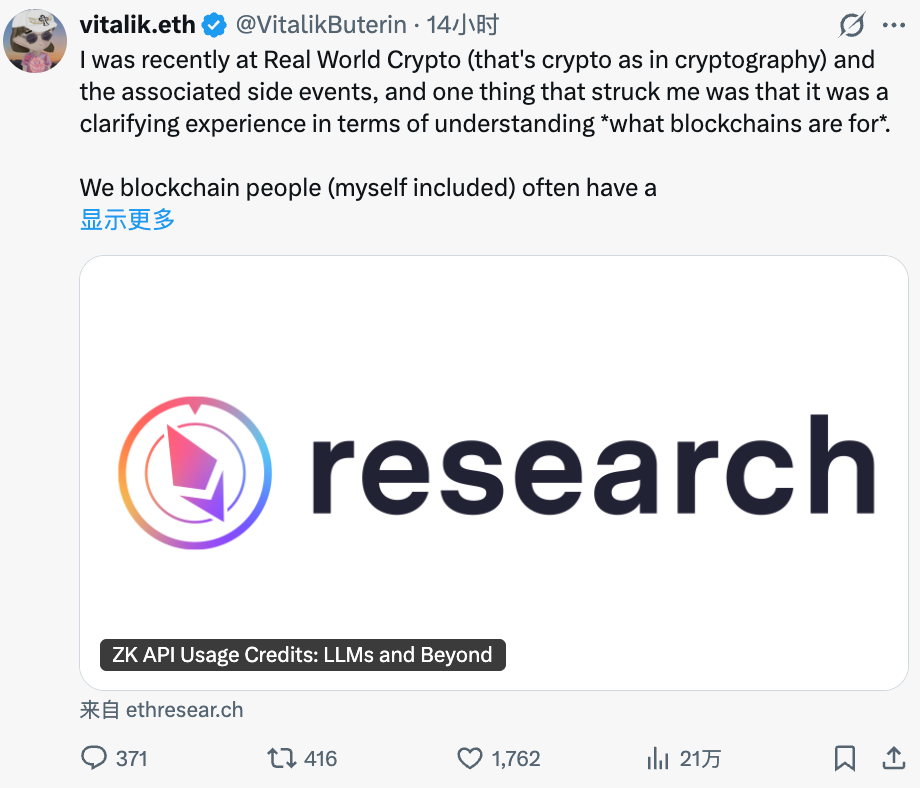
In a nutshell, it's about using zero-knowledge proofs to let you anonymously call AI large models.

Right now, whether you use ChatGPT or call Claude's API, there's only one way to pay:

Register an account, bind an email, bind a credit card.

Every conversation you have, every prompt you send, the platform knows it's from you. What you asked, when you asked it, how many times you asked—all tied to your real identity.

Vitalik and Crapis's proposal offers another path.

  1. The user deposits a sum of money into a smart contract, say 100 USDC.

  2. The contract registers this deposit into an encrypted on-chain list. After that, every time you call the API, you don't need to reveal your identity; you just generate a zero-knowledge proof.

  3. This proof does two things for the service provider: it proves you're on the list, and it proves your balance is sufficient. But the proof itself doesn't reveal which specific entry on the list you are.
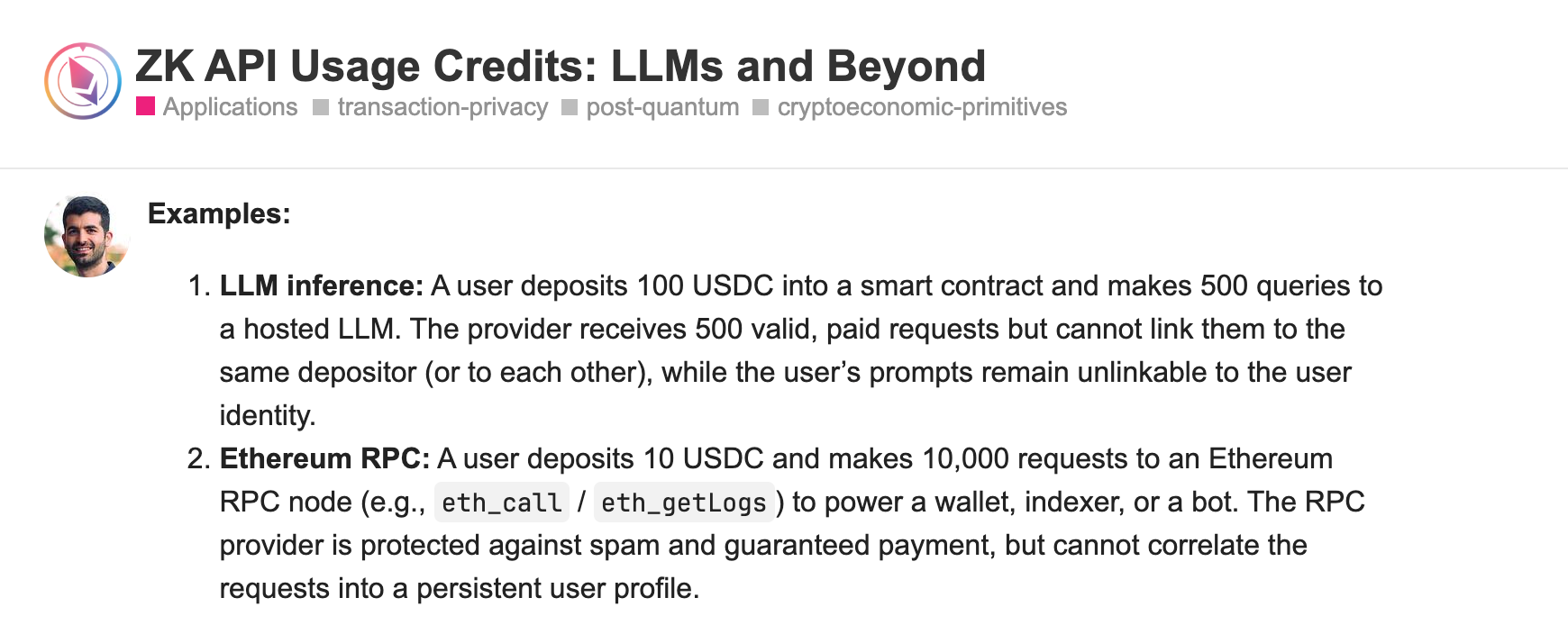
The service provider gets paid and can prevent abuse, but never knows who you are.

You can interpret this proposal as Vitalik believing that in the AI era, users shouldn't have to surrender their identity just to use an AI tool.

This proposal is still in the research phase, far from implementation, and large model manufacturers might not agree to such a method. The comments section of the proposal is also full of rebuttals and skepticism, arguing that AI model companies will always find a way to know your real identity.

But the author believes the significance of this proposal isn't entirely about whether it can be implemented.

Privacy is something Vitalik has worked on for a decade. From early support for Tornado Cash to promoting zero-knowledge proofs as a core technical roadmap for Ethereum, this thread has never been broken. It's just that in the past few years, privacy in the crypto industry's narrative lacked a big enough story to carry it.

AI has filled that story. When you talk to a large model more than anyone else every day, privacy becomes a real demand.

Vitalik Embraces AI

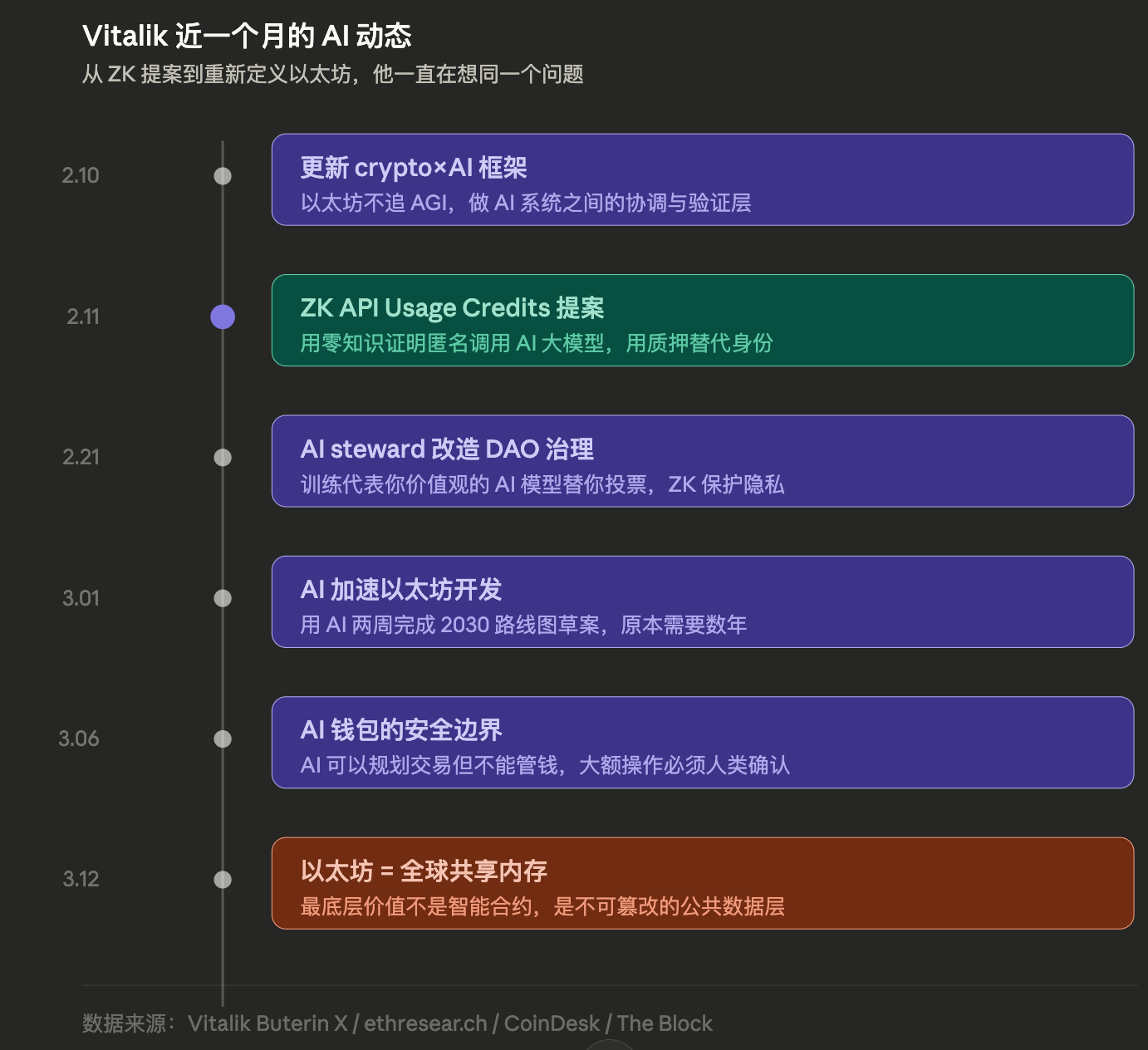
From February until now, a significant portion of what Vitalik has posted on X has been related to AI, with a density that suggests it's more than just casual chat.

Yesterday he posted a long thread saying he recently attended a cryptography conference where people cared about privacy, cared about open source, cared about censorship resistance... but had no affection for blockchain.
Among that crowd, he conducted a thought experiment:

Forget "we are the Ethereum community," start from scratch and think about where Ethereum is actually most useful.

His conclusion is that Ethereum's most fundamental value is as a bulletin board. A place where anyone can write, anyone can read, and no one can change or delete anything.

In the context of AI, this might be the most important thing Vitalik has said in the last couple of years.

We are entering an era of infinitely cheap generation. Text, images, videos, identities—AI can mass-produce them all. When everything can be forged, what becomes scarce?

These questions ultimately point to the same place: a public, persistent, irreversible data layer. And an unchangeable record is exactly what Ethereum can provide.

Over the past two years, the skepticism Ethereum has faced can be summed up in one sentence: What do you still have that others can't replace?

Looking at it now, Vitalik hasn't answered that question directly.

However, the Ethereum Foundation has done a few low-key things over the past year: formed a 50-person privacy team, established a nearly 50-person privacy research cluster, released the Kohaku privacy framework, specifically appointed an AI lead; the 2026 roadmap lists institutional-grade privacy and faster transaction confirmation as top priorities.

Looking back at his intensive output this month, it's mostly been discussions about Ethereum's privacy and efficiency issues in the context of AI.

I think Vitalik is betting on one thing: the more powerful AI becomes, the more rigid the demand for privacy and verification infrastructure will be. Whether Ethereum can meet this demand is another matter, but he has clearly chosen his table.

ETH is still hovering around 2000. Most people still aren't paying much attention to what he's been saying lately.

But perhaps in a few years, looking back, this might be the time we should have been paying attention.


Twitter:https://twitter.com/BitpushNewsCN

BitPush TG Discussion Group:https://t.me/BitPushCommunity

BitPush TG Subscription: https://t.me/bitpush

Original link:https://www.bitpush.news/articles/7619566

Domande pertinenti

QWhat is the main idea of Vitalik Buterin's proposal 'ZK API Usage Credits'?

AThe main idea is to use zero-knowledge proofs to allow users to anonymously call AI large language model APIs. Users deposit funds into a smart contract, which registers them on an encrypted on-chain list. They can then generate a zero-knowledge proof to show they are on the list and have sufficient balance without revealing their identity.

QHow does the proposed system protect user privacy when using AI models?

AThe system protects privacy by allowing users to generate a zero-knowledge proof that verifies they are on the approved list and have enough funds, without disclosing which specific user they are. The service provider receives payment and can prevent abuse but never learns the user's identity.

QWhy does Vitalik Buterin believe privacy is crucial in the AI era?

AVitalik believes that as AI becomes more integrated into daily life and people interact more with models than with humans, privacy becomes a genuine and critical need. Users should not have to surrender their identity just to use an AI tool.

QWhat role does Ethereum play in Vitalik's vision for the future?

AVitalik sees Ethereum's core value as providing a public, persistent, and immutable data layer—a bulletin board that anyone can write to and read from, but no one can alter or delete. This becomes essential in an AI era where content and identities can be easily forged, creating demand for verifiable and tamper-proof records.

QWhat actions has the Ethereum Foundation taken recently regarding AI and privacy?

AThe Ethereum Foundation has formed a 50-person privacy team, established a nearly 50-person privacy research cluster, released the Kohaku privacy framework, and appointed an AI lead. Their 2026 roadmap prioritizes institutional-grade privacy and faster transaction confirmations.

Letture associate

Must-Watch Events Next Week|CLARITY Act Could Face Senate Vote; SpaceX, Circle to Report Earnings (8.3-8.9)

**Summary: Key Events and Developments to Watch (August 3-9)** The upcoming week is marked by significant financial disclosures, key legislative deadlines, and notable product updates. **Major Financial Events:** Several companies are scheduled to release their Q2 2026 earnings. American Bitcoin (ABTC) will report on August 3, followed by SpaceX and Hut 8 Mining Corp. on August 4, and Circle on August 5. Notably, a significant portion of SpaceX shares (up to 12% of total shares) will be unlocked on August 6 following their earnings release. **Key Legislative Deadline:** The U.S. Senate faces an August 7 deadline to secure 60 votes for the CLARITY Act, a bipartisan bill aiming to establish a federal regulatory framework for cryptocurrencies. The Senate may hold a full vote on the bill during the week. **Economic Data:** The U.S. July Non-Farm Payrolls report will be released on August 7, providing crucial labor market data. **Technology & Product Updates:** * **Shutdowns:** DeFi portfolio tracker Zapper and wallet app Ctrl Wallet will cease operations on August 3. * **Upgrades:** LayerZero will deprecate its v1 relayers on August 3. XRP Ledger's new version 3.3.0, featuring five new functions, is expected next week. * **AI:** Elon Musk announced that the advanced Grok 4.6 AI model is set for release around August 7. * **Bitcoin:** The BIP-110 forced signaling for a potential Bitcoin network change is scheduled to begin around August 8. **Other Notable Events:** Chinese robotics firm Unitree Tech has set its preliminary price inquiry for its IPO for August 5. South Korean exchange Upbit will delist AQT and AERGO tokens on August 3.

marsbit1 h fa

Must-Watch Events Next Week|CLARITY Act Could Face Senate Vote; SpaceX, Circle to Report Earnings (8.3-8.9)

marsbit1 h fa

Stocks Are Plummeting More Sharply Than Cryptocurrencies. Where Has the Money Gone?

Stock Markets Plunge Deeper Than Cryptocurrencies: Where Did the Money Go? In late July, Seoul's Kospi index triggered circuit breakers for two consecutive days, plummeting over 40% from its June high. The collapse was led by heavyweight stocks like SK Hynix, whose record profits still disappointed investors, and devastating leveraged ETFs, with one major product losing over 83% of its value. This signaled a global, forced deleveraging targeting the most crowded trades. Interestingly, while stocks exhibited extreme volatility akin to crypto markets, Bitcoin rose nearly 15% in July after a prior steep drop. Analysis shows the money fleeing equities did not flow into Bitcoin. Instead, Bitcoin had already absorbed its sell-off in May-June, when U.S. spot Bitcoin ETFs saw historic outflows. The true safe-haven beneficiary was gold, whose price rose over 20% year-on-year, highlighting a decoupling between Bitcoin and gold as "digital gold." The sell-off was a targeted unwinding of leveraged positions in tech and semiconductors, accelerated by broker-dealer risk management and shifts in the AI narrative, including new competition from Chinese memory chipmakers. The retreat path was clear: from high-valuation tech stocks to cash and U.S. Treasuries, then to gold. For Bitcoin to attract sustained institutional inflows, conditions like eased global liquidity pressure, a "soft-landing" Fed rate cut, and U.S. regulatory clarity via legislation like the stalled CLARITY Act are needed. Currently, Bitcoin is not a safe haven but an already-cleared asset. Its low correlation with tech stocks, however, makes it a potential diversification play for institutional portfolios once the storm passes. The money isn't here yet, but the positioning is underway.

marsbit1 h fa

Stocks Are Plummeting More Sharply Than Cryptocurrencies. Where Has the Money Gone?

marsbit1 h fa

In Conversation with Ray Dalio: We Are Currently in an AI Bubble, with 1% of My Portfolio in Bitcoin

Ray Dalio, founder of Bridgewater Associates, warns in an interview that the current AI boom shows classic bubble characteristics, which could lead to significant economic downturns as seen in past cycles like 1929 or 2000. He explains that speculative enthusiasm, fueled by debt and overvaluation, often precedes a crash when rising rates or taxation force asset sales, causing widespread losses and recession. Dalio also outlines his "Big Cycle" theory, describing an approximate 80-year pattern where widening wealth gaps, massive government deficits, and shifting geopolitical power (like China's rise) create internal conflict and global instability. He emphasizes that we are in a late-cycle, transitional phase where traditional powers like the US and UK face decline. For personal wealth protection, Dalio advises diversification beyond cash into assets like stocks, bonds, real estate, and particularly gold, which he prefers over Bitcoin. While he holds about 1% of his portfolio in Bitcoin as a non-printable hard asset, he views gold as more secure from technological or governmental threats. Regarding AI's impact, Dalio believes it will disproportionately benefit capital owners, worsening inequality by replacing both physical and cognitive labor. He suggests that human intuition and emotional intelligence, combined with AI, will be key for future workers. On taxation, Dalio argues that wealth taxes are impractical and risk triggering asset sell-offs, reducing productive investment. He points to the UK as a cautionary example of debt, low productivity, and political strife. Geopolitically, Dalio foresees a more regionalized world, with the US showing weakness in prolonged conflicts like with Iran, akin to past imperial declines. The ideal outcome, he suggests, is coexisting powerful blocs (e.g., Americas, China-Asia Pacific) without major war.

marsbit5 h fa

In Conversation with Ray Dalio: We Are Currently in an AI Bubble, with 1% of My Portfolio in Bitcoin

marsbit5 h fa

Trading

Spot
活动图片





