Vitalik Buterin pitches ZK-proofs to audit X algorithm and rankings

cointelegraphPubblicato 2025-12-15Pubblicato ultima volta 2025-12-15

Introduzione

Vitalik Buterin, co-founder of Ethereum, has proposed that social media platform X use zero-knowledge proofs (ZK-proofs) and blockchain technology to make its content-ranking algorithm transparent and verifiable. He argues this would prove the fairness of algorithmic decisions, prevent censorship, and ensure data integrity by timestamping content on-chain. Buterin also suggests publishing the full algorithm code with a 1-2 year delay. His comments follow criticism of Elon Musk’s leadership and X’s opaque content policies. The proposal aligns with broader SocialFi and decentralized social media principles, emphasizing the need for transparency amid growing regulatory scrutiny, such as the EU’s Digital Services Act, which recently fined X for non-compliance. Buterin’s stance highlights concerns about social media’s impact on free speech and misinformation.

Ethereum co-founder Vitalik Buterin is calling for social media platforms to use cryptography and blockchain tools to make their content-ranking systems more transparent and verifiable.

In a Monday X post, Buterin argued that X should use zero-knowledge proofs (ZK-proofs) and blockchain to prove the fairness of the algorithm that determines the reach of content on the platform. He raised an issue with how X operates on Dec. 9, claiming that its owner Elon Musk’s way of leading it is harmful:

“Elon Musk I think you should consider that making X a global totem pole for free speech, and then turning it into a death star laser for coordinated hate sessions, is actually harmful for the cause of free speech.“

Ethereum Foundation AI lead Davide Crapis reacted to this initial idea by saying, “If you want to claim X is the platform for free speech, you should disclose your algorithm optimization targets.” He added that “it should be legible to the users, and tweakable.”

Buterin suggested a verifiable system that employs ZK-proofs for every decision made by the algorithm and timestamps all content, likes, and retweets on a blockchain “so the server can’t censor or lie about time.” The platform should also “commit to publishing the full algorithm code with a 1-2 year delay.”
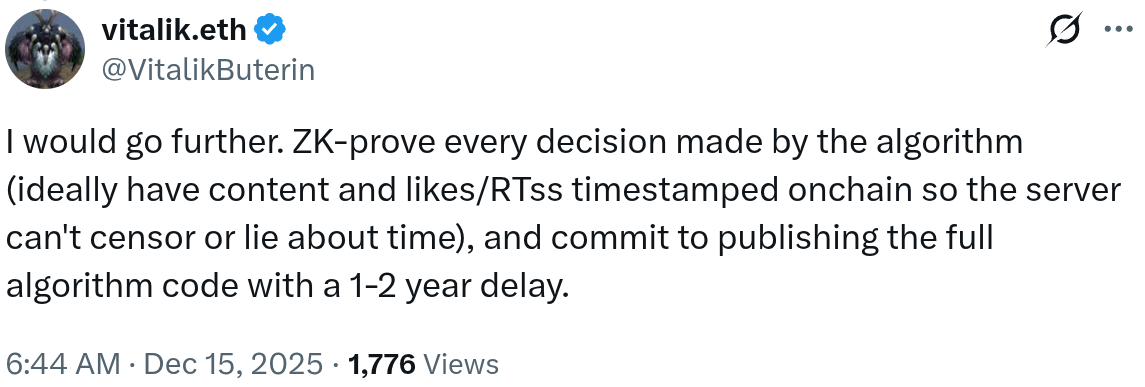
Source: Vitalik Buterin

ZK-proofs are a cryptographic way to prove that something is true without revealing the underlying data — for instance, proving that you are over 18 without sharing your full name. Buterin did not go into detail about what proofs would demonstrate in his suggested solution, but they would likely show that algorithmic decisions followed certain constraints without sharing sensitive details.

Related: Sunlight is more effective than censorship

Crypto takes on social media

Buterin’s post echoed the sentiment behind some decentralized social media platforms known as SocialFi. Such initiatives, despite none having reached mainstream adoption, appear to be taken seriously by their traditional centralized equivalents.

In early 2025, Meta, the parent company of Facebook and Instagram, blocked links to a decentralized Instagram competitor called Pixelfed. All links to the platform were labeled as “spam” and removed immediately. Others claimed that Facebook competitors, including Mastodon, were given the same treatment.

The crypto community — with its tendency to be wary of centralized control — has raised concerns about the potential impact of decisions made by social media platform leadership in the past. When Musk announced in early January that X would prioritize promoting content deemed informative or educational over other types of content, many were not convinced.

Critics questioned who would decide what qualifies and whether the policy could become a vehicle for suppressing certain viewpoints. Musk has also been accused by critics of limiting access to premium features for users who disagreed with him.

Buterin also chimed in at the time. He urged Musk to remain committed to free speech on the platform and not ban users for disagreements or expressing views.

Related: Buterin says X’s new location feature ‘risky’ as crypto users flag privacy concerns

The impact of social media on society

Research has long shown that social media has an outsized impact on society and the functioning of democratic processes. A paper published in 2024 suggested that “access to Facebook may increase belief in misinformation.”

Reuters also reported last month that recent court filings suggested that Meta shut down internal research into the mental health effects of Facebook after finding causal evidence that its products harmed users’ mental health. The study found that “people who stopped using Facebook for a week reported lower feelings of depression, anxiety, loneliness, and social comparison.”

The European Union attempted to tackle the issue with its Digital Services Act, which requires transparency on the main algorithm parameters and requires platforms to assess the risk and disclose the findings on the potential negative impact of their operations. Impacts considered explicitly include “negative effects on civic discourse and electoral processes, and public security.”

The Digital Services Act also requires that vetted researchers be given access to platform data to study their systemic risk independently. A lack of compliance by X with this specific requirement is among the reasons cited by the European Commission for imposing a 120 million euro fine earlier this month.

Other reasons include a lack of transparency on X’s ads repository and the platform’s blue checkmark purportedly deceiving users since “anyone can pay to obtain the ‘verified’ status without the company meaningfully verifying who is behind the account.”

Crypto di tendenza

Letture associate

The Verdict in Choi Tae-won's Divorce Case: Revealing the Inheritance Undercurrent Behind SK Hynix's Trillion-Won Empire

SK Group Chairman Chey Tae-won's high-profile divorce case, involving a record 1.38 trillion won settlement, has drawn attention to the succession plans for Korea's second-largest conglomerate, especially its crown jewel, SK hynix. Unlike traditional chaebol scripts centered on the eldest son, Chey's three children from his marriage to former President Roh Tae-woo's daughter, Roh Soh-yeong, are carving distinct, non-traditional paths. Eldest daughter Chey Yun-jung (b. 1989) is seen as the most evident successor. With a scientific and consulting background, she holds executive roles at SK bioscience and SK Inc.'s growth support department, focusing on future strategy and biopharma. Her marriage is to an AI infrastructure entrepreneur, not a traditional business alliance. Second daughter Chey Min-jung (b. 1991) took a unique route, voluntarily serving as a South Korean naval officer, including an anti-piracy deployment. She later worked on policy and strategy for SK hynix in Washington D.C. before co-founding an AI-driven healthcare startup. She married a former U.S. Marine Corps officer, connecting her to U.S. defense and policy circles—networks crucial for a global semiconductor giant. The only son, Chey In-geun (b. 1995), who studied physics like his father, worked briefly at SK E&S before joining McKinsey. Despite fitting the traditional "heir" profile as the eldest son, he remains silent and holds no public position or shares in SK, suggesting the old succession playbook is obsolete. As SK hynix's valuation soars, becoming a geopolitical asset in the AI era, the heirs' legitimacy is no longer automatic. They must prove themselves in fields like AI biotech, global policy, and strategic consulting. Their marriages also reflect new elite networks in tech and defense, not old political alliances. Their inheritance is the complex challenge of navigating a globalized, tech-driven world, not just a corporate throne.

marsbitIeri 09:06

The Verdict in Choi Tae-won's Divorce Case: Revealing the Inheritance Undercurrent Behind SK Hynix's Trillion-Won Empire

marsbitIeri 09:06

From OpenSea to OpenRouter: Is Alex Atallah Repeating His 'Exit at the Peak' Playbook?

From OpenSea to OpenRouter: Is Alex Atallah Repeating His "Exit at the Peak" Playbook? According to the Wall Street Journal, payments giant Stripe is in talks to acquire the AI model aggregation platform OpenRouter in a potential deal valuing the company near $100 billion. This would mark founder Alex Atallah's second creation of a company reaching a $100 billion valuation, following his co-founding of NFT marketplace OpenSea. OpenRouter, founded just over three years ago, has grown rapidly by acting as a unified gateway for developers to access over 400 AI models. It currently has about 10 million users and processes over 200 trillion tokens monthly. While the platform's annualized revenue is around $50 million, its valuation has skyrocketed from $1.3 billion in March 2026. The potential acquisition by Stripe, a company OpenRouter's founder once likened it to, represents a major expansion into AI infrastructure for the payments leader. This move echoes Atallah's previous timing with OpenSea, where he departed before the NFT market's significant downturn. For OpenRouter, selling now may be strategic. Despite its scale, its business model—charging a 5-5.5% fee on AI inference calls—faces pressure from competition, open-source models, and potential price wars among model providers, limiting its profitability narrative for an IPO. A key asset for potential acquirers like Stripe is OpenRouter's vast repository of real-world AI usage data, which offers unique insights into model performance and developer preferences that are difficult to replicate. Whether this potential deal signifies a new valuation benchmark for AI infrastructure or another market peak signal remains to be seen.

链捕手Ieri 08:42

From OpenSea to OpenRouter: Is Alex Atallah Repeating His 'Exit at the Peak' Playbook?

链捕手Ieri 08:42

Trading

Spot

Articoli Popolari

Come comprare ZK

Benvenuto in HTX.com! Abbiamo reso l'acquisto di ZKsync (ZK) semplice e conveniente. Segui la nostra guida passo passo per intraprendere il tuo viaggio nel mondo delle criptovalute.Step 1: Crea il tuo Account HTXUsa la tua email o numero di telefono per registrarti il tuo account gratuito su HTX. Vivi un'esperienza facile e sblocca tutte le funzionalità,Crea il mio accountStep 2: Vai in Acquista crypto e seleziona il tuo metodo di pagamentoCarta di credito/debito: utilizza la tua Visa o Mastercard per acquistare immediatamente ZKsyncZK.Bilancio: Usa i fondi dal bilancio del tuo account HTX per fare trading senza problemi.Terze parti: abbiamo aggiunto metodi di pagamento molto utilizzati come Google Pay e Apple Pay per maggiore comodità.P2P: Fai trading direttamente con altri utenti HTX.Over-the-Counter (OTC): Offriamo servizi su misura e tassi di cambio competitivi per i trader.Step 3: Conserva ZKsync (ZK)Dopo aver acquistato ZKsync (ZK), conserva nel tuo account HTX. In alternativa, puoi inviare tramite trasferimento blockchain o scambiare per altre criptovalute.Step 4: Scambia ZKsync (ZK)Scambia facilmente ZKsync (ZK) nel mercato spot di HTX. Accedi al tuo account, seleziona la tua coppia di trading, esegui le tue operazioni e monitora in tempo reale. Offriamo un'esperienza user-friendly sia per chi ha appena iniziato che per i trader più esperti.

205 Totale visualizzazioniPubblicato il 2024.12.13Aggiornato il 2026.06.02

Come comprare ZK

Discussioni

Benvenuto nella Community HTX. Qui puoi rimanere informato sugli ultimi sviluppi della piattaforma e accedere ad approfondimenti esperti sul mercato. Le opinioni degli utenti sul prezzo di ZK ZK sono presentate come di seguito.

活动图片