Vitalik Buterin pitches ZK-proofs to audit X algorithm and rankings

cointelegraphPubblicato 2025-12-15Pubblicato ultima volta 2025-12-15

Introduzione

Vitalik Buterin, co-founder of Ethereum, has proposed that social media platform X use zero-knowledge proofs (ZK-proofs) and blockchain technology to make its content-ranking algorithm transparent and verifiable. He argues this would prove the fairness of algorithmic decisions, prevent censorship, and ensure data integrity by timestamping content on-chain. Buterin also suggests publishing the full algorithm code with a 1-2 year delay. His comments follow criticism of Elon Musk’s leadership and X’s opaque content policies. The proposal aligns with broader SocialFi and decentralized social media principles, emphasizing the need for transparency amid growing regulatory scrutiny, such as the EU’s Digital Services Act, which recently fined X for non-compliance. Buterin’s stance highlights concerns about social media’s impact on free speech and misinformation.

Ethereum co-founder Vitalik Buterin is calling for social media platforms to use cryptography and blockchain tools to make their content-ranking systems more transparent and verifiable.

In a Monday X post, Buterin argued that X should use zero-knowledge proofs (ZK-proofs) and blockchain to prove the fairness of the algorithm that determines the reach of content on the platform. He raised an issue with how X operates on Dec. 9, claiming that its owner Elon Musk’s way of leading it is harmful:

“Elon Musk I think you should consider that making X a global totem pole for free speech, and then turning it into a death star laser for coordinated hate sessions, is actually harmful for the cause of free speech.“

Ethereum Foundation AI lead Davide Crapis reacted to this initial idea by saying, “If you want to claim X is the platform for free speech, you should disclose your algorithm optimization targets.” He added that “it should be legible to the users, and tweakable.”

Buterin suggested a verifiable system that employs ZK-proofs for every decision made by the algorithm and timestamps all content, likes, and retweets on a blockchain “so the server can’t censor or lie about time.” The platform should also “commit to publishing the full algorithm code with a 1-2 year delay.”
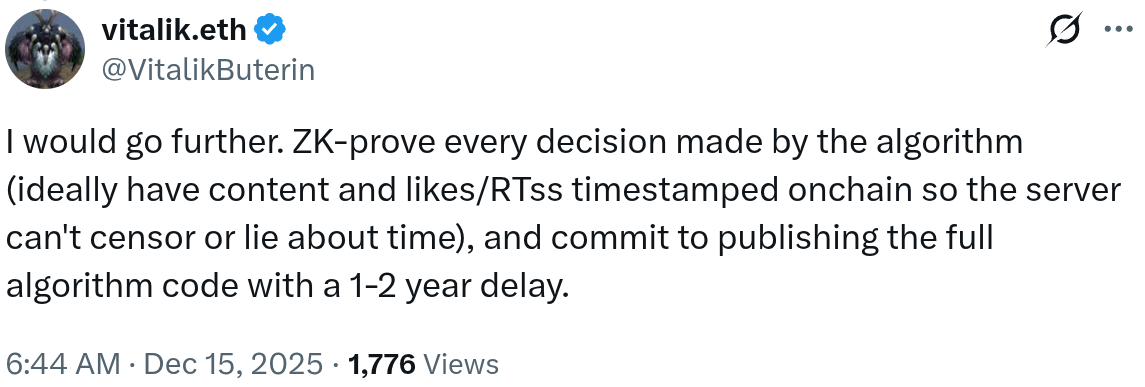
Source: Vitalik Buterin

ZK-proofs are a cryptographic way to prove that something is true without revealing the underlying data — for instance, proving that you are over 18 without sharing your full name. Buterin did not go into detail about what proofs would demonstrate in his suggested solution, but they would likely show that algorithmic decisions followed certain constraints without sharing sensitive details.

Related: Sunlight is more effective than censorship

Crypto takes on social media

Buterin’s post echoed the sentiment behind some decentralized social media platforms known as SocialFi. Such initiatives, despite none having reached mainstream adoption, appear to be taken seriously by their traditional centralized equivalents.

In early 2025, Meta, the parent company of Facebook and Instagram, blocked links to a decentralized Instagram competitor called Pixelfed. All links to the platform were labeled as “spam” and removed immediately. Others claimed that Facebook competitors, including Mastodon, were given the same treatment.

The crypto community — with its tendency to be wary of centralized control — has raised concerns about the potential impact of decisions made by social media platform leadership in the past. When Musk announced in early January that X would prioritize promoting content deemed informative or educational over other types of content, many were not convinced.

Critics questioned who would decide what qualifies and whether the policy could become a vehicle for suppressing certain viewpoints. Musk has also been accused by critics of limiting access to premium features for users who disagreed with him.

Buterin also chimed in at the time. He urged Musk to remain committed to free speech on the platform and not ban users for disagreements or expressing views.

Related: Buterin says X’s new location feature ‘risky’ as crypto users flag privacy concerns

The impact of social media on society

Research has long shown that social media has an outsized impact on society and the functioning of democratic processes. A paper published in 2024 suggested that “access to Facebook may increase belief in misinformation.”

Reuters also reported last month that recent court filings suggested that Meta shut down internal research into the mental health effects of Facebook after finding causal evidence that its products harmed users’ mental health. The study found that “people who stopped using Facebook for a week reported lower feelings of depression, anxiety, loneliness, and social comparison.”

The European Union attempted to tackle the issue with its Digital Services Act, which requires transparency on the main algorithm parameters and requires platforms to assess the risk and disclose the findings on the potential negative impact of their operations. Impacts considered explicitly include “negative effects on civic discourse and electoral processes, and public security.”

The Digital Services Act also requires that vetted researchers be given access to platform data to study their systemic risk independently. A lack of compliance by X with this specific requirement is among the reasons cited by the European Commission for imposing a 120 million euro fine earlier this month.

Other reasons include a lack of transparency on X’s ads repository and the platform’s blue checkmark purportedly deceiving users since “anyone can pay to obtain the ‘verified’ status without the company meaningfully verifying who is behind the account.”


Letture associate

Can a Hair Dryer Earn $34,000? Deciphering the Reflexivity Paradox in Prediction Markets

An individual manipulated a weather sensor at Paris Charles de Gaulle Airport with a portable heat source, causing a Polymarket weather market to settle at 22°C and earning $34,000. This incident highlights a fundamental issue in prediction markets: when a market aims to reflect reality, it also incentivizes participants to influence that reality. Prediction markets operate on two layers: platform rules (what outcome counts as a win) and data sources (what actually happened). While most focus on rules, the real vulnerability lies in the data source. If reality is recorded through a specific source, influencing that source directly affects market settlement. The article categorizes markets by their vulnerability: 1. **Single-point physical data sources** (e.g., weather stations): Easily manipulated through physical interference. 2. **Insider information markets** (e.g., MrBeast video details): Insiders like team members use non-public information to trade. Kalshi fined a剪辑师 $20,000 for insider trading. 3. **Actor-manipulated markets** (e.g., Andrew Tate’s tweet counts): The subject of the market can control the outcome. Evidence suggests Tate’sociated accounts coordinated to profit. 4. **Individual-action markets** (e.g., WNBA disruptions): A single person can execute an event to profit from their pre-placed bets. Kalshi and Polymarket handle these issues differently. Kalshi enforces strict KYC, publicly penalizes insider trading, and reports to regulators. Polymarket, with its anonymous wallet-based system, has historically been more permissive, arguing that insider information improves market accuracy. However, it cooperated with authorities in the "Van Dyke case," where a user traded on classified government information. The core paradox is reflexivity: prediction markets are designed to discover truth, but their financial incentives can distort reality. The more valuable a prediction becomes, the more likely participants are to influence the event itself. The market ceases to be a mirror of reality and instead shapes it.

marsbit4 min fa

Can a Hair Dryer Earn $34,000? Deciphering the Reflexivity Paradox in Prediction Markets

marsbit4 min fa

First Day Review of "Musk's WeChat" XChat: Even Worse Than Expected

Elon Musk's much-anticipated "WeChat-like" app, XChat, has officially launched after multiple delays. The initial review reveals a product that falls short of expectations, offering an experience largely similar to X Platform's (formerly Twitter) direct messages, despite being marketed as an encrypted communication tool. Key observations from the first-day test include: 1. The app's promoted "end-to-end encryption" and its claimed relation to Bitcoin's architecture were criticized by experts as a superficial attempt to capitalize on crypto buzz, with no real technical connection. 2. Musk's vision of an ad-free "secure communication system" is technically met, but only because the app is currently extremely basic, featuring only a single chat interface. 3. A promised anti-screenshot feature appears inconsistent; it works in X Platform group chats but fails within the XChat app itself, where screenshots still capture avatars. 4. The app supports 45 languages and has a 16+ age rating, indicating a broader tolerance for content compared to WeChat's 13+ rating. 5. A puzzling login process requires users to verify the email associated with their X account. 6. The touted encryption" feels minimal in practice, with its presence only indicated by a simple "Encrypted - Yes" label on messages. 7. Disappearing message timers for groups can be set from 5 minutes to 4 weeks, with the timer starting upon being read by a user. 8. Group invite links are shared with X Platform groups. 9. Group size limits are planned to be increased, aiming for 1000 members, a move that has drawn user criticism. 10. The app offers 8 different colored icons, and its chat bubbles are notably similar to WeChat's. Message deletion options mimic Telegram's. Crucially, many pre-announced features like importing X contacts, integrating Grok AI, X Money payments, and Cashtags are not yet available. The initial release is seen as a bare-bones and underwhelming first step.

Odaily星球日报1 h fa

First Day Review of "Musk's WeChat" XChat: Even Worse Than Expected

Odaily星球日报1 h fa

Trading

Spot
Futures

Articoli Popolari

Come comprare ZK

Benvenuto in HTX.com! Abbiamo reso l'acquisto di ZKsync (ZK) semplice e conveniente. Segui la nostra guida passo passo per intraprendere il tuo viaggio nel mondo delle criptovalute.Step 1: Crea il tuo Account HTXUsa la tua email o numero di telefono per registrarti il tuo account gratuito su HTX. Vivi un'esperienza facile e sblocca tutte le funzionalità,Crea il mio accountStep 2: Vai in Acquista crypto e seleziona il tuo metodo di pagamentoCarta di credito/debito: utilizza la tua Visa o Mastercard per acquistare immediatamente ZKsyncZK.Bilancio: Usa i fondi dal bilancio del tuo account HTX per fare trading senza problemi.Terze parti: abbiamo aggiunto metodi di pagamento molto utilizzati come Google Pay e Apple Pay per maggiore comodità.P2P: Fai trading direttamente con altri utenti HTX.Over-the-Counter (OTC): Offriamo servizi su misura e tassi di cambio competitivi per i trader.Step 3: Conserva ZKsync (ZK)Dopo aver acquistato ZKsync (ZK), conserva nel tuo account HTX. In alternativa, puoi inviare tramite trasferimento blockchain o scambiare per altre criptovalute.Step 4: Scambia ZKsync (ZK)Scambia facilmente ZKsync (ZK) nel mercato spot di HTX. Accedi al tuo account, seleziona la tua coppia di trading, esegui le tue operazioni e monitora in tempo reale. Offriamo un'esperienza user-friendly sia per chi ha appena iniziato che per i trader più esperti.

166 Totale visualizzazioniPubblicato il 2024.12.13Aggiornato il 2025.03.21

Come comprare ZK

Discussioni

Benvenuto nella Community HTX. Qui puoi rimanere informato sugli ultimi sviluppi della piattaforma e accedere ad approfondimenti esperti sul mercato. Le opinioni degli utenti sul prezzo di ZK ZK sono presentate come di seguito.

活动图片












