Visca Crypto! Top Exchange Signs 5-Year Agreement With Spanish Giant FC Barcelona

bitcoinistPubblicato 2026-04-24Pubblicato ultima volta 2026-04-24

Introduzione

European cryptocurrency exchange WhiteBIT has renewed its strategic partnership with FC Barcelona for an additional five years, extending their collaboration until 2030. As the club's Official Cryptocurrency Exchange Partner, WhiteBIT will expand its role across Barça's men's first team, women's team, and basketball team, while also partnering with the Barça Innovation Hub. The alliance aims to integrate cryptocurrency into the sports ecosystem by developing practical applications for millions of fans worldwide. Initiatives include a co-branded debit card, fan engagement programs, and digital education efforts. The partnership seeks to bridge the gap between technology and sports, moving crypto beyond the industry into everyday use.

European crypto exchange WhiteBIT has unveiled a five-year agreement with FC Barcelona to extend its strategic alliance, aiming to take digital assets beyond the industry and support global innovation in sports.

WhiteBIT Until 2030, Here We Go!

On Friday, Spanish football giant FC Barcelona and crypto exchange WhiteBIT announced the renewal of their partnership. The club, also known as Barça, has signed a partnership agreement with Europe’s largest crypto exchange by traffic volume for an additional 5 years.

WhiteBIT has collaborated with Barça since 2022 and will remain one of the club’s Global Partners and its Official Cryptocurrency Exchange Partner until 2030. Last year, the exchange displayed the name of its first International Crypto Trading Cup (ICTC 2025) winner on the LED boards during El Clásico, Spain’s biggest football match between Real Madrid and Barcelona.

According to the announcement, the strategic alliance will bring together the crypto world and FC Barcelona to “set new standards for how technology is integrated into global ecosystems and how the future relationship between digital finance, fans and sport takes shape.”
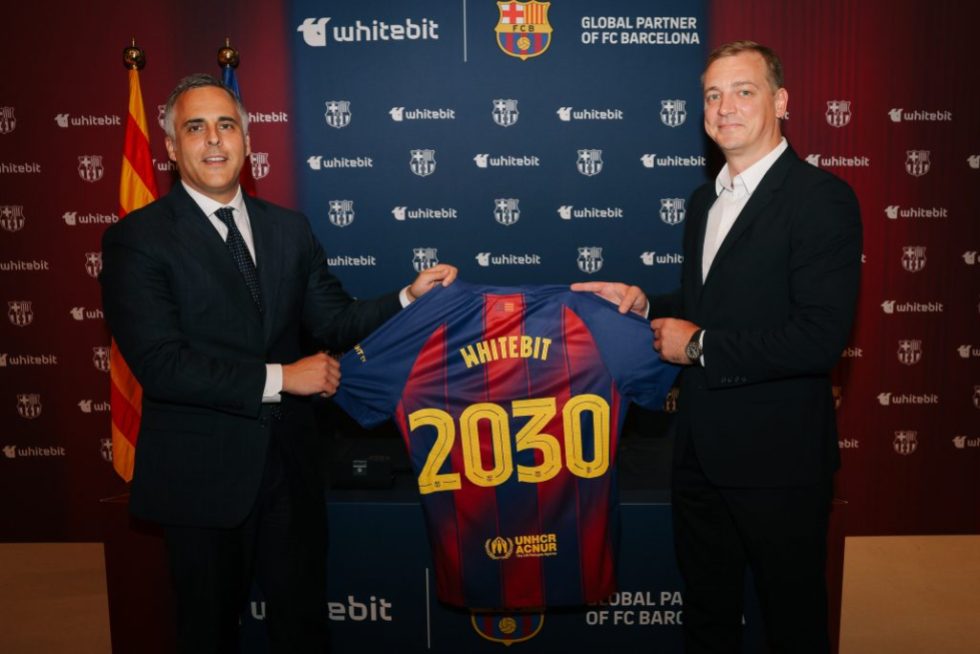
WhiteBIT and FC Barcelona's CEOs unveil five-year partnership agreement. Source: WhiteBIT

Following the partnership extension, WhiteBIT will also take on an expanded role across FC Barcelona’s men’s first team, women’s team, and basketball team. In addition, it will partner with the Barça Innovation Hub (BIHUB).

Manel del Río, CEO of FC Barcelona, affirmed that the renewal strengthens Barça’s commitment to strategic alliances with globally leading companies:

This renewal highlights the strength and appeal of our brand, as well as our ability to connect with innovative sectors. In this case, the cryptocurrency sector, a growing field with significant strategic potential for the coming years.

Meanwhile, Volodymyr Nosov, President and Founder of W Group, which includes WhiteBIT, emphasized the exchange’s mission to support mass crypto adoption “by bringing technology to everyone, everywhere.”

Taking Crypto Beyond The Industry

The alliance seeks to make cryptocurrencies a “practical, everyday tool for millions of fans around the world,” the announcement noted, moving the partnership beyond visibility to execution by developing real-world crypto applications designed to scale across the sports industry.

Therefore, both brands will collaborate on new initiatives, including fan engagement, digital education, and interactive experiences, with the goal of bridging the gap between technology and the global audience.

“Together with Barça, we are taking crypto beyond the industry and into everyday life—creating experiences that millions of fans can actually use. This is how adoption happens,” Nosov stated.

Notably, they will introduce an FC Barcelona-themed design for the exchange’s WhiteBIT Nova debit card, allowing fans to personalize their card with the club’s visual identity. The card will also offer benefits beyond the design update, including special features and future partner advantages linked to the collaboration.

Moreover, WhiteBIT has launched a promotion to give away 52 Spotify Camp Nou tickets for El Clásico on May 10, 2026. Users must complete a series of actions on the exchange between April 24 and May 4 for a chance to win.

As of this writing, WhiteBIT’s token, WBT, is trading at $55.4, a 1.1% increase in the monthly timeframe.
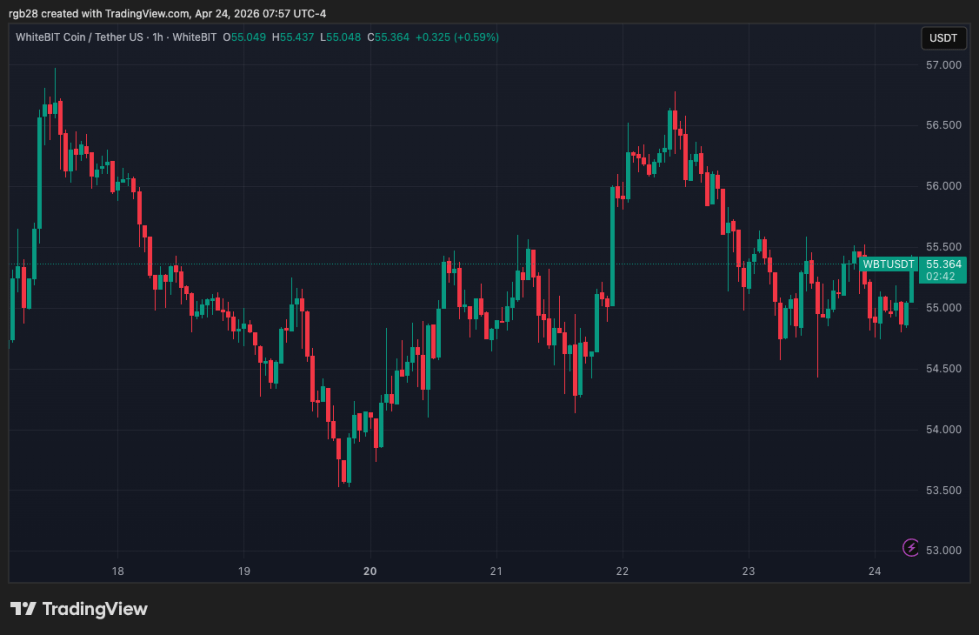
WBT's performance in the one-week chart. Source: WBTUSDT on TradingView


Domande pertinenti

QWhat is the duration of the renewed partnership between WhiteBIT and FC Barcelona?

AThe renewed partnership between WhiteBIT and FC Barcelona is for an additional 5 years, extending their alliance until 2030.

QWhich specific teams within FC Barcelona will WhiteBIT have an expanded role with following the partnership extension?

AFollowing the partnership extension, WhiteBIT will have an expanded role across FC Barcelona’s men’s first team, women’s team, and basketball team.

QWhat is the name of the FC Barcelona-themed product that WhiteBIT will introduce for its users?

AWhiteBIT will introduce an FC Barcelona-themed design for its WhiteBIT Nova debit card.

QWhat is one of the key goals of the strategic alliance between WhiteBIT and FC Barcelona, as stated in the announcement?

AOne of the key goals of the alliance is to make cryptocurrencies a practical, everyday tool for millions of fans and to develop real-world crypto applications designed to scale across the sports industry.

QWhat promotional activity is WhiteBIT running in relation to the El Clásico match in May 2026?

AWhiteBIT is running a promotion to give away 52 Spotify Camp Nou tickets for the El Clásico on May 10, 2026, where users must complete a series of actions on the exchange between April 24 and May 4 for a chance to win.

Letture associate

Annual Salary of Millions Competing for Electricians, Meta Rushes to Open Its Own Technical School

The AI boom is facing an unexpected bottleneck: a severe shortage of skilled construction workers and electricians. As tech giants like Meta, OpenAI, and Alphabet race to build massive data centers—such as OpenAI's $16 billion "Stargate" project—they are hitting a critical labor wall. The U.S. needs an estimated 130,000 more electricians, 240,000 construction workers, and 150,000 supervisors by 2030 for AI infrastructure alone, but tens of thousands of electrician jobs go unfilled each year. While AI companies offer high premiums, with electricians earning up to $280,000 annually, worker scarcity still causes massive losses—delays on a single project can cost $14.2 million per month. The complexity of building AI data centers, which require immense power (equivalent to powering hundreds of thousands of homes), sophisticated electrical systems, and advanced liquid cooling solutions, demands highly skilled technicians who are in short supply. To combat this, companies are investing heavily in training. Meta has committed $115 million to a free training school offering tuition, housing, and stipends, targeting 5,000 new workers. OpenAI is partnering with unions to secure skilled labor. These efforts are paying off, with a significant rise in Gen Z interest in trade schools over college. However, the power demands are staggering. AI data centers are driving a rapid surge in electricity consumption, projected to account for up to 12% of U.S. power use by 2028 and raising costs for consumers. Furthermore, the construction boom is project-based, leading to a potential future glut of trained workers once building peaks, which could depress wages industry-wide. The race for AI supremacy now depends as much on skilled hands as on advanced chips.

marsbit48 min fa

Annual Salary of Millions Competing for Electricians, Meta Rushes to Open Its Own Technical School

marsbit48 min fa

OpenAI No Longer Sells Its Most Expensive Model for Profit

OpenAI is shifting its business strategy away from promoting its most expensive, flagship models for every task. Recent price cuts—80% for GPT-5.6 Luna and 20% for Terra—signal a deeper change: the company now actively advises users that many tasks don't require the most powerful model. Instead, OpenAI recommends a tiered approach: use the high-end GPT-5.6 Sol for complex planning and analysis, then delegate execution to cheaper models like Luna. This mirrors moves by Anthropic, which recently launched Claude Opus 5 at half the price of its top model, Fable 5. Both companies are de-emphasizing flagship models as primary revenue drivers, using them instead for brand prestige and technological showcases. The industry is entering a "mass-market" phase, similar to automotive, where high-volume, cost-effective models handle daily operations and drive scale. OpenAI's price reductions are partly enabled by AI models themselves optimizing underlying code and infrastructure, creating a self-reinforcing cycle of efficiency gains and cost reduction. Competition is shifting from "who is smartest" to "who offers the best value." The goal is no longer selling individual models but fostering widespread API adoption and ecosystem lock-in. By making AI calls cheap and ubiquitous, companies like OpenAI aim to become the indispensable, utility-like infrastructure powering automated workflows—the "water and electricity" of software, quietly embedded everywhere.

marsbit48 min fa

OpenAI No Longer Sells Its Most Expensive Model for Profit

marsbit48 min fa

Will the Fed Definitely Raise Interest Rates in September? How Will Crypto and U.S. Stocks Withstand the Pressure?

The market's expectation for a September Fed rate hike surged dramatically in early August, jumping from under 50% to over 80% within a week. This shift followed a contentious July FOMC meeting, where a 9-3 vote to hold rates revealed growing dissent from hawkish members advocating for an immediate hike to combat persistent inflation. The primary catalyst for this repricing is rising oil prices, driven by renewed geopolitical tensions around the Strait of Hormuz, which threaten global supply. Energy costs directly influence inflation metrics, making the upcoming July CPI report (due August 12th) a critical data point. If it shows inflation reaccelerating, the probability of a September hike will solidify. For Bitcoin and crypto assets, this is typically bearish news. Bitcoin continues to behave as a high-beta, liquidity-sensitive risk asset. A rate hike raises the opportunity cost of holding non-yielding assets and could drive capital toward money markets, pressuring crypto prices in the short term. However, historical patterns suggest that if a hike is perceived as the end of a tightening cycle rather than the start, any negative price impact may be brief. U.S. stocks, particularly crypto-linked equities like Coinbase and growth-oriented tech stocks, are also vulnerable. Higher rates increase discount rates in valuation models, putting pressure on high-multiple companies. This coincides with a pivotal tech earnings season where investor focus has shifted from massive AI capital expenditure to tangible revenue and cash flow generation. Companies with negative cash flow and weak growth narratives could face heightened volatility if borrowing costs rise in September. In summary, a September Fed hike has evolved into a mainstream market scenario. Key factors to watch are oil prices, the July CPI report, and Fed communications, which will determine the final decision and its impact on volatile crypto and equity markets.

marsbit59 min fa

Will the Fed Definitely Raise Interest Rates in September? How Will Crypto and U.S. Stocks Withstand the Pressure?

marsbit59 min fa

Trading

Spot
活动图片




