Visa Brings Stablecoins To $1.7 Trillion Platform In BVNK Partnership

bitcoinistPubblicato 2026-01-15Pubblicato ultima volta 2026-01-15

Introduzione

Visa has partnered with stablecoin infrastructure provider BVNK to integrate stablecoin payments into its Visa Direct platform, a $1.7 trillion real-time global payout system. This collaboration aims to modernize money movement by reducing friction and providing faster, more efficient payment options, including during non-banking hours. Initially targeting markets with strong digital payment demand, the service will include stablecoin pre-funding and payouts. The partnership follows an investment by Visa Ventures in BVNK in May 2025. Both companies emphasize the transformative potential of stablecoins as a core payments infrastructure. This move comes as stablecoin adoption grows, with total transaction volume reaching a record $33 trillion in 2025, led by USDC and USDT.

Visa has partnered with BVNK to bring stablecoin payments to the Visa Direct platform, expanding its digital payments infrastructure.

BVNK Will Power Visa Direct’s Stablecoin Infrastructure

As announced in a Wednesday press release, BVNK and Visa have formed a strategic partnership to enable stablecoin payments on the latter’s Visa Direct platform. Based in the US, Visa is the second-largest card payment organization globally, behind only China’s UnionPay. In fact, when excluding China, the firm is the single largest, making up for 50% of total card payments.

Lately, Visa has been exploring digital asset payments, particularly those involving stablecoins, in a bid to modernize money movement. In 2025, the payments giant ran multiple stablecoin pilots related to Visa Direct, its $1.7 trillion real-time global payouts platform.

Now, it seems Visa has taken the next step by partnering with BVNK, a stablecoin infrastructure provider processing over $30 billion in payments annually. Mark Nelsen, Visa’s head of product, commercial, and money movement, said:

Stablecoins are an exciting opportunity for global payments, with enormous potential to reduce friction and expand access to faster, more efficient payment options – including during weekends, holidays and when banks are closed.

Starting with markets with strong demand for digital payments, BVNK will power a few different Visa Direct services, including stablecoin pre-funding and payouts. Visa’s new deal with BVNK hasn’t come out of the blue. Back in May 2025, Visa Ventures made an investment in the digital asset payments rail company. Jesse Hemson-Struthers, BVNK CEO, noted:

Visa and BVNK both believe in the transformational potential of stablecoin technology, not just as a payment method, but as a powerful layer of payments infrastructure.

Following the initial rollout, a broader global expansion of the service is planned, but so far, it’s unconfirmed which markets will be included, only that Visa will decide it based on “customer needs.” Stablecoins have witnessed growing adoption during the past year, as multiple countries have pushed on with legislation related to the sector. Among the most notable developments was the signing of the GENIUS Act by US President Donald Trump.

According to a report from Bloomberg, total stablecoin transaction volume rose 72% to $33 trillion in 2025, a new record.
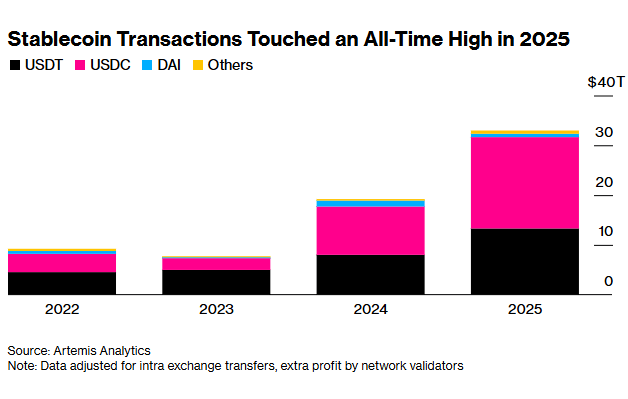
The breakdown of transactions across the major fiat-tied tokens | Source: Bloomberg

Tether’s USDT is the largest fiat-tied cryptocurrency based on market cap, with a valuation that’s more than double Circle’s USDC, but the latter still dominated in transactions during 2025. USDC made up for $18.3 trillion of the total volume, while USDT accounted for $13.3 trillion.

Together, the two tokens covered an extreme majority of the total volume last year, suggesting that activity related to other dollar-pegged tokens and non-USD stablecoins remained low.

Bitcoin Price

At the time of writing, Bitcoin is trading around $95,000, up more than 3% over the past week.

Looks like the price of the coin has surged over the past day | Source: BTCUSDT on TradingView

Domande pertinenti

QWhat is the main purpose of the partnership between Visa and BVNK?

AThe partnership aims to enable stablecoin payments on Visa's $1.7 trillion Visa Direct platform, expanding its digital payments infrastructure.

QHow much payment volume does BVNK process annually according to the article?

ABVNK processes over $30 billion in payments annually.

QWhich two stablecoins dominated transaction volume in 2025, and what were their respective volumes?

AUSDC dominated with $18.3 trillion in transaction volume, while USDT accounted for $13.3 trillion in 2025.

QWhat significant development in US stablecoin legislation is mentioned in the article?

AThe signing of the GENIUS Act by US President Donald Trump was mentioned as a significant development in stablecoin legislation.

QWhat was Bitcoin's approximate price and weekly performance at the time of writing?

ABitcoin was trading around $95,000, up more than 3% over the past week.

Letture associate

OpenAI Post-Training Engineer Weng Jiayi Proposes a New Paradigm Hypothesis for Agentic AI

OpenAI engineer Weng Jiayi's "Heuristic Learning" experiments propose a new paradigm for Agentic AI, suggesting that intelligent agents can improve not just by training neural networks, but also by autonomously writing and refining code based on environmental feedback. In the experiment, a coding agent (powered by Codex) was tasked with developing and maintaining a programmatic strategy for the Atari game Breakout. Starting from a basic prompt, the agent iteratively wrote code, ran the game, analyzed logs and video replays to identify failures, and then modified the code. Through this engineering loop of "code-run-debug-update," it evolved a pure Python heuristic strategy that achieved a perfect score of 864 in Breakout and performed competitively with deep reinforcement learning (RL) algorithms in MuJoCo control tasks like Ant and HalfCheetah. This approach, termed Heuristic Learning (HL), contrasts with Deep RL. In HL, experience is captured in readable, modifiable code, tests, logs, and configurations—a software system—rather than being encoded solely into opaque neural network weights. This offers potential advantages in explainability, auditability for safety-critical applications, easier integration of regression tests to combat catastrophic forgetting, and more efficient sample use in early learning stages, as demonstrated in broader tests on 57 Atari games. However, the blog acknowledges clear limitations. Programmatic strategies struggle with tasks requiring long-horizon planning or complex perception (e.g., Montezuma's Revenge), areas where neural networks excel. The future vision is a hybrid architecture: specialized neural networks for fast perception (System 1), HL systems for rules, safety, and local recovery (also System 1), and LLM agents providing high-level feedback and learning from the HL system's data (System 2). The core proposition is that in the era of capable coding agents, a significant portion of an AI's learned experience could be maintained as an auditable, evolving software system.

marsbit41 min fa

OpenAI Post-Training Engineer Weng Jiayi Proposes a New Paradigm Hypothesis for Agentic AI

marsbit41 min fa

Your Claude Will Dream Tonight, Don't Disturb It

This article explores the recent phenomenon of AI companies increasingly using anthropomorphic language—like "thinking," "memory," "hallucination," and now "dreaming"—to describe machine learning processes. Focusing on Anthropic's newly announced "Dreaming" feature for its Claude Agent platform, the piece explains that this function is essentially an automated, offline batch processing of an agent's operational logs. It analyzes past task sessions to identify patterns, optimize future actions, and consolidate learnings into a persistent memory system, akin to a form of reinforcement learning and self-correction. The article draws parallels to similar features in other AI agent systems like Hermes Agent and OpenClaw, which also implement mechanisms for reviewing historical data, extracting reusable "skills," and strengthening long-term memory. It notes a key difference from human dreaming: these AI "dreams" still consume computational resources and user tokens. Further context is provided by discussing the technical challenges of managing AI "memory" or context, highlighting the computational expense of large context windows and innovations like Subquadratic's new model claiming drastically longer contexts. The core critique argues that this strategic use of human-centric vocabulary does more than market products; it subtly reshapes user perception. By framing algorithms with terms associated with consciousness, companies blur the line between tool and autonomous entity. This linguistic shift can influence user expectations, tolerance for errors, and even perceptions of responsibility when systems fail, potentially diverting scrutiny from the companies and engineers behind the technology. The article concludes by speculating that terms like "daydreaming" for predictive task simulation might be next, continuing this trend of embedding the idea of an "inner life" into computational processes.

marsbit43 min fa

Your Claude Will Dream Tonight, Don't Disturb It

marsbit43 min fa

Trading

Spot
Futures
活动图片