Visa Brings Stablecoins To $1.7 Trillion Platform In BVNK Partnership

bitcoinistPubblicato 2026-01-15Pubblicato ultima volta 2026-01-15

Introduzione

Visa has partnered with stablecoin infrastructure provider BVNK to integrate stablecoin payments into its Visa Direct platform, a $1.7 trillion real-time global payout system. This collaboration aims to modernize money movement by reducing friction and providing faster, more efficient payment options, including during non-banking hours. Initially targeting markets with strong digital payment demand, the service will include stablecoin pre-funding and payouts. The partnership follows an investment by Visa Ventures in BVNK in May 2025. Both companies emphasize the transformative potential of stablecoins as a core payments infrastructure. This move comes as stablecoin adoption grows, with total transaction volume reaching a record $33 trillion in 2025, led by USDC and USDT.

Visa has partnered with BVNK to bring stablecoin payments to the Visa Direct platform, expanding its digital payments infrastructure.

BVNK Will Power Visa Direct’s Stablecoin Infrastructure

As announced in a Wednesday press release, BVNK and Visa have formed a strategic partnership to enable stablecoin payments on the latter’s Visa Direct platform. Based in the US, Visa is the second-largest card payment organization globally, behind only China’s UnionPay. In fact, when excluding China, the firm is the single largest, making up for 50% of total card payments.

Lately, Visa has been exploring digital asset payments, particularly those involving stablecoins, in a bid to modernize money movement. In 2025, the payments giant ran multiple stablecoin pilots related to Visa Direct, its $1.7 trillion real-time global payouts platform.

Now, it seems Visa has taken the next step by partnering with BVNK, a stablecoin infrastructure provider processing over $30 billion in payments annually. Mark Nelsen, Visa’s head of product, commercial, and money movement, said:

Stablecoins are an exciting opportunity for global payments, with enormous potential to reduce friction and expand access to faster, more efficient payment options – including during weekends, holidays and when banks are closed.

Starting with markets with strong demand for digital payments, BVNK will power a few different Visa Direct services, including stablecoin pre-funding and payouts. Visa’s new deal with BVNK hasn’t come out of the blue. Back in May 2025, Visa Ventures made an investment in the digital asset payments rail company. Jesse Hemson-Struthers, BVNK CEO, noted:

Visa and BVNK both believe in the transformational potential of stablecoin technology, not just as a payment method, but as a powerful layer of payments infrastructure.

Following the initial rollout, a broader global expansion of the service is planned, but so far, it’s unconfirmed which markets will be included, only that Visa will decide it based on “customer needs.” Stablecoins have witnessed growing adoption during the past year, as multiple countries have pushed on with legislation related to the sector. Among the most notable developments was the signing of the GENIUS Act by US President Donald Trump.

According to a report from Bloomberg, total stablecoin transaction volume rose 72% to $33 trillion in 2025, a new record.
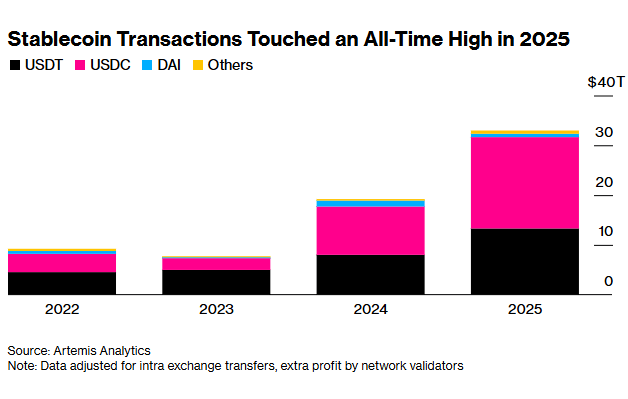
The breakdown of transactions across the major fiat-tied tokens | Source: Bloomberg

Tether’s USDT is the largest fiat-tied cryptocurrency based on market cap, with a valuation that’s more than double Circle’s USDC, but the latter still dominated in transactions during 2025. USDC made up for $18.3 trillion of the total volume, while USDT accounted for $13.3 trillion.

Together, the two tokens covered an extreme majority of the total volume last year, suggesting that activity related to other dollar-pegged tokens and non-USD stablecoins remained low.

Bitcoin Price

At the time of writing, Bitcoin is trading around $95,000, up more than 3% over the past week.

Looks like the price of the coin has surged over the past day | Source: BTCUSDT on TradingView


Domande pertinenti

QWhat is the main purpose of the partnership between Visa and BVNK?

AThe partnership aims to enable stablecoin payments on Visa's $1.7 trillion Visa Direct platform, expanding its digital payments infrastructure.

QHow much payment volume does BVNK process annually according to the article?

ABVNK processes over $30 billion in payments annually.

QWhich two stablecoins dominated transaction volume in 2025, and what were their respective volumes?

AUSDC dominated with $18.3 trillion in transaction volume, while USDT accounted for $13.3 trillion in 2025.

QWhat significant development in US stablecoin legislation is mentioned in the article?

AThe signing of the GENIUS Act by US President Donald Trump was mentioned as a significant development in stablecoin legislation.

QWhat was Bitcoin's approximate price and weekly performance at the time of writing?

ABitcoin was trading around $95,000, up more than 3% over the past week.

Letture associate

Anthropic Starts Poaching Scientists? $27K Weekly Onsite Stipend to Fix Claude's Expert-Level Errors

Anthropic has launched a new STEM Fellow program, offering $3,800 per week for a three-month, in-person residency in San Francisco. The role targets experts from science, technology, engineering, and mathematics (STEM) fields—machine learning experience is helpful but not required. Instead, Anthropic values scientific judgment and a willingness to learn quickly. Fellows will work with Claude models and internal tools under the guidance of an Anthropic researcher. Example projects include a materials scientist identifying errors in Claude’s reasoning or a climate scientist integrating atmospheric modeling software with Claude. The goal is to have experts "tell Claude where it's wrong" and improve its scientific capabilities. This initiative is part of Anthropic’s broader strategy to strengthen its scientific ecosystem, following earlier programs like the AI Safety Fellows and AI for Science programs. The company acknowledges that current AI models, while powerful, still produce high-confidence errors and lack end-to-end research autonomy. The program aims to embed domain expertise directly into model development, turning scientists into "high-level reviewers" for AI. Anthropic CEO Dario Amodei has previously emphasized AI’s potential to accelerate scientific breakthroughs, particularly in biology and healthcare. The company believes that the next phase of AI competition will depend not on scaling parameters, but on integrating human expertise to refine model accuracy and reliability.

marsbit27 min fa

Anthropic Starts Poaching Scientists? $27K Weekly Onsite Stipend to Fix Claude's Expert-Level Errors

marsbit27 min fa

On the Eve of X Money's Launch, Musk Dismantles the Referee First

"X Money Launches After Dismantling Regulator: Musk's 9-Day Power Play" In February 2025, a team from the "Department of Government Efficiency" (DOGE), led by Elon Musk, entered the Consumer Financial Protection Bureau (CFPB) headquarters. Shortly after, the CFPB was effectively dismantled—its funding frozen, activities suspended, and nearly 90% of staff laid off. This move came just nine days after X announced a partnership with Visa and as X Money prepared to launch. The article contrasts this with the decade-long regulatory battles faced by companies like Coinbase and PayPal. Coinbase spent over $75 million in political contributions and endured a major SEC lawsuit to operate legally. PayPal complied with strict state and federal rules for its stablecoin PYUSD, including 100% reserve requirements and monthly audits. However, Musk’s approach was different. After the CFPB introduced a rule placing large digital payment apps under federal oversight, Musk tweeted "Delete CFPB." Within months, the rule was revoked by Congress. Meanwhile, DOGE operatives gained "god-tier" access to CFPB databases, potentially obtaining sensitive competitive information from rivals like Apple, Google, and PayPal. The article also highlights a "suspicious exemption clause" in the GENIUS Act, which allows private companies like X to issue stablecoins with fewer restrictions. Senator Elizabeth Warren questioned whether Musk, who was a senior presidential advisor during the Act’s drafting, influenced this clause. X Money offers a 6% APY on deposits, despite FDIC warnings that stablecoin users are not insured. As X Money launches to 600 million monthly users, the article questions the fairness of a system where Musk can bypass regulations that others spent years and millions to comply with. The dismantling of the CFPB and the alleged regulatory advantages raise concerns about the future of equitable rule-making in the U.S. financial system.

marsbit36 min fa

On the Eve of X Money's Launch, Musk Dismantles the Referee First

marsbit36 min fa

Trading

Spot
Futures
活动图片