Venice Token climbs to $7 – Will VVV clear THIS supply zone?

ambcryptoPubblicato 2026-04-02Pubblicato ultima volta 2026-04-02

Introduzione

Venice Token (VVV) surged 14.55% to reach $7.06, supported by an 83.5% increase in trading volume to $45.42M. The price is now testing a key resistance level at $7.20, a historically significant supply zone. Technical indicators show a bullish structure with higher lows and a positive MACD crossover, suggesting potential for further upward movement. However, recent exchange inflows of $931.21K could introduce selling pressure. Short liquidations of $85.05K have reduced immediate downside pressure, but the market breakout depends on whether demand can absorb the increased supply near resistance.

Venice Token [VVV] climbed to $7.06 after a 14.55% daily gain, backed by rising participation and volume expansion.

Price approached a critical supply zone, keeping focus on whether buyers could extend the move.

Trading Volume rose 83.5% to $45.42M, reflecting stronger engagement behind the rally. However, the move neared a region that historically capped upside.

This left VVV at a key decision point, where structure and activity needed to align for continuation.

Can higher lows break resistance?

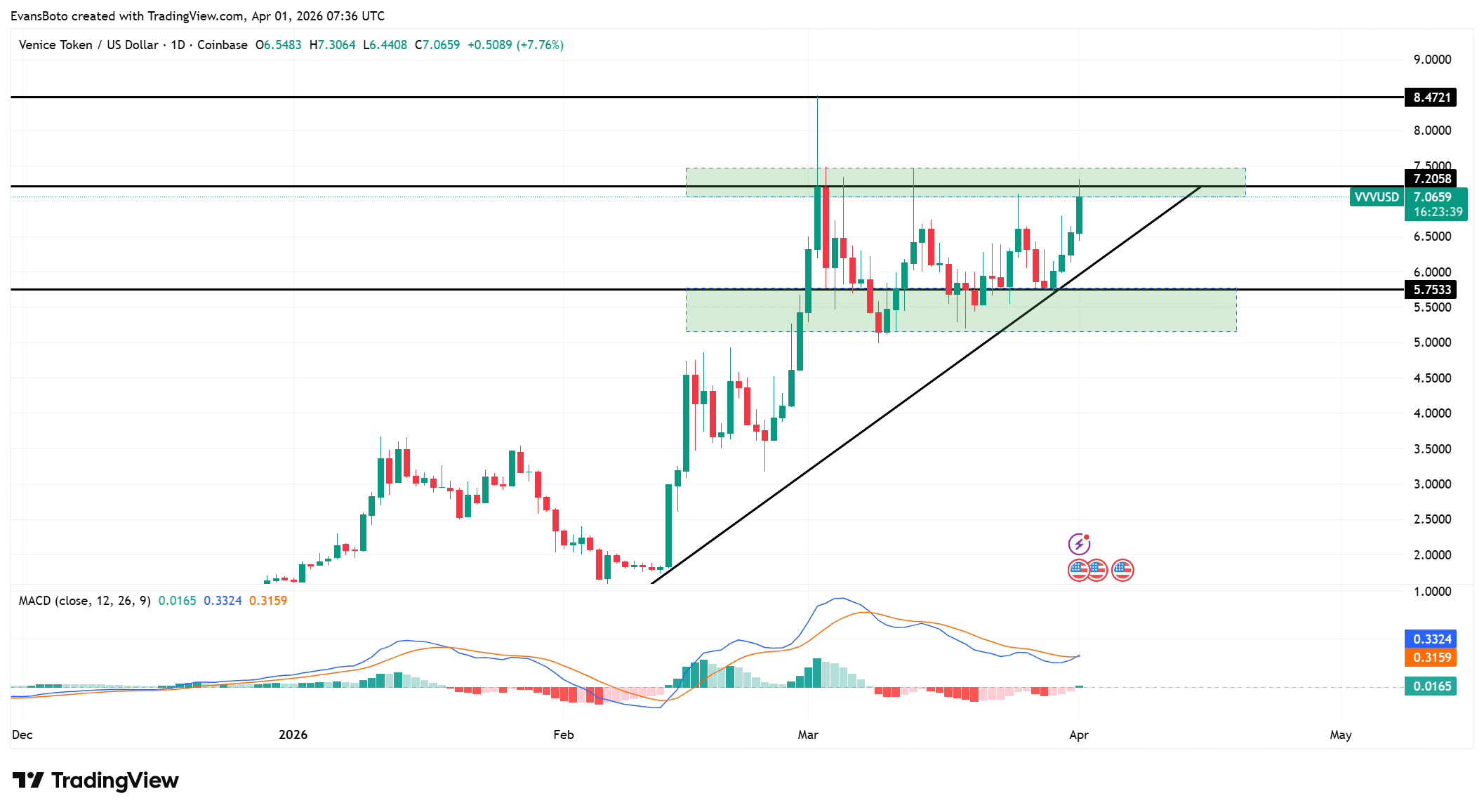
VVV formed a series of higher lows along an ascending trendline, keeping the broader structure intact.

Price compressed below the $7.20 resistance while holding above the $5.75 support. This structure showed buyers stepping in at higher levels, reinforcing upward pressure.

Even so, repeated resistance tests signaled supply remained active in this zone.

As price tightened near the upper boundary, the structure pointed toward a potential expansion. If the breakout holds, trendline support could drive continuation beyond resistance.

On top of that, MACD crossed above the signal line, with the histogram turning positive. This shift indicated strengthening bullish momentum behind the move.
Source: TradingView

Do VVV inflows signal selling pressure?

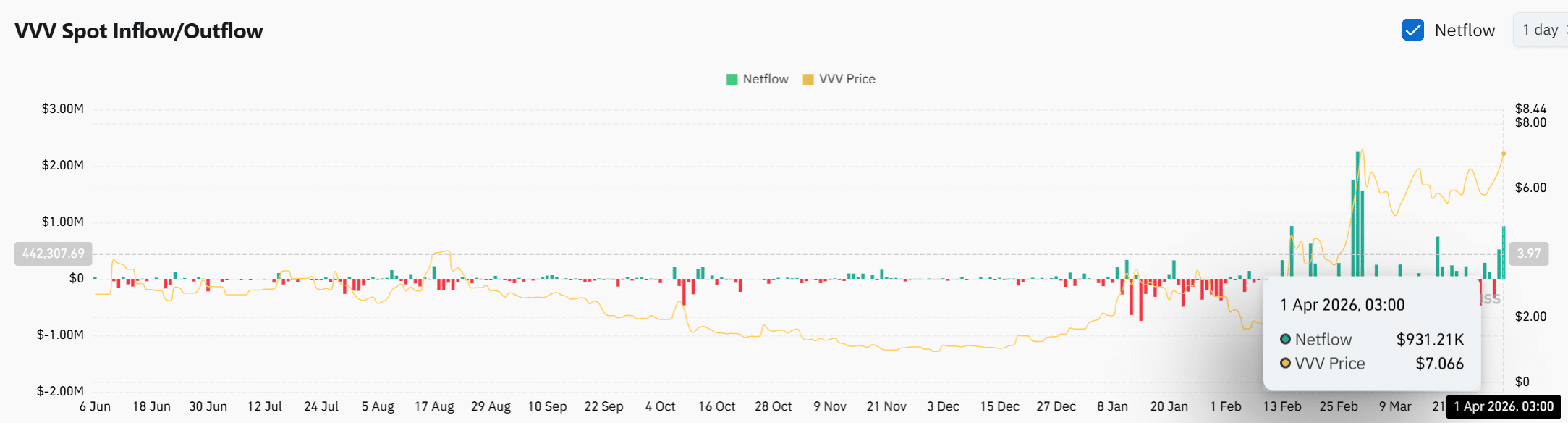
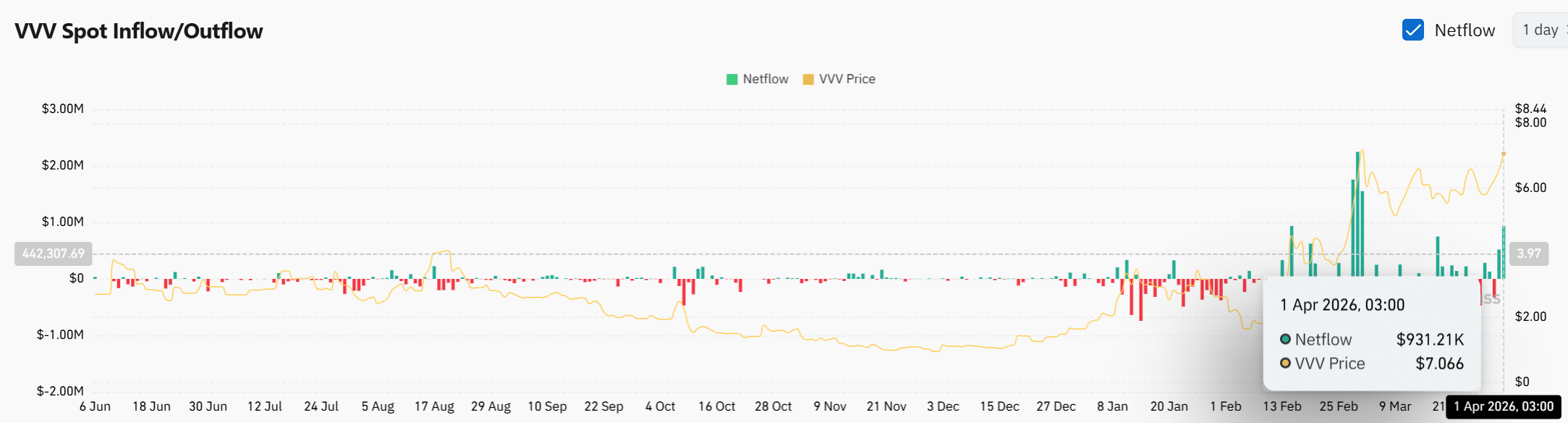
Spot Netflows have turned positive, with $931.21K in inflows recorded, marking a shift from prior outflow dominance.

This transition suggests that tokens are moving back onto exchanges, which introduces potential sell-side liquidity.

However, the timing of these inflows coincides with price testing resistance, which often reflects positioning adjustments rather than immediate distribution.

Exchange deposits increase available supply, yet they do not always translate into instant selling pressure.

As price holds near the upper range, these inflows create a layer of caution. The market now watches whether this added liquidity slows the rally or simply accompanies continued upward movement.
Source: CoinGlass

Short squeeze reshapes positioning

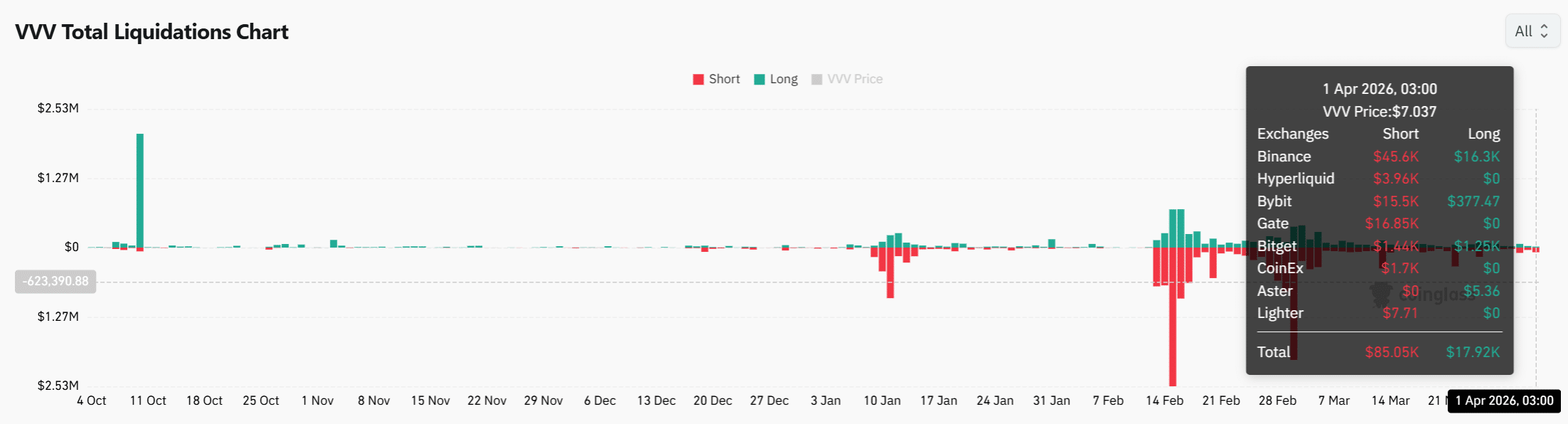
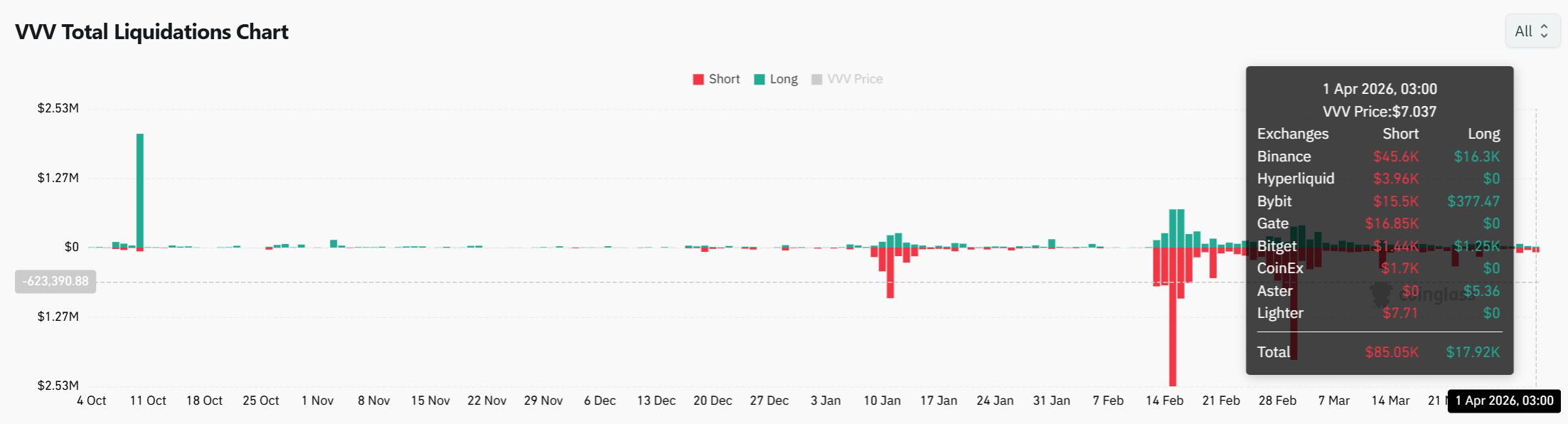
Liquidation data showed $85.05K in short liquidations versus $17.92K in long liquidations. This imbalance indicated that bearish positions faced stronger pressure.

That move aligned with a leverage reset, removing downside bets from the market.

When shorts unwind, forced buying can support the price and reduce selling pressure.

However, this also reduced immediate squeeze potential after weaker shorts exited. The liquidation profile suggested the market cleared fragile bearish positions.

As a result, price faced less resistance from leveraged downside pressure.
Source: CoinGlass

Can VVV sustain breakout?

VVV tested resistance as structure, indicators, and positioning aligned toward continuation.

Higher lows supported the trend, while MACD confirmed sustained momentum. Short liquidations reduced bearish pressure, keeping the path upward less contested.

Even so, rising exchange inflows introduced supply near resistance. If demand absorbed this supply, VVV could attempt a breakout beyond $7.20.


Final Summary

  • Venice Token [VVV] rose to $7.06, backed by a 14.55% daily gain and an 83.5% jump in Trading Volume.
  • Price approached the $7.20 resistance zone, a key level that previously capped upside.

Domande pertinenti

QWhat was the daily percentage gain that pushed Venice Token (VVV) to $7.06?

AThe daily gain was 14.55%.

QWhat is the critical resistance level that VVV price is approaching according to the article?

AThe critical resistance level is $7.20.

QHow much did the trading volume increase, and what was the new volume figure?

ATrading volume rose by 83.5% to $45.42 million.

QWhat technical indicator showed strengthening bullish momentum with a positive histogram?

AThe MACD indicator crossed above the signal line with a positive histogram, indicating strengthening bullish momentum.

QWhat does the shift to positive Spot Netflows of $931.21K suggest about token movement?

AThe positive Spot Netflows suggest that tokens are moving back onto exchanges, which introduces potential sell-side liquidity.

Letture associate

From Robinhood to Polymarket: Is the Era of Integrating All Assets on a Single Platform Coming?

From Robinhood to Polymarket: The Era of All-in-One Asset Platforms Is Coming Asset classes are rapidly converging. Platforms that once specialized in single categories—such as stocks, cryptocurrencies, or prediction markets—are now moving toward offering all three. Robinhood pioneered this model, starting with equities, adding crypto in 2018, and prediction markets in 2025. This strategy has proven resilient: when crypto revenues fell, other segments like options and stocks filled the gap. Now, prediction market leaders Polymarket and Kalshi are moving in the same direction, both announcing perpetual futures trading on April 21, 2026, pending regulatory approval. These futures will cover assets like Bitcoin, gold, and stocks such as Nvidia. This trend mirrors the consolidation seen in consumer tech, like smartphones replacing dedicated cameras and MP3 players. Younger users, accustomed to interacting with multiple asset types from an early age, will increasingly demand unified platforms. A key competitive advantage in prediction markets is collateral utilization—idle assets locked during betting periods. Polymarket’s move into perpetuals may be a strategy to generate yield from that capital, similar to earlier DeFi integrations like PolyAave. As the regulatory landscape evolves, traditional finance is also likely to incorporate crypto and prediction markets, further accelerating this convergence.

marsbit6 min fa

From Robinhood to Polymarket: Is the Era of Integrating All Assets on a Single Platform Coming?

marsbit6 min fa

OpenAI Goes Left, DeepSeek Goes Right

On April 24, 2026, DeepSeek released V4, a Chinese large language model offering a free "million-token context window," enabling it to process vast amounts of data like entire books or years of corporate documents in one go. In contrast, OpenAI’s GPT-5.5, released around the same time, is more powerful but significantly more expensive, charging up to $180 per million output tokens. DeepSeek’s strategy represents a shift from a pure AI research firm to a heavy-infrastructure player, building data centers in Inner Mongolia’s Ulanqab to bypass U.S. chip export restrictions. This move, supported by Huawei’s Ascend chips and China’s cheap green electricity, highlights a fundamental divergence in AI development models: U.S. firms focus on high-cost, high-margin services, while Chinese players like DeepSeek prioritize accessibility and affordability. Facing intense talent poaching from tech giants, DeepSeek is seeking a $44 billion valuation funding round to retain researchers and scale infrastructure. Meanwhile, Chinese manufacturers are compressing AI models to run on smartphones, making AI accessible offline and across the Global South. Through open-source models and localized solutions, Chinese AI is empowering non-English speakers and low-income users, driving a form of "digital equality." While Silicon Valley builds walled gardens, DeepSeek and others are turning AI into a public utility—like tap water—flowing freely to those previously left behind.

marsbit32 min fa

OpenAI Goes Left, DeepSeek Goes Right

marsbit32 min fa

$292 Million KelpDAO Cross-Chain Bridge Hack: Who Should Foot the Bill?

On April 18, 2026, an attacker stole 116,500 rsETH (worth ~$292M) from KelpDAO’s cross-chain bridge in 46 minutes—the largest DeFi exploit of 2026. The stolen assets were deposited into Aave V3 as collateral, causing $177–200M in bad debt and triggering a cascade of losses across nine DeFi protocols. Aave’s TVL dropped by ~$6B overnight. This legal analysis argues that KelpDAO and LayerZero Labs share concurrent liability, with fault apportioned 60%/40%. KelpDAO negligently configured its bridge with a 1-of-1 decentralized verifier network (DVN)—a single point of failure—despite LayerZero’s explicit recommendation of a 2-of-3 setup. LayerZero, which operated the compromised DVN, failed to secure its RPC infrastructure against a known poisoning attack vector. Both protocols’ terms of service cap liability at $200 (KelpDAO) or $50 (LayerZero), but these limits are likely unenforceable due to unconscionability, gross negligence exceptions, and potential securities law invalidation (if rsETH is deemed a security under the Howey test). Aave’s governance also faces fiduciary duty claims for raising rsETH’s loan-to-value ratio to 93%—far above competitors’ 72–75%—without adequately assessing bridge risks, amplifying the systemic fallout. Practical recovery targets include LayerZero Labs (a registered Canadian entity), KelpDAO’s founders, auditors, and identifiable Aave governance delegates. The incident underscores escalating legal risks for DeFi protocols, infrastructure providers, and governance participants.

marsbit1 h fa

$292 Million KelpDAO Cross-Chain Bridge Hack: Who Should Foot the Bill?

marsbit1 h fa

Trading

Spot
Futures

Articoli Popolari

Come comprare GAIN

Benvenuto in HTX.com! Abbiamo reso l'acquisto di GriffinAI (GAIN) semplice e conveniente. Segui la nostra guida passo passo per intraprendere il tuo viaggio nel mondo delle criptovalute.Step 1: Crea il tuo Account HTXUsa la tua email o numero di telefono per registrarti il tuo account gratuito su HTX. Vivi un'esperienza facile e sblocca tutte le funzionalità,Crea il mio accountStep 2: Vai in Acquista crypto e seleziona il tuo metodo di pagamentoCarta di credito/debito: utilizza la tua Visa o Mastercard per acquistare immediatamente GriffinAIGAIN.Bilancio: Usa i fondi dal bilancio del tuo account HTX per fare trading senza problemi.Terze parti: abbiamo aggiunto metodi di pagamento molto utilizzati come Google Pay e Apple Pay per maggiore comodità.P2P: Fai trading direttamente con altri utenti HTX.Over-the-Counter (OTC): Offriamo servizi su misura e tassi di cambio competitivi per i trader.Step 3: Conserva GriffinAI (GAIN)Dopo aver acquistato GriffinAI (GAIN), conserva nel tuo account HTX. In alternativa, puoi inviare tramite trasferimento blockchain o scambiare per altre criptovalute.Step 4: Scambia GriffinAI (GAIN)Scambia facilmente GriffinAI (GAIN) nel mercato spot di HTX. Accedi al tuo account, seleziona la tua coppia di trading, esegui le tue operazioni e monitora in tempo reale. Offriamo un'esperienza user-friendly sia per chi ha appena iniziato che per i trader più esperti.

303 Totale visualizzazioniPubblicato il 2025.09.24Aggiornato il 2025.09.24

Come comprare GAIN

Discussioni

Benvenuto nella Community HTX. Qui puoi rimanere informato sugli ultimi sviluppi della piattaforma e accedere ad approfondimenti esperti sul mercato. Le opinioni degli utenti sul prezzo di GAIN GAIN sono presentate come di seguito.

活动图片