Venice Token climbs to $7 – Will VVV clear THIS supply zone?

ambcryptoPubblicato 2026-04-02Pubblicato ultima volta 2026-04-02

Introduzione

Venice Token (VVV) surged 14.55% to reach $7.06, supported by an 83.5% increase in trading volume to $45.42M. The price is now testing a key resistance level at $7.20, a historically significant supply zone. Technical indicators show a bullish structure with higher lows and a positive MACD crossover, suggesting potential for further upward movement. However, recent exchange inflows of $931.21K could introduce selling pressure. Short liquidations of $85.05K have reduced immediate downside pressure, but the market breakout depends on whether demand can absorb the increased supply near resistance.

Venice Token [VVV] climbed to $7.06 after a 14.55% daily gain, backed by rising participation and volume expansion.

Price approached a critical supply zone, keeping focus on whether buyers could extend the move.

Trading Volume rose 83.5% to $45.42M, reflecting stronger engagement behind the rally. However, the move neared a region that historically capped upside.

This left VVV at a key decision point, where structure and activity needed to align for continuation.

Can higher lows break resistance?

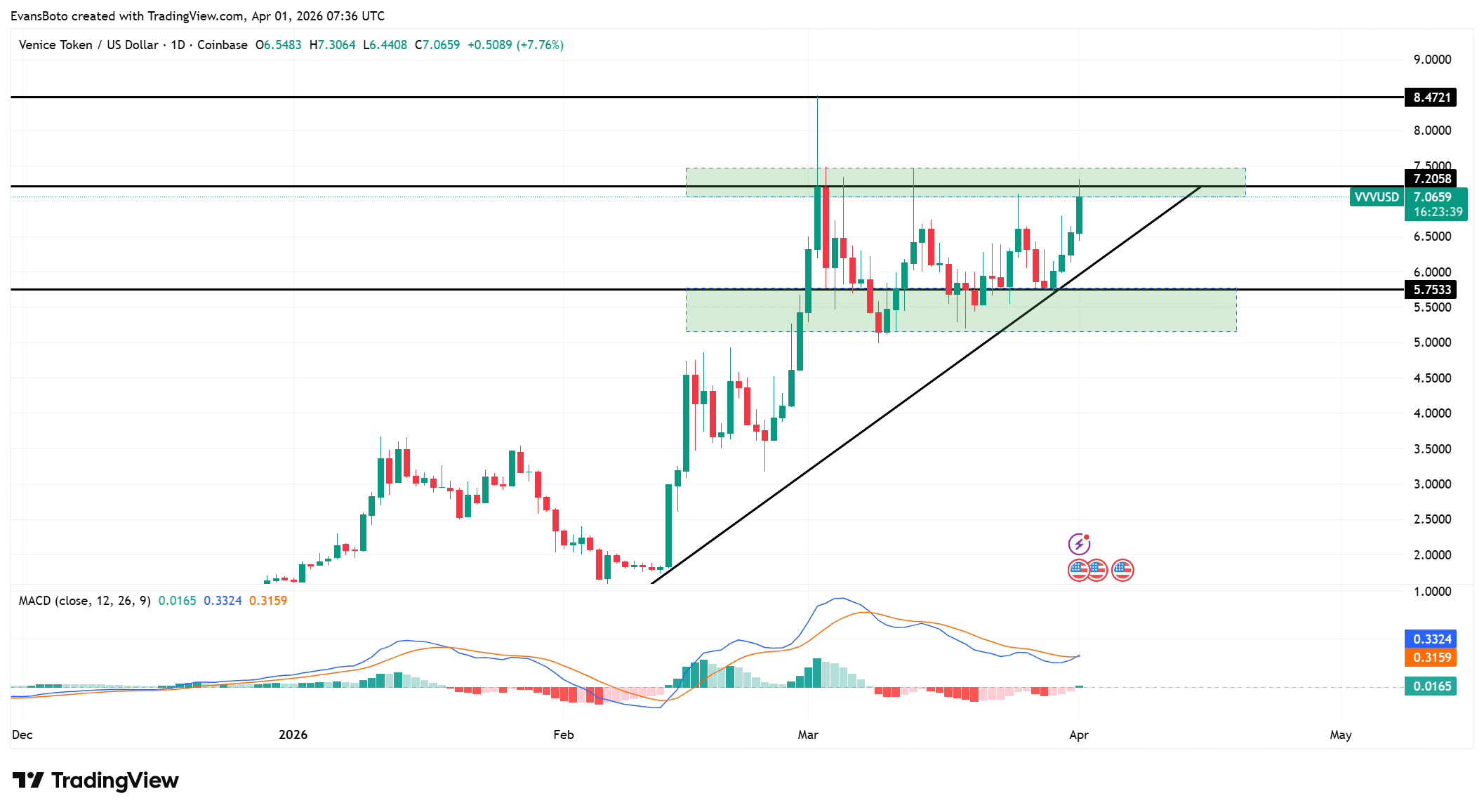
VVV formed a series of higher lows along an ascending trendline, keeping the broader structure intact.

Price compressed below the $7.20 resistance while holding above the $5.75 support. This structure showed buyers stepping in at higher levels, reinforcing upward pressure.

Even so, repeated resistance tests signaled supply remained active in this zone.

As price tightened near the upper boundary, the structure pointed toward a potential expansion. If the breakout holds, trendline support could drive continuation beyond resistance.

On top of that, MACD crossed above the signal line, with the histogram turning positive. This shift indicated strengthening bullish momentum behind the move.
Source: TradingView

Do VVV inflows signal selling pressure?

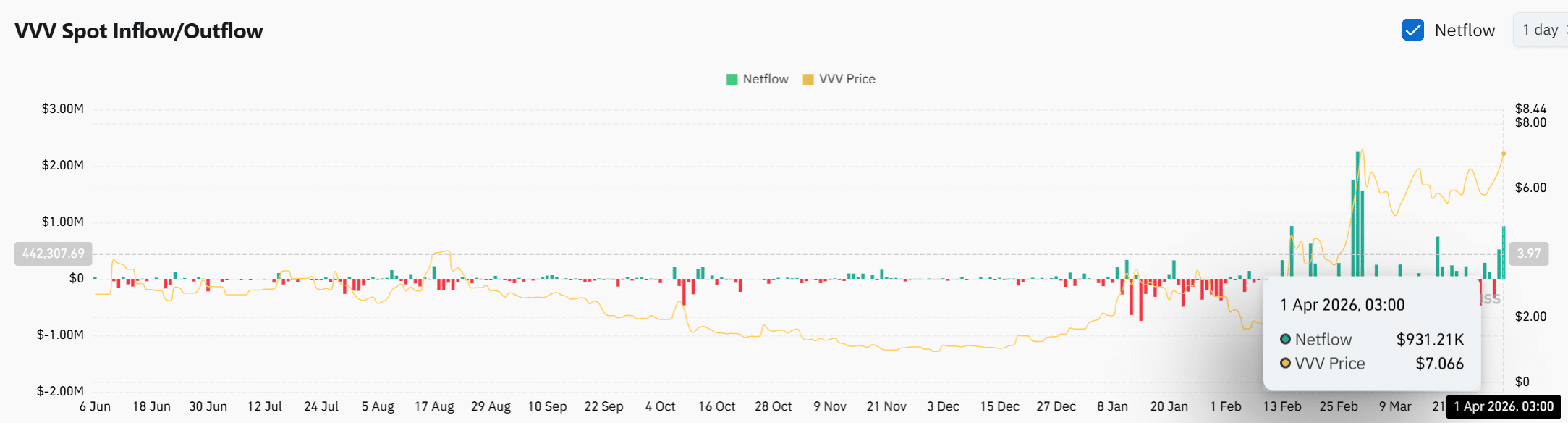
Spot Netflows have turned positive, with $931.21K in inflows recorded, marking a shift from prior outflow dominance.

This transition suggests that tokens are moving back onto exchanges, which introduces potential sell-side liquidity.

However, the timing of these inflows coincides with price testing resistance, which often reflects positioning adjustments rather than immediate distribution.

Exchange deposits increase available supply, yet they do not always translate into instant selling pressure.

As price holds near the upper range, these inflows create a layer of caution. The market now watches whether this added liquidity slows the rally or simply accompanies continued upward movement.
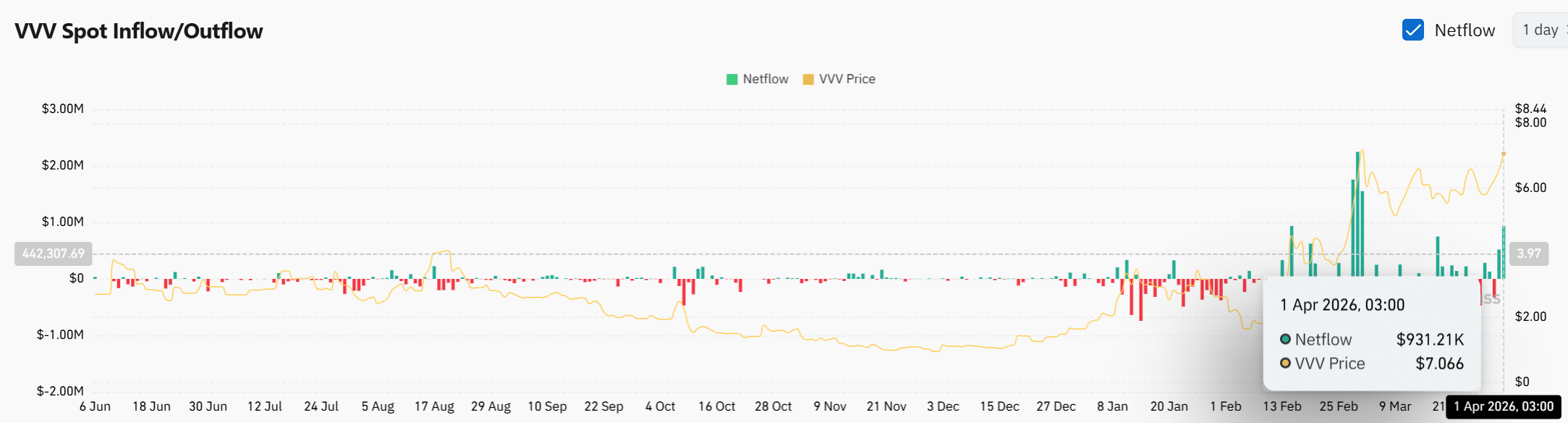
Source: CoinGlass

Short squeeze reshapes positioning

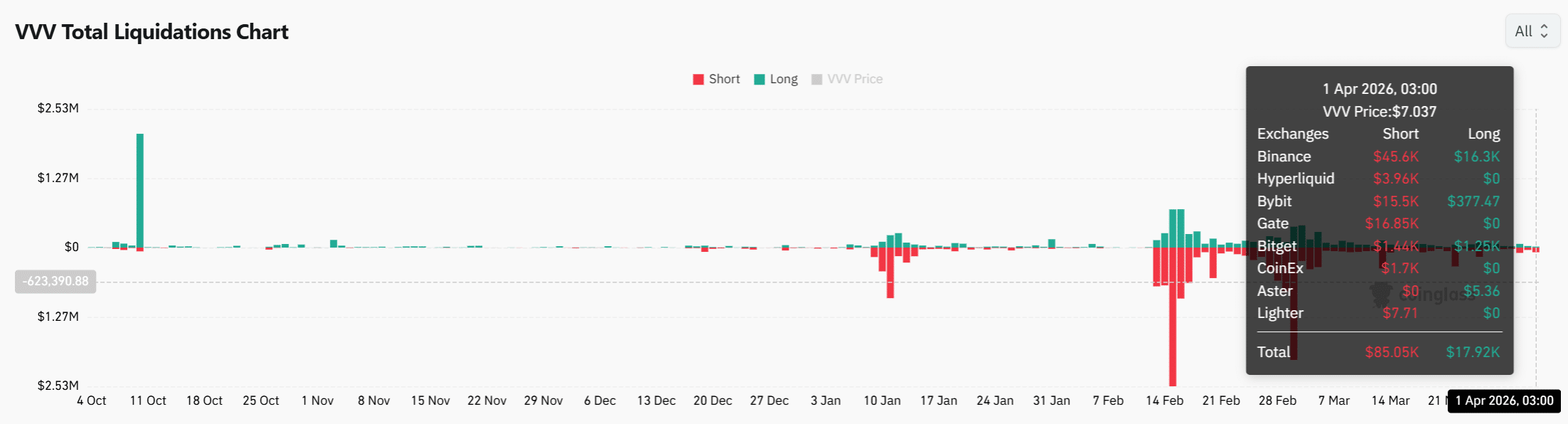
Liquidation data showed $85.05K in short liquidations versus $17.92K in long liquidations. This imbalance indicated that bearish positions faced stronger pressure.

That move aligned with a leverage reset, removing downside bets from the market.

When shorts unwind, forced buying can support the price and reduce selling pressure.

However, this also reduced immediate squeeze potential after weaker shorts exited. The liquidation profile suggested the market cleared fragile bearish positions.

As a result, price faced less resistance from leveraged downside pressure.
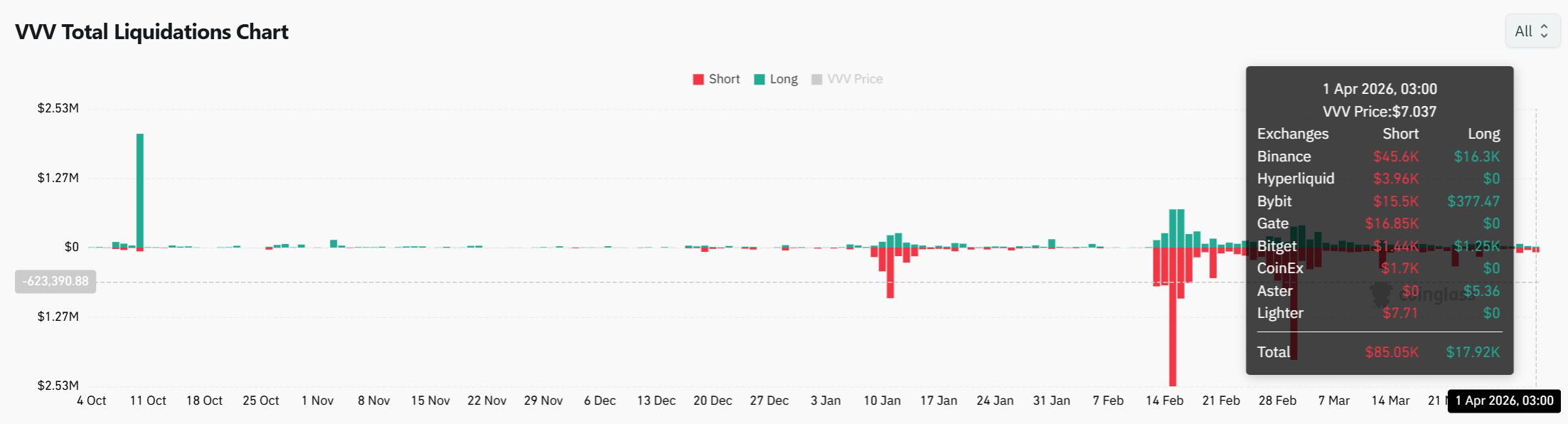
Source: CoinGlass

Can VVV sustain breakout?

VVV tested resistance as structure, indicators, and positioning aligned toward continuation.

Higher lows supported the trend, while MACD confirmed sustained momentum. Short liquidations reduced bearish pressure, keeping the path upward less contested.

Even so, rising exchange inflows introduced supply near resistance. If demand absorbed this supply, VVV could attempt a breakout beyond $7.20.


Final Summary

  • Venice Token [VVV] rose to $7.06, backed by a 14.55% daily gain and an 83.5% jump in Trading Volume.
  • Price approached the $7.20 resistance zone, a key level that previously capped upside.

Domande pertinenti

QWhat was the daily percentage gain that pushed Venice Token (VVV) to $7.06?

AThe daily gain was 14.55%.

QWhat is the critical resistance level that VVV price is approaching according to the article?

AThe critical resistance level is $7.20.

QHow much did the trading volume increase, and what was the new volume figure?

ATrading volume rose by 83.5% to $45.42 million.

QWhat technical indicator showed strengthening bullish momentum with a positive histogram?

AThe MACD indicator crossed above the signal line with a positive histogram, indicating strengthening bullish momentum.

QWhat does the shift to positive Spot Netflows of $931.21K suggest about token movement?

AThe positive Spot Netflows suggest that tokens are moving back onto exchanges, which introduces potential sell-side liquidity.

Letture associate

Bitcoin's 'Rally Ends,' Officially Entering the Later Stage of a Bear Market?

Bitcoin prices declined 13% this week, reversing the recent rebound and signaling a likely transition into the later stages of a bear market. Key on-chain metrics deteriorated, with the short-term holder cost basis falling below the Realized Price—a pattern last seen in early 2022, characteristic of bear market maturity. The rally to ~$82k proved to be a bear market bounce, as evidenced by the 90-day realized profit/loss ratio failing to sustain above the bullish threshold of 2. Daily realized losses surged to $1.35B, including significant selling from long-term holders who accumulated near cycle tops, indicating ongoing supply redistribution. Price was rejected almost precisely at the aggregate US spot ETF cost basis of ~$83k, turning that level into resistance and leaving the average ETF investor underwater again. Spot market selling pressure intensified, with the 7-day volume delta turning significantly negative to its weakest level since February. While a major long liquidation event cleared over $400M in leverage, spot demand has not yet stepped in to absorb the resulting supply. Options markets continue pricing in higher future volatility (elevated volatility risk premium) and maintain a skew toward put options, reflecting persistent demand for downside protection, though not yet panic. Overall, market structure remains fragile. Sustained recovery likely requires a reclaim of the ETF cost basis, a shift back to positive spot demand, and a slowdown in realized loss-taking. Until then, the market risks further downside or extended consolidation within the broader bear trend.

Foresight News1 h fa

Bitcoin's 'Rally Ends,' Officially Entering the Later Stage of a Bear Market?

Foresight News1 h fa

How Risky is the "Death Spiral" of MSTR and STRC?

Summary: This article explores the perceived "death spiral" risk between MicroStrategy (MSTR), its Bitcoin holdings, and its perpetual preferred stock (STRC), drawing comparisons to the LUNA-UST collapse. While both systems feature price anchors, high yields for holders, and potential feedback loops, their core mechanisms differ fundamentally. The MSTR-STRC structure relies on continuous financing to sustain its high dividend payouts, primarily through stock ATM offerings. A negative feedback cycle could occur: falling MSTR stock price makes raising equity capital harder, increasing pressure to sell Bitcoin, which undermines STRC confidence and further depresses MSTR. However, unlike LUNA-UST's automated, direct linkage, the MSTR-STRC loop is weaker and has brakes: STRC dividends can be deferred or rates lowered, and STRC holders have a $100/share liquidation preference in bankruptcy, providing a price floor. The company's sustainability hinges on its ability to continue financing. Its current ~$900 million USD reserves cover only about 6.3 months of its ~$1.71 billion annual interest/dividend burden. The next six months are critical, aligning with both the potential bottom in Bitcoin's four-year cycle and the depletion timeline of its reserves. While a LUNA-style catastrophic collapse is deemed highly unlikely due to structural differences, the key question is whether MicroStrategy can navigate this period through healthy deleveraging to restart its capital engine.

Foresight News1 h fa

How Risky is the "Death Spiral" of MSTR and STRC?

Foresight News1 h fa

Trading

Spot
Futures

Articoli Popolari

Come comprare GAIN

Benvenuto in HTX.com! Abbiamo reso l'acquisto di GriffinAI (GAIN) semplice e conveniente. Segui la nostra guida passo passo per intraprendere il tuo viaggio nel mondo delle criptovalute.Step 1: Crea il tuo Account HTXUsa la tua email o numero di telefono per registrarti il tuo account gratuito su HTX. Vivi un'esperienza facile e sblocca tutte le funzionalità,Crea il mio accountStep 2: Vai in Acquista crypto e seleziona il tuo metodo di pagamentoCarta di credito/debito: utilizza la tua Visa o Mastercard per acquistare immediatamente GriffinAIGAIN.Bilancio: Usa i fondi dal bilancio del tuo account HTX per fare trading senza problemi.Terze parti: abbiamo aggiunto metodi di pagamento molto utilizzati come Google Pay e Apple Pay per maggiore comodità.P2P: Fai trading direttamente con altri utenti HTX.Over-the-Counter (OTC): Offriamo servizi su misura e tassi di cambio competitivi per i trader.Step 3: Conserva GriffinAI (GAIN)Dopo aver acquistato GriffinAI (GAIN), conserva nel tuo account HTX. In alternativa, puoi inviare tramite trasferimento blockchain o scambiare per altre criptovalute.Step 4: Scambia GriffinAI (GAIN)Scambia facilmente GriffinAI (GAIN) nel mercato spot di HTX. Accedi al tuo account, seleziona la tua coppia di trading, esegui le tue operazioni e monitora in tempo reale. Offriamo un'esperienza user-friendly sia per chi ha appena iniziato che per i trader più esperti.

318 Totale visualizzazioniPubblicato il 2025.09.24Aggiornato il 2026.06.02

Come comprare GAIN

Discussioni

Benvenuto nella Community HTX. Qui puoi rimanere informato sugli ultimi sviluppi della piattaforma e accedere ad approfondimenti esperti sul mercato. Le opinioni degli utenti sul prezzo di GAIN GAIN sono presentate come di seguito.

活动图片