Venezuela, Sanctioned and Kicked Out of the Dollar System by the U.S., Turns to USDT

marsbitPubblicato 2026-02-22Pubblicato ultima volta 2026-02-22

Introduzione

Venezuela, heavily sanctioned by the US and cut off from the dollar system, has turned to USDT (Tether) to manage a significant portion of its national revenue, particularly from oil sales. An estimated 80% of the country's oil transactions are now conducted using the stablecoin. This shift was not a voluntary adoption of cryptocurrency but a necessity due to the inability to legally transact in USD. The Venezuelan government, which once banned stablecoins, now facilitates their use for both corporate and retail payments, including salaries and groceries. However, the use of cryptocurrencies like USDT remains limited in large-scale illicit activities, such as drug trafficking, where traditional cash-based and trade-based money laundering methods still dominate. US authorities have not emphasized crypto in recent indictments, suggesting that digital assets may not yet be practical for moving very large sums illicitly. Nonetheless, Venezuela’s embrace of a digital dollar sets a precedent for other nations under sanctions and may paradoxically reinforce the global dominance of the dollar.

Author: Blockworks

Compiled by: Deep Tide TechFlow

Deep Tide Introduction: Venezuela's case is the most powerful real-world footnote for stablecoins—not because they chose crypto, but because they had no other choice. This article demonstrates the complete path of a sovereign nation forced to adopt USDT under sanction pressure, while also revealing the real limitations of stablecoins in large-scale money laundering scenarios.
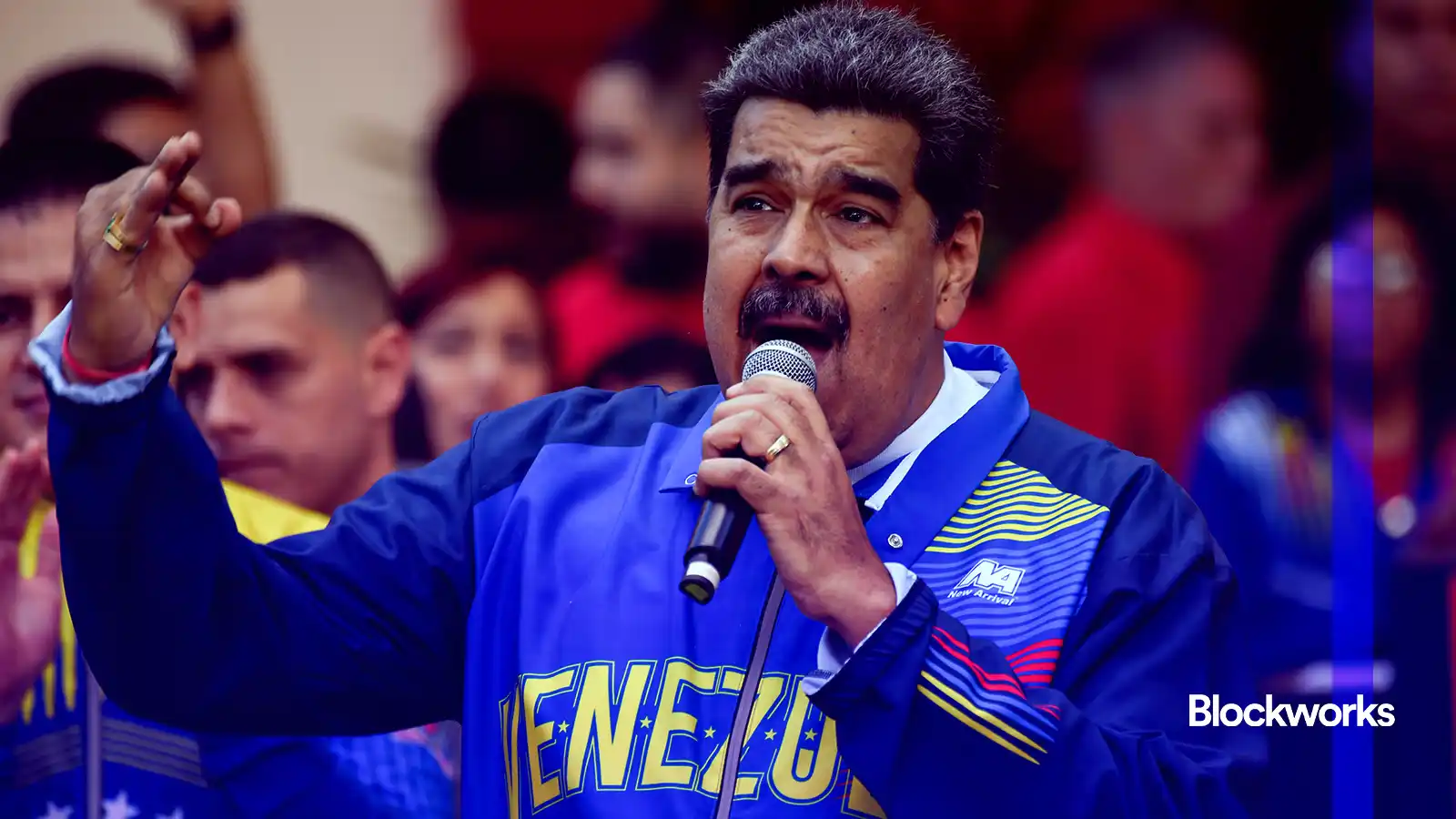
"I don't think it's a bad thing, this so-called 'dollarization' process... Thank God it exists."

— Nicolás Maduro

A recent report by The New York Times stated that Venezuela has become "the first country to manage a large portion of its fiscal revenue using cryptocurrency."

But this was not an active choice.

Approximately half of Venezuela's revenue comes from oil sales denominated in U.S. dollars. As a sanctioned country, Venezuela cannot legally send or receive dollars.

Previously, sanctioned governments typically exchanged oil for dollars—or bartered oil for goods or infrastructure investments—through a network of shell companies and offshore banks.

Now, they have a simpler option: accept stablecoins as payment. Economist Asdrúbal Oliveros estimates that Tether's USDT is the medium of exchange for about 80% of Venezuela's oil sales.

The Venezuelan government once banned the use of stablecoins for transactions, viewing them as a threat to the bolívar. But the devastating impact of U.S. sanctions left it with almost no choice, ultimately forcing it to embrace stablecoins.

Venezuela's current interim president, Delcy Rodriguez, acknowledged the inevitability of crypto-driven dollarization as early as August last year. She told business leaders at the time that "non-traditional management mechanisms" were being implemented to better manage the bolívar exchange rate.

Reuters reported shortly thereafter: "The Venezuelan government has allowed greater use of USDT since June." With state approval, banks now sell USDT obtained from oil sales to local businesses, which use these stablecoins to pay domestic and international suppliers.

They also hope stablecoins will circulate at the retail level: the head of Venezuela's National Supermarket Association recently stated on national television that grocery stores are advancing system upgrades to accept USDT payments.

In other words, the Venezuelan government is encouraging the use of dollars issued by Tether to replace its own currency, the bolívar.

As a result, USDT—which many Venezuelans call "Binance dollars"—is now used in various scenarios, "from buying groceries and paying apartment management fees to issuing salaries and paying suppliers."

So, for a stablecoin enthusiast like me, it was quite disappointing to see that the U.S. government's indictment against Nicolás Maduro didn't even mention cryptocurrency or stablecoins.

The indictment describes illegal fund flows using the old ways: planes returning from Mexico "loaded with drug proceeds"; weapons like grenades bartered for cocaine; protection fees paid by sharing shipments of cocaine; and a $2.5 million cash bribe.

Why no mention of cryptocurrency?

There are two possibilities: 1) The U.S. government has stopped publicly criticizing crypto, and prosecutors know when to skip it; or 2) Crypto and stablecoins are still inadequate for the scale of funding required by Maduro and his associates. The former is more interesting, but the latter is more likely the truth.

"It is difficult for the state to quickly liquidate these [crypto] assets," explained Asdrúbal Oliveros, "because transferring crypto funds requires going through various controls that are currently not being met."

A report by TRM Labs reached a similar conclusion: "Large-scale drug trafficking organizations still heavily rely on physical cash, trade-based money laundering, and the protection of state or quasi-state institutions when moving core proceeds. Cryptocurrency typically plays a secondary or complementary role rather than replacing these mechanisms."

Analysts from the national security think tank Lawfare also agree: "Cryptocurrency-based sanctions evasion remains a drop in the bucket compared to traditional illicit finance channels."

Some are more optimistic about the practicality of stablecoins and crypto in the field of "international payments."

For example, InSight Crime reported that Mexican drug cartels are sustained by an "industrial-scale crypto money laundering pipeline" that funnels black money through digital networks to Chinese chemical suppliers.

They detailed a niche market where stablecoins have found a fit: acting as intermediaries connecting Chinese money brokers who need dollars to sell to clients circumventing China's capital controls, and Mexican drug cartels who need to buy fentanyl precursor chemicals from China.

This isn't the product-market fit crypto enthusiasts hoped for, but in terms of actual behavior, the fit is quite strong. For instance, the DEA stated that its seizures of illicit cash have significantly decreased because criminal groups are "placing cryptocurrency above traditional cash laundering schemes."

Correspondingly, seizures of "virtual currency" have risen significantly: between 2020 and 2024, the DEA seized $2.5 billion in cryptocurrency, compared to only $2.2 billion in cash.

This might explain why Maduro and his associates stick to more traditional payment methods—traceable cryptocurrency and freezable stablecoins are not yet ready for the largest-scale money laundering needs.

Nonetheless, Venezuela's embrace of the digital dollar is setting a precedent. Lawfare concluded: "U.S. adversaries have established a working proof-of-concept, and emerging financial technologies may further consolidate it."

If that's the case, the U.S. dollar itself might be further consolidated as a result.

Being prohibited from using dollars did not push Venezuela to adopt the yuan for oil settlements—instead, it led the government to switch to the digital dollar.


Domande pertinenti

QWhy has Venezuela turned to using USDT for its oil sales according to the article?

ADue to U.S. sanctions, Venezuela cannot legally send or receive U.S. dollars. Approximately 80% of its oil sales are now conducted using Tether's USDT as a transaction medium, as it provides a simpler alternative to traditional workarounds involving shell companies and offshore banks.

QWhat was the Venezuelan government's initial stance on stablecoins like USDT, and why did it change?

AThe Venezuelan government initially banned stablecoin transactions, viewing them as a threat to the Bolivar. However, the devastating impact of U.S. sanctions left them with almost no choice, forcing them to embrace stablecoins to manage revenue and economic activities.

QHow is USDT being used within Venezuela beyond oil sales, as mentioned in the article?

AUSDT is used for various daily transactions, including buying groceries, paying apartment management fees, disbursing salaries, and settling payments with suppliers. The government is encouraging its use at the retail level, with supermarkets adapting systems to accept USDT payments.

QWhy does the article suggest that cryptocurrencies and stablecoins were not mentioned in the U.S. government's indictment against Nicolás Maduro?

AThe article presents two possibilities: 1) The U.S. government has shifted away from publicly criticizing crypto, and prosecutors omitted it strategically, or 2) Cryptocurrencies and stablecoins are still inadequate for the scale of money laundering required by Maduro and his associates, with traditional methods like cash and trade-based laundering remaining dominant.

QWhat broader implication does the article highlight regarding the use of digital dollars like USDT in sanctioned economies?

AThe article suggests that Venezuela's adoption of USDT sets a precedent, creating a 'working proof-of-concept' for other U.S. adversaries. This could further entrench the use of digital dollars, ironically strengthening the U.S. dollar's role even in economies sanctioned by the U.S., rather than prompting a shift to alternatives like the Chinese yuan.

Letture associate

Popular Interaction Collection | Interstate Launches Points Event; Flip Early Waitlist Application (June 12)

**Interstate Launches Points Event, Flip Opens Early Waitlist Applications** *Originally published by Odaily Planet Daily, author Asher.* **Interstate**, an infrastructure platform integrating on-chain transactions for assets like Meme tokens, prediction markets, and xStocks, has launched a points event. Each trade on the platform now rewards users with points. The project has completed a $1.5 million seed round from investors including MH Ventures, Alchemy Ventures, and Marshland Capital. Users can visit the official website to connect their wallets and start earning points through trading tasks (note: the site may experience high traffic). **Flip**, an AI-powered financial assistant, has opened applications for its early waitlist. The platform allows users to manage finances via chat, helping with spending tracking, bill management, investment portfolio monitoring (including stocks and crypto), and more. Flip recently raised $1.4 million in a pre-seed round led by The House Fund and participated in a16z's Speedrun accelerator. Interested users can join the waitlist via the official website. **ArcNova**, an AI-native infrastructure platform for short-form video and entertainment, continues to offer tasks for earning points. Users can sign in daily, complete social and app tasks, and refer friends to accumulate points. The project announced a $15 million funding round in May, backed by Adaverse Ventures, Animoca Brands, and others. The task portal is accessible through the ArcNova website. These updates highlight ongoing opportunities for user engagement and potential rewards across emerging crypto and AI projects.

Odaily星球日报5 min fa

Popular Interaction Collection | Interstate Launches Points Event; Flip Early Waitlist Application (June 12)

Odaily星球日报5 min fa

MoneyGram: Why Did We Launch Our Own Stablecoin?

MoneyGram, a global leader in cross-border remittances for over 80 years, has launched its own stablecoin, MGUSD. The initiative aims to evolve from single-transaction services to becoming a more integral part of users' financial lives. By allowing customers to hold a stable US dollar balance within the MoneyGram app, MGUSD enables not only remittances but also everyday spending, currency exchange, cash access, and future financial services. Targeting the billions globally who face challenges like currency volatility or lack of bank accounts, MGUSD leverages Stellar blockchain technology with a self-custody wallet architecture. This gives users control over their assets while providing a secure, compliant experience through a trusted brand. The approach focuses on solving existing customer pain points within MoneyGram's established network, rather than competing for broad crypto market liquidity. A key advantage is MoneyGram's hybrid model, combining digital services with the world's largest physical network for crypto-to-cash conversions. The stablecoin also modernizes the company's internal infrastructure, streamlining treasury management and partner settlements, with annual forex volume via stablecoins already reaching $2 billion. The project was delivered in about a year, driven by a reorganization into agile, cross-functional teams that operate with startup-like speed while leveraging decades of institutional expertise. Partners include Stablecoin (issuance), Crossmint (wallet APIs), Fireblocks (enterprise treasury), m0 (smart contracts), and the Stellar network. MoneyGram emphasizes that enhancing direct consumer offerings strengthens its partner ecosystem. The future direction is clear: to provide users worldwide with stable value storage, better financial tools, and greater control over their funds through a trusted, existing network.

Foresight News51 min fa

MoneyGram: Why Did We Launch Our Own Stablecoin?

Foresight News51 min fa

BIP-110 Controversy Intensifies: Bitcoin May Face Its Most Divisive Hard Fork Battle in Years

Bitcoin is approaching a critical block height of 961,632, which could activate the controversial BIP-110 proposal. This proposal aims to restrict the amount of non-financial data, such as inscriptions and other large data payloads, within Bitcoin transactions. Supporters, including some node operators and Bitcoin purists, argue that BIP-110 is necessary to preserve Bitcoin's core function as a monetary settlement layer by reducing network congestion and node operational burdens caused by non-essential data. They frame it as a correction to keep the network true to its original purpose. However, critics, including prominent figures like Blockstream's Adam Back and developer Jameson Lopp, warn that the proposal's implementation mechanism is dangerously flawed. They highlight that its low 55% miner signaling threshold, coupled with a contentious enforcement mechanism allowing nodes to unilaterally reject non-compliant blocks, significantly increases the risk of a chain split. Opponents argue this sets a dangerous precedent for transaction censorship, undermines Bitcoin's protocol neutrality, and creates excessive uncertainty for developers and businesses, especially since the rule is proposed as a temporary one-year measure. Market analysts, such as those from Bitfinex, suggest a full-scale network split is unlikely due to a lack of broad economic consensus. Major mining pools remain neutral, and adoption of the new rules is minimal. They view the situation more as a governance stress test. The primary risk is operational disruption: if a minority chain persists, major exchanges and custodians may need to temporarily suspend Bitcoin deposits and withdrawals to manage security and liquidity, potentially unsettling newer institutional investors. While BIP-110 is not expected to succeed in overtaking the main chain, its approach has ignited a significant debate about Bitcoin's governance, core values, and resilience.

Foresight News1 h fa

BIP-110 Controversy Intensifies: Bitcoin May Face Its Most Divisive Hard Fork Battle in Years

Foresight News1 h fa

Trading

Spot
Futures
活动图片




