VCs Sticking to the Primary Market: How Much Money Do They Still Have?

Odaily星球日报Pubblicato 2026-04-22Pubblicato ultima volta 2026-04-22

Introduzione

The article discusses the current state of the cryptocurrency venture capital (VC) market, based on a debate among investors from firms like Pantera Capital, Crucible Capital, and others. Key insights reveal that while VC funds are not short on capital, there is a scarcity of high-quality investment opportunities. The discussion highlights a structural shift: early-stage funding is more dispersed and competitive, with many smaller funds active, but later-stage growth capital is highly concentrated among a few large players like Paradigm and Pantera. Data indicates that over 80% of funding in 2026 went to later rounds, but this includes "graduated" fintech projects that have entered traditional VC realms. The core issue is not the availability of money, but its distribution and accessibility—early-stage founders face intense competition for funding, while later-stage funding is gatekept by a handful of major firms. This reflects a broader trend where VCs are being more selective, prioritizing long-term, proven projects over narrative-driven investments, and founders must demonstrate substantial progress and resilience to secure capital.

Original | Odaily Planet Daily (@OdailyChina)

Author | Azuma (@azuma_eth)
Who knows the current state of the cryptocurrency primary market best? Naturally, it's the VCs still active in the market.

In recent days, several investors from Pantera Capital, Crucible Capital, Blockworks, and Varys Capital engaged in a small-scale discussion on X about the industry's primary market situation. Although there were some differences in their views on the market's current state, their debate might help us understand the primary market's condition a step further.

Counterintuitive Reality: VCs Aren't Short on Money, But There Aren't Many Worthwhile Investment Opportunities

On the evening of April 20, Crucible Capital Partner and GP Meltem Demirors published a short post on X explaining why the number of financing deals in the cryptocurrency industry is significantly decreasing.

Demirors believes that, overall, the "supply side" of early-stage founders and projects in the cryptocurrency industry is not as large as in other high-growth industries. Over the past 4 years, this gap has become increasingly apparent, which is why this VC has started to shift its attention outside the cryptocurrency market.

The venture capital business in the cryptocurrency market has been developing for 10 years, but the truly proven directions that can generate "VC-level returns" are actually just a few — stablecoins/payments, exchanges, and financial products. For VC investors and frontline founders, the industry now has fewer blockbusters, longer cycles, so the requirements for industry insight, resilience, and long-termism are higher, which is why the barrier from seed round to Series A is also increasing.

Although there are still some "era-defining" founders building category-defining companies (the VC's job is to find them and win the opportunity to invest in them), the reality is that there is a clear gap between "the stories founders are telling" and "what VCs can reasonably invest in."

After Demirors' short post was published, it sparked discussion among many VC peers on the topic.

Several investors replied below agreeing with Demirors' view. Among them, Blockworks Co-founder Mippo followed up summarizing, agreeing with Demirors, the current problem in the primary market is the insufficient number of excellent founders and projects; actually, the VC side has plenty of funds to invest — but at the same time, early-stage VC funding is oversupplied, while funding focused on later-stage growth is still noticeably lacking.

Partial Disagreement: Where Exactly Is the Money Concentrated?

Regarding whether VC funds are concentrated in the early discovery stage or the later growth stage, Pantera Capital investor Mason Nystrom and Varys Capital Venture Lead Tom Dunleavy held completely opposite views, and the two engaged in a heated debate.

Dunleavy first stated that he disagreed with Mippo's view that "early-stage funds are oversupplied, later-stage funds are lacking": "I would take the completely opposite view. There is actually a lot of mid-to-late stage cryptocurrency VC money right now — mostly from recently raised and currently fundraising funds, like Paradigm, Multicoin, Pantera, Dragonfly, etc., and that's not even counting traditional VCs that partially dabble in the crypto market. Conversely, funding for seed and earlier stages focused on the industry is lacking...... As long as you haven't completely switched to looking at AI, there are actually many interesting projects to invest in."

But as an insider at one of the later-stage VCs listed by Dunleavy (Pantera), Nystrom strongly refuted Dunleavy's claim. He believes that VC funds in the industry are now more concentrated in the early stages, rather than Series A, Series B, or beyond.

Nystrom did the math: if a fund wants to focus on Series A or Series B financing, they need to invest in at least 20-25 projects, each requiring a large sum — about $15 million for Series A, about $40 million for Series B — by this calculation, a fund focused on Series A needs at least $300 million in assets under management (AUM), and a fund focused on Series B needs at least $800 million. This hasn't even accounted for reserve capital, which typically requires keeping 10% - 50% cash on hand. How many funds in the industry meet this requirement?

So the reality is, there might be at least 50 funds in the industry with AUM less than $100 million, but at the same time, there might only be about 15 funds with AUM over $400 million. There are extremely few big players in the industry that can participate in Series B and beyond; there might indeed be more Series B and later-stage funding in fintech (like stablecoins), but these projects have long "graduated" into the traditional VC system and can no longer be simply considered cryptocurrency market projects.

But Dunleavy was not convinced. In his response, he posted Galaxy's Q1 primary market financing report, mentioning that the number of industry-wide financing deals in Q1 fell by 49% year-on-year, but the average deal size increased by 76% (about $36 million) — the total financing amount for seed and earlier stages was only $268 million; Series A had $370 million; Series B was even higher at $1.1 billion; later stages were as high as $2.72 billion (mainly from Kalshi and Polymarket).

Dunleavy thus rebutted, saying the data proves that in 2025, over 50%+ of the industry's investment went to later stages (already a historical high), and in 2026 it has already reached 80%+.
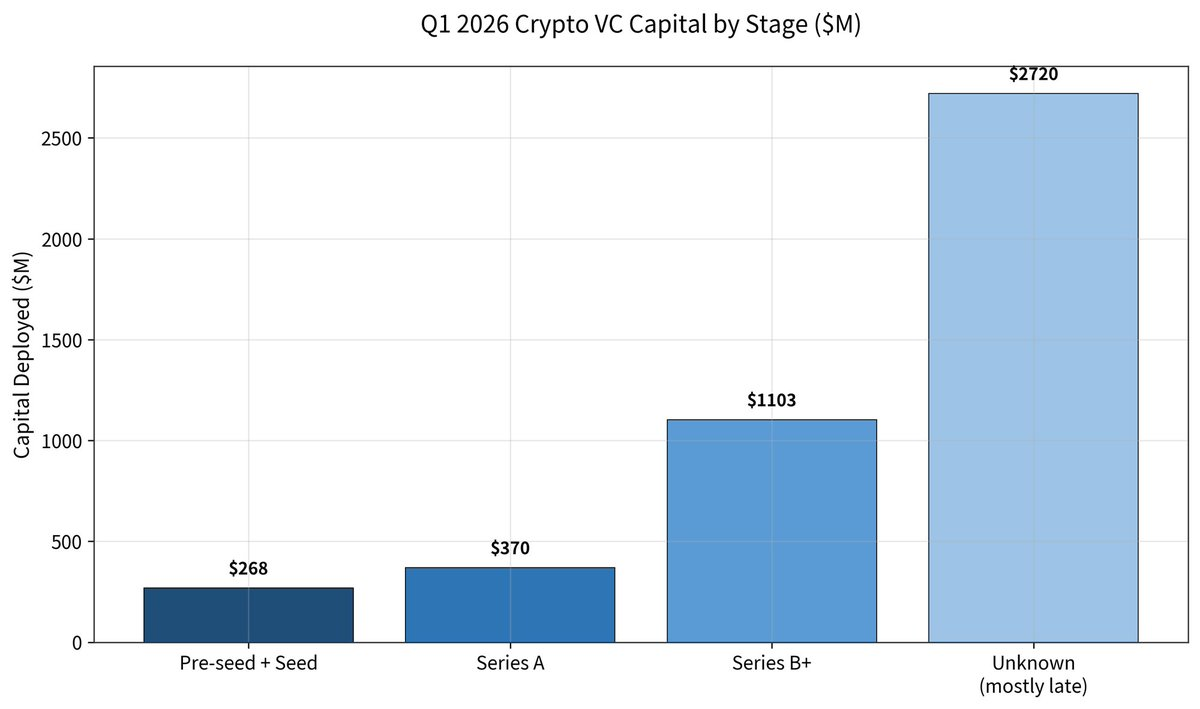
Dunleavy finally estimated the current funding situation in the primary market — available funds for Series A and later stages are about $6 to $7 billion, concentrated in 5 to 6 large institutions; available funds for seed and earlier stages are about $1 to $2 billion, scattered across dozens of smaller, more dispersed funds.

Nystrom responded again, stating that in the data posted by Dunleavy, the vast majority of later-stage investments actually come from fintech-related "graduated" projects, but such projects have long entered the sight of traditional VCs and received investment, and should no longer be counted within the industry.

Nystrom then continued to argue based on Dunleavy's conclusion that "only 5-6 funds can invest in Series A and beyond, but dozens of funds can invest in seed stage": "This means if you can't convince 1 of those 6, you're basically out of luck; but in the early stage, as long as 1 of the dozens of funds is willing to invest, you can survive. The 'accessibility' of these two is completely unequal."

Furthermore, funds like Pantera Capital that have the ability to invest in mid-to-late stages actually also invest in seed rounds, but the reverse is not true. Additionally, more and more VCs are turning into liquidity funds, so the scale of funds in the industry that can truly invest in mid-to-late stages is much smaller than the numbers suggest.

Compared to "Is There Money", the Real Question Is "Where Is the Money, Can It Be Accessed"

In short, neither side could convince the other, but based on the direct confrontation between these two frontline investors, we got a further glimpse into the reality of the cryptocurrency primary market — "is there money" does not seem to be the core problem of the primary market; "where is the money, can it be accessed" is.

Superficially, the data shows the industry's funds are still ample, even highly concentrated in later rounds; but from actual experience, both VCs and entrepreneurs are facing a more "structurally tightened" market — early-stage funds appear dispersed but competition is fierce, mid-to-late stage funds appear ample but the threshold is extremely high. This also means the rules of the game in the primary market are changing. The era of relying on narratives, traffic, and short-cycle realization to complete the financing loop is quickly fading away; replaced by a financing environment that relies more on real business progress, long-term capabilities, and deterministic growth paths.

For VCs, this is a cycle of "making fewer moves, focusing more on judgment"; for entrepreneurs, it is a survival test that must cross a longer cycle and a higher barrier.


Domande pertinenti

QAccording to the article, what is the main reason for the decrease in the number of cryptocurrency financing deals?

AThe main reason is a shortage of high-quality founders and projects, not a lack of VC capital. There is a significant gap between the stories founders are pitching and what VCs can reasonably invest in.

QWhat is the key disagreement between Mason Nystrom and Tom Dunleavy regarding VC funding?

AThey disagree on where the VC funding is concentrated. Nystrom argues that funding is more abundant in the early stages (seed), while Dunleavy contends that the majority of capital is concentrated in the later stages (Series A and beyond), held by a few large funds.

QBased on the Galaxy Q1 report cited, what was the trend in deal size and number of deals in Q1?

AThe number of financing deals in Q1 decreased by 49% year-over-year, but the average deal size increased by 76%, to approximately $36 million.

QWhat does Tom Dunleavy estimate is the total amount of available capital for Series A and later stages, and how is it distributed?

ATom Dunleavy estimates that there is approximately $6-7 billion in available capital for Series A and later stages, concentrated in the hands of 5 to 6 large institutions.

QWhat is the article's conclusion about the core problem in the current primary market?

AThe core problem is not whether there is money available, but rather where the money is located and whether founders can access it. The market is structurally tighter, with intense competition for early-stage funding and extremely high barriers to accessing later-stage capital.

Letture associate

The Shutdown of Claude Mythos Revealed the True Cost of Renting AI to Me

The sudden shutdown of Claude Mythos this week starkly highlights a critical, often overlooked risk for founders: when your core capability relies entirely on someone else's platform, your fate is not in your own hands. The key question becomes: who truly owns the intelligence your product depends on? For years, the debate around open-source models focused on cost. Now, the evidence is clear: fine-tuned open-source models can achieve frontier-level quality for specific, mission-critical tasks at a fraction of the cost. However, the deeper issue is control. Relying on a third-party API is like renting; it works until the landlord changes the rules, raises the rent, or asks you to leave—as Mythos experienced. The lesson is not to stop using frontier models—they are incredible infrastructure. The goal is ownership. Ownership means starting with a powerful open-source model and shaping it around what makes your company unique: your data, workflows, domain expertise, and definition of "good." Over time, the model becomes less generic and more reflective of your business, creating durable value. The optimistic conclusion is that AI's future doesn't hinge on one superior model. There is no single frontier. The frontier includes proprietary models, models fine-tuned on company-specific knowledge, specialized models for narrow problems, and intelligent routers orchestrating model ensembles. The most interesting development is not models getting smarter, but intelligence becoming increasingly customizable. The winning companies will be those that transform intelligence into a unique, owned asset. Looking ahead, the vision is not one model dominating all, but many teams owning the part of the frontier that matters most to them.

marsbit40 min fa

The Shutdown of Claude Mythos Revealed the True Cost of Renting AI to Me

marsbit40 min fa

Tiger Research: U.S. Strategic Bitcoin Reserve - Should the Market Be Happy or Disappointed?

Tiger Research analyzes the evolution of U.S. legislative efforts regarding a strategic Bitcoin reserve, concluding the market impact is limited in the short term but potentially positive long-term. The core event was a March 2025 executive order by former President Trump, which designated confiscated Bitcoin as a strategic reserve and promised not to sell existing holdings (approx. 190k BTC). As it contained no mandate to purchase new Bitcoin, the market reacted negatively, with prices dropping 5.7%. Legislative history shows a significant retreat from initial ambitions. The 2024 "BITCOIN Act" proposed mandatory purchases of 1 million BTC over five years. Reintroduced in 2025, it stalled due to high fiscal costs, concerns over dollar hegemony, and opposition from the Treasury Secretary. The current frontrunner, the 2026 "American Retirement and Monetary Advancement (ARMA) Act," is a compromise. It lacks any purchase requirement, instead focusing on consolidating existing government-held Bitcoin and legally prohibiting its sale for at least 20 years. While ARMA has higher passage odds due to bipartisan support and no purchase mandate, its immediate market effect is neutral. It eliminates potential government selling pressure but creates no new demand. The long-term significance is that formally establishing Bitcoin as a national reserve asset in law could later reignite debates on mandatory purchases. Therefore, the path to a government buyer is longer than initially priced by the market, but the directional narrative remains intact.

marsbit43 min fa

Tiger Research: U.S. Strategic Bitcoin Reserve - Should the Market Be Happy or Disappointed?

marsbit43 min fa

US Stock Market Trend (June 16): SpaceX Rises 42% in Two Days, New Fed Chairman Takes Office Today

**U.S. Stocks Trend (June 16): SpaceX Soars 42% in Two Days, New Fed Chair Takes Office Today** Markets surged on Monday following former President Trump's social media announcement of a completed U.S.-Iran deal to reopen the Strait of Hormuz, pending a June 19 signing. The news triggered a broad risk-on rally: oil prices crashed, tech stocks soared, bond yields fell, and defensive sectors lagged. **Market Performance:** The Nasdaq jumped 3.07%, led by semiconductor stocks like Micron (+9.2%). The S&P 500 gained 1.65%, and the Dow rose 0.92% to a record high. However, the Russell 2000 small-cap index underperformed (+0.72%). SpaceX continued its hot streak, rising another 5% pre-market after disclosures of large buys by an Australian billionaire and Cathie Wood's ARK. Boeing also rallied on the transportation optimism. Conversely, energy stocks like Chevron fell over 3% on the oil price plunge, with other defensive sectors also selling off. The day's action showed a clear rotation of funds from energy/defensive plays into AI and tech narratives. **Macro & Outlook:** The VIX fear index fell 8.37%. Treasury yields declined, and WTI crude dropped over 5%. Attention now shifts to a packed schedule: the Bank of Japan is widely expected to hike rates to 1.0% on Tuesday. The Fed's June meeting concludes Wednesday, marking new Chair Wash's debut. While rates are expected to hold, his tone on stubborn inflation and the "dot plot" will be crucial for gauging the 2024 rate path. The formal Iran deal signing is set for Friday. **Trend Perspective:** While the peace deal is a genuine positive, Monday's explosive rally may have gotten ahead of itself, pricing in a swift resolution to inflation concerns. The shortened trading week faces a triple test: BoJ tightening, the Fed's policy stance, and deal implementation details. Tech and semiconductors, which led the surge, remain vulnerable to any disappointment from these key events. The real price discovery begins with the central banks' communications this week.

marsbit1 h fa

US Stock Market Trend (June 16): SpaceX Rises 42% in Two Days, New Fed Chairman Takes Office Today

marsbit1 h fa

Trading

Spot
Futures
活动图片