VCs on 2025 Crypto Investments: 84% of 118 Tokens Break Issue Price, Only One Type of Company is Quietly Making Money

marsbitPubblicato 2026-04-22Pubblicato ultima volta 2026-04-22

Introduzione

Crypto investor Ching Tseng categorizes the market into four quadrants based on two axes: crypto-native vs. traditional finance (TradFi)-oriented, and having traction vs. no traction. In 2025, 84.7% of 118 tracked token launches fell below their issuance price, with a median fully diluted valuation drop of 71%. Crypto-native projects without traction are experiencing massive capital destruction, often relying on speculative narratives without sustainable revenue or user retention. Crypto-native teams with traction, often built in prior cycles, generate real revenue but face structural challenges with their tokens lacking direct value capture mechanisms. While some have implemented successful buyback programs, the core issue remains finding growth beyond crypto volatility. TradFi-oriented startups without traction face long, costly enterprise sales cycles but benefit from a robust M&A environment, with crypto acquisitions reaching a record $8.6 billion in 2025. The current winners are TradFi-oriented companies with traction, particularly in the Real World Asset (RWA) tokenization space, which grew from $5.5B to $18.6B in 2025. They are winning through enterprise sales, building alliances, and improving unit economics on established compliance stacks. Their main risk is being bypassed by large incumbent institutions building their own infrastructure. The overarching theme is market maturation, where narrative alone is insufficient for long-term success.

Author: Ching Tseng

Compiled by: Deep Tide TechFlow

Deep Tide Guide: Investor Ching Tseng categorizes crypto companies into four quadrants: crypto-native/traditional finance-oriented, with traction/without traction. In 2025, 84.7% of 118 token issuances broke their issue price. Crypto-native projects without traction are massively destroying capital, while traditional finance-oriented companies with traction are capturing the $18 billion RWA market. This article clarifies where the money is flowing and which tokenomics models have failed.

Sitting on the investor side this year, I found that almost every crypto founder I met can be classified into one of four categories. The two axes are simple: crypto-native vs. traditional finance-oriented, with traction vs. without traction. Four quadrants, covering about 75% of the market.

The challenges faced by each quadrant are completely different. Here is my breakdown.
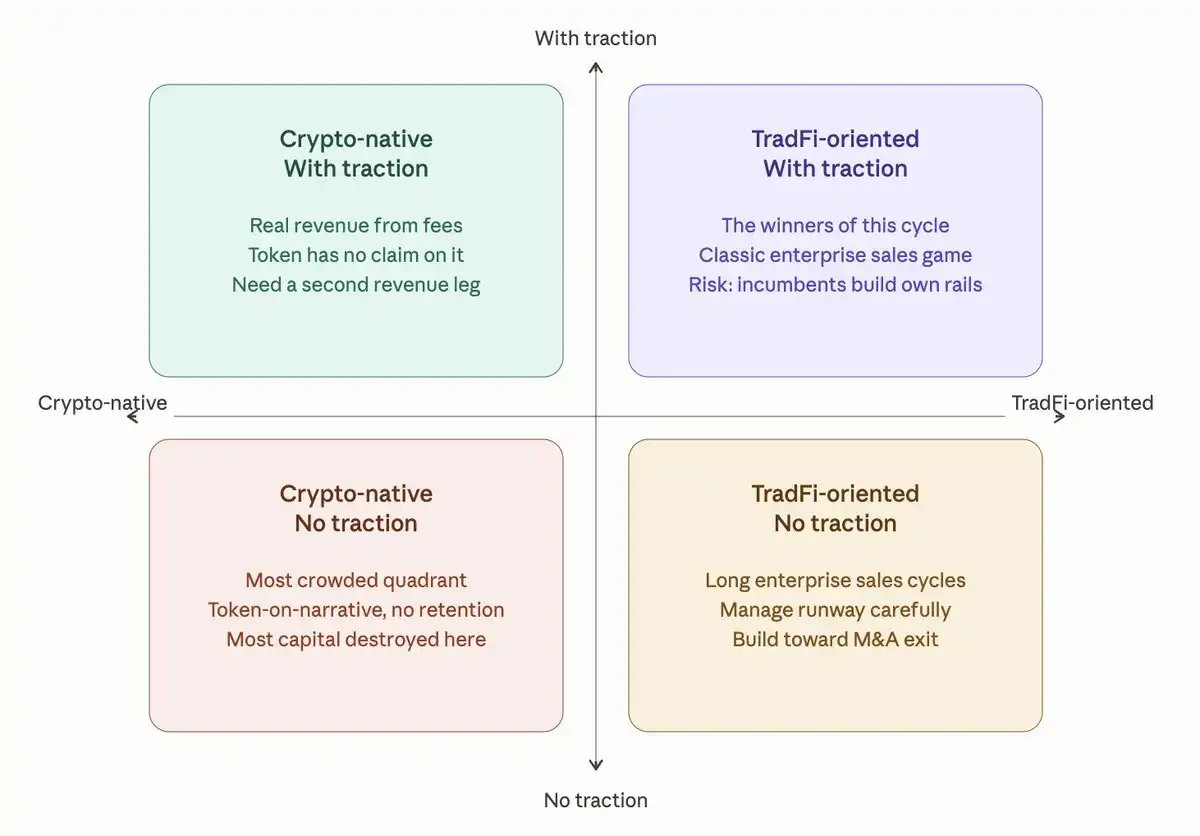
Crypto-Native, Without Traction

This is the most crowded quadrant and the area where capital is being destroyed most severely.

These teams are still showcasing TVL numbers that were inflated in the last cycle but cannot explain why they worked back then. They ask for valuations of $20 million, $30 million, sometimes even $200 million, with only a utility token and a roadmap, claiming the token has a "clear use case" because it is used to pay fees or for governance voting.

The data is brutal. Among the 118 token issuances tracked in 2025, 84.7% fell below their issue price, with the median fully diluted valuation dropping by 71%. Some of the most hyped "native DeFi L1s" of this cycle saw their TVL drop by over 90% in the first year after launch, with tokens following a similar trend. AI-related token groups saw an average annual return of -50%, with several top performers of 2024 pulling back over 80% from their peaks.

The pattern is consistent. Initial traction comes from users seeking quick profits rather than genuinely liking your product. Tokens priced based on narratives, without revenue or user retention to support their valuations, bled in 2025. Massive emissions exposed that on-chain activity was primarily mercenary behavior.

What this quadrant needs to internalize is: the long-term value of a token comes from the team's ability to generate revenue and return capital to holders, not from artificial utility that forces users to spend it. Regulation still prevents anyone from publicly saying "the token is equity," but empirically, that is the only model that works. Everything else is, at best, a cyclical trade.

If you are here, the honest approach is not to issue another token. It is to return to the basics: who are your real users, what are they willing to pay for, and how can you capture a portion of that?

Crypto-Native, With Traction

This quadrant is full of teams that built something real many years ago, often in the last cycle, and have been quietly earning decent revenue from trading, lending, or exchange fees. The teams are small, cash flow covers salaries, and the product works.

Sounds good? But they also have challenges to overcome.

Most issued tokens early and are now stuck with a structural problem: revenue exists, but the token has no mechanical claim to it. Some of the largest products in the market handle monthly trading volumes of tens or even hundreds of millions of dollars, but for years the direct value captured by the token has been zero. No matter how good the revenue/profits are, the market does not truly trade the token at a consistent multiple; the market prices expected growth, not current economic conditions.

The buyback debate is the other half of the story for this quadrant. Some protocols that promised weekly fee-funded buybacks in early 2025 saw their prices rise over 40% in the following month. Others running automated, fee-funded buyback programs cumulatively bought back over $1 billion in tokens within seven months, with single-day buybacks nearing $4 million at their peak. DeFi buybacks totaled approximately $2 billion in 2024-2025.

Buybacks sound like the answer. Sometimes they are. But for teams in this quadrant without excess revenue, buying back tokens is just burning future runway to defend a price that may not hold. The harder and better question is, can you grow a second revenue line not tied to crypto volatility? Because if traditional finance-oriented competitors build better distribution into institutions while you are still surviving on altcoin traders, your moat will quickly turn into commodity-priced infrastructure.

Traditional Finance-Oriented, Without Traction

This group ballooned in 2024-2025. Custody tools, compliance middleware, tokenization rails, on-chain forex, institutional settlement—all genuinely useful. All expensive. All have enterprise sales cycles measured in quarters, not weeks.

The problem is not the product. It's the math. Founders raised $15 million to $30 million assuming institutions would come, but even onboarding a tier-1 bank client can take 12-18 months and requires compliance infrastructure that eats a year of burn before the first dollar of revenue lands.

The good news is that the exit environment for this quadrant is exceptionally healthy. Crypto M&A hit a record $8.6 billion in 2025, with over 140 VC-backed crypto companies acquired, a 59% jump year-over-year. Several of the largest deals saw existing giants paying hundreds of millions to billions of dollars for distribution, licenses, and enterprise relationships in derivatives, trading infrastructure, and payment rails.

If you are in this quadrant, the cool-headed play is: manage valuation and cash runway like your life depends on it, aim for a meaningful M&A outcome, because it is real. Don't price yourself out of the acquirer pool. Don't burn 24 months of runway chasing one enterprise logo. Build complementary partnerships with larger players who might ultimately want to acquire you.

Traditional Finance-Oriented, With Traction

The winners of the current regime.

Tokenized real-world assets grew from $5.5 billion at the start of 2025 to $18.6 billion by year-end, a 3.4x growth in twelve months. The largest tokenization platforms now handle billions in institutional liquidity, with market leaders holding around 20% share, supporting one of the world's largest tokenized treasury funds with nearly $3 billion AUM.

These companies aren't trying to convince anyone crypto is the future. Their institutional clients have already decided. The game now is straightforward enterprise sales: win more banks, more asset managers, more issuers; build alliance structures where an institution buying one of your products naturally buys three more from your partners; compress unit economics on the compliance and custody stack you've already built.

If the team is a pure service provider, this becomes a classic enterprise software war: sales velocity, net retention, integration depth.

The primary risk for this quadrant is not from crypto-native competition. It's from existing behemoths, large asset managers and global banks, eventually building their own rails, bypassing the startups that helped them adapt to the chain. The window is real, but not infinite.

The four quadrants appear different on the surface but are all navigating the same underlying shift: the market is maturing.

This doesn't mean narrative is dead. Institutions also chase hot themes, as anyone who has watched semiconductor and AI valuations over the past two years knows. But in a mature market, the half-life of pure narrative is shorter. It can still get you started, but it cannot keep you going.


Domande pertinenti

QAccording to the article, what percentage of the 118 token launches tracked in 2025 fell below their issuance price?

A84.7% of the 118 token launches tracked in 2025 fell below their issuance price.

QWhich quadrant of crypto companies is described as the current winners of the system and is capitalizing on the RWA market?

AThe 'Traditional Finance-Oriented, With Traction' quadrant is described as the current winners, capitalizing on the tokenized real-world asset (RWA) market which grew to $18.6 billion.

QWhat is the primary risk for companies in the 'Traditional Finance-Oriented, With Traction' quadrant?

AThe primary risk is not from crypto-native competitors, but from existing giants like large asset managers and global banks who may build their own on-chain infrastructure, bypassing the startups that helped them adapt.

QWhat does the data suggest is the only empirically working model for a token's long-term value?

AThe data suggests that the only empirically working model is one where the token is treated as equity, meaning the team generates revenue and returns capital to holders, rather than forcing artificial utility.

QWhat was the total value of crypto M&A (Mergers and Acquisitions) in 2025, as stated in the article?

ACrypto M&A reached a record $8.6 billion in 2025.

Letture associate

GitHub, Transfixed by AI

On the night of February 9th, GitHub suffered a major outage caused by a simple configuration change—reducing a cache refresh interval from 12 to 2 hours—that triggered a cascade of failures. This was not an isolated event, but part of a broader pattern. In early 2026, GitHub experienced at least 8 major incidents, failing to meet its promised 99.9% availability. These outages stemmed from structural issues: explosive growth in load, tight service coupling, and insufficient protection against abnormal traffic. This unprecedented load is driven by AI Agents. In 2025, GitHub handled ~1 billion commits. By 2026, weekly commits reached 275 million, projecting to ~14 billion for the year—a 14x increase. AI tools like Claude Code now contribute 4.5% of all public repository commits, with weekly submissions surging 25x in just three months. AI-generated pull requests jumped from 4 million to 17 million per month in half a year. Unlike human developers, AI Agents work continuously, generating commits at a scale that overwhelms infrastructure designed for human rhythms. The surge also shattered GitHub's business model. Copilot's flat-rate pricing, based on assisting human developers, became unsustainable as Agentic AI sessions consumed resources worth hundreds of dollars for a few dollars in fees. In response, GitHub imposed usage limits and, by June 1st, shifted to a pay-per-use "AI Credits" system. Facing this new reality, GitHub realized a 10x scaling plan was insufficient. It announced a need to *redesign* its architecture for 30x current scale—decoupling services, adding fault isolation, and improving change management to prevent cascading failures. Other platforms like Stripe and AWS are facing similar challenges with AI Agents. Fundamentally, GitHub is transitioning from a human collaboration platform to an "exhaust pipe" for automated AI workflows. Its detailed post-mortem reports aim to maintain trust during this turbulent rebuild. The February outage was not just a technical glitch, but a signal of the software industry's entry into a new, AI-driven era.

marsbit12 min fa

GitHub, Transfixed by AI

marsbit12 min fa

Both Suffer Massive Losses Exceeding $90 Billion, Which Is in Greater Peril: Strategy or Bitmine?

Facing massive paper losses exceeding $90 billion each amidst a sharp market downturn, "Digital Asset Treasury" (DAT) giants Strategy and Bitmine find themselves in a precarious position, but with different underlying risks. Strategy, heavily invested in Bitcoin (BTC), faces significant financial strain. Its strategy relies heavily on debt, including convertible notes and preferred stock (STRC) requiring substantial dividend payments. With its cash reserves dwindling and BTC offering no staking yield for cash flow, Strategy's high leverage makes it vulnerable. A continued price decline could force asset sales to meet obligations, potentially creating a negative feedback loop. Its market value has already fallen sharply. In contrast, Bitmine, an Ethereum (ETH) holder, appears on firmer financial ground. It primarily funds its purchases through equity offerings (like ATM programs), avoiding debt pressure. It also generates income by staking a large portion of its ETH holdings. While not immune to market drops and shareholder dilution concerns, Bitmine maintains more flexibility, recently announcing a new preferred share offering to raise further capital. The core divergence lies in their financing: Bitmine uses equity (investor money), while Strategy uses debt (borrowed money). Consequently, Bitmine currently faces less immediate liquidity pressure than Strategy, which must navigate the dual challenge of servicing debt/dividends and a declining core asset (BTC) price.

marsbit19 min fa

Both Suffer Massive Losses Exceeding $90 Billion, Which Is in Greater Peril: Strategy or Bitmine?

marsbit19 min fa

Where the AI Bubble Really Is: Which Layer of Players Are Naked

AI Bubble: Where It Really Is and Who's Swimming Naked This analysis dissects the AI industry not as a single entity but as a five-layer pyramid, arguing that bubbles are concentrated in specific tiers, not uniformly distributed. **Key Distinction from the 2000 Dot-com Bubble:** Unlike 2000, where companies had stock prices before revenue, today's leading AI players have massive, contract-backed revenue driving their valuations. Core infrastructure demand is real, with every GPU running at full capacity for paying customers. **The Five-Layer Pyramid & Bubble Assessment:** * **L0 (Fab/Manufacturing) & Top L4 (Leading AI Apps): NO BUBBLE.** Companies like TSMC, NVIDIA, major cloud providers (Microsoft, Google, Meta, Amazon), and top AI labs have real revenues and orders. Supply is tightly constrained by TSMC's disciplined capacity control and physical limits like power/land for data centers, preventing a supply glut. * **L1 (Memory): BATTLEGROUND.** Sky-high HBM margins could signal a new structural cycle or a classic "boom before bust." The oligopoly of three major players may enforce supply discipline, making this a high-stakes bet. * **L2 (Interconnect/Optical Modules): BUBBLE TERRITORY.** Companies like Lumentum and AAOI have seen stock surges (4-10x) far outpacing revenue growth. This hardware segment has lower physical barriers to expansion than fabs, allowing speculation. It mirrors the 2000 bubble's epicenter—optics. * **L3 (Infrastructure/"GPU Landlords"): VULNERABLE.** GPU leasing companies profit from the current compute shortage but own no long-term moat. Their business model relies on a temporary bottleneck that will ease as big tech expands and new tech (e.g., potential space-based data centers) emerges. * **L4 Long Tail (VC-backed Startups): STRONG BUBBLE SIGNALS.** VC funding concentration in AI is twice that of the 1999 peak. Many startups with little revenue use the valuation logic of successful giants to justify their own, creating high risk of a "valuation crunch" when funding dries up. **Critical Risks to Monitor:** 1. **GPU Depreciation & Accounting:** Companies extending the assumed useful life of GPUs artificially boost profits. The true economic life depends on future generational leaps from NVIDIA. 2. **"GPU Credit" & Off-Balance-Sheet Leverage:** Emerging structures where shell companies borrow to buy GPUs and lease them out (with chipmakers sometimes investing) move debt off major balance sheets. This echoes the "vendor financing" of 2000 and the securitization risks of 2008, though currently small-scale. 3. **TSMC Abandoning Caution:** If the primary supply bottleneck (TSMC's conservative capacity planning) breaks, runaway supply could trigger a bust. 4. **Algorithmic Efficiency Breakthrough:** A major leap in software efficiency could drastically reduce the need for raw compute hardware, undermining the investment thesis. **Conclusion:** The AI boom is expensive and has frothy areas, but its core is underpinned by real demand and physical supply constraints. The bubble risk is layered: most present in optical components, GPU leasing, and the long-tail startup ecosystem, while the foundational chip manufacturing and leading application layers remain relatively solid—for now.

marsbit32 min fa

Where the AI Bubble Really Is: Which Layer of Players Are Naked

marsbit32 min fa

Trading

Spot
Futures

Articoli Popolari

Come comprare ONE

Benvenuto in HTX.com! Abbiamo reso l'acquisto di Harmony (ONE) semplice e conveniente. Segui la nostra guida passo passo per intraprendere il tuo viaggio nel mondo delle criptovalute.Step 1: Crea il tuo Account HTXUsa la tua email o numero di telefono per registrarti il tuo account gratuito su HTX. Vivi un'esperienza facile e sblocca tutte le funzionalità,Crea il mio accountStep 2: Vai in Acquista crypto e seleziona il tuo metodo di pagamentoCarta di credito/debito: utilizza la tua Visa o Mastercard per acquistare immediatamente HarmonyONE.Bilancio: Usa i fondi dal bilancio del tuo account HTX per fare trading senza problemi.Terze parti: abbiamo aggiunto metodi di pagamento molto utilizzati come Google Pay e Apple Pay per maggiore comodità.P2P: Fai trading direttamente con altri utenti HTX.Over-the-Counter (OTC): Offriamo servizi su misura e tassi di cambio competitivi per i trader.Step 3: Conserva Harmony (ONE)Dopo aver acquistato Harmony (ONE), conserva nel tuo account HTX. In alternativa, puoi inviare tramite trasferimento blockchain o scambiare per altre criptovalute.Step 4: Scambia Harmony (ONE)Scambia facilmente Harmony (ONE) nel mercato spot di HTX. Accedi al tuo account, seleziona la tua coppia di trading, esegui le tue operazioni e monitora in tempo reale. Offriamo un'esperienza user-friendly sia per chi ha appena iniziato che per i trader più esperti.

307 Totale visualizzazioniPubblicato il 2024.12.12Aggiornato il 2026.06.02

Come comprare ONE

Discussioni

Benvenuto nella Community HTX. Qui puoi rimanere informato sugli ultimi sviluppi della piattaforma e accedere ad approfondimenti esperti sul mercato. Le opinioni degli utenti sul prezzo di ONE ONE sono presentate come di seguito.

活动图片












