Author: Mandy, Azuma, Odaily Planet Daily
Original Title: VC Data Plummets, New Coin Narratives Dwindle – What Will Crypto Trading Look Like in a Year?
This weekend, amid internal and external troubles, the crypto market suffered another bloodbath. BTC is currently hovering around the strategic cost price of $76,000, while altcoins are so dismal that looking at their prices makes one want to poke their own eyes out.
Behind the current bleak scene, after recent conversations with projects, funds, and exchanges, one question keeps recurring in my mind: what exactly will the crypto market be trading a year from now?
The more fundamental question behind this is: if the primary market no longer produces the "future secondary market," what will the secondary market be trading in a year? What changes will happen to exchanges?
Although the death of altcoins has long been a cliché, the market hasn’t been short of projects over the past year. Every day, projects are still queuing up for TGE. As a media outlet, we are still frequently coordinating market promotions with project teams.
(Note: In this context, when we say "projects," we are mostly referring narrowly to "project teams" – simply put, those benchmarking against Ethereum and the Ethereum ecosystem: underlying infrastructure and various decentralized applications, and specifically "token-issuing projects." This is the cornerstone of so-called native innovation and entrepreneurship in our industry. So, we’ll temporarily set aside Memes and platforms emerging from traditional industries venturing into crypto.)
If we pull the timeline back a bit, we’ll discover a fact we’ve all been avoiding: these upcoming TGE projects are all 'legacy projects.' Most of them raised funds 1-3 years ago and are only now finally reaching token generation, or are even being forced to issue tokens due to internal and external pressures.
This seems like a kind of "industry inventory clearance," or, to be blunter, queuing up to complete their lifecycle: issue the token, give the team and investors closure, and then lie down quietly awaiting death, or spend the money in the account hoping for a miraculous turnaround.
The Primary Market is Dead
For "old-timers" like us who entered the industry during the ICO era or even earlier, have experienced several bull and bear cycles, and witnessed industry红利 empowering countless individuals, there’s a subconscious belief: given enough time, new cycles, new projects, new narratives, and new TGEs will always emerge.
However, the reality is that we are far from our comfort zone.
Let's look directly at the data. Over the recent four-year cycle (2022 -2025), excluding special primary market activities like M&A, IPO, and public fundraising, the number of financing deals in the crypto industry has shown a clear downward trend (1639 ➡️ 1071 ➡️1050➡️829).
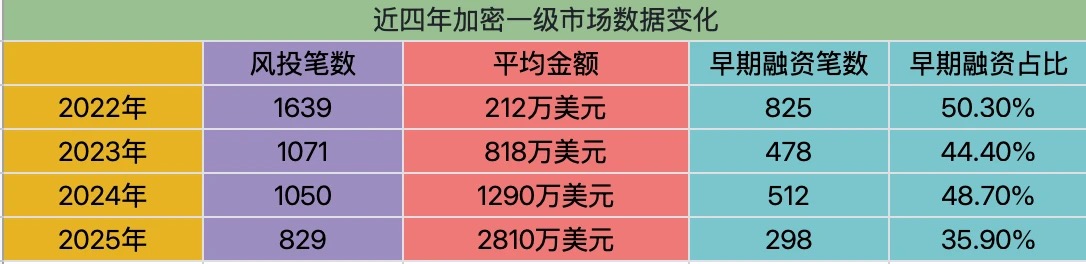
The reality is uglier than the data suggests. The change in the primary market is not just an overall shrinkage in amount but a structural collapse.
Over the past four years, the number of early-stage rounds (including angel, pre-seed, and seed rounds), representing the industry's fresh blood, has shown a steeper decline (825 ➡️ 298, a 63.9% drop over four years) compared to the overall decrease (49.4% drop). The primary market's ability to supply blood to the industry has been shrinking.
The few sectors showing an upward trend in deal count are financial services, exchanges, asset management, payments, AI, etc., which apply crypto technology, but most have little real relation to us – frankly, the vast majority won't "issue tokens." In contrast, native "projects" like L1, L2, DeFi, and social have seen a more significant decline in financing.
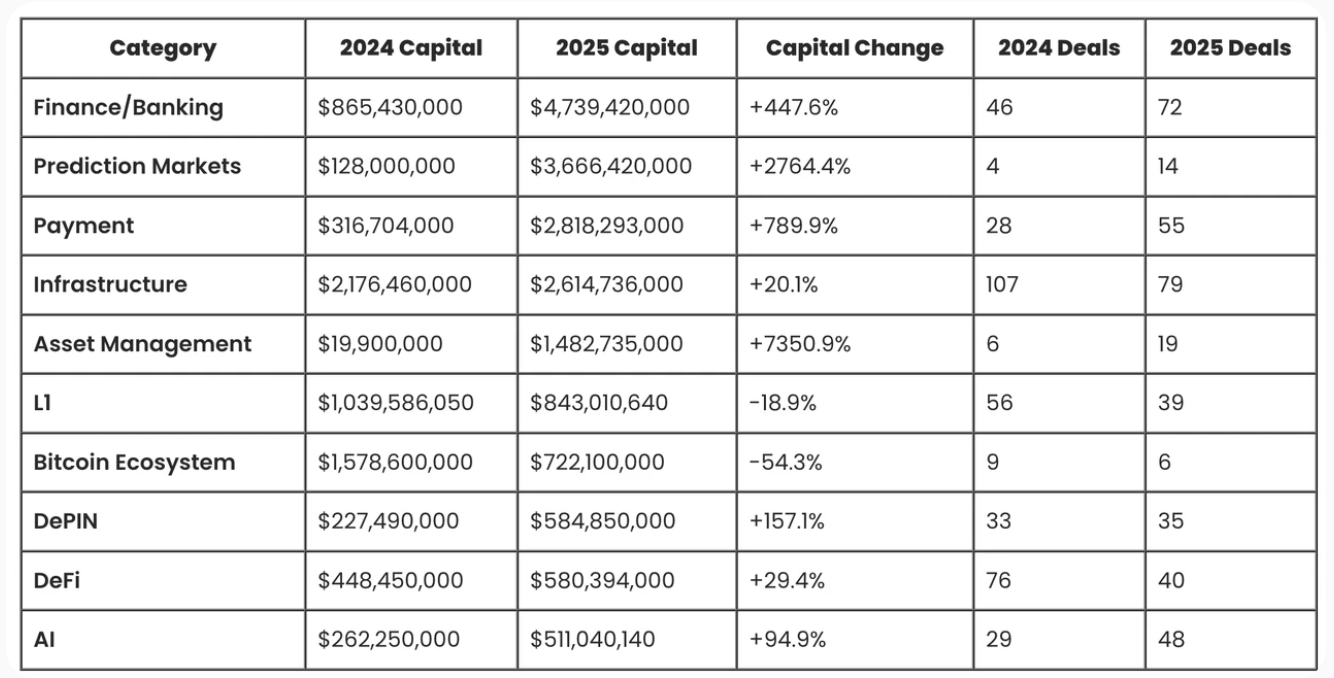
One easily misinterpreted data point is that while the number of financing deals has drastically reduced, the average amount per deal has risen. The main reason is that the "big projects" mentioned earlier have secured large amounts of capital from traditional finance, significantly raising the average. Additionally, mainstream VCs tend to double down on betting on a few "super projects," such as Polymarket's multiple rounds of hundred-million-dollar financing.
From the crypto capital side, this top-heavy vicious cycle is even more pronounced.
Not long ago, an outside friend asked me about a certain well-known, super-old crypto fund that was raising capital. He was puzzled after looking at the Deck and asked me why their returns were "so poor." The table below shows the real data from that Deck. I won't name the fund, just excerpt its performance data for funds from 2014-2022.
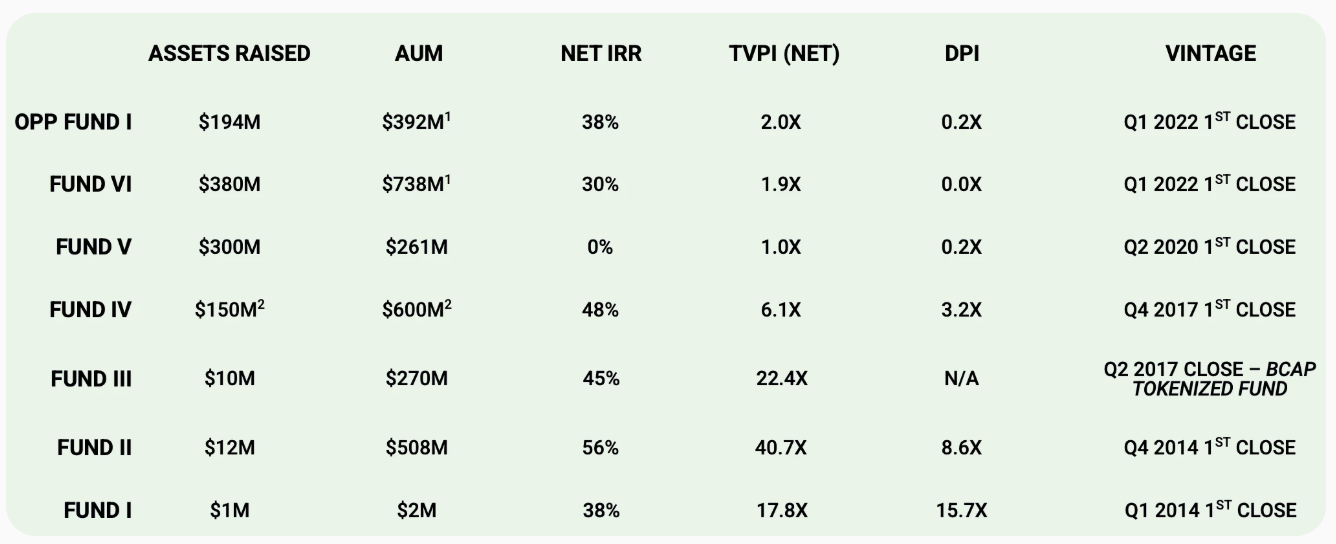
It can be clearly seen that between 2017–2022, the fund-level IRR and DPI of this fund changed significantly – the former represents the fund's annualized return level, reflecting more the "paper profit ability," while the latter represents the multiple of cash returns actually returned to LPs.
Looking at different vintages, this set of fund returns shows a very clear "cycle断层 (cycle fault line)": Funds established between 2014–2017 (Fund I, Fund II, Fund III, Fund IV) significantly outperformed, with TVPI generally in the 6x–40x range, Net IRR maintained between 38%–56%, and also already possessing high DPI, indicating these funds not only had high paper profits but had also completed large-scale realization, eating the era红利 of early crypto infrastructure and leading protocols going from 0 to 1.
Funds established after 2020 (Fund V, Fund VI, and the 2022 Opportunity Fund) clearly dropped a grade, with TVPI basically concentrated in the 1.0x–2.0x range, and DPI close to zero or very low, meaning returns mostly still remain on paper and cannot be converted into real exit profits. This reflects that against the backdrop of valuation inflation, intensified competition, and declining project supply quality, the primary market cannot replicate the excess return structure driven by "new narratives + new asset supply."
The real story behind the data is that after the DeFi Summer hype in 2019, valuations for crypto-native protocols in the primary market became inflated. When these projects finally issued tokens 2 years later, they faced weak narratives, industry tightening, exchanges controlling their fate and临时修改 (temporarily modifying) terms, etc.,普遍表现不尽人意 (generally performing poorly), even with market cap inversion. Investors became the disadvantaged group, and fund exits became difficult.
But these cycle-mismatched funds can still create a false appearance of prosperity locally in the industry, until the past 2 years when some massive star funds were raising capital, and the惨烈 (severity) of the real data became直观地看到 (visibly apparent).
The fund I used as an example currently has AUM接近 (close to) $3 billion, which also makes it a mirror to observe the industry cycle – doing well or not is no longer a question of individual project selection; the大势已去 (general trend has already gone).
While old牌 (veteran) funds, though now struggling to raise capital, can still survive, lie flat, eat management fees, or pivot to investing in AI, many more funds have long since shut down or turned to secondary markets.
For example, the current "Ethereum Bull King" in the Chinese market, Boss Yi Lihua – who remembers that not long ago he was a representative figure in primary, investing in over a hundred projects annually?
The Substitute for Altcoins Was Never Meme
When we say crypto-native projects are drying up, a counterexample is the explosion of Memes.
Over the past two years, one说法 (saying) has been repeatedly brought up in the industry: the substitute for altcoins is Meme.
But looking back now, this conclusion has actually been proven wrong.
In the early days of the Meme wave, we played Memes the way we played mainstream altcoins – screening a large number of Meme projects for so-called fundamentals, community quality, narrative rationality, trying to find the one that could survive long-term, constantly refresh itself, and eventually grow into Doge, or even the "next Bitcoin."
But today, if someone still tells you to "hold Meme" like that, you’d think they’ve lost their mind.
The current Meme is a mechanism for the instant monetization of热度 (heat): it's a博弈 (game) of attention and liquidity, a product批量 (mass-produced) by Devs and AI tools,
an asset form with an extremely short lifecycle but a continuous supply.
It no longer aims to "survive," but to be seen, traded, and utilized.
There are also several consistently profitable Meme traders in our team. Clearly, they focus not on the project's future, but on rhythm, spread speed, sentiment structure, and liquidity path.
Some say Memes are unplayable now, but in my view, after Trump's "final pump," Meme has truly matured as a new asset form.
Meme was never a substitute for "long-term assets"; it has returned to the essence of attention finance and liquidity博弈 (gaming). It has become more pure, more cruel, and also less suitable for most ordinary traders.
Seeking Solutions Outward
Asset Tokenization
So when Memes become professionalized, Bitcoin becomes institutionalized, altcoins wither, new projects face a断层 (break), what can we ordinary folks who nonetheless like value research, comparative analysis, possess speculative attributes, yet aren't pure high-frequency probability gamblers, and want sustainable development, actually play with?
This question doesn't just belong to retail.
It also lies before exchanges, market makers, and platforms – after all, the market cannot forever rely on higher leverage and more aggressive contract products to maintain activity.
In fact, when this entire固有逻辑 (inherent logic) begins to collapse, the industry has long started seeking solutions from its extensions.
The direction we are all discussing is repackaging traditional financial assets into on-chain tradable assets.
Stock tokenization, precious metal assets, are becoming the top priority for exchange layouts. From a host of centralized exchanges to the decentralized platform Hyperliquid, this path is seen as the key to breaking the deadlock, and the market has given positive feedback – during the craziest days for precious metals last week, daily silver trading volume on Hyperliquid once exceeded $1 billion, with tokenized stocks, indices, precious metals, and other assets once occupying half of the top ten trading volume spots, pushing HYPE up 50% short-term under the narrative of "full-asset trading."
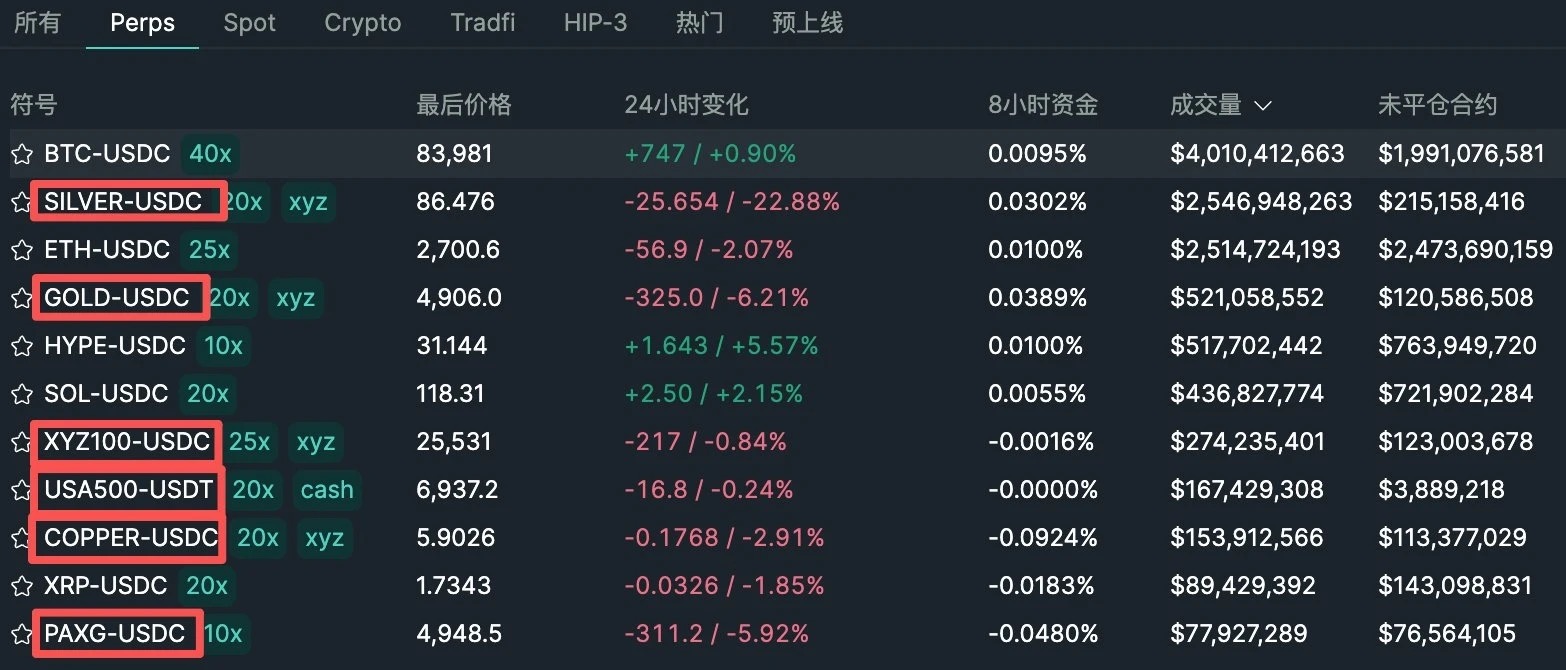
Admittedly, some current slogans, such as "providing new choices, low门槛 (barrier to entry) for traditional investors," etc., are still unrealistic and premature.
But from a crypto-native perspective, it might solve internal problems: after the supply and narratives of native assets slow down, old coins wither, and new coins断供 (supply cut off), what new trading rationale can crypto exchanges still provide to the market?
Tokenized assets are easy for us to上手 (get started with). In the past, we researched: public chain ecosystems, protocol revenue, token models, unlock schedules, and narrative space.
Now, the research objects are starting to become: macroeconomic data, financial reports, interest rate expectations, industry cycles, and policy variables. Of course, we've already been researching many of these parts for a long time.
In essence, this is a migration of speculative logic, not simply a category expansion.
Listing gold tokens, silver tokens, isn't just about adding a few more trading pairs; what they are truly trying to introduce are new trading narratives – bringing the volatility and rhythm originally belonging to traditional financial markets into the internal crypto trading system.
Prediction Markets
Besides bringing "external assets" on-chain, another direction is bringing "external uncertainty" on-chain – prediction markets.
According to Dune data, although the crypto market crashed last weekend, prediction market trading activity反而增加 (instead increased), with weekly transaction count hitting a new historical high of 26.39 million. Leading Polymarket had 13.34 million transactions, followed closely by Kalshi with 11.88 million.
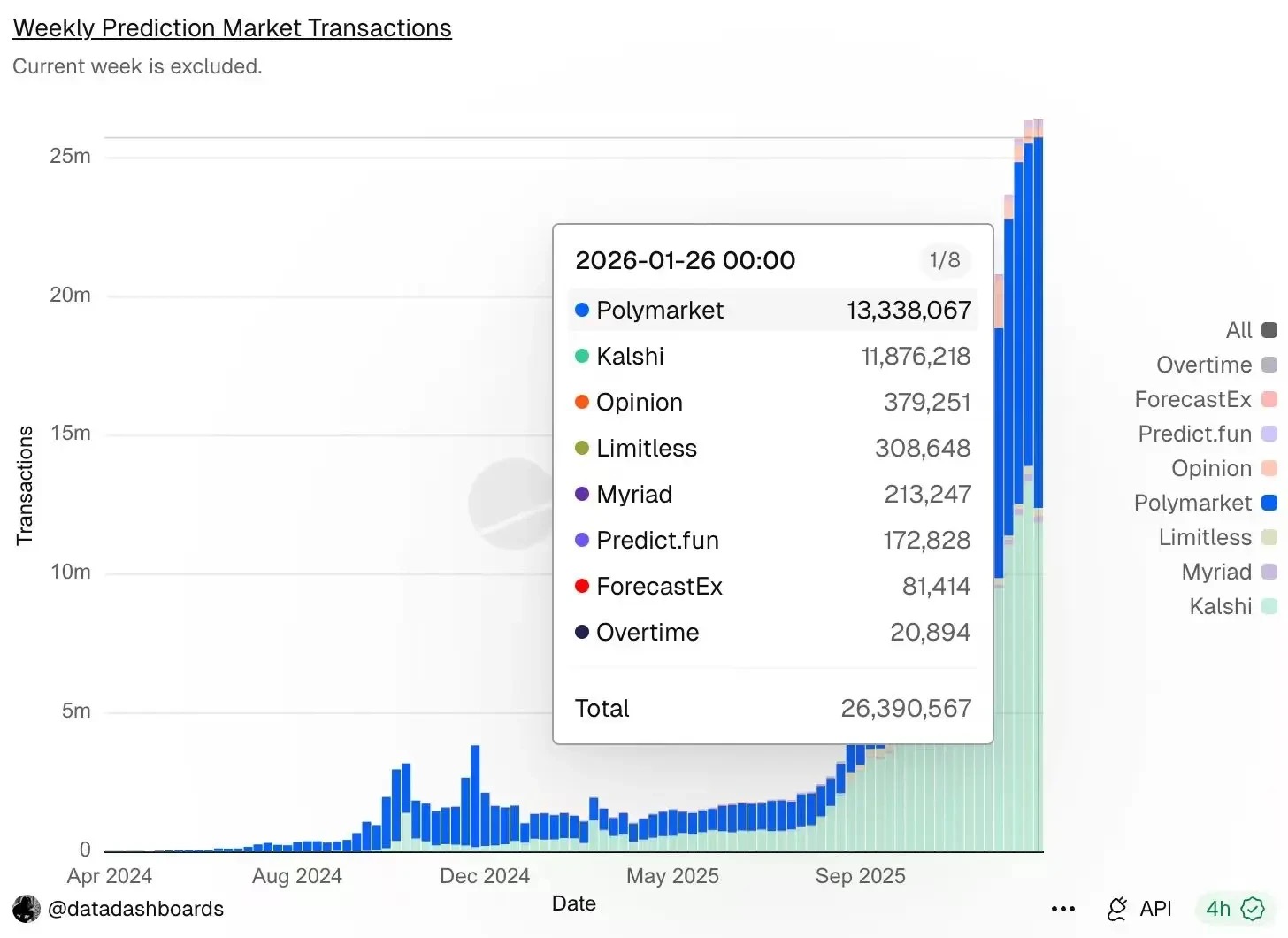
We won't elaborate on the development prospects and scale expectations of prediction markets here, Odaily最近 (recently) writes over 2 analysis articles on prediction markets daily...... everyone can search for them自行取用 (and use them as needed).
I want to talk from the perspective of crypto users: why do we play prediction markets? Is it because we are all degens?
Of course we are.
Actually, for a long time, altcoin traders本质上 (essentially) weren't betting on technology, but on events: will it get listed, is there a partnership announcement, is it about to issue a token, is it launching a new feature, is there a regulatory benefit, can it ride the next narrative wave.
Price is just the result; the event is the starting point.
Prediction markets, for the first time,拆 (disassembled) this from an "implied variable in the price curve" into an object that can be traded directly.
You no longer need to buy a token to indirectly bet on whether a certain outcome will happen; you can directly bet on "whether it will happen" itself.
More importantly, prediction markets fit the current environment of "new project supply cut-off, narrative scarcity."
When新增 (newly added) tradable assets become fewer, market attention反而更加集中 (instead concentrates more) on macro, regulation, politics, big shot behavior, and major industry nodes.
In other words, the tradable "标的 (underlyings)" are decreasing, but the tradable "events" are not减少 (decreasing),甚至变得更多 (even becoming more).
This is also why the liquidity that prediction markets have truly gained traction with in the past two years almost entirely comes from non-crypto-native events.
It essentially introduces the uncertainty of the external world into the internal crypto trading system. From a trading experience perspective, it's also more friendly to the original crypto traders:
The core question is极度简化 (extremely simplified) to one – will this outcome happen? And, is this current probability expensive?
Unlike Meme, the门槛 (barrier) for prediction markets isn't execution speed, but information judgment and structural understanding.
Hearing this, doesn't it feel like maybe I can try this too.
Conclusion
Perhaps the so-called crypto circle will eventually die out in the not-too-distant future, but before it dies, we are still struggling and折腾 (fussing). After "new coin-driven trading" gradually exits the stage, the market will always need a new, low-participation-threshold, narratively传播性 (communicable), sustainable speculative vehicle.
Or rather, the market won't disappear; it will only migrate. When the primary market no longer produces the future, what the secondary market can truly trade are these two things – the uncertainty of the external world, and tradable narratives that can be repeatedly重构 (reconstructed).
What we can do is perhaps adapt in advance to yet another migration of the speculative paradigm.