If we talk about the most unexpected winner in the AI track in 2026, Nokia definitely counts as one.
Most people's memory of it still lingers on the lonely背影 of selling its mobile phone business in 2013 and the definitive conclusion of "being淘汰 by the times."
But the reality is that this company, misunderstood as having "disappeared," has quietly completed a textbook-level business rebirth.
In the first quarter of 2026, Nokia's net profit skyrocketed by over 200% year-on-year. Holding 5G Standard Essential Patents ranking among the top six globally, it received a strategic investment endorsement of $10 billion from NVIDIA. Orders for its optical networking business are in such high demand that delivery schedules are already booked until the second half of the year.
The former "King of Mobile Phones" now stands at the core track of the global technology industry once again with the dual identity of a "Patent Giant + AI Infrastructure Provider."
PART 01
The "Lying Down" Business of Nokia After the Phone Curtain Call
The public's misunderstanding about Nokia essentially equates the "failure of the mobile phone business" with "corporate failure."
Many people overlook the fact that Microsoft only bought the brand usage rights and manufacturing business of Nokia's mobile phones back then, leaving the most valuable communication technology patents, of which Nokia didn't sell a single one.
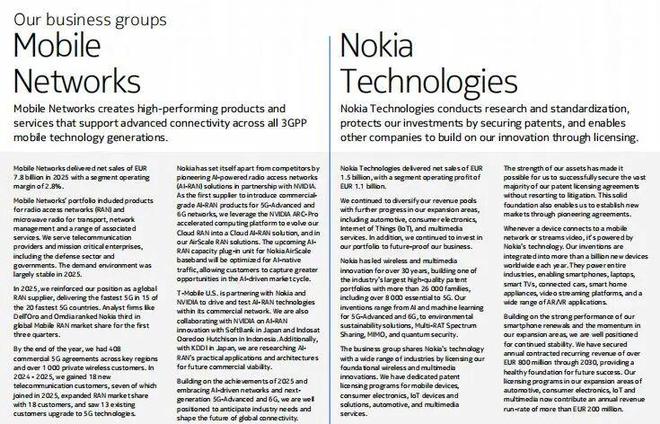
As of 2025, Nokia holds over 26,000 patent families, including more than 7,000 5G Standard Essential Patents (SEPs), with about 70% of the patent families having a remaining validity period of over ten years.
What do these patents mean?
All global mobile phone manufacturers, whether Apple, Samsung, Huawei, or Xiaomi, as long as their devices support 4G or 5G communication, cannot bypass Nokia's technical barriers and must pay it patent licensing fees.
Nokia's royalty rate for 5G phones is no more than 3 euros per unit. Although the unit price seems low, the profit margin on this revenue is extremely high, almost akin to a "rent collection" model.
The 2025 financial report shows that Nokia's patent licensing business generated annual net sales of 1.5 billion euros, with an operating profit margin exceeding 70%, of which over 800 million euros in core cellular patent revenue has been locked in until 2030.
Source: 2025 Financial Report
More notably, Nokia is systematically replicating this "patent royalty" model from the traditional mobile phone field to multiple high-growth sectors.
Riding the wave of automotive intelligence, in 2025, Nokia reached 4G/5G patent licensing agreements with automakers like Mercedes-Benz and at least four Chinese automakers. Through the Avanci patent pool, its 5G automotive patent fee is set at $32 per vehicle, and $20 per vehicle for 4G.
Furthermore, Nokia has also reached into the video streaming sector. In 2025, it completed the acquisition of 298 core video codec patents from LG Electronics. By the end of the year, it had signed licensing agreements with seven streaming platforms including Amazon and Starz.
Simultaneously, it initiated patent lawsuits against giants like Paramount and Warner Bros. in the US, Germany, and other places, accelerating the implementation of a "playback tax" across the industry.
From handheld terminals to smart cars, and further to digital content and the Internet of Things, by the end of 2025, Nokia had signed patent licensing agreements with over 250 enterprises worldwide, building a patent royalty network covering all scenarios.
PART 02
Nokia's New "Optical-Compute Integration" Engine After the AI Computing Boom
If patents are Nokia's "cash cow," then optical networks and AI-RAN are its true engines charging into the AI era.
Relying on these two core technologies, this underestimated company has long been deeply embedded in the core of AI computing infrastructure, becoming a key partner for giants like NVIDIA, Google, and Microsoft.
In June 2024, Nokia acquired the US optical communications company Infinera for $2.3 billion, thereby gaining full-chain technology from optical chips, optical modules to transmission systems, boosting its market share to second globally, only behind Huawei.
The real value of this acquisition lies in: there are very few companies worldwide capable of independently designing and manufacturing high-end optical semiconductor chips, and Infinera is one of them.
This means Nokia can directly supply high-speed optical modules of 800G and 1.6T to AI data centers, with a single optical fiber transmission rate as high as 1.6 Tbps and latency reduced to microseconds.
Performance is the most direct proof: its optical networking revenue grew 19% in 2025, and rose another 20% in Q1 2026, with an operating profit margin exceeding 15%, over five times that of its mobile networking business. The book-to-bill ratio is far greater than 1, with customers queuing for goods. Among the top ten global cloud service providers, nine use Nokia's optical networking technology.
If optical networking brings stable hardware orders for Nokia, AI-RAN earns it long-term, sustainable service revenue.
Traditional 5G base stations typically have baseband computing utilization rates below 10% during nighttime traffic troughs. Nokia's AI-RAN technology allows base stations to run AI inference tasks using idle computing power while ensuring communication quality, enabling localized processing for smart security, autonomous driving edge computing, lightweight large model inference, etc.
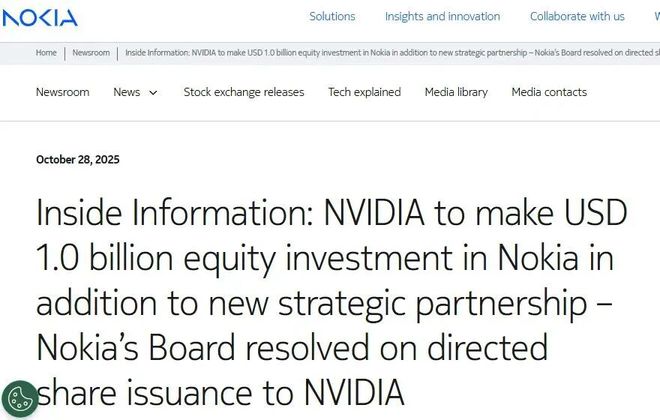
In October 2025, NVIDIA invested a whopping $10 billion in strategic funding, precisely eyeing the dormant computing power within Nokia's global millions of base stations.
Source: Company Website
The jointly launched AI Aerial platform deeply integrates NVIDIA GPUs with Nokia's base station network. It has already been piloted in Indonesia, completing Southeast Asia's first AI-driven 5G call.
Currently, AI-RAN is undergoing pilot verification with over 10 leading global operators. In Q1 2026, revenue from AI and cloud customers grew 49% year-on-year, with quarterly orders reaching about one billion euros, becoming Nokia's fastest-growing emerging business.
PART 03
Nokia's "Positioning + Subscription" Dual Springboard Before 6G Standardization
For a long time, the capital market has priced Nokia using traditional telecom equipment vendor valuation standards, resulting in a significantly lower price-to-earnings ratio compared to peers like Ericsson and Cisco.
However, this valuation discount will be completely broken with the advent of the 6G era. 2026 is a crucial year for 6G standard setting, with formal commercialization expected by 2030.
Relying on its industry-leading AI-native architecture, Nokia is expected to achieve an overtaking in the 6G era and become a core global standard-setter.
Its advantages are mainly concentrated in: being able to embed AI capabilities directly into the network's physical layer and data link layer, enabling smooth evolution on existing AirScale base stations without additional hardware; the intelligent resource optimization technology jointly tested with KDDI, which reduces base station power consumption by 40% and increases throughput fourfold, has already been verified; promoting the inclusion of non-terrestrial networks in the 6G standard to achieve global coverage.
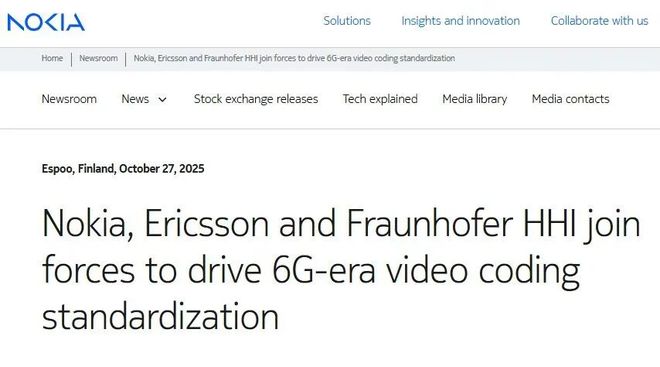
More crucially, in October 2025, Nokia and Ericsson joined hands with Germany's Fraunhofer HHI in a historic tripartite cooperation, jointly promoting the formulation of 6G video codec standards, further enhancing Nokia's influence in this field.
Source: Company Website
Simultaneously, Nokia is breaking the traditional telecom equipment vendor model of one-time sales, transitioning towards a persistent revenue technology service provider through network automation and subscription-based services.
Currently, Nokia has launched 9 SaaS products, with an addressable market size projected to reach $2.6 billion in 2026. Its MantaRay SON self-organizing network solution has been deployed and validated in the networks of over 120 global customers. The entire MantaRay product portfolio supports the TM Forum's Level 4 Autonomous Network level, significantly reducing manual intervention.
Additionally, the 2025 financial report shows that its full-year free cash flow reached 1.5 billion euros, with an FCF conversion rate of 72%, and a free cash flow yield of approximately 4.4%. The company's stable and continuous dividend payouts also provide investors with a certain level of cash return assurance.
Today's Nokia has long shed its old label of a "nostalgia brand" and transformed into a hidden giant holding core technologies, binding with the AI红利, and positioning for the future of 6G.
Market perception always lags behind industrial transformation, but as more capital begins to re-examine Nokia's true value, the curtain on a long-overdue value re-rating is just beginning to rise.