Valuation of $1 Billion, After Five Years of Exploration, Why Did It "Admit Defeat"?

marsbitPubblicato 2025-12-09Pubblicato ultima volta 2025-12-09

Introduzione

Farcaster, a once-promising decentralized social protocol that raised $180 million and reached a near-$1 billion valuation, has officially pivoted away from its Web3 social networking strategy after 4.5 years of effort. Co-founder Dan Romero announced the shift toward a wallet-first approach, acknowledging that the original vision of a decentralized Twitter alternative did not achieve product-market fit. Despite initial excitement and growth—with monthly active users (MAU) briefly surging to around 80,000 in mid-2024—Farcaster failed to break out beyond the crypto-native user base. Its MAU later declined to under 20,000 by late 2025, revealing structural challenges: high onboarding barriers, highly insular content, and an inability to compete with established platforms like X or Instagram. The protocol’s wallet feature, initially introduced as a supplementary tool, demonstrated stronger retention and usage patterns, leading the team to refocus on wallet-based growth. The recent acquisition of token launch tool Clanker further signals this strategic turn toward financial utility rather than social interaction. The shift has sparked community debate, with long-time users expressing concern over the platform’s cultural change from social networking to transaction-oriented interactions. Nonetheless, Farcaster’s move underscores a broader realization in Web3: that social needs may not be the primary entry point for users, whereas practical tools like wallets offer clearer paths...

After five years of operation, raising approximately $180 million in total funding, and once reaching a valuation nearing $1 billion, Farcaster has officially admitted: the path of Web3 social has not succeeded.
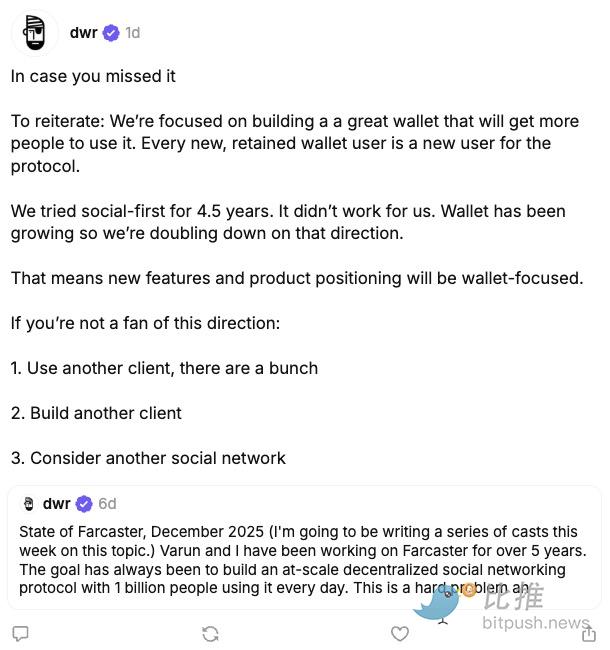
Recently, Farcaster co-founder Dan Romero posted a series of messages on the platform, announcing that the team will abandon the "social-first" product strategy and instead fully focus on the wallet direction. In his words, this is not an active upgrade but a choice forced by reality after a long period of attempts.

"We tried a social-first approach for 4.5 years, but it didn't work."

This judgment not only signifies Farcaster's transformation but also once again highlights the structural challenges of Web3 social.

The Gap Between Ideal and Reality: Why Farcaster Failed to Become a "Decentralized Twitter"

Farcaster was born in 2020, during the rise of the Web3 narrative. It attempted to address three core issues of Web2 social platforms:

  • Platform monopoly and censorship
  • User data not belonging to the users themselves
  • Creators unable to monetize directly

Its design approach was highly idealistic:

  • Decentralized protocol layer
  • Freely buildable clients
  • On-chain social relationships, migratable

Among the various "decentralized social" projects, Farcaster was once considered the product closest to PMF. Especially after Warpcast gained traction in 2023, many KOLs from Crypto Twitter joined, making it seem like the prototype of the next-generation social network.

But problems soon emerged.

According to Farcaster's monthly active user (MAU) statistics on Dune Analytics, Farcaster's user growth trajectory shows a very clear but not optimistic pattern:
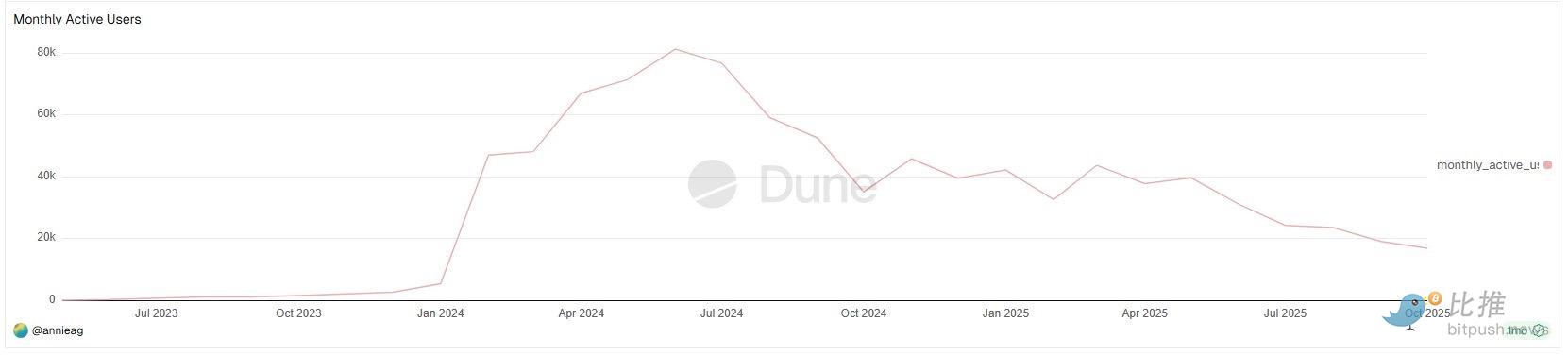
For most of 2023, Farcaster's monthly active users were almost negligible;

The real growth inflection point occurred in early 2024, with MAU rapidly increasing from a few thousand to about 40,000–50,000 in a short period, and even approaching 80,000 by mid-2024.

This was the only truly scalable growth window since Farcaster's inception. It is particularly noteworthy that this growth did not happen during a bear market but during a period of high activity in the Base ecosystem and the emergence of dense SocialFi narratives.

However, this window did not last long.

Starting in the second half of 2024, the MAU data showed a clear decline, and over the following year, it exhibited a volatile downward trend:

  • MAU rebounded multiple times, but the peaks continued to lower
  • By the second half of 2025, monthly active users had fallen to less than 20,000

In fact, Farcaster's growth has always been unable to "break through," with its user structure highly homogeneous:

  • Crypto industry professionals
  • VCs
  • Builders
  • Crypto-native users

For ordinary users:

  • High registration barriers
  • Social content is heavily "insider-focused"
  • The user experience is not better than X / Instagram

This prevented Farcaster from ever forming true network effects.

DeFi KOL Ignas (@DeFiIgnas) on X bluntly stated that Farcaster "just admitted what everyone has felt for a long time":

The strength of X's (formerly Twitter) network effects is almost impossible to break head-on.

This is not a problem with the crypto narrative but a structural barrier of social products. From a product perspective, the issues with Farcaster's social side are very typical:

  • User growth remained locked within the crypto-native population
  • Content was highly insular, difficult to spill over
  • Creator monetization and user retention did not form a positive feedback loop

This is why Ignas succinctly summarized Farcaster's new strategy in one sentence:

"It's easier to add social to a wallet than to add a wallet to a social product."

This judgment essentially acknowledges that "social is not the first-order need of Web3."

"The Bubble Is Comfortable, but the Numbers Are Cold"

If the MAU data answers "How did Farcaster perform?", then another question is: How big is this market itself?

Crypto creator Wiimee provided a set of striking comparative data on X.
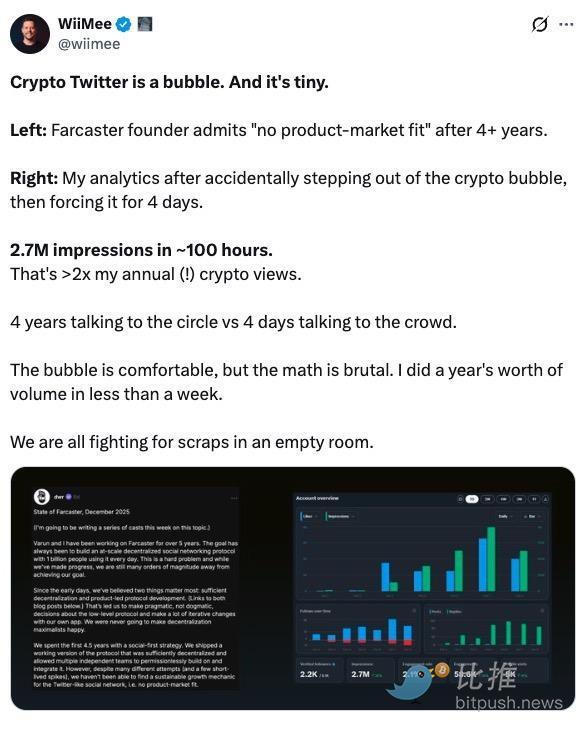
After "accidentally stepping out of the crypto content circle," Wiimee created content for a general audience for four consecutive days. His analysis data showed that in about 100 hours, he received 2.7 million impressions, more than double the total views of all his crypto content over a year.

He stated:

"Crypto Twitter is a bubble, and it's small. Four years of speaking to insiders is less effective than four days of speaking to the general public."

This is not a direct criticism of Farcaster but reveals a more fundamental problem:

Crypto social itself is a highly self-referential ecosystem with weak spillover capabilities. When content, relationships, and attention are confined to the same batch of native users, even the most refined protocol design struggles to break through the upper limit of market size.

This means that Farcaster's challenge was not that "the product wasn't good enough" but that "there aren't enough people in the field."

Wallet, However, Achieved PMF

What truly changed Farcaster's internal judgment was not a reflection on social but the unexpected validation of the wallet.

Earlier in 2024, Farcaster introduced a built-in wallet in its application, initially intended as a supplement to the social experience. But from the usage data, the wallet's growth slope, frequency of use, and retention performance were significantly different from the social module.

Dan Romero emphasized in a public response:

"Every new and retained wallet user is a new user for the protocol."

This statement itself reveals the core logic of the strategic shift. The wallet addresses not "the desire to express" but real, rigid on-chain behavioral needs: transfers, transactions, signatures, and interactions with new applications.

In October, Farcaster acquired Clanker, an AI Agent-driven token issuance tool, and gradually integrated it into the wallet system. This move was also seen as the team's clear bet on the "wallet-first" path.

From a business perspective, this direction has clear advantages:

  • Higher frequency of use
  • Clearer monetization paths
  • Tighter integration with the on-chain ecosystem

In contrast, social seems more like a nice-to-have rather than an engine for growth.

Although the wallet strategy is justified by the data, community controversy followed.

Several long-term users explicitly stated that they are not opposed to the wallet itself but are uncomfortable with the resulting cultural shift: from "users" being redefined as "traders," from "co-builders" being labeled as "old guard."

This exposes a practical problem: when a product direction changes, community sentiment is often harder to migrate than the roadmap. Farcaster's protocol layer remains decentralized, but the choice of product direction is still concentrated in the hands of the team. This tension is amplified during a transformation.

Romero later admitted that communication was problematic but made it clear that the team had made its choice.
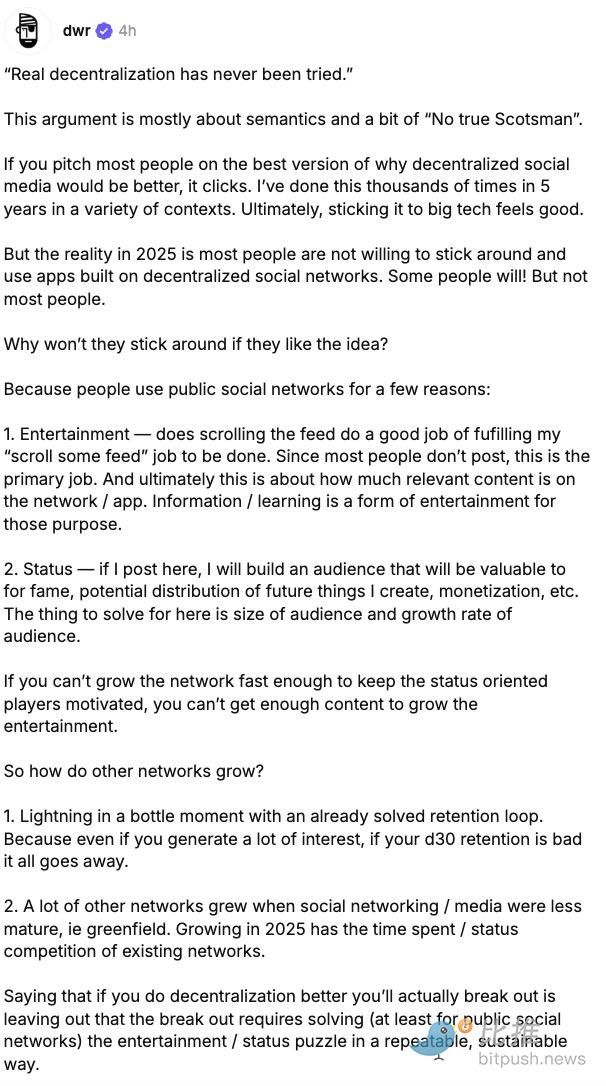
This is not arrogance but a common realistic decision made by startup projects in the later stages of their lifecycle. In this sense, Farcaster did not abandon the social ideal but gave up the illusion of its scalability.

As one observer perhaps rightly said:

"First, let users stay for the tools; then there is space for social."

Farcaster's choice may not be the most romantic, but it might be the one closest to reality. Deeply integrating native financial tools (wallets, transactions, issuance) is the practical path to converting into sustainable commercial value.


Domande pertinenti

QWhy did Farcaster decide to pivot from a social-first strategy to focusing on wallets?

AFarcaster pivoted because after 4.5 years, the social-first approach did not work. The platform struggled to achieve product-market fit (PMF) for social, with user growth remaining confined to a small, crypto-native audience and failing to break out into the mainstream. In contrast, the wallet feature showed stronger growth, higher usage frequency, and better retention, indicating a clearer path to sustainable value.

QWhat were the main user growth challenges Farcaster faced with its social product?

AFarcaster's user growth was highly homogenous, consisting mainly of crypto professionals, VCs, builders, and crypto-native users. It failed to attract ordinary users due to high registration barriers, heavily insular 'crypto-only' content, and an user experience not superior to established platforms like X (Twitter) or Instagram. This prevented it from achieving network effects and scaling beyond its niche.

QHow did the performance of Farcaster's wallet feature influence its strategic shift?

AThe wallet feature demonstrated significantly better performance metrics than the social module, including a steeper growth curve, higher frequency of use, and improved user retention. This data convinced the team that wallet-driven growth, tied to essential on-chain activities like transactions and interacting with dApps, was a more viable path to achieving PMF and sustainable protocol adoption.

QWhat structural barriers did Farcaster encounter in competing with established social platforms like X (Twitter)?

AFarcaster faced immense structural barriers, primarily the powerful network effects of incumbent platforms like X (Twitter), which are nearly impossible to disrupt head-on. The crypto social ecosystem itself is a small, self-reinforcing bubble with limited ability to attract a broad user base, making it difficult for any protocol, no matter how well-designed, to achieve significant market scale.

QWhat does Farcaster's pivot reveal about the perceived role of social in the Web3 ecosystem?

AFarcaster's pivot suggests that social interaction is not a primary, first-order need in Web3. Instead, utility-driven tools like wallets, which facilitate core on-chain activities such as trading, transfers, and interacting with applications, are more fundamental and have a clearer path to product-market fit and commercial sustainability than social features alone.

Letture associate

OpenAI's Largest Internal Wealth Creation: 600 People Cash Out a Total of $6.6 Billion, 75 Take Home the Maximum $30 Million Each

A Wall Street Journal report reveals OpenAI's unprecedented pre-IPO wealth creation. In a single employee stock sale last October, over 600 current and former employees sold shares, collectively cashing out approximately $6.6 billion. Due to high investor demand, the company tripled the individual sale cap to $30 million, with about 75 employees selling the maximum amount. This event represents the largest such transaction in tech industry history for a private company. OpenAI's valuation was $500 billion for this tender offer. Employees with over two years of tenure were eligible, allowing many post-ChatGPT hires their first liquidity event. The company's stock has reportedly grown over 100-fold in seven years. Following a restructuring, employees collectively hold about 26% of OpenAI. The scale of executive wealth is also staggering. In court testimony related to Elon Musk's lawsuit, President and co-founder Greg Brockman confirmed his OpenAI stake is worth around $30 billion. Analysis indicates about 165 current and former employees hold a combined ~$164.9 billion in equity, averaging nearly $1 billion per person in paper wealth. OpenAI's per-employee stock-based compensation is estimated to be 34 times the average of major tech firms before their IPOs. OpenAI continues its rapid ascent, closing a $122 billion funding round at an $852 billion valuation in March. With monthly revenue hitting $2 billion, over 900 million weekly ChatGPT users, and plans for a potential trillion-dollar IPO in late 2026, this wealth-creation engine shows no signs of stopping.

链捕手21 min fa

OpenAI's Largest Internal Wealth Creation: 600 People Cash Out a Total of $6.6 Billion, 75 Take Home the Maximum $30 Million Each

链捕手21 min fa

Understanding CPO (Co-Packaged Optics) in One Article: Why Nvidia Is Willing to Spend $3.2 Billion on a Fiber?

NVIDIA and Corning announced a multi-year strategic partnership on May 6, 2026, with NVIDIA committing up to $3.2 billion to support Corning's U.S. expansion. This investment will triple Corning's manufacturing plants and significantly boost its optical fiber and communications production capacity. The core driver behind this massive investment is the fundamental shift from copper to optical interconnect technology within AI data centers. As GPU clusters scale, copper wires face critical limitations: severe signal attenuation over distance, high energy consumption for signal integrity, and excessive heat generation. Optical fiber, transmitting light instead of electrical signals, solves these issues with minimal loss, near-light speed, and lower power needs. The article outlines a three-stage evolution of data center interconnect: 1. **Traditional Copper Interconnects:** The mainstream solution of the 2010s, now being phased out due to scaling bottlenecks. 2. **Pluggable Optical Modules:** The current mainstream, where modules convert electrical signals to light externally. This process still introduces energy loss and latency. 3. **CPO (Co-Packaged Optics):** The next-generation technology where the optical engine is integrated directly with the GPU chip package. This drastically reduces the electrical signal travel distance to mere millimeters, slashing power consumption and latency while boosting data density. NVIDIA CEO Jensen Huang has identified CPO as an essential core technology for AI infrastructure. NVIDIA's investment signifies a strategic shift from being a buyer to actively controlling its supply chain for critical components. With demand for specialized optical fiber far outstripping supply—evidenced by soaring prices—securing long-term manufacturing capacity has become a competitive necessity. While Corning's expansion may pressure some suppliers, a projected global fiber supply gap of 5-15% over the next few years creates a significant opportunity window, particularly for Chinese manufacturers competitive in optical preforms, chips, and modules. Ultimately, NVIDIA's move is not about chasing a trend but an engineering imperative. The transition to light-based interconnects like CPO is driven by the physical limits of copper, marking a definitive step in the ongoing AI computing revolution.

marsbit46 min fa

Understanding CPO (Co-Packaged Optics) in One Article: Why Nvidia Is Willing to Spend $3.2 Billion on a Fiber?

marsbit46 min fa

KOL's Perspective: Why Is SOL Set to Rise from This Point?

**Summary: Why SOL is Positioned for Growth at This Level** The article argues that SOL is poised for an upward move from its current price point, citing several key factors. Primarily, SOL has just broken out of a 4-month consolidation phase. This breakout signals a return of risk appetite to the broader crypto market, as SOL is seen as a key indicator of overall crypto health. The token's ownership has reportedly shifted from short-term traders and tourists to long-term accumulators, leading to low volume. Any meaningful increase in trading activity could thus trigger significant upward momentum. Fundamental strengths include strong institutional adoption, integration with DeFi and RWAs (Real-World Assets), and the potential benefits from the Clarity Act. Despite its high volatility—having dropped 70% from its all-time high but still up 12x from its bear market low—SOL is highlighted as one of the few tokens from the last cycle to reach new highs. It boasts a robust ecosystem of applications, users, and protocols. Future catalysts include the expected influx of AI developers following the Miami Accelerate conference, which focused on AI on Solana. Furthermore, Solana is positioned as the premier chain for memecoin activity, a trend expected to continue and drive network usage and fees. The article concludes that recent price action reflects a healthy transfer to long-term holders, setting the stage for growth.

marsbit1 h fa

KOL's Perspective: Why Is SOL Set to Rise from This Point?

marsbit1 h fa

Trading

Spot
Futures
活动图片




