Valentine’s Day Crypto Warning: US Attorney Issues Crypto-Fueled Romance Scam Alert

ccn.comPubblicato 2026-02-14Pubblicato ultima volta 2026-02-14

Introduzione

The US Department of Justice has issued a Valentine’s Day warning about cryptocurrency-fueled romance scams. Fraudsters typically approach victims on dating sites or social media, using fake profiles and stolen photos to build emotional trust over weeks or months. They then fabricate emergencies and request payments in crypto, gift cards, or wire transfers—methods that are difficult to reverse. Recent cases include a Colorado man who lost $1.4 million after meeting a woman on a dating app who persuaded him to invest in crypto. According to Chainalysis, crypto scams received at least $14 billion in 2025, with impersonation scams surging by 1,400% compared to the previous year. Authorities advise conducting reverse image searches, consulting trusted friends before sending money, and reporting suspicious activity to the FBI.

Key Takeaways

  • The Department of Justice has issued a crypto warning as Valentine’s Day hits.
  • Real-world losses are escalating.
  • Crypto scam activity surged in 2025.

U.S. federal prosecutors are warning Americans not to let Valentine’s Day turn into a costly heartbreak, as romance scammers increasingly demand payment in cryptocurrency.

The U.S. Attorney’s Office for the Northern District of Ohio on Thursday urged the public to remain vigilant against online crypto romance scams that exploit victims’ trust and emotions.

Try Our Recommended Crypto Exchanges
Sponsored
Disclosure
We sometimes use affiliate links in our content, when clicking on those we might receive a commission at no extra cost to you. By using this website you agree to our terms and conditions and privacy policy.
"}' data-trk="6970dbafcbd599f15ce64045" href="https://links.ccn.com/links?code=6985b71f73f50d4865cba0f2" rel="nofollow" target="_blank">
ChangeNow<\/h3>"}' data-trk="6970dbafcbd599f15ce64045" href="https://links.ccn.com/links?code=6985b71f73f50d4865cba0f2" rel="nofollow" target="_blank">

ChangeNow

promotions
Receive 0.4% of the volume from each transaction with your referral link.<\/strong>"}' data-trk="6970dbafcbd599f15ce64045" href="https://links.ccn.com/links?code=6985b71f73f50d4865cba0f2" rel="nofollow" target="_blank"> Receive 0.4% of the volume from each transaction with your referral link.
Coins
217
Claim Offer
"}' data-trk="6899b9831836d97539c51aa6" href="https://links.ccn.com/links?code=693293fa4a5bcb6231949c97" rel="nofollow" target="_blank">
Bitunix<\/h3>"}' data-trk="6899b9831836d97539c51aa6" href="https://links.ccn.com/links?code=693293fa4a5bcb6231949c97" rel="nofollow" target="_blank">

Bitunix

promotions
Receive up to $100,000 worth of exclusive gifts for newcomers upon registration.<\/strong>"}' data-trk="6899b9831836d97539c51aa6" href="https://links.ccn.com/links?code=693293fa4a5bcb6231949c97" rel="nofollow" target="_blank"> Receive up to $100,000 worth of exclusive gifts for newcomers upon registration.
Coins
151
Claim Offer
"}' data-trk="67adf8d4f12aaec7e4808bf5" href="https://links.ccn.com/links?code=693291aa4a5bcb62319448b2" rel="nofollow" target="_blank">
Bitget<\/h3>"}' data-trk="67adf8d4f12aaec7e4808bf5" href="https://links.ccn.com/links?code=693291aa4a5bcb62319448b2" rel="nofollow" target="_blank">

Bitget

promotions
New user rewards up to 6,200 USDT.<\/strong>"}' data-trk="67adf8d4f12aaec7e4808bf5" href="https://links.ccn.com/links?code=693291aa4a5bcb62319448b2" rel="nofollow" target="_blank"> New user rewards up to 6,200 USDT.
Coins
89
Claim Offer
Explore All Offers

DOJ Flags Valentine’s Day Crypto Warning

Federal prosecutors said fraudsters typically approach victims on dating websites, social media platforms, and messaging apps, posing as romantic partners.

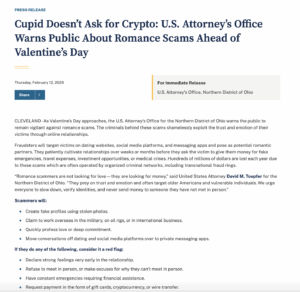
In a stark warning , titled “Cupid Doesn’t Ask for Crypto,” the DOJ explained how bad actors cultivate relationships over weeks or months before fabricating emergencies, travel needs, or medical crises.

Among the clearest warning signs, according to the Justice Department, are requests for payment in crypto, gift cards, or wire transfers, methods favored by scammers because they are hard to reverse.

The office said scammers frequently create fake profiles using stolen photos, claim to work overseas in the military or international business, and profess deep affection quickly.

The DOJ has issued a Valentine’s Day warning about crypto. | Source: DOJ

They often move conversations off mainstream dating platforms to private messaging apps and avoid meeting in person.

“Romance scammers are not looking for love — they are looking for money,” said U.S. Attorney David M. Toepfer for the Northern District of Ohio.

Adding: “They prey on trust and emotion and often target older Americans and vulnerable individuals. We urge everyone to slow down, verify identities, and never send money to someone they have not met in person.”

Regional Cases Underscore Growing Threat

Victims are advised to conduct reverse image searches of profile photos, consult trusted friends before sending funds, and report suspicious activity to the FBI’s Internet Crime Complaint Center (IC3).


In the report, authorities cited recent regional cases, including a Ghanaian national charged in an alleged scheme that took more than $8 million from elderly victims.

Last September, a Colorado man was also reported to have lost $1.4 million after falling victim to a crypto-linked romance scam.

The man, who first spoke to 9News , said he met a woman on Ashley Madison, a website marketed to married people seeking affairs.

After weeks of video chatting and exchanging photos, their conversations shifted to the woman’s interest in crypto and her view of it as a good opportunity for him.

Over roughly six weeks, the man said he made four separate cryptocurrency transfers, ultimately losing $1.4 million in retirement funds and life savings.

Crypto Scams Surge in 2025

The warning comes amid a broader surge in cryptocurrency-related fraud.

Blockchain analytics firm Chainalysis said in its 2026 report that crypto scams received at least $14 billion in on-chain funds last year, up sharply from initial 2024 estimates of $9.9 billion.

Based on historical trends, the firm projected that the 2025 total could exceed $17 billion as more illicit wallets are identified.

The average scam payment rose to $2,764 in 2025 from $782 in 2024, a 253% year-on-year increase, according to Chainalysis.

Impersonation scams, also known as Pig Butchering scams, recorded a 1,400% surge in inflows compared with the previous year.


Top Trending Crypto Articles
  • Best Exchanges Check Out Our Recommended Exchanges Here
  • Buy Crypto Fast How To Buy Crypto with a Credit Card Now
  • Safe Crypto Gambling See Our Picks for the Best Crypto Gambling Sites

Domande pertinenti

QWhat is the main warning issued by the U.S. Department of Justice regarding Valentine's Day?

AThe U.S. Department of Justice has issued a warning about romance scammers who increasingly demand payment in cryptocurrency, urging the public to remain vigilant against online crypto romance scams that exploit victims' trust and emotions.

QWhat are some of the red flags mentioned by the DOJ to identify crypto romance scams?

ARed flags include requests for payment in cryptocurrency, gift cards, or wire transfers; scammers creating fake profiles using stolen photos; claiming to work overseas in the military or international business; professing deep affection quickly; and moving conversations off mainstream platforms to private messaging apps while avoiding in-person meetings.

QHow much did crypto scams receive in on-chain funds in 2025 according to Chainalysis?

AAccording to Chainalysis, crypto scams received at least $14 billion in on-chain funds in 2025, with projections that the total could exceed $17 billion as more illicit wallets are identified.

QWhat was the average scam payment in 2025 compared to 2024?

AThe average scam payment rose to $2,764 in 2025, which is a 253% increase from the $782 average in 2024.

QWhat advice does the DOJ give to avoid falling victim to these scams?

AThe DOJ advises victims to conduct reverse image searches of profile photos, consult trusted friends before sending funds, and report suspicious activity to the FBI’s Internet Crime Complaint Center (IC3). They also emphasize never sending money to someone they have not met in person.

Letture associate

Playnance’s $GCOIN Lists on KoinBX Amid Rapid Growth in India

Playnance's native token, $GCOIN, has been listed on the cryptocurrency exchange KoinBX as of June 18. This move aims to enhance accessibility for its rapidly growing community, particularly in India, where the blockchain-powered Web3 iGaming ecosystem has gained significant traction. Over 130 partners in Playnance's "Be the Boss" program have built communities engaging thousands of active players in the region. The "Be the Boss" model allows participants to create and manage their own gaming communities, earning rewards tied to community activity. CEO Pini Peter noted India's high engagement, with community leaders successfully building player networks. One partner, Dr. Nicolas, reported earning over $57,000 through the program in recent months, highlighting both the financial rewards and the opportunity to grow an engaged community. $GCOIN serves as the ecosystem's core utility token, incentivizing participation and aligning the interests of players and community leaders ("Bosses"). The listing on KoinBX is part of Playnance's strategy to expand globally, increasing the token's utility and accessibility by combining community ownership, gamified engagement, and blockchain-based incentives. Founded in 2020, Playnance is a Web3 iGaming infrastructure company focused on creating live, non-custodial, on-chain products to onboard mainstream users. It currently processes approximately one million transactions daily, aiming to simplify the user experience while maintaining full on-chain transparency.

TheNewsCrypto35 min fa

Playnance’s $GCOIN Lists on KoinBX Amid Rapid Growth in India

TheNewsCrypto35 min fa

STRC Hits Historic Low, Saylor's Perpetual Motion Machine Grinds to a Halt

STRC, the perpetual preferred stock issued by MicroStrategy to fund its Bitcoin purchases, hit a historic low of $85.32, a 17% discount to its $100 par value. Designed as a "digital credit engine" to trade stably near par and enable continuous share issuance for buying Bitcoin, its plunge signals a breakdown in this model. Three key factors drove the decline: 1. Bitcoin's price fell over 50% from its peak, trading around $63,000 amid hawkish Fed signals. 2. MicroStrategy's cash reserves were depleted after a $1.5 billion convertible note repayment, slashing the dividend coverage for STRC's 11.5% yield to ~7 months. The company then sold 32 BTC to cover dividends—Michael Saylor's first Bitcoin sale since 2022—damaging the "never sell" narrative. 3. A competing Bitcoin-backed preferred stock, Strive's SATA, offers a higher yield (~13%) and daily dividends, drawing investors away from STRC. The drop triggers a negative cycle: STRC below par halts ATM share issuances, cutting off a key funding source for Bitcoin buys and potentially forcing more BTC sales for dividends, further eroding confidence. While Saylor argues the model is mathematically sound—needing only 2.3% annual Bitcoin growth to sustain itself—the market is testing the resilience of the leveraged Bitcoin treasury strategy in a bear market. The STRC price now reflects rising skepticism about this financial machinery's durability during downturns.

marsbit56 min fa

STRC Hits Historic Low, Saylor's Perpetual Motion Machine Grinds to a Halt

marsbit56 min fa

A Guide to Grayscale’s ‘Bottom Fishing’: Using Cash Flow to Assess Cryptocurrency Value

**Title:** Grayscale's Guide to Bottom-Fishing: Valuing Cryptoassets Using Cash Flows **Summary:** This report by Grayscale Research presents a fundamental valuation framework for cryptocurrency assets, moving beyond pure speculation to analyze those with underlying cash flows. It distinguishes between "commodity-like" assets (e.g., Bitcoin) and "cash-flow" assets, primarily within DeFi. Using the leading decentralized lending protocol Aave as a case study, the analysis applies traditional financial methodologies like Discounted Cash Flow (DCF) and Price-to-Earnings (P/E) multiples. Key findings indicate that AAVE tokens are currently undervalued. Despite recent challenges, the protocol's strong revenue growth, ~50% net profit margin, and diversified treasury support a fundamental valuation range of $80-$100 per token (compared to a ~$75 market price at the time of writing). In a base-case scenario driven by stablecoin adoption and regulatory clarity, the fair value could rise to around $175 within a year. The report emphasizes that protocol success does not automatically translate to token value. It critically examines the "value capture" mechanisms—such as buybacks, burns, and staking rewards—that channel protocol profits to token holders. Furthermore, it addresses the legal and governance complexities of Decentralized Autonomous Organizations (DAOs), noting their difference from traditional corporate equity but highlighting how robust, transparent governance can align protocol economics with holder interests. The conclusion is that the crypto market is maturing, with capital increasingly flowing towards projects with demonstrable fundamentals, real adoption, and disciplined capital allocation, creating opportunities for value-based investors.

marsbit2 h fa

A Guide to Grayscale’s ‘Bottom Fishing’: Using Cash Flow to Assess Cryptocurrency Value

marsbit2 h fa

After semiconductors lead the gains, are funds buying into AI orders or a macroeconomic rebound?

After US-Iran talks led to a temporary ceasefire and framework for reopening the strategic Strait of Hormuz, U.S. stocks rose on June 18, with the Nasdaq gaining 1.9%. The semiconductor and AI hardware sectors outperformed. This rally stemmed primarily from reduced geopolitical risk, which lowered oil prices and inflation expectations, easing discount rate pressure on high-valuation growth stocks like tech. The key question is not whether tech rebounded, but the nature of the rebound. The market appears to be selectively repricing AI infrastructure plays rather than broadly chasing AI narratives. Gains were concentrated in chips, optical interconnects, memory, and domestic manufacturing—segments tied to tangible data center build-outs and capital expenditure. Intel's ~10% surge, fueled by a Trump statement about potential Apple collaboration, exemplifies this mixed dynamic. It reflects policy catalysts and domestic manufacturing sentiment more than confirmed fundamentals. Meanwhile, strong earnings from companies like Astera Labs (revenue up 93% YoY) provided concrete evidence of AI-driven demand in hardware. In essence, the rally represents a risk-premium recalibration. Lower Middle East tensions opened a valuation repair window, and capital flowed first into AI infrastructure segments with visible near-term revenue streams. The sustainability of this move hinges on upcoming Q2 earnings, specifically continued strength in cloud provider capex, AI server orders, and hardware company guidance. Policy hopes alone are insufficient; the cycle needs validation from orders and financials.

marsbit2 h fa

After semiconductors lead the gains, are funds buying into AI orders or a macroeconomic rebound?

marsbit2 h fa

Trading

Spot
Futures
活动图片