USDT moves $156B in small transfers as Tether eyes $500B valuation

ambcryptoPubblicato 2025-12-13Pubblicato ultima volta 2025-12-13

Introduzione

Tether (USDT) is rapidly expanding its influence beyond stablecoins, with $156 billion settled in small transfers under $1,000, indicating growing use for remittances and daily transactions in regions with limited banking access. The company is now targeting capital markets, exploring a stock sale that could value it at $500 billion and raise up to $20 billion, potentially tokenizing its shares for enhanced liquidity. Additionally, Tether is diversifying into acquisitions like a majority stake in Juventus FC, investing €1 billion, and expanding into AI, robotics, and commodity markets, where it became the largest non-central bank gold buyer with 116 tonnes in Q3 2025.

Tether [USDT] is getting bigger!

The company is scaling across payments, capital markets, and even legacy institutions. From a surge in small-dollar transfers to ambitions that stretch far beyond stablecoins, Tether is testing the limits of how big a crypto-native giant can go.

Small transfers, big deal

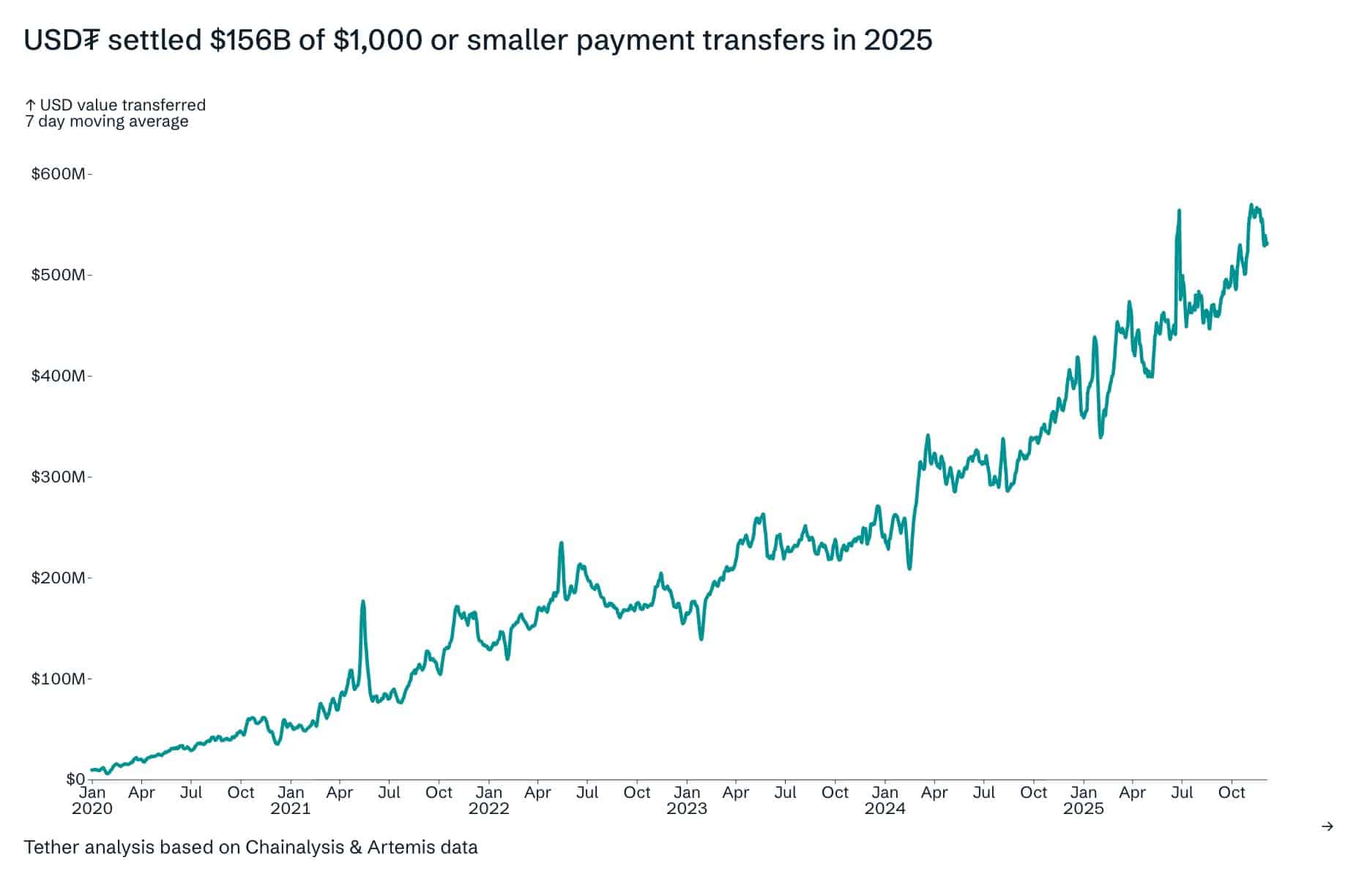
According to data shared by Tether CEO Paolo Ardoino on X, USDT settled $156 billion worth of transfers under $1,000. As the chart shows, small-value transactions have climbed steadily over the past few years, moving through 2024 and into 2025.

Source: X

The seven-day Moving Average is now consistently above $500 million, indicating high-frequency usage.

In regions where traditional banking is expensive or difficult to access, USDT has become a straightforward payment method for remittances and everyday transactions.

From payments to capital markets

That steady rise in small USDT transfers is a precursor for more.

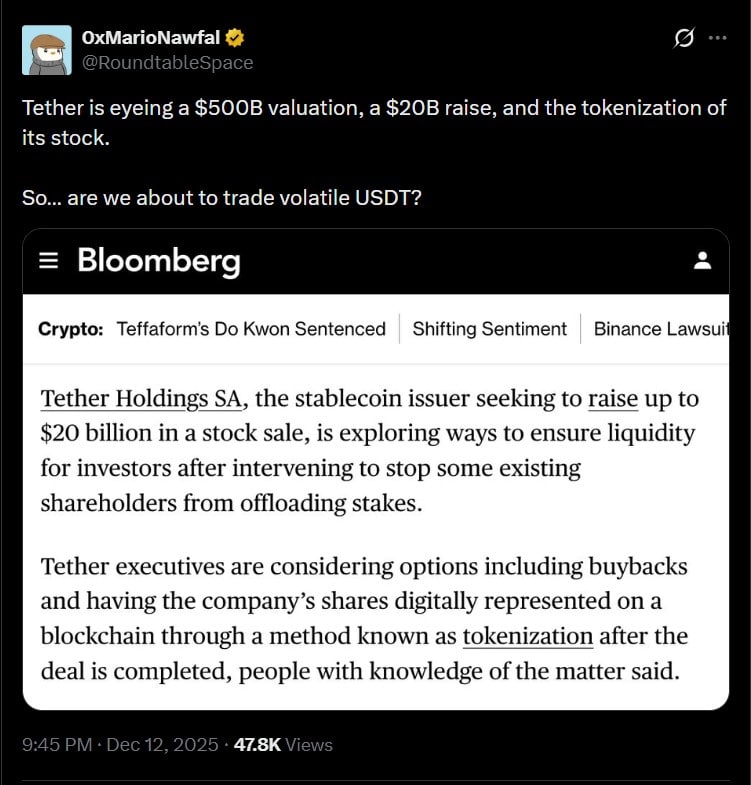
Beyond payments, the company is now eyeing the capital markets. According to a Bloomberg report, Tether is exploring a stock sale that could value the firm at around $500 billion and raise as much as $20 billion.

Executives are also considering tokenizing Tether’s shares on a blockchain to improve liquidity for investors.

Source: X

The move would take Tether from issuing the world’s largest stablecoin to turning itself into a tradeable, on-chain financial asset.

Tether beyond USDT

The company has submitted a binding all-cash proposal to acquire Exor’s 65.4% stake in Italian football giant Juventus FC, with plans to invest €1 billion into the club if the deal closes.

At the same time, Tether is pushing deeper into AI and robotics, backing an Italian humanoid robotics startup and supporting large-scale compute infrastructure for open AI development.

It is also deep in the commodity markets. In Q3 2025, Tether became the largest gold buyer outside central banks, holding 116 tonnes and driving fresh demand for tokenized gold.


Final Thoughts

  • $156 billion in small USDT transfers; Tether is becoming a global payments backbone.
  • A potential $500B valuation shows ambition to rival traditional financial giants.
Next: Analyzing MYX’s price surge – Is $3.45 the next stop?
Share
  • Share
  • Tweet

Letture associate

Bitcoin Withdrawals Continue: 8 Years of Storage in a Coldcard Cold Wallet Ended in Zero

Coldcard Hardware Wallet Hacked: Losses Mount Due to Vulnerable Seed Generation A critical vulnerability in Coldcard hardware wallets has led to a continued wave of fund thefts. According to Galaxy Research, the total stolen has reached 1,367.05 BTC (approx. $88.6 million) from 4,585 addresses, a significant increase from the initial 594.5 BTC reported on July 30, 2026. Most of the stolen funds remain on the attackers' addresses. The issue is not with the current firmware, which Coinkite has updated, but with seed phrases generated on vulnerable devices between March 2021 and the release of fixed firmware versions. Due to a programmer error, devices switched from using a hardware random number generator to the software-based Yasmarang generator, which was initialized with publicly accessible data like the chip's serial number. This made the seed phrases predictable through offline brute-force attacks, meaning wallets remain at risk until funds are moved to a new wallet generated with the patched firmware. Affected devices include Mk2/Mk3 with firmware 4.0.1–4.1.9 (and up to 5.0.3), Mk4/Mk5 up to version 5.6.0, and Q models up to 1.5.0Q. The only exceptions are seeds created with a high-entropy method like at least 50 independent dice rolls or a strong unique BIP-39 passphrase. All other owners must generate a new seed on the fixed firmware and transfer their assets. A case highlighting the human impact involves a 39-year-old long-term investor who lost 2 BTC (approx. $130,000) in minutes. He had accumulated the Bitcoin over eight years through physical labor, viewing it as a financial lifeline and a retirement plan in a country suffering from hyperinflation. His story underscores that even conservative "buy and hold in cold storage" strategies can be compromised by such underlying technical flaws. From a technical perspective, this incident echoes historical failures where weak random number generators undermined cryptographic security, challenging the assumption that offline storage is automatically foolproof.

cryptonews.ru1 h fa
Bitcoin Withdrawals Continue: 8 Years of Storage in a Coldcard Cold Wallet Ended in Zero

cryptonews.ru1 h fa

Trading

Spot
活动图片