USD1 Hits $5 Billion Market Cap As Trump Hails ‘Built In America’ Stablecoin

bitcoinistPubblicato 2026-01-31Pubblicato ultima volta 2026-01-31

Introduzione

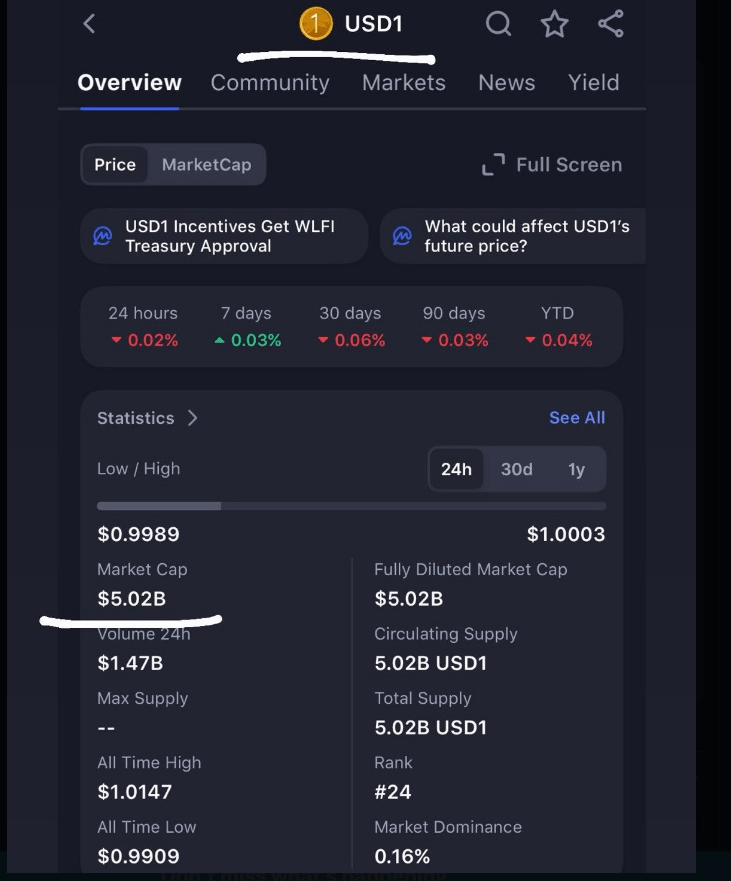
USD1, a stablecoin issued by World Liberty Financial, has surpassed a $5 billion market cap, becoming one of the largest dollar-pegged tokens. It maintained its $1 peg despite increased market interest, aided by new exchange listings and incentives. The milestone was celebrated by the Trump family on social media, boosting mainstream attention. Growth was driven by improved liquidity, institutional adoption, and large fund movements. However, questions remain about reserve transparency and regulatory compliance, with the issuer seeking a U.S. banking charter. Notably, while USD1 thrived, other related speculative tokens fell sharply, highlighting a market shift toward stability over volatility.

USD1 has pushed past a $5 billion market cap, a rapid climb that has attracted wide attention across crypto markets. Reports say the stablecoin, issued by World Liberty Financial, now ranks among the largest dollar-pegged tokens.

Trading has stayed close to the $1 peg even as overall market interest spiked. Some exchanges have added new pairs and incentives, which helped volume swell over recent weeks.

Market Milestone Reached

Reports note that members of the Trump family celebrated the milestone on social feeds, calling USD1 “Built in America.” US President Donald Trump was quoted praising the token as an example of American engineering and finance coming together.

That message boosted mainstream interest and brought a fresh round of headlines. At the same time, other tokens linked to the same circle have fallen sharply, showing mixed fortunes across related projects.

How The Coin Grew

Liquidity and listings matter. Based on exchange disclosures, USD1 gained listings and earning programs that made the stablecoin easier for traders and institutions to hold massive balances.

This lowered technicalities for movement and helped the coin’s market valuation rise quickly. On-chain activity shows large inflows at times, while prices stayed steady around the dollar peg.

Reports say some big holders moved funds between platforms, which pushed reported market cap numbers higher on public trackers.

Trust And Regulation

There remain some queries over transparency in reserves, along with some queries from banking regulators and observers about a clearer audit and a specific banking arrangement for issuance.

Total crypto market cap currently at $2.78 trillion. Chart: TradingView

According to reports, the issuer has applied for charter and is taking steps to be in compliance with US requirements. While this has reassured some of the investors, others claim they still need proof to gain their trust.

The regulatory angle is shaping future plans for expansion and institutional use.

Comparisons And Contrast

USD1’s rise has not lifted every project tied to the same names. One meme token linked to the group dropped more than 90% from its peak.

Investors are splitting between stable, utility-style holdings and speculative bets that have lost steam. Reports say the stablecoin’s steady peg made it attractive to users fleeing volatility elsewhere.

This split highlights a broader shift: some money prefers a token that holds value closely to the dollar, while other funds chase quick gains.

Featured image from Unsplash, chart from TradingView

Domande pertinenti

QWhat is the current market cap of the USD1 stablecoin and why has it attracted attention?

AThe USD1 stablecoin has reached a market cap of $5 billion, attracting wide attention due to its rapid growth and its position as one of the largest dollar-pegged tokens.

QWhich company issued the USD1 stablecoin and how did the Trump family react to its milestone?

AThe USD1 stablecoin was issued by World Liberty Financial. Members of the Trump family, including Donald Trump Jr., celebrated the $5 billion market cap milestone on social media, hailing it as 'Built in America'.

QWhat are two key factors that contributed to the rapid growth of USD1's market valuation?

ATwo key factors were increased liquidity through new exchange listings and earning programs, which made it easier for traders and institutions to hold large balances, and large on-chain inflows that pushed the reported market cap higher.

QWhat are some of the regulatory concerns or queries surrounding the USD1 stablecoin?

AThere are queries over the transparency of its reserves and calls from banking regulators and observers for a clearer audit and a specific banking arrangement for its issuance. The issuer has applied for a charter and is taking steps to comply with US requirements.

QHow does the performance of USD1 contrast with other tokens linked to the same group, and what does this highlight?

AWhile USD1 has grown steadily, other tokens like a related meme coin dropped over 90% from its peak. This contrast highlights a broader market shift where some investors prefer stable, utility-style holdings, while others chase speculative, volatile bets.

Letture associate

The Verdict in Choi Tae-won's Divorce Case: Revealing the Inheritance Undercurrent Behind SK Hynix's Trillion-Won Empire

SK Group Chairman Chey Tae-won's high-profile divorce case, involving a record 1.38 trillion won settlement, has drawn attention to the succession plans for Korea's second-largest conglomerate, especially its crown jewel, SK hynix. Unlike traditional chaebol scripts centered on the eldest son, Chey's three children from his marriage to former President Roh Tae-woo's daughter, Roh Soh-yeong, are carving distinct, non-traditional paths. Eldest daughter Chey Yun-jung (b. 1989) is seen as the most evident successor. With a scientific and consulting background, she holds executive roles at SK bioscience and SK Inc.'s growth support department, focusing on future strategy and biopharma. Her marriage is to an AI infrastructure entrepreneur, not a traditional business alliance. Second daughter Chey Min-jung (b. 1991) took a unique route, voluntarily serving as a South Korean naval officer, including an anti-piracy deployment. She later worked on policy and strategy for SK hynix in Washington D.C. before co-founding an AI-driven healthcare startup. She married a former U.S. Marine Corps officer, connecting her to U.S. defense and policy circles—networks crucial for a global semiconductor giant. The only son, Chey In-geun (b. 1995), who studied physics like his father, worked briefly at SK E&S before joining McKinsey. Despite fitting the traditional "heir" profile as the eldest son, he remains silent and holds no public position or shares in SK, suggesting the old succession playbook is obsolete. As SK hynix's valuation soars, becoming a geopolitical asset in the AI era, the heirs' legitimacy is no longer automatic. They must prove themselves in fields like AI biotech, global policy, and strategic consulting. Their marriages also reflect new elite networks in tech and defense, not old political alliances. Their inheritance is the complex challenge of navigating a globalized, tech-driven world, not just a corporate throne.

marsbit17 h fa

The Verdict in Choi Tae-won's Divorce Case: Revealing the Inheritance Undercurrent Behind SK Hynix's Trillion-Won Empire

marsbit17 h fa

From OpenSea to OpenRouter: Is Alex Atallah Repeating His 'Exit at the Peak' Playbook?

From OpenSea to OpenRouter: Is Alex Atallah Repeating His "Exit at the Peak" Playbook? According to the Wall Street Journal, payments giant Stripe is in talks to acquire the AI model aggregation platform OpenRouter in a potential deal valuing the company near $100 billion. This would mark founder Alex Atallah's second creation of a company reaching a $100 billion valuation, following his co-founding of NFT marketplace OpenSea. OpenRouter, founded just over three years ago, has grown rapidly by acting as a unified gateway for developers to access over 400 AI models. It currently has about 10 million users and processes over 200 trillion tokens monthly. While the platform's annualized revenue is around $50 million, its valuation has skyrocketed from $1.3 billion in March 2026. The potential acquisition by Stripe, a company OpenRouter's founder once likened it to, represents a major expansion into AI infrastructure for the payments leader. This move echoes Atallah's previous timing with OpenSea, where he departed before the NFT market's significant downturn. For OpenRouter, selling now may be strategic. Despite its scale, its business model—charging a 5-5.5% fee on AI inference calls—faces pressure from competition, open-source models, and potential price wars among model providers, limiting its profitability narrative for an IPO. A key asset for potential acquirers like Stripe is OpenRouter's vast repository of real-world AI usage data, which offers unique insights into model performance and developer preferences that are difficult to replicate. Whether this potential deal signifies a new valuation benchmark for AI infrastructure or another market peak signal remains to be seen.

链捕手17 h fa

From OpenSea to OpenRouter: Is Alex Atallah Repeating His 'Exit at the Peak' Playbook?

链捕手17 h fa

Trading

Spot
活动图片