US Tech Sector Volatility Catalyzes a 2026 Strategy Shift Toward $LIQUID Infrastructure

bitcoinistPubblicato 2026-02-09Pubblicato ultima volta 2026-02-09

The narrative governing global capital markets is shifting. Violently. For the past eighteen months, the ‘AI trade,’ dominated by Nvidia, Microsoft, and the overarching US tech sector, sucked the oxygen out of every room in finance. But with recent earnings volatility and fears of a capex bubble, institutional allocators are eyeing the exit. The question isn’t if a rotation is coming; it’s where the money goes next.

Data suggests the answer isn’t traditional defensive stocks. It’s ‘liquid infrastructure.’

As US tech equities face headwinds from high interest rates, smart money is looking at the plumbing of the decentralized internet. The logic is simple (and overdue): while consumer apps like meme coins are volatile, the infrastructure connecting them acts as a toll road. In crypto, that means protocols solving the industry’s most expensive headache: fragmentation.

Right now, liquidity is trapped in silos. Bitcoin holds over $1.5T; Ethereum dominates DeFi; Solana owns the retail flow. They don’t speak to each other. The rotation predicted for 2026 isn’t just about buying tokens; it’s about investing in the unification layers that let capital move without friction. Enter the Layer 3 (L3) projects fusing these disparate chains to capture the value of the next cycle. Projects like LiquidChain ($LIQUID).

The New Risks of AI Disruption

Beyond infrastructure, investors are grappling with the fact that AI is beginning to ‘disrupt the disruptors.’ There is growing concern that new AI tools, such as recent automations in legal work, could eventually automate away the need for traditional software entirely. Furthermore, while current earnings remain stable, uncertainty is mounting regarding future profit margins due to the historic levels of capital expenditure required to sustain the AI boom.

The Institutional Case for Unified Liquidity Layers

Current friction costs are unsustainable. A trader moving assets from Bitcoin to Solana currently faces a gauntlet of wrapped asset risks, bridge hacks, and slippage that can erode margins by 3-5%. Sound efficient? Hardly. This fragmentation is the primary bottleneck choking off true mass adoption.

LiquidChain has emerged as the direct response. By architecting a Layer 3 protocol specifically as a ‘Cross-Chain Liquidity Layer,’ it creates a single environment where Bitcoin, Ethereum, and Solana exist on the same plane. That matters for one reason: it shifts the value proposition from pure speculation to actual utility.
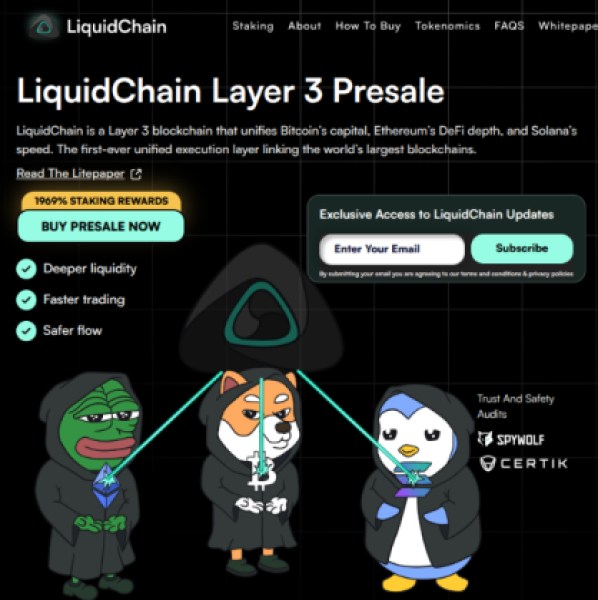
For developers, the appeal of LiquidChain’s ‘Deploy-Once Architecture’ is immediate. Instead of writing separate codebases for Rust and Solidity, builders can launch apps on LiquidChain that access users from both giants, plus Bitcoin. It effectively solves the ‘cold start’ problem for new dApps.

From a market structure perspective, this consolidation is critical. If 2024 was the year of the Layer 2 wars, 2026 is shaping up to be the era of Layer 3 aggregation. The protocol’s ability to offer ‘Single-Step Execution’ means complex strategies, previously impossible for compliance-focused institutions due to counterparty risk, finally become viable.

LEARN MORE ABOUT LIQUIDCHAIN ON ITS OFFICIAL PRESALE SITE

LiquidChain ($LIQUID) Presale Data Signals Early Infrastructure Demand

While the broader market stares at Bitcoin’s daily candles, early allocators are positioning themselves in infrastructure. The on-chain data for LiquidChain supports this rotation thesis.

$LIQUID has already raised over $532K. That number isn’t just significant for its size; it’s about timing. Raising over half a million dollars during macro uncertainty signals high-conviction capital. Investors are buying the thesis, not the hype.

At the current presale price of $0.0136, the market treats $LIQUID as a venture bet with asymmetric upside compared to established L1s. The tokenomics look designed to incentivize deep liquidity, a must for any protocol claiming to unify $BTC and $ETH. By using a Cross-Chain VM, the network uses the $LIQUID token as transaction fuel across the merged ecosystem. If usage scales, so does buy pressure.

The risk? Execution. Building a secure L3 that handles native Bitcoin assets without wrapping is technically demanding. But if the protocol succeeds in becoming the liquidity router for the 2026 cycle, that $0.0135 entry point might look like a steal relative to the value of the flows passing through the network.

BUY LIQUIDCHAIN ($LIQUID) HERE.

The content of this article is for informational purposes only and does not constitute financial advice. Cryptocurrency investments, particularly in presale stages and new infrastructure protocols, carry high risks, including total loss of capital. Always perform your own due diligence.


Domande pertinenti

QWhat is the main investment shift discussed in the article, and why is it happening?

AThe main investment shift is from the dominant 'AI trade' and US tech stocks towards 'liquid infrastructure.' This is happening due to recent earnings volatility in the tech sector, fears of a capex bubble, and the unsustainable fragmentation of liquidity across different blockchain silos like Bitcoin, Ethereum, and Solana.

QWhat problem does LiquidChain aim to solve in the crypto ecosystem?

ALiquidChain aims to solve the problem of fragmented liquidity and high friction costs in the crypto ecosystem. It addresses issues like wrapped asset risks, bridge hacks, and slippage that occur when moving assets between different blockchains by creating a unified Layer 3 cross-chain liquidity layer.

QWhat technological feature does LiquidChain offer to attract developers?

ALiquidChain offers a 'Deploy-Once Architecture,' which allows developers to launch applications that can access users and liquidity from multiple major blockchains (like Bitcoin, Ethereum, and Solana) without needing to write separate codebases for each, effectively solving the 'cold start' problem for new dApps.

QWhat does the article cite as a new risk associated with the AI sector?

AThe article cites that AI is beginning to 'disrupt the disruptors,' with growing concerns that new AI tools could automate away the need for traditional software. There is also mounting uncertainty about future profit margins due to the historic levels of capital expenditure required to sustain the AI boom.

QWhat does the early presale data for $LIQUID indicate about investor sentiment?

AThe early presale data, which shows over $532K raised during a period of macro uncertainty, indicates that investors are making high-conviction bets on the infrastructure thesis rather than speculative hype. It signals a strategic rotation of capital into projects that solve fundamental problems like liquidity fragmentation.

Letture associate

Why Do You Always Lose Money on Polymarket? Because You're Betting on News, While the Pros Read the Rules

Why do you always lose money on Polymarket? Because you bet on news, while the pros study the rules. This article explains how top traders ("che tou") profit by meticulously analyzing market rules, not just predicting events. Polymarket, a prediction market platform, often sees disputes over event outcomes due to ambiguous rule wording. For instance, a market asking "Who will be the leader of Venezuela by the end of 2026?" was misinterpreted by many who bet on Delcy Rodríguez, assuming she held power. However, the rules specified "officially holds" as the formally appointed, sworn-in individual. Since Nicolás Maduro was still recognized as president officially, he won the market—even being in prison. To resolve such disputes, Polymarket uses a decentralized arbitration system via UMA protocol. The process involves: 1. Proposal: Anyone can propose a market outcome by staking 750 USDC, earning 5 USDC if unchallenged. 2. Dispute: A 2-hour window allows challenges with a 750 USDC stake; successful challengers earn 250 USDC. 3. Discussion: A 48-hour period on UMA Discord for evidence and debate. 4. Voting: UMA token holders vote in two 24-hour phases (blind then public). Outcomes require >65% consensus and 5M tokens voted; otherwise, four re-votes occur before Polymarket intervention. 5. Settlement: Results are final and automatic. Unlike traditional courts, Polymarket’s system lacks separation between arbitrators and stakeholders—voters often hold market positions, creating conflicts of interest. This leads to herd mentality in discussions and non-transparent outcomes without explanatory rulings, preventing precedent formation. Thus, success on Polymarket hinges on deep rule interpretation, not just event prediction, exploiting gaps between reality and contractual wording.

marsbit2 h fa

Why Do You Always Lose Money on Polymarket? Because You're Betting on News, While the Pros Read the Rules

marsbit2 h fa

DeepSeek Funding: Liang Wenfeng's 'Realist' Pivot

DeepSeek, a leading Chinese AI company, has initiated its first external funding round, aiming to raise at least $300 million at a valuation of no less than $10 billion. This move marks a significant shift from its founder Liang Wenfeng’s previous idealistic stance of rejecting external capital to maintain independence. Despite strong financial backing from its parent company, quantitative trading firm幻方量化 (Huanfang Quant), which provided an estimated $700 million in revenue in 2025 alone, DeepSeek faces mounting challenges. Key issues include a 15-month gap in major model updates, delays in its flagship V4 release, and the loss of several core researchers to competitors offering significantly higher compensation. The company is also undergoing a strategic pivot by migrating its infrastructure from NVIDIA’s CUDA to Huawei’s Ascend platform, a move aligned with China’s push for technological self-reliance amid U.S. export controls. However, DeepSeek lags behind rivals like智谱AI and MiniMax—both now publicly listed—in areas such as product ecosystem, multimodal capabilities, and commercialization. The funding round, though relatively small in scale, is seen as a way to establish a market-validated valuation anchor, making employee stock options more competitive and facilitating talent retention. It also signals DeepSeek’s transition from a pure research-oriented organization to a commercially-driven player in the global AI ecosystem.

marsbit2 h fa

DeepSeek Funding: Liang Wenfeng's 'Realist' Pivot

marsbit2 h fa

Trading

Spot
Futures
活动图片