US Stock Storage Fever Spreads to Crypto for the Third Time, VVV Leads 'AI Data Infrastructure' Sector Gains

marsbitPubblicato 2026-05-11Pubblicato ultima volta 2026-05-11

Introduzione

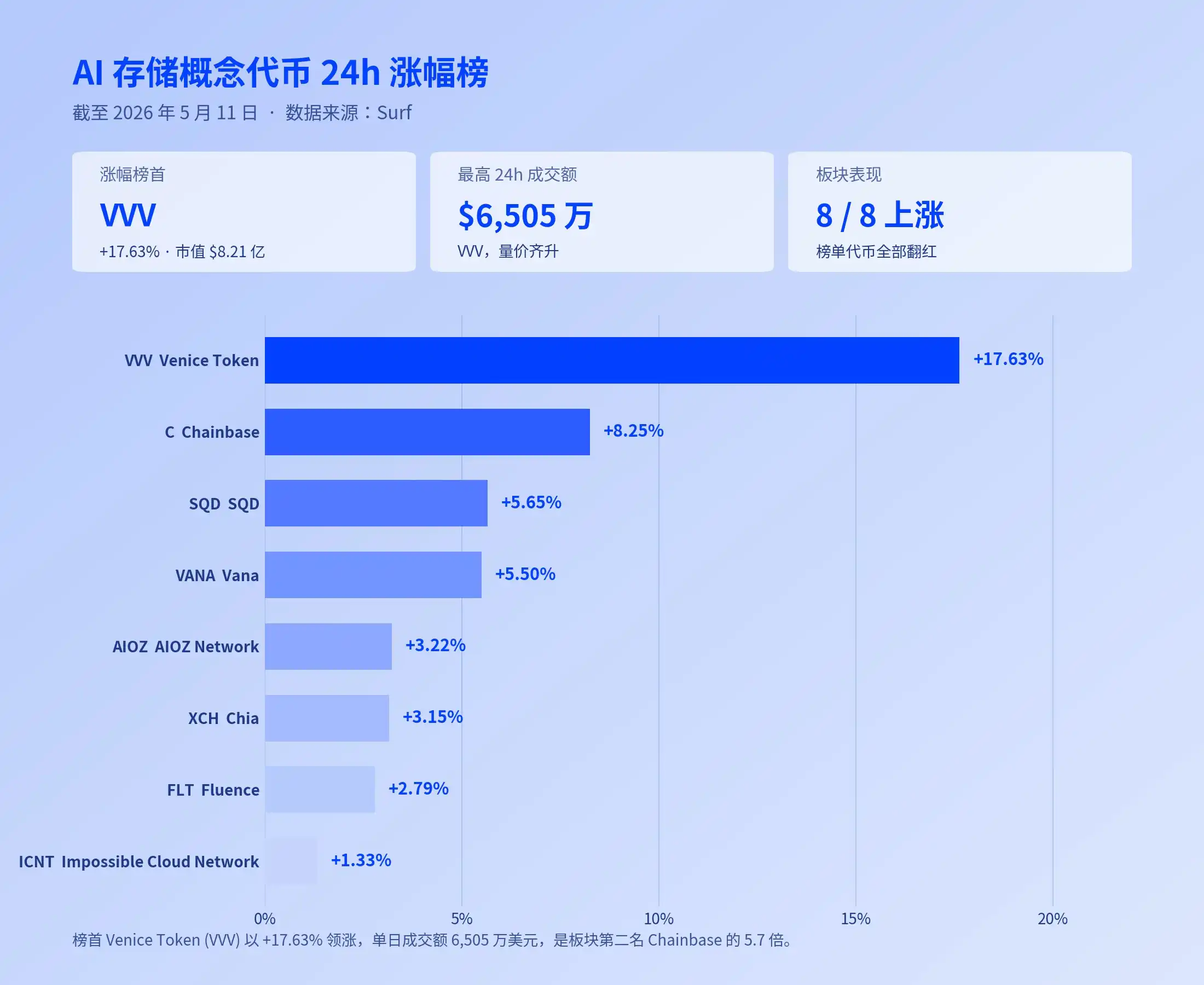
U.S. stock storage rally spreads to crypto for the third time, with VVV leading the 'AI data infrastructure' sector. On May 11, Venice Token (VVV) surged 17.63% with $65.05M volume, followed by Chainbase, SQD, and Vana, rising 5-8%. This mirrors gains in U.S. storage stocks like SanDisk and Micron. The crypto AI narrative is shifting. The initial wave (May 6-7) saw pure storage tokens like FIL, AR, and STORJ rise, driven by spillover from the U.S. storage chip boom. The second wave saw broader DePIN sector gains. The current third wave has moved beyond pure storage to broader "AI infrastructure." VVV, a decentralized AI inference platform, leads due to its own catalysts like a token burn mechanism and partnership news, alongside the broader market trend. Notably, traditional storage tokens showed minimal gains (<4%) on May 11, indicating the rally is becoming more selective, focusing on projects with specific narratives like AI data or compute. The pattern suggests the sector rally may be in a later stage, with sustainability depending on whether the U.S. storage chip boom continues.

Author: Claude, Shenchao TechFlow

Shenchao Insight: The capital spillover effect of the US stock market's storage chip "super cycle" is recurring in the crypto market with a frequency of three times a week. On May 11, the 'AI Data Infrastructure' sector token Venice Token (VVV) surged 17.63% in a single day, leading the gains with a trading volume of $65.05 million; Chainbase, SQD, and Vana followed with gains between 5% and 8%. Meanwhile, the fuel hasn't died down on the US stock end. On May 8, SanDisk skyrocketed 16.60%, Micron Technology rose 15.49%, pushing its market cap past $842.2 billion, and accumulated a nearly 38% gain for the week. From FIL breaking out of its range on May 6, to IO soaring 69% in a single day on May 7, and VVV taking the baton this Monday, the market trend has extended from single storage leaders to the entire "AI Data + Inference Compute" infrastructure sector.

The crypto AI sector is up again today, but the narrative is quietly shifting.

If the story a week ago was "the three major storage leaders FIL, AR, and STORJ rising in tandem with US stocks SanDisk and Micron," then entering this week, the main market trend has spread from pure storage to a broader "AI infrastructure": AI inference compute (VVV), on-chain data networks (Chainbase), data indexing (SQD), user data DAOs (Vana) are taking turns leading the charge. However, the driving source behind all this remains unchanged: the still-burning storage chip frenzy in US stocks.

First Wave of Transmission: May 6, FIL/AR/STORJ Triple Rise

The first instance of follow-on gains in the crypto market occurred on May 6.

According to a BanklessTimes report on May 6, Filecoin (FIL) opened at $0.975 that day, reaching an intraday high of $1.161 and closing at $1.122, marking a single-day gain of 15.08%, breaking out of a sideways consolidation range that had lasted over three months since early February. FIL's spot trading volume for the day reached $372 million, a sharp 260.22% increase from the previous day; futures trading volume hit $816 million, up 213.63% sequentially. In the same sector, Storj gained 40% and Arweave rose 20% for the day.

Chinese crypto information channel Followin that day forwarded analyst Ao Ying's viewpoint, directly attributing this round of gains to capital spillover from US stock storage trading, stating "funds from equity market storage trading are repricing FIL." The logic chain is that AI infrastructure's consumption of storage capacity has already booked capacity through 2026; this supply-demand logic first gets priced in the US stock market, then transmits to crypto tokens pegged as "on-chain storage."

Second Wave Continuation: May 7, IO Soars 69% in a Day, DePIN Sector Follows Suit and Spreads

The market movement didn't stop after a single day. According to TradingView data cited by CoinMarketCap CMC AI, FIL rose another 15.5% on May 7, breaking through the key resistance level of $1.08 that it had failed to breach since February.

The sector's diffusion was even more dramatic, with IO surging 69% and STORJ rising another 30% on the same day. The second wave of gains indicates this is no longer a localized rally of "leaders rising alone while the long tail remains calm," but rather the DePIN (Decentralized Physical Infrastructure Networks) sector being systematically repriced by the market.

However, CoinMarketCap CMC AI also cited a bearish analysis on the same day, labeling FIL a "dead asset," citing the token's cumulative decline of 99% from its all-time high. This contradiction precisely reflects the current rift in the crypto storage sector: short-term beta-driven gains from capital spillover coexist with medium-to-long-term skepticism about business models.

Third Wave Diffusion: May 11, VVV Leads 'AI Data + Inference Compute' Gains

This Monday's rally saw the main theme shift from "pure storage" to broader "AI infrastructure."

Data shows VVV's current price is $17.83, with a market cap of $821 million and a single-day trading volume of $65.05 million, 5.7 times that of the second-ranked project in the sector, Chainbase. Ranks two through four in the sector were Chainbase (C, +8.25%), SQD (+5.65%), and Vana (VANA, +5.50%), with market caps ranging between $14 million and $54 million.
However, VVV is not strictly a storage token. According to a January 2025 report by The Block and Venice's official documentation, VVV is the native token of Venice, a decentralized AI inference platform founded by Erik Voorhees, positioned to "provide private, uncensorable inference services for AI Agents." Staking VVV allows users to proportionally share in the compute power revenue from the Venice API, without needing to pay per request.

VVV's leading gains have their own fundamental catalysts. According to a Phemex analysis on April 7, Venice permanently reduced its annual token inflation by 25% on February 10, 2026 (from 80 million to 60 million). On March 2, it surged 20% in a single day after OpenClaw announced selecting Venice as its primary inference model supplier. According to Messari data, Venice officially launched a "programmatic VVV buyback and burn" mechanism on April 15, where every Venice Pro subscription triggers a $1 on-chain token buyback and burn. CMC AI data shows that as of March, approximately 33 million VVV (42% of the initial supply) had been burned.

At this point, the crypto AI sector's story can be broken into two layers: the external factor is the spillover from the US stock storage frenzy, while the internal factor is that tokens like VVV, which have real deflation mechanisms and concrete partnership developments, are catalyzing themselves. The tokens that have delivered outsized gains in this rally almost all possess both layers of logic.

Four Genuine Storage Tokens Gained Less Than 4% Today

It's worth noting that the genuine storage projects are not among the top gainers on today's Surf list. Four traditional decentralized storage projects—AIOZ Network (+3.22%), Chia (+3.15%), Fluence (+2.79%), and Impossible Cloud Network (+1.33%)—all gained less than 4%. Last week's leaders, FIL, AR, and STORJ, don't even appear on this list.

This structural difference signals that the pure "storage beta transmission" rally might have entered its second stage. The first stage (May 6-7) was the catch-up rally of storage leaders. The second stage (this week) sees tokens with their own narrative catalysts taking the baton: VVV has its buy-and-burn mechanism, Chainbase carries the "AI data" label, while SQD and Vana belong to the "data network" concept. Capital is picking "tokens with a story" within the sector, rather than indiscriminately deploying funds.

Historically, this three-phase pattern of "leader catch-up → concept diffusion → capital cherry-picking" often signifies that a sector rally has entered its latter half. Future sustainability will depend on whether the US stock storage chip frenzy can maintain momentum. Based on the current supply-demand landscape of DRAM contract prices rising 58% to 63% and HBM capacity sold out through 2026, the story, at least from a fundamental perspective, is not over yet.


Domande pertinenti

QWhat are the three major phases of the 'storage hype' spillover from the U.S. stock market into the crypto market as described in the article?

AThe three phases are: 1) Initial spillover on May 6th with leading storage tokens like FIL, AR, and STORJ rising. 2) Continuation and diffusion on May 7th, extending to the broader DePIN/AI infrastructure sector, highlighted by IO's surge. 3) Further diffusion on May 11th, where the rally spread from pure storage to 'AI data + inference compute' infrastructure, led by VVV and followed by projects like Chainbase, SQD, and Vana.

QWhy did VVV (Venice Token) experience a significant price increase on May 11th, according to the article?

AVVV's surge was driven by a combination of external and internal factors. Externally, it benefited from the ongoing spillover effect from the U.S. stock market's storage chip rally. Internally, it had specific fundamental catalysts: a permanent 25% reduction in annual token inflation in February 2026, a partnership announcement with OpenClaw in March that boosted its price, and the launch of a 'programmatic VVV buyback and burn' mechanism on April 15th, where every Venice Pro subscription triggers a $1 token buyback and burn.

QWhat key difference does the article highlight between the market performance on May 11th and the initial rallies on May 6th-7th?

AOn May 11th, the rally shifted from purely 'storage' tokens (like FIL, AR, STORJ) to a broader 'AI infrastructure' theme, including AI inference compute (VVV), on-chain data networks (Chainbase), data indexing (SQD), and user data DAOs (Vana). In contrast, the initial rallies on May 6th-7th were more focused on traditional decentralized storage龙头 tokens. Furthermore, on May 11th, actual storage projects like AIOZ Network and Chia saw minimal gains (<4%), indicating资金 was becoming more selective, focusing on projects with stronger narratives beyond just the storage beta.

QWhat is the primary external driver identified for the rallies in the crypto AI/data infrastructure sector throughout the discussed period?

AThe primary external driver is the capital spillover from the 'super cycle' boom in U.S. stock market storage chip companies, specifically the massive gains seen in stocks like美光科技 (Micron) and闪迪 (SanDisk). The article states that the logic is that AI infrastructure's huge demand for storage capacity, which has already driven up prices and valuations in traditional markets, is now being repriced into crypto tokens that represent 'on-chain storage' and related AI data infrastructure.

QAccording to the article, what does the current market structure (with selective gains in narrative-driven tokens) suggest about the stage of the sector's rally?

AThe article suggests that the market structure, moving from 'leader catch-up' to 'concept diffusion' and then to 'capital picking specific stories,' typically indicates the sector rally is entering its later stages. The sustainability from this point forward will depend more on whether the U.S. stock market storage hype continues and on the individual fundamentals of the crypto projects, rather than on broad, indiscriminate buying across the entire sector.

Letture associate

SpaceX, OpenAI, Anthropic: The Three AI Giants Racing for IPO, Which One Is Worth Betting On?

SpaceX, OpenAI, and Anthropic are poised for historic IPOs within weeks, potentially raising a combined $180 billion—a sum exceeding the entire internet bubble's fundraising. The hosts of the Limitless Podcast argue this isn't just individual company financing but an unprecedented capital concentration for AI infrastructure, driven by an insatiable need for compute, data centers, power, and chips. SpaceX's IPO is notable for reportedly changing market index rules to allow faster inclusion, potentially funneling trillions in passive retirement funds into its stock, despite its unproven space-based data center business model. In contrast, Anthropic demonstrates explosive growth, with ARR reportedly hitting $45 billion and approaching profitability, fueled by strong enterprise adoption of products like Claude Code. Google's separate $80 billion raise highlights the immense capital pressure, even for giants. The discussion acknowledges bubble risks but leans optimistic. The hosts contend the massive spending is building essential physical infrastructure for the next technological era. A key bottleneck isn't capital but the real-world limits of chip manufacturing and construction speed. As long as demand for AI compute outstrips supply, this investment cycle represents a foundational build-out rather than a purely financial bubble. All three companies are seen as foundational bets on the future, with Anthropic often cited as the most immediately compelling due to its proven revenue trajectory.

marsbit1 h fa

SpaceX, OpenAI, Anthropic: The Three AI Giants Racing for IPO, Which One Is Worth Betting On?

marsbit1 h fa

From 'Old Guys' to 'New Favorites': How AI Is Revaluing Old Infrastructure from Dell to Nokia?

From "Vintage Tech" to "New AI Darlings": How AI Revalues Old Infrastructure One year ago, tech giants like Dell, Nokia, Cisco, and Western Data were seen as slow-growth, low-valuation stories, far from the AI spotlight dominated by players like Nvidia. Now, these legacy tech stocks are gaining market attention, sparking debate on whether this is genuine industry revaluation or a temporary narrative. As AI moves from model parameters to real-world data centers, the market is recognizing companies with proven delivery and infrastructure capabilities. This shift marks a change in the AI investment thesis: from pure model and GPU focus to the complex systems engineering required for deployment. Companies like Dell, HPE, and Corning are being revalued not for being "sexy" AI innovators, but for their decades of accumulated expertise in supply chains, enterprise delivery, and infrastructure—assets that have become critical in the AI buildout phase. The revaluation is unfolding across three key infrastructure lines: 1. **Servers & System Integration:** Dell and HPE are emerging as crucial system integrators or "general contractors" for AI data centers, translating GPU orders into complete, deployable server racks integrated with power, cooling, and networking. 2. **Networking & Connectivity:** AI's scale demands robust high-speed connections. Corning (fiber optics), Nokia (AI-RAN, 6G), and Cisco (data center switches) are gaining importance for enabling efficient data transfer within and between AI clusters. 3. **Storage:** Beyond high-speed memory (HBM/DRAM), the AI data explosion is driving demand for high-capacity hard drives (HDDs) from companies like Western Digital and Seagate to handle training data, logs, and cold storage cost-effectively. For this revaluation to be substantive and not just a narrative, three criteria are key: 1) Concrete AI-related order and revenue growth (e.g., Dell's AI server sales), 2) Upward revisions to company financial guidance, and 3) Sustainable improvements in profit quality, not just top-line revenue spikes. In essence, AI's transition to a real construction phase is re-pricing "old assets" against "new demand." The opportunity, however, is selective. Only those legacy firms that are demonstrably integrated into the capital expenditure chains of data center and enterprise AI deployment are likely to experience a true "logic re-rating" rather than just a temporary valuation bounce.

marsbit1 h fa

From 'Old Guys' to 'New Favorites': How AI Is Revaluing Old Infrastructure from Dell to Nokia?

marsbit1 h fa

The Merger of Codex and ChatGPT Marks the Beginning of a Major Reshuffle in Programming Tools

OpenAI is shifting its strategic focus from ChatGPT to Codex, merging them along with the browser tool Atlas into a unified desktop super-app. This move signals an internal belief that Codex, originally a programming tool, represents the next evolution of AI more than conversational models like ChatGPT. Over the past year, Codex's weekly active users have surged past 5 million. The key distinction is that while ChatGPT answers questions, Codex executes tasks. Enterprises increasingly value this ability to get work done over simply receiving advice. Consequently, Codex is attracting professionals beyond developers, including analysts, bankers, marketers, and product managers. OpenAI's reorganization and increased investment in Codex stem from recognizing that the future of AI competition lies in execution capabilities, not just conversation. The company is launching role-specific plugins (e.g., for data analysis, sales, design) to transform Codex into a broad knowledge work platform that automates and redefines white-collar workflows. Beyond being a tool, Codex reflects OpenAI's ambition to redefine software. New features like "Sites"—which generates interactive websites from documents—and collaborative "Annotations" aim to create a paradigm where the AI understands the goal and handles the tools and steps, functioning more like a digital colleague than traditional software. The ultimate goal is a unified experience where the user cares only about the completed task.

marsbit1 h fa

The Merger of Codex and ChatGPT Marks the Beginning of a Major Reshuffle in Programming Tools

marsbit1 h fa

Interpreting Investment Opportunities in the Age of Great Navigation, Invesco Great Wall Fund Releases '2026 Report on Chinese Enterprises Going Global'

Invesco Great Wall Fund has released its "2026 China Corporate Globalization Report," titled "The 'Great Navigation Era' of Chinese Enterprises." The report analyzes the new trends and investment opportunities as Chinese companies expand globally, moving from simple product exports to comprehensive overseas operations involving services, branding, and local production. Driven by factors like trade friction, the pursuit of higher profit margins abroad, and policy support, globalization is becoming essential for Chinese companies. The report outlines an evolution: from early product export ("Globalization 1.0") to the current "Globalization 2.0," characterized by overseas capacity, capital goods investment, consumer brand expansion, and service exports. Chinese firms' competitive advantages are highlighted, including a vast engineer talent pool, low-cost and robust infrastructure, and complete industrial clusters. Specific sectors with significant出海 potential are identified: * **Capital Goods** (e.g., engineering machinery, power equipment): Benefiting from global demand, especially in Belt & Road markets and the AI-driven power grid upgrade cycle. * **Consumer Brands**: Transitioning from cost to brand advantage, leveraging供应链 efficiency. * **Technology & Innovation**: Including AI applications, optical modules within global tech supply chains, and new energy vehicles focusing on local production. * **Pharmaceuticals**: Chinese biotech firms are becoming preferred partners for global pharma, with potential for breakthrough drugs in areas like oncology and weight loss. The report concludes that corporate globalization represents a sustained, core theme for China's capital markets, though companies must navigate challenges like geopolitics and localization.

marsbit1 h fa

Interpreting Investment Opportunities in the Age of Great Navigation, Invesco Great Wall Fund Releases '2026 Report on Chinese Enterprises Going Global'

marsbit1 h fa

Trading

Spot
Futures
活动图片