US Stock Registration Giant Acquired by Cryptocurrency Exchange, Accelerating Stock Tokenization

marsbitPubblicato 2026-05-09Pubblicato ultima volta 2026-05-09

Introduzione

Bullish (NYSE: BLSH), a crypto asset trading platform, announced a $4.2 billion acquisition of Equiniti, a major Wall Street transfer agent serving nearly 3,000 public companies. This move aims to accelerate stock tokenization by securing a critical, regulated piece of financial infrastructure that maintains official shareholder records and handles dividends. The deal signals intensifying competition in the tokenization race. True "native" on-chain securities require a licensed transfer agent for legal ownership registration—a bottleneck Bullish now aims to solve. The acquisition positions Bullish to bridge traditional equity markets with blockchain, leveraging Equiniti's extensive client network and compliance credentials. This follows recent key developments: ICE (NYSE's parent) plans a new tokenized securities platform, and the SEC approved Nasdaq's tokenized stock pilot. Bullish's strategy is to establish a neutral, cross-platform infrastructure ahead of these initiatives. The combined company expects high growth from its tokenization business, targeting the vast U.S. equity market. The narrative is shifting from "crypto vs. Wall Street" to convergence, where legacy infrastructure is upgraded onto blockchain rails. The next 18 months will be crucial for observing the rollout of NYSE's platform, Bullish-Equiniti integration, and the broader adoption of tokenized securities by institutions.

Author: Chloe, ChainCatcher

May 5, 2026 – Cryptocurrency trading platform Bullish (NYSE: BLSH) announced that it will acquire Equiniti, a company considered the "behind-the-scenes nervous system" of the entire U.S. stock market on Wall Street, from private equity firm Siris Capital for $4.2 billion. Upon the news, Bullish's stock price surged, rising by approximately 20% at one point.
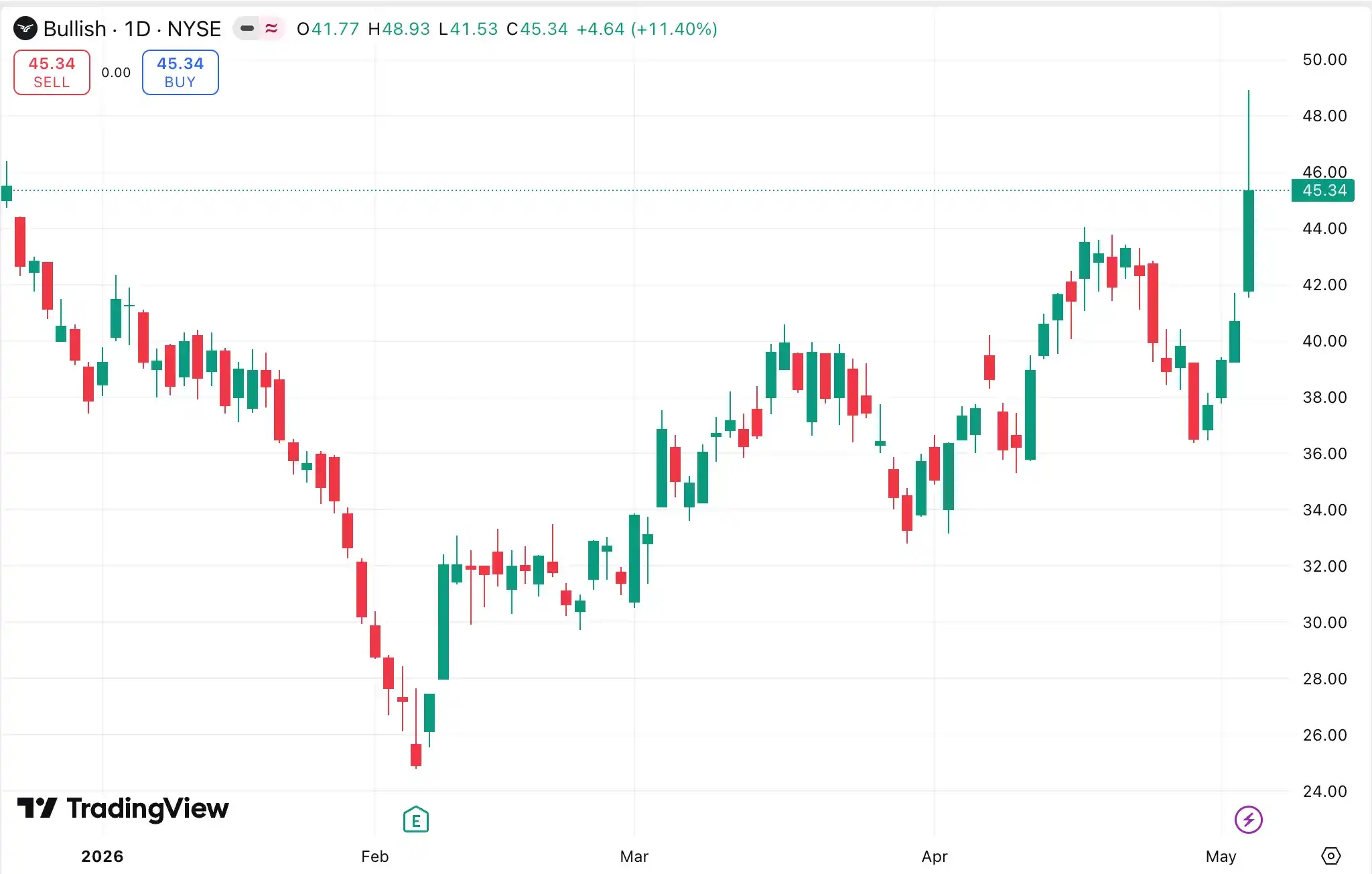
Bullish's acquisition of Equiniti aims to leverage the role of a Transfer Agent to insert itself into the competition and cooperation between traditional exchanges and cryptocurrency platforms. Now, when Wall Street's oldest infrastructure is being acquired by a crypto exchange, what is this arms race really about? And who will be the winner?

Wall Street Tokenization Race Heats Up

Equiniti serves nearly 3,000 listed companies globally, maintains records for 20 million shareholders, and handles $500 billion in dividends and payment flows annually. It is a well-known "transfer agent agency" on Wall Street. The shareholder registry for the well-known Berkshire Hathaway is maintained by it, Rolls-Royce dividends are paid by it; Equiniti is the choice for many traditional enterprises.

When a crypto exchange is willing to spend $4.2 billion (including $1.85 billion in assumed debt and approximately $2.35 billion in Bullish stock consideration) to acquire such a financial infrastructure company, it no longer represents a simple merger and acquisition story. This is a critical signal flare indicating that Wall Street's tokenization race has entered a white-hot stage.

Why Buy Equiniti? Is the Transfer Agent the "Final Piece of the Puzzle" for Tokenization?

To understand the strategic significance of this deal, one must first grasp a concept: the real bottleneck for Tokenized Securities lies not in the issuance side, but in the registration side.

In traditional capital markets, when a company issues stock, the entity that truly records "who owns how many shares" is not the exchange, nor the brokerage, but the transfer agent. It is responsible for:

  • Maintaining the shareholder register (who is a shareholder, how many shares are held)

  • Processing dividend and interest payments

  • Managing corporate actions such as stock splits, stock repurchases, mergers

  • Completing the legal registration of ownership when shares change hands

In other words, the transfer agent is the legal "System of Record" for a listed company's shareholder records. In most major markets, this is a mandatory role that listed companies must have.

Why Has This Become a Key Competitive Factor in the Tokenization Track?

Over the past few years, the market has seen many attempts at "tokenized stocks." Securitize CEO Carlos Domingo once pinpointed the issue in one sentence: most so-called tokenized stocks currently are actually derivatives or price-tracking tools, not truly native equity issued on the blockchain.

Truly "on-chain native securities" require a regulated, legally recognized transfer agent that can update the shareholder register in real-time on the blockchain, handle compliance restrictions, and execute dividend distributions.

Bullish CEO Tom Farley (former NYSE president) mentioned in the deal announcement: Tokenization is the most important infrastructure shift in capital markets in the next 25 years. To implement it on an institutional scale, three conditions must be met, including end-to-end tokenization services, a unified ledger, and large-scale issuer relationships. Acquiring Equiniti gives Bullish a stronger foothold on Wall Street.

The combined company is expected to generate approximately $1.3 billion in adjusted revenue and over $500 million in adjusted EBITDA (after capital expenditures) in 2026. More notably, the company expects overall revenue growth of 6%–8% annually from 2027 to 2029, while the tokenization and blockchain business itself is projected to grow at a rate of 20% annually.

This means Bullish is betting not on how much profit Equiniti's existing traditional business will generate, but on using this 30-year-old infrastructure with accumulated client relationships and regulatory licenses as a "springboard" to penetrate the $70 trillion U.S. stock market.

The timing of this deal is extremely precise. Looking back at the first four months of 2026, the tokenization timeline has almost progressed week by week:

January 19: NYSE Parent ICE Announces Plan to Build Tokenized Trading Platform

Intercontinental Exchange (ICE), parent of the NYSE, announced it will develop a new tokenized securities trading and on-chain settlement platform:

  • 24/7 Trading: Breaking the 9:30 AM–4:00 PM time limit of U.S. stocks

  • Real-time On-Chain Settlement: Replacing the current T+1 settlement

  • Ordering by Dollar Amount: Supporting fractional share trading

  • Stablecoins as a Funding Source: Allowing crypto funds to directly enter the stock market

This platform will combine NYSE's existing Pillar matching engine with a blockchain backend settlement system, supporting multiple chains for settlement and custody.

March 18: SEC Approves Nasdaq Tokenized Stock Pilot

The U.S. Securities and Exchange Commission (SEC), in Release No. 34-105047, approved the proposal Nasdaq submitted in September 2025. Upon approval, eligible Nasdaq market participants can choose to settle Russell 1000 component stocks and ETFs tracking the S&P 500 and Nasdaq 100 in either tokenized form or traditional form.

It's worth noting that Nasdaq's strategy differs from NYSE's. Nasdaq is integrating tokenization into the existing exchange, allowing dealers to choose between traditional equity or tokenized form on the backend. NYSE, on the other hand, is building a separate digital trading platform, even bypassing DTCC to settle directly on the blockchain.

March 24: NYSE Signs MOU with Securitize to Jointly Build Tokenization Infrastructure

Less than a week after the SEC approved Nasdaq's proposal, NYSE immediately announced signing a memorandum of understanding with Securitize (invested in by BlackRock and Ark Invest) to co-develop infrastructure for its digital trading platform.

Securitize, an SEC-registered transfer agent, will become one of the first companies qualified to mint tokenized stocks and ETFs on this platform. This cooperation also includes designing a "Digital Transfer Agent Program" to set standards for other transfer agents to enter the tokenization market.

May 5: Bullish Spends $4.2 Billion to Acquire Equiniti

Looking at this timeline side by side reveals something particularly interesting: Bullish is not just acquiring a transfer agent; it is aiming to seize the neutral infrastructure positioning of "cross-platform, non-partisan" before the NYSE/Nasdaq competition unfolds further.

Equiniti serves 3,000 issuers and has business dealings with NYSE, Nasdaq, London Stock Exchange, Hong Kong Exchanges, and others. Acquiring it is equivalent to simultaneously holding the client lists and regulatory compliance licenses of both NYSE and Nasdaq.

This is Not "Crypto vs. Wall Street," But a Convergence of the Two

A few years ago, we were talking about "whether crypto can replace traditional finance." But the deals in 2026 tell us the real story is: Traditional financial infrastructure is being refurbished onto the blockchain track. And in this process, whoever holds the licenses and the customers will define the capital markets for the next 25 years.

The essence of Bullish's acquisition of Equiniti is binding the "20th-century shareholder register" with "21st-century smart contracts." Once this bridge is built, institutional investors can trade Apple stock on weekends, retail investors can buy fractional ETF shares with USDC, listed companies can see real-time changes in their shareholder structure, and cross-border equity transactions can be shortened from T+2 to a few seconds.

NYSE plans to launch in the second half of 2026, Nasdaq's pilot has been approved, and Bullish-Equiniti is expected to complete the deal in early 2027. The next 18 months will be a critical window to judge whether this tokenization revolution is "real or hype." For investors, four things are worth closely tracking: first, the progress of SEC approval for NYSE's digital trading platform; second, the integration execution of Bullish-Equiniti, especially the acceptance of tokenization services by Equiniti's existing clients; third, the next steps of crypto exchanges like Coinbase and Kraken in terms of "institutionalization" and "compliance"; and finally, whether the path between Securitize and Equiniti will lead to cooperation or competition.

For Bullish, $4.2 billion is a heavy bet. But for Wall Street, this is just the prologue to the tokenization story.


Domande pertinenti

QWhat is the strategic significance of Bullish acquiring Equiniti, according to the article?

AThe strategic significance lies in acquiring a key piece of financial infrastructure—a major transfer agent. This gives Bullish direct access to the legal system of record for shareholder ownership (the shareholder registry), which is a mandatory role for public companies. The acquisition positions Bullish to bridge traditional equity markets with blockchain technology, enabling true native tokenized securities by solving the bottleneck at the registration end, not just the issuance end.

QWhat critical role does a transfer agent like Equiniti play in the traditional capital markets?

AA transfer agent serves as the official system of record for a public company's shareholders. Its core functions include maintaining the shareholder registry (recording who owns how many shares), processing dividend and interest payments, managing corporate actions like stock splits and buybacks, and legally recording ownership changes when shares are traded.

QHow does the article differentiate between most current 'tokenized stocks' and true 'native on-chain securities'?

AThe article states that most current 'tokenized stocks' are often just derivatives or price-tracking instruments linked to the underlying stock. True 'native on-chain securities' require a regulated, legally recognized transfer agent to maintain the shareholder registry directly on a blockchain in real-time, handle compliance restrictions, and execute distributions like dividends, thereby representing actual legal ownership.

QWhat were two key developments in the tokenization race mentioned in the article that occurred in early 2026 before the Bullish-Equiniti deal?

AFirst, in January, NYSE's parent company ICE announced plans to build a new tokenized securities trading and on-chain settlement platform featuring 24/7 trading and real-time settlement. Second, in March, the SEC approved Nasdaq's pilot program allowing qualified participants to settle trades for certain stocks and ETFs in tokenized form alongside the traditional method.

QWhat does the article suggest is the broader narrative shift, as illustrated by deals like Bullish acquiring Equiniti?

AThe article suggests the narrative has shifted from 'crypto versus Wall Street' to a convergence of the two. The core story is now about rebuilding and upgrading traditional financial infrastructure onto blockchain rails. In this process, the entities that control critical licenses, client relationships, and infrastructure—like transfer agents—are positioned to define the next era of capital markets.

Letture associate

SpaceX, OpenAI, Anthropic: The Three AI Giants Racing for IPO, Which One Is Worth Betting On?

SpaceX, OpenAI, and Anthropic are poised for historic IPOs within weeks, potentially raising a combined $180 billion—a sum exceeding the entire internet bubble's fundraising. The hosts of the Limitless Podcast argue this isn't just individual company financing but an unprecedented capital concentration for AI infrastructure, driven by an insatiable need for compute, data centers, power, and chips. SpaceX's IPO is notable for reportedly changing market index rules to allow faster inclusion, potentially funneling trillions in passive retirement funds into its stock, despite its unproven space-based data center business model. In contrast, Anthropic demonstrates explosive growth, with ARR reportedly hitting $45 billion and approaching profitability, fueled by strong enterprise adoption of products like Claude Code. Google's separate $80 billion raise highlights the immense capital pressure, even for giants. The discussion acknowledges bubble risks but leans optimistic. The hosts contend the massive spending is building essential physical infrastructure for the next technological era. A key bottleneck isn't capital but the real-world limits of chip manufacturing and construction speed. As long as demand for AI compute outstrips supply, this investment cycle represents a foundational build-out rather than a purely financial bubble. All three companies are seen as foundational bets on the future, with Anthropic often cited as the most immediately compelling due to its proven revenue trajectory.

marsbit2 h fa

SpaceX, OpenAI, Anthropic: The Three AI Giants Racing for IPO, Which One Is Worth Betting On?

marsbit2 h fa

From 'Old Guys' to 'New Favorites': How AI Is Revaluing Old Infrastructure from Dell to Nokia?

From "Vintage Tech" to "New AI Darlings": How AI Revalues Old Infrastructure One year ago, tech giants like Dell, Nokia, Cisco, and Western Data were seen as slow-growth, low-valuation stories, far from the AI spotlight dominated by players like Nvidia. Now, these legacy tech stocks are gaining market attention, sparking debate on whether this is genuine industry revaluation or a temporary narrative. As AI moves from model parameters to real-world data centers, the market is recognizing companies with proven delivery and infrastructure capabilities. This shift marks a change in the AI investment thesis: from pure model and GPU focus to the complex systems engineering required for deployment. Companies like Dell, HPE, and Corning are being revalued not for being "sexy" AI innovators, but for their decades of accumulated expertise in supply chains, enterprise delivery, and infrastructure—assets that have become critical in the AI buildout phase. The revaluation is unfolding across three key infrastructure lines: 1. **Servers & System Integration:** Dell and HPE are emerging as crucial system integrators or "general contractors" for AI data centers, translating GPU orders into complete, deployable server racks integrated with power, cooling, and networking. 2. **Networking & Connectivity:** AI's scale demands robust high-speed connections. Corning (fiber optics), Nokia (AI-RAN, 6G), and Cisco (data center switches) are gaining importance for enabling efficient data transfer within and between AI clusters. 3. **Storage:** Beyond high-speed memory (HBM/DRAM), the AI data explosion is driving demand for high-capacity hard drives (HDDs) from companies like Western Digital and Seagate to handle training data, logs, and cold storage cost-effectively. For this revaluation to be substantive and not just a narrative, three criteria are key: 1) Concrete AI-related order and revenue growth (e.g., Dell's AI server sales), 2) Upward revisions to company financial guidance, and 3) Sustainable improvements in profit quality, not just top-line revenue spikes. In essence, AI's transition to a real construction phase is re-pricing "old assets" against "new demand." The opportunity, however, is selective. Only those legacy firms that are demonstrably integrated into the capital expenditure chains of data center and enterprise AI deployment are likely to experience a true "logic re-rating" rather than just a temporary valuation bounce.

marsbit2 h fa

From 'Old Guys' to 'New Favorites': How AI Is Revaluing Old Infrastructure from Dell to Nokia?

marsbit2 h fa

Trading

Spot
Futures
活动图片