US government ‘tech force’ gets backup from Coinbase, Robinhood

cointelegraphPubblicato 2025-12-17Pubblicato ultima volta 2025-12-17

Introduzione

The US government has launched a "Tech Force" initiative to address critical skill shortages in AI, cybersecurity, and software engineering by recruiting private sector talent. Crypto exchange Coinbase and trading platform Robinhood are among nearly 30 initial partners, which also include major firms like Apple, Nvidia, and OpenAI. This signals a government need for crypto expertise as the technology integrates into finance. The program will place about 1,000 early-career and experienced workers in federal agencies for one- to two-year stints. Agencies will hire and fund the tech teams, while private companies provide training. The initiative aims to revitalize the government workforce, where only 7% are early-career professionals, compared to nearly a quarter in the private sector.

Crypto exchange Coinbase and trading platform Robinhood are among a group of tech companies lending a hand to the US government’s new “Tech Force.”

The launch of the Tech Force on Monday aims to tap the private sector’s talent to plug “critical skills gaps” in the government across artificial intelligence, cybersecurity and software engineering.

Big Tech firms will lend their workers to serve one- to two-year stints at federal agencies, with the government seeking 1,000 early-career candidates and “experienced managers.”

Coinbase and Robinhood were named among nearly 30 “initial private sector partners,” which included Apple, Amazon Web Services, Nvidia and OpenAI, a sign that the government needs crypto expertise as the technology has rapidly integrated into the financial system.

Tech Force to deploy across government

The Office of Personnel Management (OPM) said the new tech workers would be inserted across a vast range of agencies, from the Treasury, the Commerce Department and the IRS.

The tech teams would be hired and funded by the agencies and report to their heads, with the private sector providing training.

“As we have people retiring from government, we’re not doing a great job of bringing in the next generation of leaders in government,” OPM director Scott Kupor told CNBC.
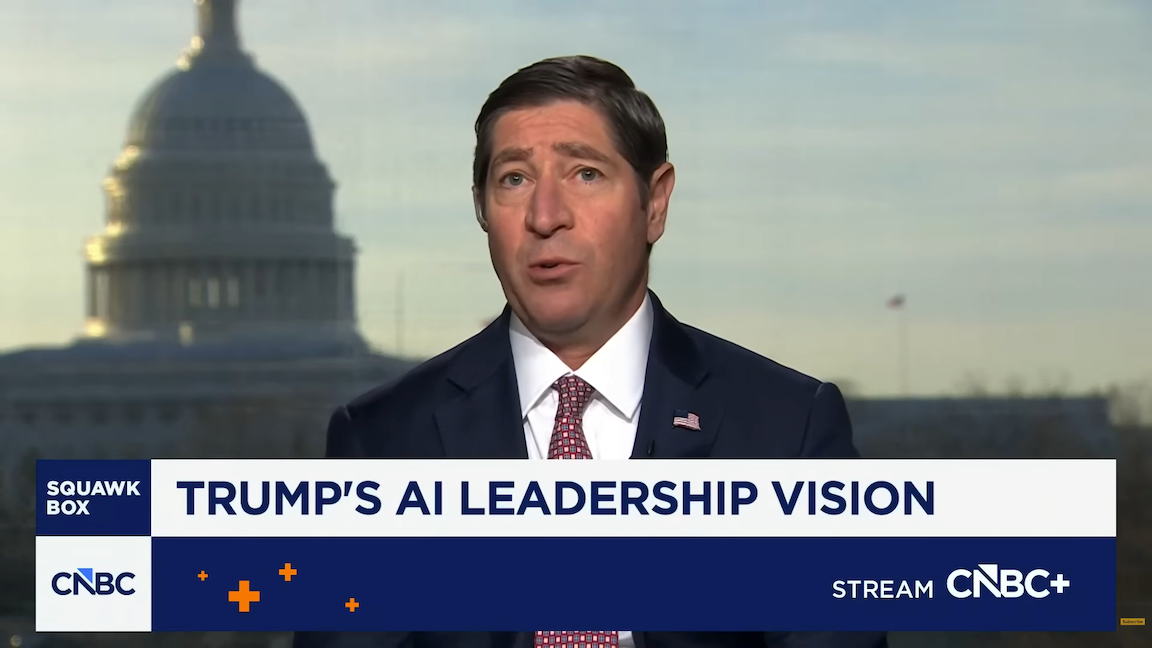
OPM director Scott Kupor speaking to CNBC’s “Squawk Box.” Source: YouTube

He said about 7% of the US government workforce are in their early career, those with five to seven years of work experience, compared to almost a quarter in the rest of the workforce.

Kupor added that the OPM and its private sector partners would put on a job fair for the workers after they completed their terms in the government.

“What we’re really trying to demonstrate is that the work that you can do in government is both challenging, complex, and that if you decide ultimately you want to go into the private sector, that’s great, that work is valued,” he said. “You’ll have the opportunity to take that as the next stage of your career.”

Related: Warren sounds alarm on DeFi, cites PancakeSwap amid market structure delay

Alongside Coinbase and Robinhood, the private sector partners also include Adobe, Amazon Web Services, AMD, Anduril, Apple, Box, C3.ai, Databricks, Dell Technologies, Docusign, Google Public Sector, IBM, Meta, Microsoft, Nvidia, OpenAI, Oracle, Palantir, Salesforce, SAP, ServiceNow, Snowflake, Synopsys, Uber, Workday, xAI, and Zoom.

Crypto companies, particularly blockchain analytics firms, have frequently assisted the US government with expertise in tracking and tracing cryptocurrency flows in criminal and regulatory investigations.

US market regulators under the Trump administration have also consulted with the crypto sector on how to develop their approaches as the policy environment toward the industry has warmed.

Magazine: Quitting Trump’s top crypto job wasn’t easy: Bo Hines

Letture associate

Bitcoin's 'Rally Ends,' Officially Entering the Later Stage of a Bear Market?

Bitcoin prices declined 13% this week, reversing the recent rebound and signaling a likely transition into the later stages of a bear market. Key on-chain metrics deteriorated, with the short-term holder cost basis falling below the Realized Price—a pattern last seen in early 2022, characteristic of bear market maturity. The rally to ~$82k proved to be a bear market bounce, as evidenced by the 90-day realized profit/loss ratio failing to sustain above the bullish threshold of 2. Daily realized losses surged to $1.35B, including significant selling from long-term holders who accumulated near cycle tops, indicating ongoing supply redistribution. Price was rejected almost precisely at the aggregate US spot ETF cost basis of ~$83k, turning that level into resistance and leaving the average ETF investor underwater again. Spot market selling pressure intensified, with the 7-day volume delta turning significantly negative to its weakest level since February. While a major long liquidation event cleared over $400M in leverage, spot demand has not yet stepped in to absorb the resulting supply. Options markets continue pricing in higher future volatility (elevated volatility risk premium) and maintain a skew toward put options, reflecting persistent demand for downside protection, though not yet panic. Overall, market structure remains fragile. Sustained recovery likely requires a reclaim of the ETF cost basis, a shift back to positive spot demand, and a slowdown in realized loss-taking. Until then, the market risks further downside or extended consolidation within the broader bear trend.

Foresight News36 min fa

Bitcoin's 'Rally Ends,' Officially Entering the Later Stage of a Bear Market?

Foresight News36 min fa

How Risky is the "Death Spiral" of MSTR and STRC?

Summary: This article explores the perceived "death spiral" risk between MicroStrategy (MSTR), its Bitcoin holdings, and its perpetual preferred stock (STRC), drawing comparisons to the LUNA-UST collapse. While both systems feature price anchors, high yields for holders, and potential feedback loops, their core mechanisms differ fundamentally. The MSTR-STRC structure relies on continuous financing to sustain its high dividend payouts, primarily through stock ATM offerings. A negative feedback cycle could occur: falling MSTR stock price makes raising equity capital harder, increasing pressure to sell Bitcoin, which undermines STRC confidence and further depresses MSTR. However, unlike LUNA-UST's automated, direct linkage, the MSTR-STRC loop is weaker and has brakes: STRC dividends can be deferred or rates lowered, and STRC holders have a $100/share liquidation preference in bankruptcy, providing a price floor. The company's sustainability hinges on its ability to continue financing. Its current ~$900 million USD reserves cover only about 6.3 months of its ~$1.71 billion annual interest/dividend burden. The next six months are critical, aligning with both the potential bottom in Bitcoin's four-year cycle and the depletion timeline of its reserves. While a LUNA-style catastrophic collapse is deemed highly unlikely due to structural differences, the key question is whether MicroStrategy can navigate this period through healthy deleveraging to restart its capital engine.

Foresight News55 min fa

How Risky is the "Death Spiral" of MSTR and STRC?

Foresight News55 min fa

How Much Debt Does Strategy Really Have? Is There a Risk of Implosion?

MicroStrategy's Debt Risk: A Turning Point in the "Never Sell" Strategy As of June 3, 2026, MicroStrategy holds 843,706 bitcoins (valued at ~$53.1B) but faces significant financial obligations. Its capital structure includes $6.75B in convertible notes and $15.48B in perpetual preferred stock (led by the $8.5B STRC series), creating an annual payout burden of ~$1.71B. With software revenue at only ~$500M, interest and dividend obligations far exceed operating income. A critical shift occurred in late May 2026 when the company sold 32 bitcoins for ~$2.5M to cover dividends, breaking CEO Michael Saylor's long-standing "never sell" pledge. This symbolic move triggered a sharp decline in both Bitcoin's price and MSTR stock, reflecting market fears about cash flow sustainability. The core of the strain is the STRC perpetual preferred stock, designed as a "permanent loan" with no maturity date but requiring high monthly dividends (currently 11.5%). Its business model relies on a three-part cycle: issuing new STRC shares, using proceeds to buy more Bitcoin and fund a USD reserve, and using that reserve to pay dividends. This cycle depends on continuous investor demand for STRC and Bitcoin's price appreciation. Analysis shows Bitcoin needs to appreciate at least 2.3% annually to cover the $1.71B in yearly obligations at current holdings. With Bitcoin price down ~22% from March 2026 highs, this pressure has intensified. The company's $900M USD reserve can only cover about 7 months of payments if STRC issuance stalls. Key risks are not immediate bankruptcy or forced Bitcoin liquidation (as BTC is not collateral), but rather: 1) The erosion of MSTR's premium to its Bitcoin holdings (mNAV), which would cripple its ability to raise cheap capital; 2) A vicious cycle where stagnant Bitcoin prices reduce STRC demand, draining the USD reserve and forcing BTC sales, further depressing prices. The period from February 2027 to September 2028 is a crucial test, with over $5.9B in convertible notes facing put options or maturity. In essence, MicroStrategy has evolved from a simple Bitcoin holder into a complex financial entity acting like a "private Bitcoin bank," leveraging its BTC holdings to create layered financial products. Its survival depends on maintaining Bitcoin's price trend, its stock premium, and market appetite for its preferred shares. The recent token sale marks not a betrayal of its Bitcoin thesis, but an admission that the leveraged strategy must eventually be paid for.

marsbit1 h fa

How Much Debt Does Strategy Really Have? Is There a Risk of Implosion?

marsbit1 h fa

Trading

Spot
Futures

Articoli Popolari

Come comprare US

Benvenuto in HTX.com! Abbiamo reso l'acquisto di Talus Network (US) semplice e conveniente. Segui la nostra guida passo passo per intraprendere il tuo viaggio nel mondo delle criptovalute.Step 1: Crea il tuo Account HTXUsa la tua email o numero di telefono per registrarti il tuo account gratuito su HTX. Vivi un'esperienza facile e sblocca tutte le funzionalità,Crea il mio accountStep 2: Vai in Acquista crypto e seleziona il tuo metodo di pagamentoCarta di credito/debito: utilizza la tua Visa o Mastercard per acquistare immediatamente Talus NetworkUS.Bilancio: Usa i fondi dal bilancio del tuo account HTX per fare trading senza problemi.Terze parti: abbiamo aggiunto metodi di pagamento molto utilizzati come Google Pay e Apple Pay per maggiore comodità.P2P: Fai trading direttamente con altri utenti HTX.Over-the-Counter (OTC): Offriamo servizi su misura e tassi di cambio competitivi per i trader.Step 3: Conserva Talus Network (US)Dopo aver acquistato Talus Network (US), conserva nel tuo account HTX. In alternativa, puoi inviare tramite trasferimento blockchain o scambiare per altre criptovalute.Step 4: Scambia Talus Network (US)Scambia facilmente Talus Network (US) nel mercato spot di HTX. Accedi al tuo account, seleziona la tua coppia di trading, esegui le tue operazioni e monitora in tempo reale. Offriamo un'esperienza user-friendly sia per chi ha appena iniziato che per i trader più esperti.

398 Totale visualizzazioniPubblicato il 2025.12.11Aggiornato il 2026.06.02

Come comprare US

Discussioni

Benvenuto nella Community HTX. Qui puoi rimanere informato sugli ultimi sviluppi della piattaforma e accedere ad approfondimenti esperti sul mercato. Le opinioni degli utenti sul prezzo di US US sono presentate come di seguito.

活动图片